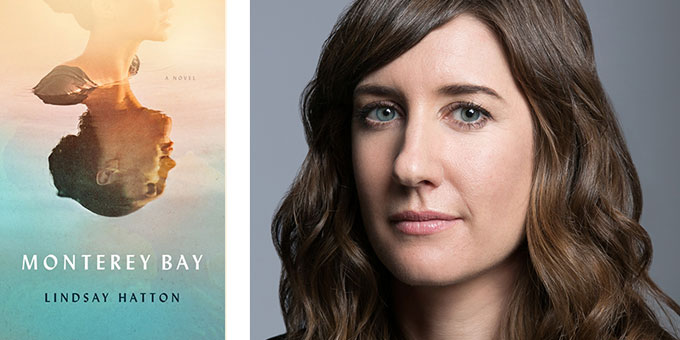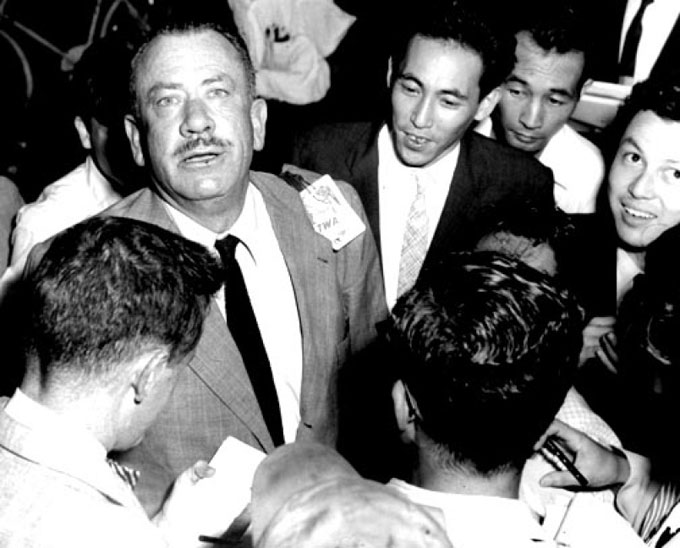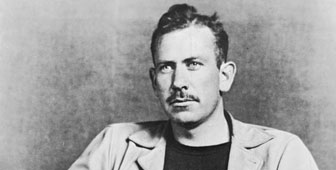
The main action of Monterey Bay, Lindsay Hatton’s debut novel, takes place in 1940, a big year for John Steinbeck, Ed Ricketts, and Monterey’s Cannery Row, where Hatton’s story is set. Waves churned up by the publication of The Grapes of Wrath in 1939 were swamping Steinbeck, who made his escape to the Sea of Cortez in the spring of 1940 with his friend Ed Ricketts, the marine biologist mythologized by Steinbeck’s 1945 novel Cannery Row. Hatton—who spent summers working at the Monterey Bay Aquarium on modern-day Cannery Row—leverages John Steinbeck’s predicament and Ed Ricketts’s reputation as a lover of women not his wife in her tale of an anti-ingenue’s coming of age among flawed men in an era less sexually prohibitive than our own. Other writers who have fictionalized events involving John Steinbeck, such as Steve Hauk, draw their characters exclusively from real life. Hatton—a resident of Cambridge, Massachusetts—mixes fantasy and reality to create Margot Fiske, a 15-year-old with chops and attitude who takes up with Ed Ricketts and clashes with John Steinbeck. Steinbeck employed a similar technique in his writing after Sea of Cortez (1941), notably Cannery Row and East of Eden. Readers didn’t seem to mind then, and they probably won’t now. Read a full review to learn more about Lindsay Hatton and Monterey Bay.
W.H. Auden and His Kind: Christopher Isherwood on The Grapes of Wrath in 1939
Shortly after emigrating to America in 1939 with the poet W. H. Auden, Christopher Isherwood, the British author of Berlin Stories, wrote a review of The Grapes of Wrath for Kenyon Review, the new American literary magazine that—like John Steinbeck—quickly gained prestige and influence with readers and critics in the United States. Intimate friends since school days in England, Isherwood and Auden arrived in New York in January. Isherwood moved on to California, and in July confided this to his diary: “I forced myself to write—a review of The Grapes of Wrath and a short story called “I Am Waiting”—but there was no satisfaction in it.” Despite his mood, Isherwood’s review of The Grapes of Wrath was upbeat and positive; like the diaries, novels, and plays that he produced over five decades in America, his insights (and criticism) seem as fresh today as they were in 1939. What made Christopher Isherwood, an adoptive American, so receptive to John Steinbeck’s all-American novel when it was published? Temperamentally and socially the two men were opposites. Steinbeck preferred privacy and solitude to self-confession and self-promotion, the distinguishing features of Isherwood’s career as the main character in his books. Steinbeck’s people were middle-class, immigrant, and self-made; Isherwood came from landed gentry with deep roots in English history. But both men believed in the power of sympathy and synchronicity, and coincidence can be as important as difference in life, as in literature.
John Steinbeck, Christopher Isherwood, and Synchronicity
Both writers were born in the decade prior to World War I, when America—like England—was outgrowing Victorianism. Both were christened (and later confirmed) into the Anglican Church, an experience that effected their prose style, if not their souls. Each was an elder or only son in a family dominated by an ambitious mother: Isherwood’s father was a British infantry officer who was killed at Ypres in 1915, leaving behind a wife and two sons, an older brother who inherited the Isherwood fortune, and three younger siblings with Steinbeckian names—John, Esther, and Mary. From childhood, John Steinbeck and Christopher Isherwood were imaginative storytellers with a drive to write that drove them to drop out of college to follow their muse. By 1940 both had achieved success in their calling and hobnobbing with film-world celebrities and hangers-on in Hollywood. Despite holding opposite views about the value of autobiography, both worked well in various forms, writing novels, play-novelettes, travel books, and war correspondence that attracted a following. Each loved the warmth of the sun and the sound of the sea—unlike W.H. Auden, who stayed behind in New York in 1939 when Isherwood left for Los Angeles, where Isherwood remained until he died in 1986. (He became an American citizen in 1946.) Oddly, though Hollywood was a village and they had mutual friends in the business, neither Isherwood’s dairies not Steinbeck’s biographers suggest that they ever met.
W.H. Auden and His Kind Weren’t John Steinbeck’s
Nature and nurture conspired to keep them apart. Like other members of W.H. Auden’s circle, Isherwood was openly gay from an early age. Steinbeck grew up in small-town Salinas, where deviance was closeted; the Isherwoods were cosmopolitan provincials with property in London (Isherwood’s Uncle Henry was homosexual, and a jurist ancestor signed King Charles’s death warrant). Unlike Steinbeck, who struggled at the start and stayed in America until established, Isherwood inherited position, connections, and cash that helped pave his way, traveling extensively in Europe before settling in America. His exploration of Berlin’s pre-Nazi gay underground provided material for the 1930s Berlin fiction later adapted for stage and screen as Cabaret. His early novels—All the Conspirators (1928), The Memorial (1932), Mr. Norris Changes Trains (1935)—sold better than Steinbeck’s books—Cup of Gold, The Pastures of Heaven, To a God Unknown—published in the same period. Above all, his relationships with other writers differed dramatically from those of Steinbeck. Isherwood was a born extrovert who wrote poetry and plays with W.H. Auden and nourished friendships with other famous authors, including Aldous Huxley and Thomas Mann. Steinbeck took a disliking to Alfred Hitchcock, the quintessentially English snob who directed the war movie (Lifeboat) scripted by Steinbeck. Isherwood’s collaboration with the Austrian director Berthold Viertel was so gratifying that he wrote a novel (Prater Violet) about their friendship.
A Neglected Grapes of Wrath Review, Still Relevant Today
Christopher Isherwood had a reputation as a ready reviewer when he arrived in America with W.H. Auden, so the Grapes of Wrath assignment made sense. Although the piece he produced for The Kenyon Review is mentioned in John Steinbeck: The Contemporary Reviews (Cambridge University Press, 1996), that helpful anthology omits the full text, which seems a shame. Fortunately, it can be found in Exhumations (Simon and Schuster, 1966), a collection of Isherwood’s stories, articles, and verse that also includes reviews of authors (Stevenson, Wells, T.E. Lawrence) of interest to Steinbeck and Isherwood, two writers with more in common than their differences suggest. Here are four samples, still relevant, from the 1939 review of John Steinbeck’s Grapes of Wrath:
(1) On the Promise of Steinbeck’s California
“Meanwhile, the sharecroppers have to leave the Dust Bowl. They enter another great American cycle—the cycle of migration towards the West. They become actors in the classic tragedy of California. For Eldorado is tragic, like Palestine, like every other promised land.”
(2) On Participating in Steinbeck’s Story
“It is a mark of the greatest poets, novelists and dramatists that they all demand a high degree of co-operation from their audience. The form may be simple, and the language as plain as daylight, but the inner meaning, the latent content of a masterpiece, will not be perceived without a certain imaginative and emotional effort. . . . The novelist of genius, by presenting the particular instance, indicates the general truth [but] the final verdict, the ultimate synthesis, must be left to the reader; and each reader will modify it according to his needs. The aggregate of all these individual syntheses is the measure of the impact of a work of art upon the world.”
(3) On Didacticism in Fiction
“Mr. Steinbeck, in his eagerness for the cause of the sharecroppers and his indignation against the wrongs they suffer, has been guilty, throughout this book, of such personal, schoolmasterish intrusions upon the reader. Too often we feel him at our elbow, explaining, interpreting, interfering with our independent impressions. And there are moments at which Ma Joad and Casy—otherwise such substantial figures—seem to fade into mere mouthpieces, as the author’s voice comes through, like the other voice on the radio.”
(4) On Art vs. Life in Novels
“If you claim that your characters’ misfortunes are due to the existing system, the reader may retort that they are actually brought about by the author himself. Legally speaking, it was Mr. Steinbeck who murdered Casy and killed Grampa and Granma Joad. In other words, fiction is fiction. Its truths are parallel to, but not identical with, the truths of the real world.”
Mark Twain and Ernest Hemingway Lead John Steinbeck in Search for Single-Author Websites
If author websites are any indicator of continued popularity in American literature, Mark Twain and Ernest Hemingway are the current winners. According to my count of websites devoted to 82 American authors represented in panel titles at this week’s meeting of the American Literature Association, just a handful of writers come close to Hemingway or Twain in the number of author websites with their name in the URL. Happily, John Steinbeck is among them. Like Mark Twain (at six sites), Ernest Hemingway (nine), and John Steinbeck (four), William Faulkner, F. Scott Fitzgerald, and Jack Kerouac are the subject of at least four sites each, including one or more blog sites connecting their life and work to contemporary issues.
Just a handful of writers come close to Hemingway or Twain in the number of author websites with their name in the URL. Happily, John Steinbeck is among them.
By my count, 65 writers in this year’s American Literature Association lineup are the subject of single-author websites of one kind or another. Most are societies, study centers, or collections devoted to the author’s writing. Some are houses or museums associated with the author’s life, and 28 are blog sites that foster popularity by recording reader passion and encouraging public conversation about the author’s ideas. Steinbeck, Faulkner, Fitzgerald, and Kerouac have sites representing each category, but with four separate blog sites devoted to his life and writing, Ernest Hemingway holds the record for blog volume about an American author. Uniquely (but unsurprisingly) among the American authors I checked, Mark Twain is also the subject of a website representing the interests of an author’s estate.
With four separate blog sites devoted to his life and writing, Ernest Hemingway holds the record for blog volume about an American author.
But if blogging also equals attention span in American literature, at least a quarter of the writers on the American Literature Association marquee continue to have meaning in the lives of readers. Besides Twain, Hemingway, Faulkner, Fitzgerald, Steinbeck, and Kerouac, the list of American authors with an active blog site in their name includes Louisa May Alcott, Elizabeth Bishop, E.E. Cummings, Emily Dickinson, Theodore Dreiser, Margaret Fuller, Cormac McCarthy, Carson McCullers, Toni Morrison, Flannery O’Connor, Charles Olson, Edgar Allan Poe, Gertrude Stein, Harriet Beecher Stowe, John Updike, Kurt Vonnegut, and August Wilson. Another, Thornton Wilder, is the subject of a blog site started by family members—an idea for John Steinbeck that is, due to circumstances, unlikely to see the light of day.
John Steinbeck Returns to American Literature Lineup (And to San Francisco)
Following an absence of four years, John Steinbeck will return to the annual program of the American Literature Association when the organization holds its May 26-29, 2016 conference in San Francisco, the city where Steinbeck spent time as a Stanford student and struggling writer. A coalition of academic societies devoted to American writers from the 18th century to the present, the American Literature Association—like Steinbeck—began in California. It was founded in San Diego, the site of the most recent conference that featured Steinbeck, and its membership includes societies devoted to American writers—Raymond Carver, Percival Everett, Robinson Jeffers, Jack Kerouac, Sinclair Lewis, Jack London, Frank Norris, William Saroyan, Wallace Stegner, Gertrude Stein, John Steinbeck, Mark Twain, Thornton Wilder—with a California connection. “Steinbeck in Salinas and Abroad,” the subject of the May 26 panel organized by the International Society of Steinbeck Scholars, will focus on historical, ethnic, and ethical aspects of Steinbeck’s life and writing. Register at the American Literature Association conference website.
Report on Japanese-Americans in Monterey Herald Recalls John Steinbeck, Internationalist
According to a report by Monterey Herald writer Carly Mayberry, the Japanese American Citizens League Hall in Monterey, California has a World War II-era letter, signed by (among others) John Steinbeck, welcoming the Japanese to the city Steinbeck later left because, he said, he no longer felt welcome there. The April 25 Monterey Herald story notes that the 90-year old building was given to the Monterey chapter of the Japanese American Citizens League by an organization called the Japan Businessman Association in 1942, the year the United States entered World War II after the Japanese attack on Pearl Harbor. Steinbeck—an advocate of constitutional rights for all citizens—protested the Japanese internment that followed as immoral and unnecessary. But he was also a realist. During their 1940 expedition to the Sea of Cortez, he and his friend Ed Ricketts (who also signed the welcome letter) lamented the damage being done to the fragile ocean floor by Japanese commercial fishing. Later they tried unsuccessfully to interest the U.S. government in Japanese-sponsored scientific research documenting the underwater geography of the Pacific, where Japanese and American forces fought bitterly for supremacy throughout World War II. That conflict ended in August 1945, when American bombers dropped nuclear weapons on the Japanese cities of Hiroshima and Nagasaki. Japan eventually recovered, and Steinbeck eventually visited Tokyo, speaking at a 1957 writers’ meeting ten years after the trip he made to Soviet Russia with another international-minded friend, the French-Hungarian photographer Robert Capa. Ten years later he traveled to Southeast Asia, the final leg in a life journey that ended back on the Monterey Peninsula, where his wife, sons, and sisters scattered his ashes in 1968. Observing the family’s wish for privacy, the Monterey Herald declined to report on the event.
International Relations Explored at John Steinbeck Conference in San Jose
Steinbeck lovers from all over convene this Wednesday at San Jose State University’s Martin Luther King, Jr. Library, where Steinbeck experts will probe literary influences, international relations, and various cultural collisions found in the author’s controversial writing and reputation. Speakers for the May 4-6 conference, hosted by the International Society of Steinbeck Scholars, include Robert DeMott and Susan Shillinglaw—former directors of the Martha Heasley Cox Center for Steinbeck Studies at San Jose State and authors of major books on Steinbeck’s life and work—as well Richard Astro, a pioneer in the study of Steinbeck’s friend and collaborator Ed Ricketts; Mimi Gladstein, a Texas theater and English professor who writes about Steinbeck’s depiction of women; and Paul Douglass, an expert on modern literature and philosophy at San Jose State who served as the Steinbeck Center’s director from 2005 to 2013. The conference organizers—led by Nick Taylor, the center’s current director, and Barbara Heavilin, the editor of Steinbeck Review—are prepared for sparks to fly and made plans accordingly. When the conference closes on Friday, attendees will have the option of boarding a bus for Salinas, 90 minutes south of San Jose, where they can decompress by enjoying the 2016 Steinbeck Festival, “Steinbeck on Land and Sea.”
$4.8 Million Gift to John Steinbeck Center Reported By San Jose Mercury News
The April 20, 2016 San Jose Mercury News reports a record-breaking gift to San Jose State University by Martha Heasley Cox, a retired English professor with a love for John Steinbeck. In 1955—the year East of Eden became a movie—Cox arrived in San Jose from Arkansas with a new PhD to work at San Jose State, where she taught courses and organized conferences devoted to Steinbeck, wrote best-selling college textbooks, and invested the proceeds to support her passion for Steinbeck and her university. Her collection of books by and about Steinbeck became the core of the school’s Steinbeck Studies Center, the oldest academic enterprise devoted to the author in America, and she provided start-up funding for the organization, which was named in her honor. According to the San Jose Mercury News story, $3.1 million of Cox’s posthumous gift will fund the center’s Steinbeck Fellows program for young writers, and $1 million will augment the endowment of a lecture series, also bearing her name, that brings major authors—including Norman Mailer, Toni Morrison, and Andre Dubus III—to the San Jose State University campus each year. The balance of Cox’s bequest will support an online database of Steinbeck materials. As noted by the Mercury News, her gift is the largest made by a faculty member in the school’s history.
Steven Spielberg, Daniel Day-Lewis Grapes of Wrath Motion Picture Off or On?
Steven Spielberg’s motion picture remake of The Grapes of Wrath with Daniel Day-Lewis may finally happen if a suit by Waverly Scott Kaffaga, the daughter of John Steinbeck’s widow Elaine, is successful. The legal filing against Steinbeck’s son Thom and others—the latest in a war of litigation among Steinbeck’s various heirs—was reported on April 4, 2016 by the motion-picture news magazine The Hollywood Reporter. According to the report, Universal Studios abandoned plans in 2014 for a motion picture remake of East of Eden because of alleged interference by quarreling heirs, but Steven Spielberg’s interest in remaking The Grapes of Wrath, with Daniel Day-Lewis in a starring role, appears to be the cause of the latest filing by Kaffaga and Steinbeck’s literary agents, MacIntosh and Otis. (James Franco’s interest in making a motion picture adaptation of Tortilla Flat was also mentioned in the piece.) Read The Hollywood Reporter for details, and stay tuned for the next chapter in the ongoing Steinbeck family saga.
Sea of Cortez at 75: Salinas, California Celebrates John Steinbeck on Land and Sea
The annual Steinbeck Festival held in John Steinbeck’s hometown of Salinas, California is back. In celebration of Steinbeck’s enduring legacy as a writer-activist-ecologist, and the land-and-sea ethic exemplified in his 1941 work Sea of Cortez, the May 6-8, 2016 festival—“Steinbeck on Land and Sea”—features activities designed for a variety of tastes, including informal “JON talks,” documentary films, and tours of the Red Pony Ranch, Ed Ricketts’s lab, and Steinbeck’s Salinas. Whale-watching off the Monterey coast is also part of the mix.
Guest speakers exemplify the festival’s land-and-sea theme from a diversity of backgrounds and perspectives. They include the distinguished Steinbeck scholar Robert DeMott talking about a favorite subject, Steinbeck and fishing; William Souder, the critically acclaimed biographer of Rachel Carson and John James Audubon, introducing his biography-in-progress of John Steinbeck; Katie Rodger, an expert on Ed Ricketts, discussing a newly published essay by Steinbeck’s close friend and collaborator; Kyle Van Houtan, Director of Science at the Monterey Bay Aquarium, on the land-and-sea-and-culture link found in studying sea turtle populations in Hawaii; Gavin Jones, chair of the English department at Stanford University, on Steinbeck, land, drought, and race; and the writer Mary Ellen Hannibal talking about her new book on citizen science and its connections to Steinbeck, Ricketts, and their acquaintance Joseph Campbell.
The multicultural character of this year’s festival line-up matches the population of Salinas, California—and a pattern in John Steinbeck’s life and work, including Sea of Cortez. The author Sergio Chavez, the photographer Daniel Ruanova, and the documentary filmmaker Ignacio Rodriguez will discuss the cultural impact of braceros in the Salinas Valley, Jean Vengua will talk about Fillipino newspapers, and Eric Palmer will show a “teaser” of his new documentary film about Japanese flower growers in the area. John Gregg, owner of the boat Steinbeck and Ricketts sailed to the Sea of Cortez in 1940, will update festival-goers about restoration work on The Western Flyer. Harold Augenbraum, former Director of the National Book Award, will discuss Steinbeck’s frequently-taught novel The Pearl in English and Spanish. Stanford biology professor William Gilly will recount his 2004 trip retracing Steinbeck and Ricketts’s expedition to Baja, and how the Sea of Cortez has changed since Steinbeck and Ricketts made their voyage and wrote their book.
Beer was consumed on The Western Flyer, and Steinbeck once appeared in a magazine ad for Ballantine Ale. This connection to Steinbeck’s life on land and sea will be celebrated in Steinbeck Home Brew Fest, staged in the National Steinbeck Center’s beer garden in collaboration with the Steinbeck Rotary Club, and in “Craft Beer 101,” one of several half-hour “JON talks” planned for this year’s festival. In a related tribute to California’s land-and-sea culture, David Dennis of Ventana Surfboards will show how he makes surfboards from Steinbeck-themed wood.
One-day and three-day tickets can be purchased online at the National Steinbeck Center website or by calling 831-775-4721.
Always Something to Do in Salinas: 2016 John Steinbeck Festival Celebrates Main Street and Sea of Cortez
The National Steinbeck Center will celebrate John Steinbeck’s life, time, and work May 6, 7, and 8 in Salinas, California, the writer’s home town. The 2016 John Steinbeck Festival—“From Salinas to Sea of Cortez: Steinbeck on Land and Sea”—boasts an all-star lineup (the Steinbeck scholar, poet, and fisherman Robert DeMott; Steinbeck’s biographer William Souder; Susan Shillinglaw, the Steinbeck center’s executive director) and a variety of topics, including Steinbeck’s 1940 voyage to the Sea of Cortez, Latino culture and writing in California, and the living heritage of Main Street Salinas. Says Shillinglaw, “There’s ‘always something to do in Salinas,’ as Steinbeck wryly noted in an essay by the same name, and there’s much that is ‘festive’ in the 2016 festival, with Steinbeck Rotary sponsoring Main Street’s first ‘Steinbeck’s Home Brew Fest’ and a beer garden on the NSC patio. In his 1955 essay, Steinbeck noted that the town’s motto was ‘Salinas is,’ adding, ‘I don’t know what that means, but there is no doubt of its compelling tone.’”