John Steinbeck’s Of Mice and Men and Stephen King’s Alternate History of America

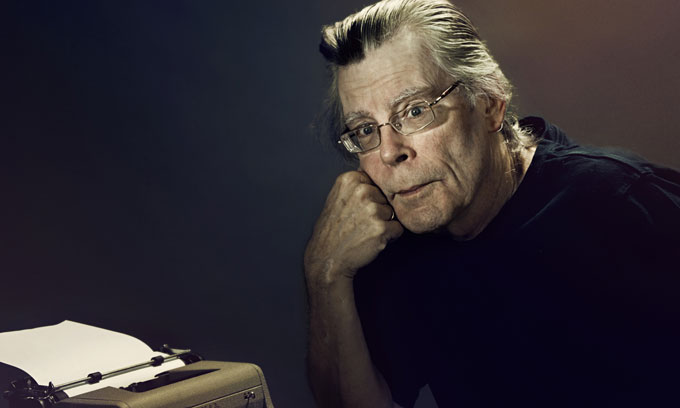
Image of Stephen King

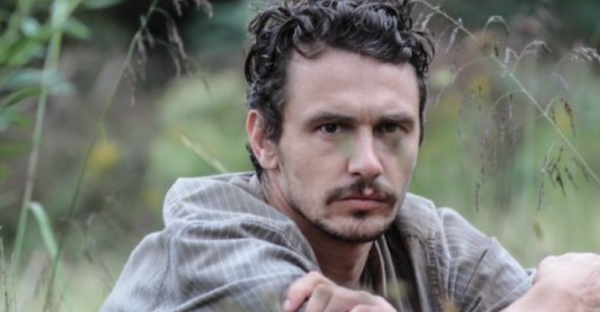
John Steinbeck wasn’t a fan of science fiction, but Stephen King, the reigning master of the form, is a fan of Steinbeck and his books, including Of Mice and Men. Steinbeck’s 1937 novella about George and Lennie plays a particularly important role in 11/22/63, King’s alternate history of America, published on November 8, 2011, five years to the day before Americans elect their 45th president. The TV adaptation of King’s novel downplayed Of Mice and Men but mentioned Steinbeck and starred James Franco, who played George on Broadway and Mac in the 2016 movie adaptation of In Dubious Battle. Like Steinbeck’s 1936 novel about the conflict between modern labor and capital, King’s horror-history of America after 1963 is powerful projection of a political divide that Steinbeck regretted but understood.

Image of James Franco in Stephen King's 11/22/63

Of Mice and Men aside, the major alteration made in Hulu TV’s version of 11/22/63 is in the chain of events set in motion by Franco’s character, a high school English teacher from Maine who time-travels to Dallas to stop Lee Harvey Oswald from assassinating John Kennedy. While underscoring the danger of messing with the past, which like Texas resists interference, King’s story also deals with complexities of cause, effect, and unintended consequences around issues that preoccupy Americans from both political camps today—terrorism, race relations, and climate change, whether acknowledged (Hillary Clinton) or denied (Donald Trump).

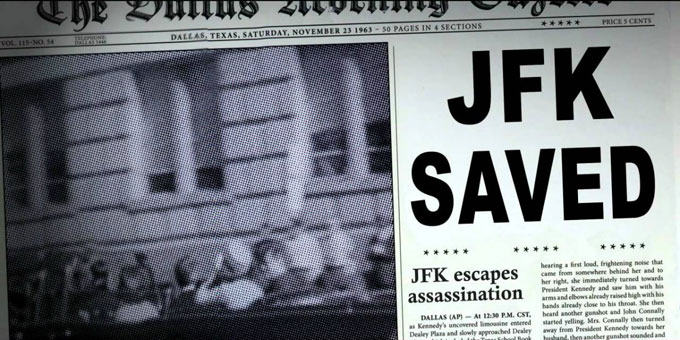
Image of alternate history newspaper from Stephen King's 11/22/63

In King’s alternate history of America, Kennedy lives to serve two terms but fails to enact civil rights legislation, end the escalating war in Southeast Asia, or prevent the election of George Wallace in 1968. President Wallace—a proto-Trump figure with a trigger-happy VP—firebombs Chicago, goes nuclear in Vietnam, and leaves an apocalyptic mess for a series of feckless, one-term successors that includes Humphrey, Reagan, and Clinton (Hillary, not Bill). Skipping this intervening narrative, the Hulu miniseries fast-forwards to a post-apocalyptic America populated by alien “Kennedy camps” and terrorist street gangs with dirty bombs—a version of alternate history certain to offend people who revere Kennedy while fulfilling the worst fears of those who revile Donald Trump.

Image of nuclear blast in Stephen King's alternate history of America

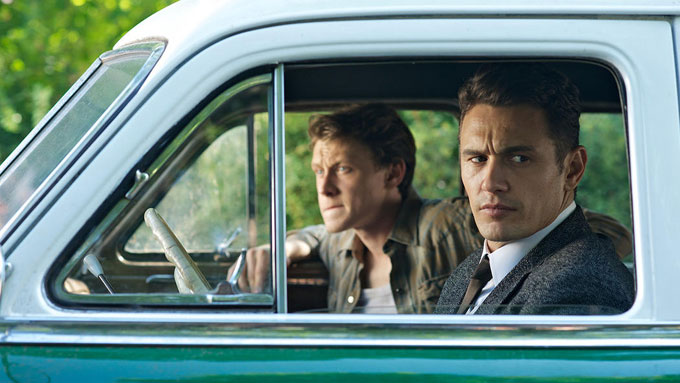
Both groups include fans who will be disappointed in the diminished attention paid to John Steinbeck in the TV version of 11/22/63, where Of Mice and Men is basically limited to a favorite-book comment made by Franco’s character to the librarian who becomes his love interest. In the novel, long but not too long at 850 pages, Of Mice and Men provides dramatic depth, character development, and thematic amplification absent from the eight-part miniseries. Early in the book Franco’s character ponders the challenge of “exposing sixteen-year-olds to the wonders of Shakespeare, Steinbeck, and Shirley Jackson.” Later, while teaching in Texas, he directs Of Mice and Men in a high school production that provides a dimension of joy sadly missing from the miniseries: “At that moment I cared more about Of Mice and Men than I did about Lee Harvey Oswald . . . . I thought that Vince looked like Henry Fonda In The Grapes of Wrath.”

Image of George MacKay and James Franco in 11/22/63

Of Mice and Men Helps 11/22/63 Connect with America

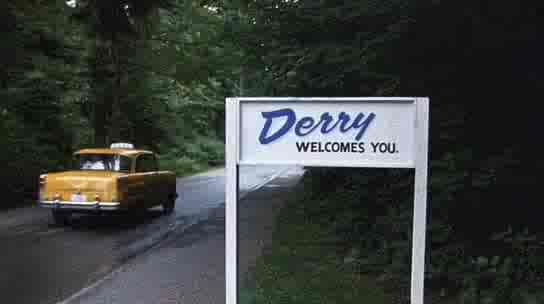
Image of Stephen King's Derry, MaineStephen King, who co-wrote and produced the Hulu series, must share the blame—if that’s the word—for shortchanging John Steinbeck in the interest of narrative compression. The loss is regrettable, and in light of another change unnecessary as well. The first incidence of time travel in the novel takes place in the fictional town of Derry, Maine, a nightmare venue familiar to Stephen King fans from his other books. This episode is important, and it includes a character named Bill Turcotte, a slow-moving, middle-aged loser who threatens Franco’s character and gets left behind in Derry. In the TV version, the Derry action takes place in Kentucky and Turcotte—a wound-up ingénue—stays in the story as a sidekick, all the way to Dallas and the confrontation with Oswald. Unlike Derry and its scary clowns, Turcotte’s Kentucky feels tame. And the time devoted to his character, played by a 23-year-old English actor with a lousy Southern accent, would have been better invested in keeping Of Mice and Men, an essential piece of Americana, in the picture.

John Steinbeck, Donald Trump, and the King of Horror

Image of Donald Trump scary clownBut that’s a quibble. More important is the attention drawn to the phenomenon described years ago by the historian Richard Hofstadter as the paranoid style in American politics. During a recent interview with the book editor of The Washington Post, Stephen King confessed that “a Trump presidency scares me more than anything else.” Exercising and exorcising paranoia is what King does in his writing, of course, so whatever the outcome of this week’s election, it’s safe to assume that a scary-Trump novel will be making us scream soon. Maybe an alternate history of America since 2011? With John Steinbeck as a modern-day time traveler on a mission, like James Franco’s character in 11/22/63, to rewrite the record and save us from ourselves?


Passed On: John Steinbeck’s Affinity for the Visual Arts

Image of Thom and John Steinbeck

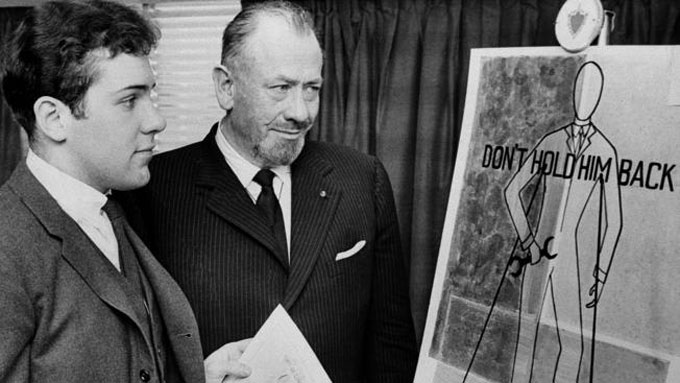
John Steinbeck not only liked being painted, he liked artists and had a deep affinity for the visual arts. For much of his life he counted artists among his most trusted friends. His appreciation for the visual arts, and the needs of working artists, started on the Monterey Peninsula and continued in New York. As suggested by this undated photograph of Steinbeck with his son Thom, he passed this appreciation on to his children. As a result, of the great American writers of the 20th century perhaps none has been captured in portraits and drawings as often as John Steinbeck.

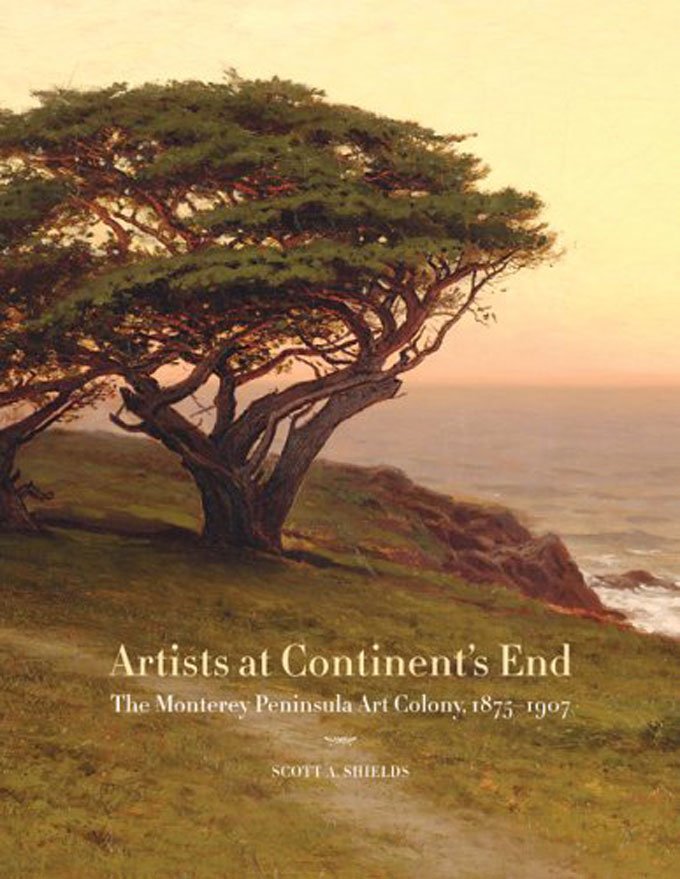
Cover image of Monterey Peninsula art colony history

I think there are two main reasons for Steinbeck’s attraction to artists and being a subject of their work. The place where Steinbeck lived for much of his first 40 years, California’s Monterey Peninsula, was thick with gifted artists when Steinbeck was growing up and beginning his career. And because what Steinbeck was writing in the 1930s and 40s did not make him particularly popular with the local establishment, even endangering him, his circle of friends was necessarily limited, and included artists. This connection with artists carried over when Steinbeck moved to New York and eventually extended to Europe as well. I have a 2001 letter from the late Thomas Steinbeck in which he wrote, “By the time I showed up on the scene, my father had already sat for a number of notable painters.’’ Thom “showed up’’ in New York City, where he was born to John Steinbeck and Gwyndolyn Conger in 1944.

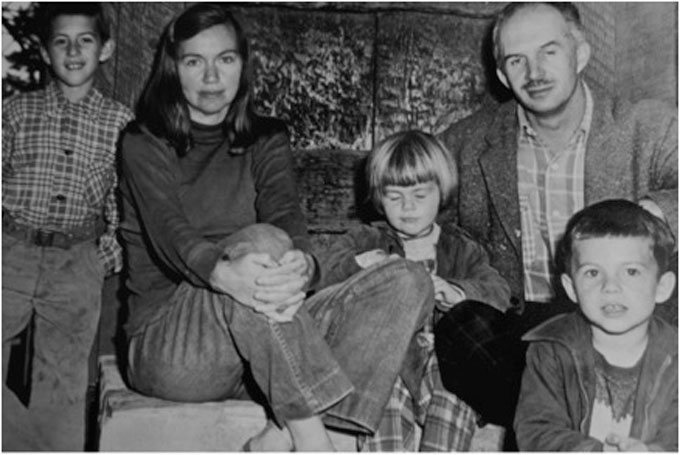
Image of Judith Deim, Ellwood Graham, and children

Three major portraits of Steinbeck that we know of were made before he left California for New York. One was by James Fitzgerald. The other two were by the husband-and-wife artists Ellwood Graham and Judith Deim, shown here with their children in an unattributed photograph from the late 1940s or early 1950s.

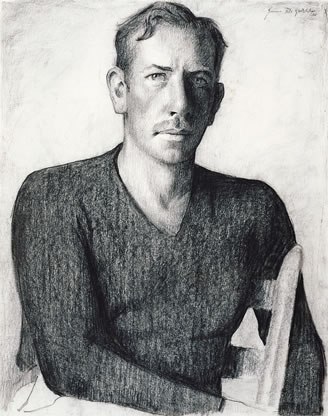
Image of John Steinbeck portrait by James FitzgeraldFitzgerald was born in Milton, Massachusetts and arrived in 1928 as a seaman aboard a freighter. Once he settled in Monterey, he became a part of the group of writers and artists who gathered at Ed Ricketts’s legendary lab on Cannery Row. In 1935, the year Tortilla Flat was published, Fitzgerald did this charcoal study of a young, gaunt Steinbeck, his face half in shadow, that now hangs in the National Portrait Gallery. Reportedly Steinbeck and Fitzgerald had their disagreements, but their friendship endured. There is a photograph of Steinbeck, Fitzgerald, and Ricketts standing on Cannery Row with improvised musical instruments in their hands, including pots and pans. Fitzgerald left Monterey in 1943 for Monhegan Island off the coast of Maine; several years ago the Monhegan Museum established the James Fitzgerald Legacy in honor of his standing as one of America’s greatest watercolorists.

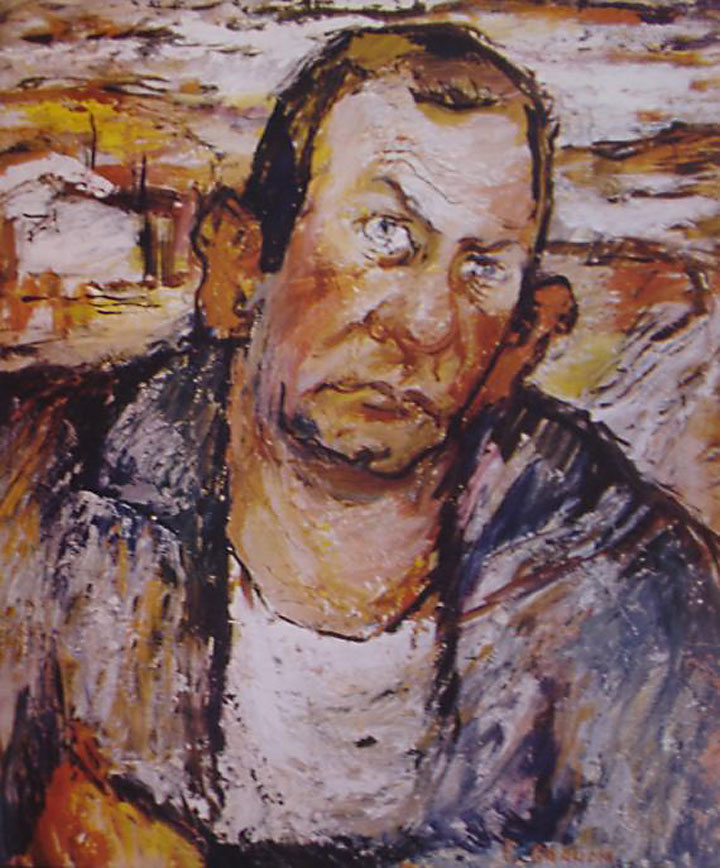
Graham and Deim were both born in St. Louis, Missouri in 1911. Sometime in 1936 or 1937 they met Steinbeck and Ricketts–who were on their way to Mexico–while working on a WPA mural project at the Ventura Post Office in Southern California. The fiction writer and the marine biologist from Pacific Grove were impressed by the work and invited the young couple to visit the Monterey Peninsula, where Deim and Graham eventually settled. Steinbeck was generous, paying their way to Mexico to learn to “paint out loud,’’ advising them, Deim later wrote, to “go to Patzcuaro and not to Tasco where all the tourists go.’’

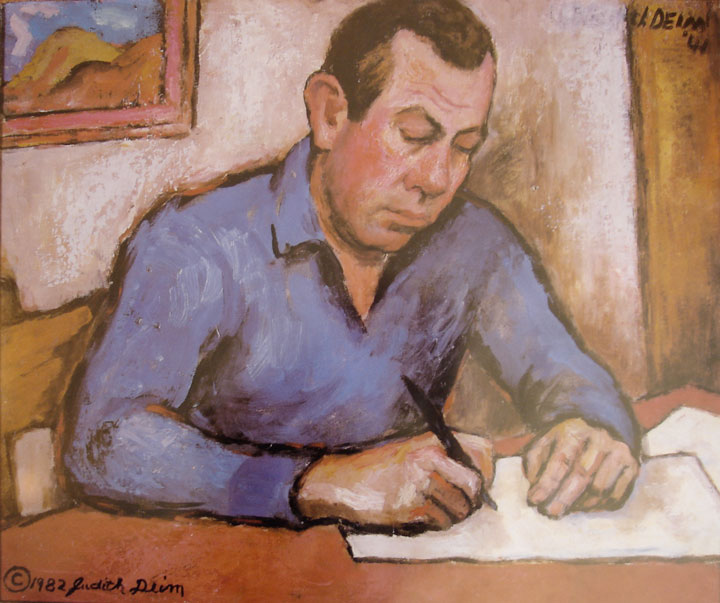
Image of John Steinbeck portrait by Judith Deim

In 2000 Deim wrote that when Steinbeck and Ricketts returned from their expedition to the Sea of Cortez in 1940 “there was much rejoicing, partying, storytelling at the Lab. After a few days of this . . . John felt it was time to get to work. He said, ‘Why don’t you kids paint my portrait and I shall be forced to concentrate and get on with my book.’” Deim’s modern, compact portrait of Steinbeck in the act of writing, shown here, now hangs at the Martha Heasley Cox Center for Steinbeck Studies in San Jose.

Image of John Steinbeck portrait by Ellwood Graham

Ellwood Graham’s psychological study of John Steinbeck (above) has been missing for decades. One story says that Steinbeck’s friend, the film director John Huston coveted the painting, another that it was won or lost in a poker game. Its discovery, if it still exists, would be a major find.

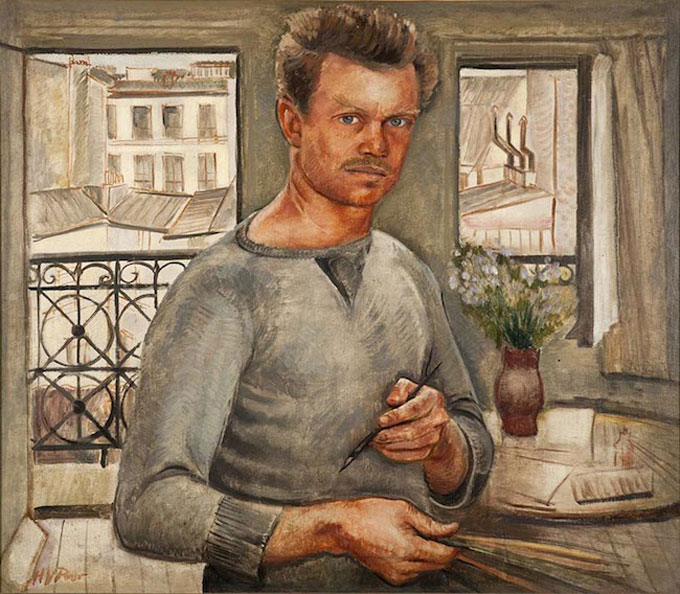
Image of self-portrait by Henry Varnum PoorOne of the first artists Steinbeck became friendly with in New York was Henry Varnum Poor, shown in this self-portrait. In the early 1940s Poor was, like Steinbeck, a resident of Rockland County, and he agreed to be a character witness for Steinbeck in 1942 when the writer applied for a New York State pistol license. This took some courage because Poor had executed a major mural in the Department of Justice building in Washington, and Steinbeck was controversial.

In 1944 John and Gwyn commissioned Poor to do a Steinbeck family portrait, with Gwyn holding a crying infant Thomas. It’s a stark painting. Thom, who disparaged his depiction by Poor in the 2001 letter, added that “My mother loved this painting above all others, which only lends credence to Mr. Poor’s interpretive skills.’’ Whatever he thought of Poor’s painting—which now belongs to the National Steinbeck Center in Salinas—John Steinbeck continued the family-portrait habit. Thom, again in his 2001 letter, noted that “before I could tear myself from the ancestral grasp, my portrait had been painted three times.’’

By maintaining his relationship with artists in New York, it’s possible that Steinbeck wanted to help keep them employed, as he had for Graham and Deim back on the Monterey Peninsula. Thom writes about his father’s close friendship in New York with “that singular genius William Ward Beecher.’’ Thom and his brother Johnnie were fascinated by Beecher’s work but were “pole-axed’’ when their father told them Beecher would paint their portrait, which they realized meant lengthy sittings, away from mischief-making. Thom later recalled that when he and John misbehaved their father took out his frustration by “shaking his fist’’ at his sons’ portraits rather than at them.

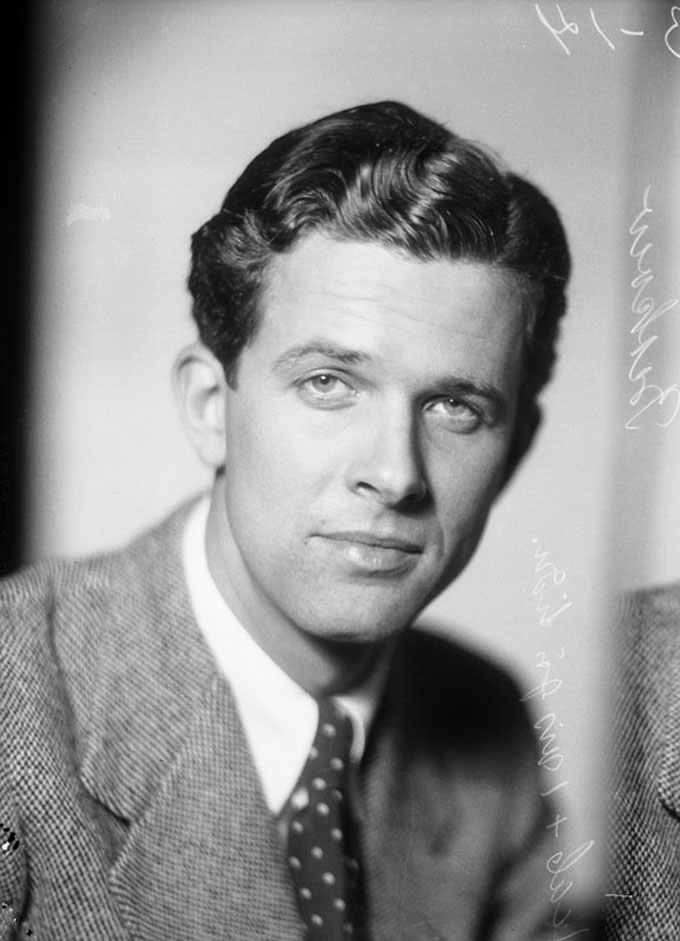
Image of Bo BeskowAnother Steinbeck portraitist was the handsome Swedish artist Bo Beskow (left), who painted or drew the writer at least three times. Beskow remained a trusted confidant during a three-decade relationship in which the two friends exchanged letters, notes, and encouragement, sometimes under trying circumstances. Beskow’s informal 1946 portrait of a smiling John Steinbeck illustrates the fall 2012 issue of Steinbeck Review. A Beskow drawing of Steinbeck with the notation “Copenhagen, Dec. 8, 1962’’—two days before Steinbeck’s Nobel Prize speech—came to auction several years ago.
Of course artists didn’t depict Steinbeck only in portraiture. Judith Deim’s late-1930s painting “Beach Picnic’’ shows Steinbeck, Ricketts, and other members of the lab group gathered on an unidentified Monterey Peninsula or Big Sur beach. Deim said the painting, which has a pensive quality, was done when threats were being made against Steinbeck and his friends gathered around him protectively, as the composition suggests.
Cover image of Cannery Row sketches by Bruce Ariss

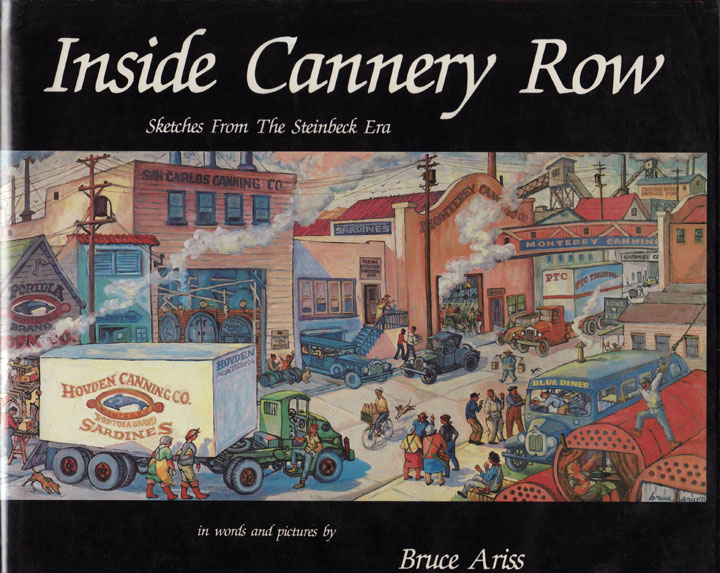
Bruce Ariss, another prominent Monterey Peninsula artist from the lab group, did an arresting drawing of Steinbeck sitting under a cypress tree watching as the characters he created parade by on a busy Cannery Row. Ariss’s spontaneous drawings of Steinbeck and Ricketts and the others populate his book Inside Cannery Row: Sketches from the Steinbeck Era. Some of Ariss’s images can be seen today on the colorful banners that dot Cannery Row.

Not all of Steinbeck’s artist friends drew or painted him. Armin Hansen and Howard Everett Smith were leading artists on the Monterey Peninsula with close relationships to Steinbeck, but I know of no portrait of the writer by either one. Hansen wasn’t really a portraitist, so it’s unlikely he painted Steinbeck. Smith did do portraits: perhaps his most famous subject was the poet Robinson Jeffers, after John Steinbeck the Monterey Peninsula’s greatest literary figure.

Image of Tortilla Flat book illustration by Peggy Worthington Best

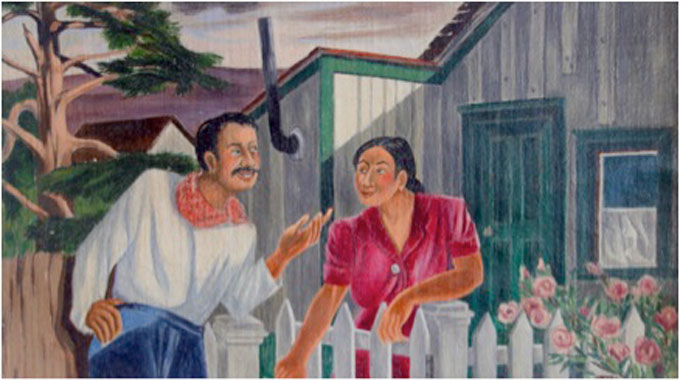
And then there were the illustrators of Steinbeck’s books. Mahlon Blaine, an artist Steinbeck met in 1925 while traveling to New York for work, created the cover art for Cup of Gold, Steinbeck’s first novel. Steinbeck was unsatisfied with the image, and he continued to be involved in selecting illustrators for many of the works that followed. To create the cover art and illustrations for the deluxe edition of Tortilla Flat like the one shown here, he helped choose Peggy Worthington (later Peggy Worthington Best), the wife of a poet and editor at Viking Press, his publisher. Thomas Hart Benton, the Missouri populist painter, was a natural choice to illustrate Viking’s deluxe edition of The Grapes of Wrath.

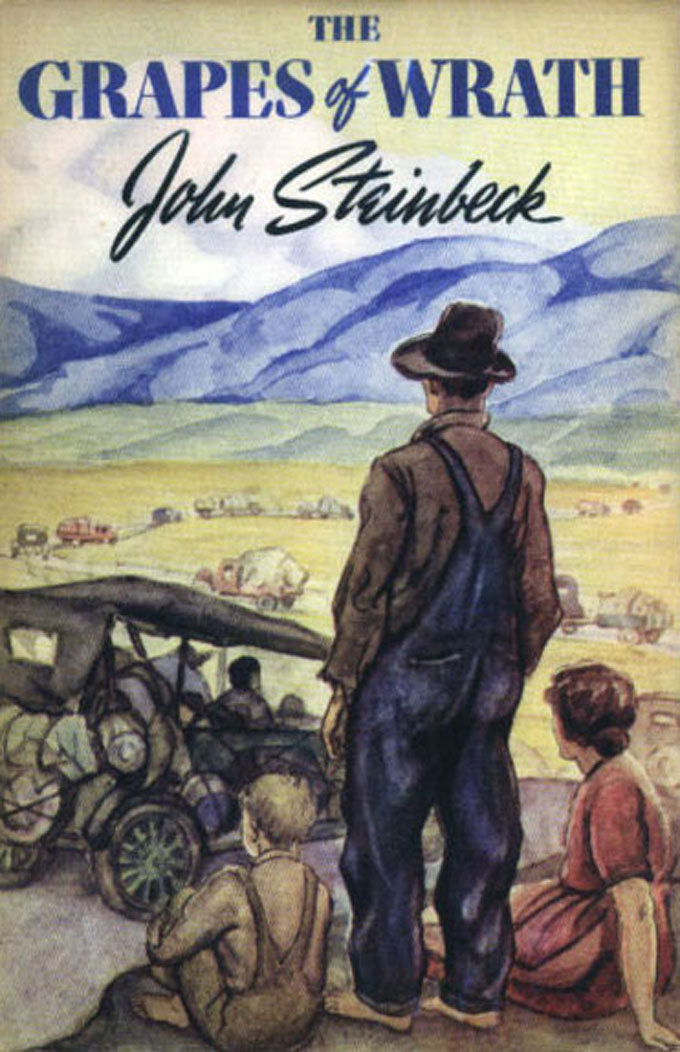
I’m uncertain whether Steinbeck knew Elmer Hader, the California artist who created the dust jacket for the first edition of the novel in 1939. Both Steinbeck and Hader were from Monterey County, Hader born in 1889 in the little town of Pajaro, not far from Salinas. If Hader wasn’t personally acquainted with the author, he certainly understood The Grapes of Wrath. His inspired image of the Oklahoma Joads seeing California for the first time has become almost as iconic as the characters themselves.

Cover image of John Steinbeck's "The Grapes of Wrath"

Some years ago I was contacted by the auction house that was putting the original watercolor for Hader’s Grapes of Wrath cover up for auction. They asked what I thought it should sell for. Guessing, I said $30,000-$35,000. That seemed high, they replied, since no Hader painting had ever sold for more than a tenth of that amount. Looking back today it’s obvious the eventual purchaser got a bargain . . . for $65,000.

I think Steinbeck would have smiled at that result. He liked artists and he wanted them to receive their due, preferably while they were alive. He passed on his affinity for the visual arts, and he did what he could to help the artists he knew.

This is the 300th post published by SteinbeckNow.com since the site launched three years ago. View the related video—Steinbeck’s Storied Artists, with commentary by Steve Hauk—from the site’s YouTube channel.—Ed.

Paul Newman’s Of Mice and Men: Steve Hauk’s True Story

Image of Paul Newman

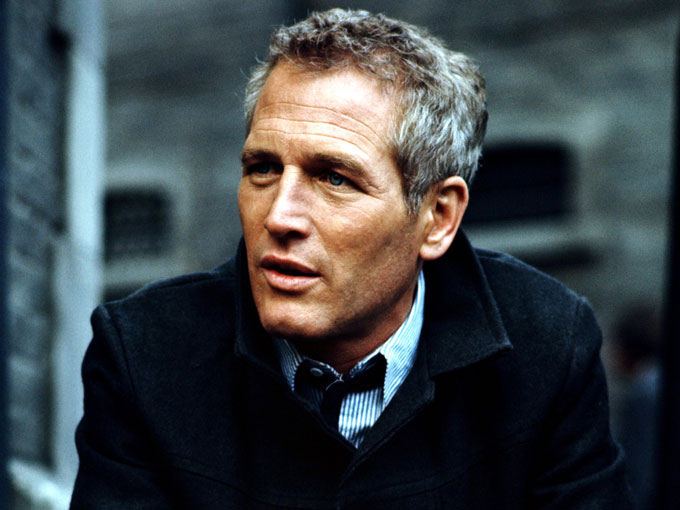
Now and then I wonder what Steinbeck’s Of Mice and Men would have looked like staged by Paul Newman, how it would have felt. Would George have taken on a swagger? Would Curley’s wife have been even sexier? Newman after all had a way with exotic characters, whether Ben Quick or Brick or Cool Hand Luke or Fast Eddie Felson.

Paul Newman had a way with exotic characters, whether Ben Quick or Brick or Cool Hand Luke or Fast Eddie Felson.

Before assuming Newman might have exaggerated or distorted Steinbeck’s earthier Lennie or Slim, it’s good to remember the Westport Country Playhouse production of Thornton Wilder’s Our Town. Newman’s folksy Stage Manager couldn’t have been more sagely understated. That was in 2003.

Image of Westport Country Playhouse

By 2007 Newman was dying and knew he didn’t have much work left in him. The fact that he chose to direct Of Mice and Men at Westport–in what would have been his theater directing debut at age 81–was certainly a deep bow to Steinbeck. The play was to open in mid-2008, but Newman’s health worsened precipitously. He stepped down from the production on May 23.

The fact that he chose to direct ‘Of Mice and Men’ at Westport–in what would have been his theater directing debut at age 81–was certainly a deep bow to Steinbeck.

I was disappointed–I wanted to see what he would have done with it. While I knew I couldn’t make it to Westport to see the production, I figured it would be filmed, as Our Town had been for public television showing. Newman died several months later, in September 2008.

Newman’s Challenge: “Where ya’ gonna send the dime?”

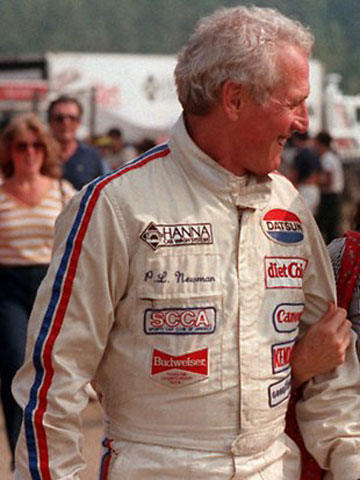
I’d met Paul Newman two decades earlier. It was 1987. I was writing sports for the Monterey Herald, and he had come to Monterey to race at the Laguna Seca racetrack. We talked cars and speed, then the conversation turned to theater and film. He mentioned he would soon be editing a film version of Tennessee Williams’ The Glass Menagerie starring his wife, Joanne Woodward.

I’d met Newman two decades earlier. I was writing for the Monterey Herald, and he had come to Monterey to race at the Laguna Seca racetrack.

I have no idea why, but I said, ”Well, it’s a great play but don’t you think it’s been done too often?’’

He stared at me and said slowly and clearly, as if I was standing there talking to Chance Wayne throwing back another shot of bourbon, “It’ll knock your socks off–and I’ll bet ya’ a dime.’’

About then other reporters moved in and I said goodbye. I’d only gone a short way when Newman called after: “Where ya’ gonna send the dime?’’

I’d only gone a short way when Newman called after: ‘Where ya’ gonna send the dime?’

The reporters stepped aside as he jotted his address on a scrap of paper. My wife Nancy and I saw the film several months later. Knocked our socks off. I wanted to send him the dime but couldn’t find the scrap of paper with his address–and have not come across it to this day.

The reporters stepped aside as he jotted his address on a scrap of paper.

I’ve never felt so guilty over nonpayment of anything. I knew he expected some kind of reply and just about the worse kind of reply to anything is silence. Years later I got an address for him and mailed him a dollar. I didn’t receive an answer but by then he was fighting the cancer and I didn’t expect one. Still, I hoped he’d read my apologetic letter and smile as he pocketed the dollar.

Paul Newman and Steinbeck: A Marriage Made in Heaven?

paul-newman-racingOf Mice and Men would to my knowledge have been Newman’s first artistic encounter with Steinbeck. But that day in 1987 at the racetrack in Monterey, when the conversation turned to literature, he acknowledged he was in Steinbeck country in classic Newman style. His blue eyes scanning the surrounding hills close by Steinbeck’s Pastures of Heaven, he said, “No wonder Steinbeck loved it here–sure is pretty.’’

Paul Newman was famous for the way he could throw a line. But the one that will always haunt me is “Where ya’ gonna send the dime?’’ 

Another true story by Steve Hauk will appear next week, the 300th blog post published since SteinbeckNow.com launched three years ago. Meanwhile, here is a sample of Paul Newman’s “folksy Stage Manager” in the 2003 Westport Country Playhouse production of Our Town.–Ed.

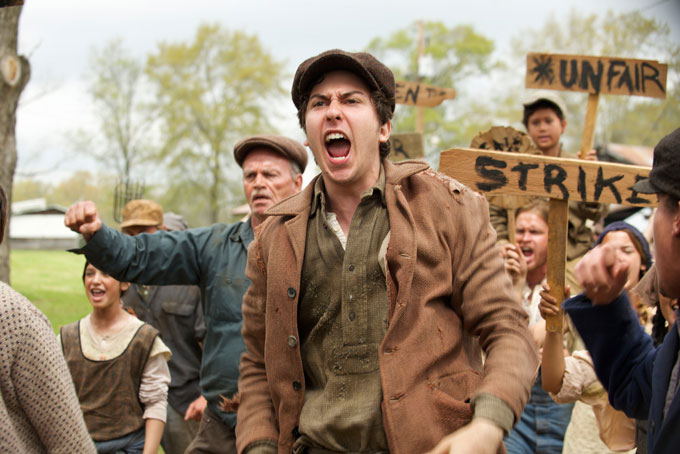
In Dubious Battle Motion Picture by James Franco, Steinbeck Fan, Premieres

Image of scene from James Franco's motion picture of "In Dubious Battle"

Image of James FrancoMovie reviews, like book reviews, sometimes influence audience behavior. But as John Steinbeck proved, loyal fans often ignore reviews if they really like an author or an actor. When James Franco’s motion picture adaptation of In Dubious Battle is released in the U.S. later this year, it’s doubtful that fans of Steinbeck or Franco will be affected one way or the other by the breathless reviews and red carpet hoopla In Dubious Battle received at film festivals in September. Reviews were mixed following the movie’s premiere at the Venice Film Festival, but Franco won points for making the first motion picture adaptation of Steinbeck’s 1936 strike novel, and that may be what fans appreciate most when they see the movie for themselves.

Reviews were mixed following the movie’s premiere at the Venice Film Festival, but Franco won points for making the first adapatation of Steinbeck’s 1936 strike novel.

Franco reread In Dubious Battle while rehearsing the role of George for the Broadway stage revival of Steinbeck’s 1937 play-novella Of Mice and Men, which has been filmed twice despite being, in Franco’s view, far less suited for the screen than the earlier book. During a press conference at the Deauville Film Festival following Venice, he explained that he decided to make In Dubious Battle now because “as a storyteller [I knew] it would make a great movie” and because its “central conflict had a topical resonance” he felt audiences would understand. That point seemed lost on critics at the Venice Film Festival: some got facts wrong about the novel; others ignored Franco’s intentions and concentrated on his personality and appearance. The response from critics may be more discerning when Franco’s movie opens at the film festival in Toronto, where reviewers won’t have to explain Steinbeck’s story to readers, or the parallels between Steinbeck’s time and today.

Rebel with a Cause: Filming Faulkner and Steinbeck

Image of James Franco as James DeanWhatever the final verdict on the film, Franco also deserves credit for both directing and acting (as Mac) and for attracting an amazing cast, including Bryan Cranston, Vincent d’Onofrio, Robert Duvall, Ed Harris, Sam Shepard, Selena Gomez, and Natt Wolff. Franco has appeared in dozens of movies, and he’s best known by mainstream moviegoers for playing slapstick characters in Animal House pictures like The Interview. But he has portrayed intelligent characters intelligently in highbrow films and acted and directed in adaptations of novels by Faulkner even harder to film than Steinbeck.

Whatever the final verdict on the film, Franco also deserves credit for both directing and acting (as Mac), and for attracting an amazing cast.

Like Faulkner, Steinbeck learned his limits when he tried to write for Hollywood, and he preferred to leave the job of adapting to specialists like Franco’s friend Matt Rager, the screenwriter Franco turns to when he makes literary movies, including biopics about authors. In several of these films Franco portrays tormented artistes from Steinbeck’s era—including Hart Crane, James Dean, and Alan Ginsburg—about whom Steinbeck could be critical. Franco grew up in Palo Alto, where Steinbeck went to college, and he writes fiction that appeals to the kind of reader who, unlike Steinbeck, is naturally attracted to Crane, Dean, and Ginsburg.. Like these figures, and like Steinbeck, Franco follows his own drummer as an artist, and his fans—like Steinbeck’s—respond in the same spirit. For American fans, Franco’s independence, courage, and passion for Steinbeck are cause enough to celebrate the making of In Dubious Battle, despite ill-informed movie reviews at foreign film festivals.

Steinbeck Event Benefits Cesar Chavez Center

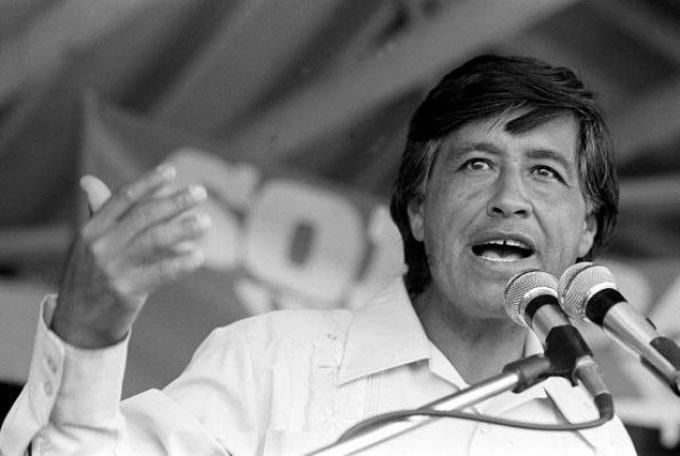
Image of Cesar Chavez

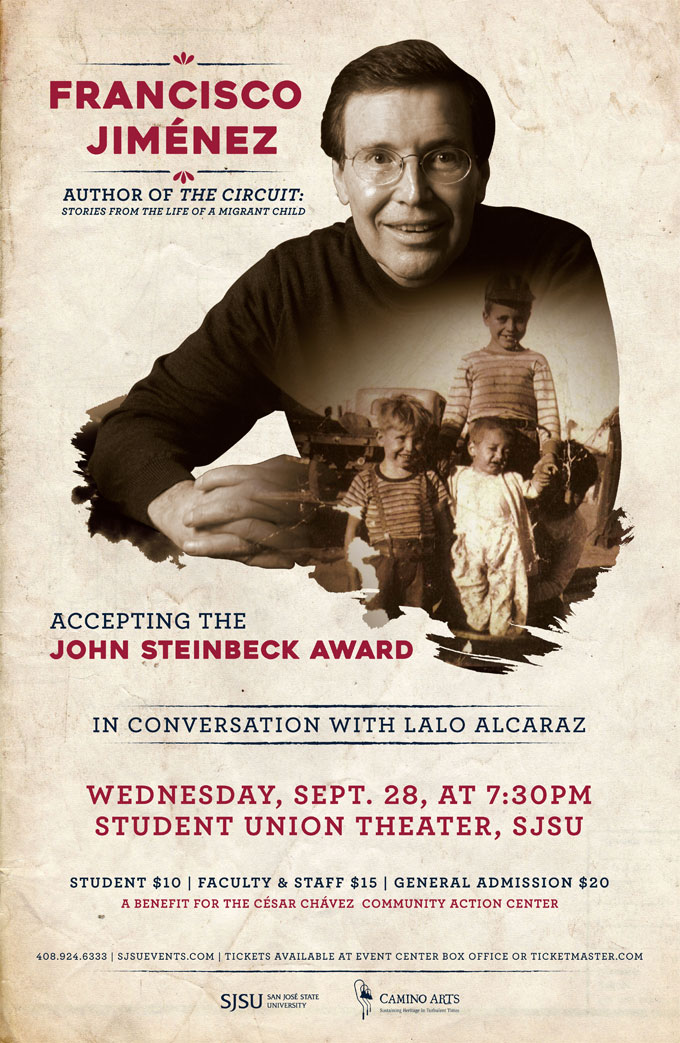
Francisco Jimenez, an award-winning children’s writer and Santa Clara University professor, will receive the John Steinbeck “In the souls of the people” award at a September 28 event benefiting San Jose State University’s Cesar Chavez Community Action Center. The award, which has been given in the past to such writers as Ruby Bridges and Khaled Hosseini, is sponsored by the school’s Martha Heasley Cox Center for Steinbeck Studies. As a boy Jimenez migrated to California from Mexico with his family, whose transient existence he compares to that of the Joads in The Grapes of Wrath. His first book, The Circuit: Stories from the Life of a Migrant Child (1997), won the Americas Award for Children and Young Adults Literature. After receiving his PhD, he joined the faculty of Santa Clara University, his alma mater, where he was CASE/Carnegie Foundation Professor of the Year in 2002. He is an especially sympathetic admirer of Cesar Chavez, the labor and civil rights leader who—with Dolores Huerta, a previous Steinbeck award winner—founded the National Farm Workers Association in 1962. The September 28 benefit, which begins at 7:30 p.m. in San Jose State University’s Student Union Theater, will feature Francisco Jimenez in conversation with Lalo Alcarez, the creator of “La Cucaracha,” the first nationally syndicated political cartoon by a Latino artist in the United States. General admission tickets are $20 and are available from the San Jose State University event center.

Image of Francisco Jimenez award event poster

Thinking of John Steinbeck? Pencil Your Own Blog Post

Image of someone thinking about a blog post on John Steinbeck, who wrote with a pencil

SteinbeckNow.com is the author website with an ambitious mission: to connect John Steinbeck, who preferred pencils, with readers accustomed to computers. Other American authors also have author websites. But most are designed for academics, or tied to venues or foundations raising funds for programs and projects. Steinbeck never wanted an academic title or degree; he even resisted when his home town attempted to name a school after him. Pitches for money made him uncomfortable and commercialism often made him angry. In this same spirit, the only non-academic author website that bears his name is non-commercial and focused on the present, not the past. Content comes from contributors who write for love, not money; new blog posts are published weekly, almost 300 since the site launched three years ago. Contributors, 48 to date, come from the United States, Europe, and Africa as well. Some write poetry, fiction, or drama inspired by Steinbeck’s life or work. A few are specialists who prefer to test their ideas online before writing their article or book. Most are amateurs who participate in Steinbeck’s books as he intended, with imagination. Thinking about John Steinbeck in a fresh or personal way? Put your thoughts in a blog post for the only Steinbeck author website created for readers like you. Content is curated and subject to editing, but turnaround is fast and layout looks appealing. Steinbeck thought imaginatively, then put pencil to paper. Now it’s your turn to write. Getting started is easy: email the idea for your blog post to williamray@steinbecknow.com.


Memo to the Supreme Court On Of Mice and Men and the Death Penalty, With Helpful Hints from Literary Criticism

Image of members of the Supreme Court

The August 22 New York Times story by Adam Liptak—“Supreme Court to Consider Legal Standard Drawn From ‘Of Mice and Men’”—suggests that a book by John Steinbeck, like the Bible itself, is open to misinterpretation whenever there is a point to prove. In response to the Supreme Court’s 2002 decision barring execution of the “intellectually disabled,” reports Liptak, “Texas took a creative approach, adopting what one judge there later called ‘the Lennie standard,’” so named for Lennie Small, the mentally handicapped farmhand who kills and gets killed in Of Mice and Men. “This fall, in Moore v. Texas, No. 15-797,” Liptak continues, “the United States Supreme Court will consider whether the Court of Criminal Appeals, Texas’ highest court for criminal matters, went astray last year in upholding the death sentence of Bobby J. Moore based in part on outdated medical criteria and in part on the Lennie standard.”

The story by Adam Liptak suggests that a book by John Steinbeck, like the Bible itself, is open to misinterpretation whenever there is a point to prove.

John Steinbeck explained that his fictional character was based on fact in a 1937 New York Times interview quoted by Liptak. “Lennie was a real person,” Steinbeck told the Times. “He is in an
insane asylum in California right now.” Responding to the misuse of his father’s novel when the Texas case made news in 2012, Thomas Steinbeck—a novelist very much in his father’s image—objected in the strongest terms. “The character of Lennie was never intended to be used to diagnose a medical condition like intellectual disability,” he said at the time. “I find the whole premise to be insulting, outrageous, ridiculous and profoundly tragic [and] I am certain that if my father, John Steinbeck, were here, he would be deeply angry and ashamed to see his work used in this way.”

Lessons from Literary Criticism for the Supreme Court

Of Mice and Men is popular with middle and high school students, yet legal authorities continue to misread the author’s intention, as noted in Liptak’s story. The Supreme Court’s decision regarding the Lennie standard seems certain to set a precedent for legal debate about the death penalty, so understanding what Steinbeck intended matters. Judges like source citations, and reviewing literary criticism written around Steinbeck’s intention in Of Mice and Men may clarify their thinking. The brief summary of literary criticism that follows is intended to spare Steinbeck from further misreading as arguments over eugenics, euthanasia, and the Lennie standard unfold in the courts.

Of Mice and Men is popular with middle and high school students, yet legal authorities continue to misread the author’s meaning.

Fundamental to the death penalty debate is understanding what Steinbeck meant by having George execute Lennie at the end of the novel. Charlotte Hadella and critics have questioned the inevitability of this ending, the so-called mercy killing carried out by George at Slim’s urging as something that must done to spare Lennie from being lynched. George looks up to Slim, a figure of respect whose word counts among the menon the ranch. But Slim’s motives are murky, and he is associated with earlier killings in the novel—the shooting of Candy’s dog and the elimination of Lulu’s unwanted puppies.

Fundamental to the death penalty debate is understanding what Steinbeck meant by having George execute Lennie at the end of the novel.

Likewise, Louis Owens’s reading of the novel revolves around “the various deaths that punctuate the story,” beginning with Slim’s drowning of four puppies from Lulu’s litter. Carlson takes the opportunity to agitate for saving one puppy for Candy so that they can shoot Candy’s old dog, whose offense is that he “stinks.” In an attempt “to give his argument the kind of humanitarian bent euthanasia proponents prefer,” Carlson tells Candy it’s cruel to keep the dog alive—even though there is nothing to indicate that the animal is suffering or unhappy—and a killing of convenience suddenly seems inevitable. Candy appeals to Slim, who takes what Hadella calls “an enormous ethical leap” by saying he wishes someone would shoot him if he got “old and crippled” like the dog. Or like Candy himself, who Owens suggests may have cause to wonder whether Slim will decide to shoot him too someday. Like Lennie and Crooks, Candy is just the kind of character Curley’s wife calls weak—“unproductive,” “valueless,” inconvenient like his dog.

The Gun: Connecting Eugenics, Execution, and Fascism

Steinbeck makes the parallels between the dog’s shooting by Carlson and George’s shooting of Lennie unmistakable, for both are shot “in exactly the same way with the same gun.” As Owens notes, “Dog and man are both annoyances and impediments to the smooth working of the ranch. One stinks and one kills too many things.” When the body of Curley’s wife is discovered, George’s first impulse is humane, to capture Lennie and lock him up so he won’t be a danger to society. But Slim objects. Using the rationale that justified killing Candy’s dog, Slim argues that Lennie would be better off dead than incarcerated—in Slim’s words “locked up, strapped down, and caged.” Slim, Owens observes, “is playing God.” Significantly, the gun used for these killings is described as a Luger, according to Owens a deftly emphasized detail intended by Steinbeck to associate them with eugenics and fascism in Germany.

The gun used for these killings is described as a Luger, according to Owens a deftly emphasized detail intended by Steinbeck to associate them with eugenics and fascism in Germany.

In support of this point, Owens demonsrates Steinbeck’s familiarity with studies of eugenics whose conclusions were used to justify the forced sterilization of those deemed defective by the Heredity Court in Hitler’s Germany. Their Blood Is Strong, the title of the predecessor to The Grapes of Wrath, shows Steinbeck’s familiarity with when he wrote Of Mice and Men. As Owens points out, the ominous repetition of the word Luger in the novel clearly connects “the supposed ‘mercy’ killings of the novel with the rise of Fascism in Germany.”

Their Blood Is Strong, the title of the predecessor to The Grapes of Wrath, shows Steinbeck’s familiarity with eugenics when he wrote Of Mice and Men.

In the light of literary criticism, then, Of Mice and Men can be understood as a cautionary tale written in response to current events. Accepting Lennie’s and the dogs’ deaths as inevitable, as mercy killings that simply must be done, is contrary to Steinbeck’s meaning, the act of misappropriation pointed out by Thomas Steinbeck in his comments about his father and capital punishment. Furthermore, Slim’s inviting George to have a drink after shooting Lennie is an invitation to accept a worldview in which life is nullified—the Nazi world of eugenics, euthanasia, and extermination. This worldview is reflected in current political rhetoric about racial purity, national identity, and the justification of police violence and mass deportation.

This worldview is reflected in current political rhetoric about racial purity, national identity, and the justification of police violence and mass deportation.

Both presidential campaigns remind us that the sanctity of the Supreme Court depends on the outcome of the election. Both would benefit from understanding the moral questions raised by John Steinbeck in Of Mice and Men. Where is our compassion? Who will care for the Lennies of our world today? As for the Supreme Court as presently constituted, I have this advice: read Steinbeck’s novel—closely, slowly, carefully, paying attention to details—and read with your heart, as Steinbeck intended for all his books. Though it may seem so sometimes, America isn’t Nazi Germany. Don’t use Steinbeck’s story as an excuse to execute those who are mentally ill or intellectually handicapped because they don’t pass the Lennie test.

Suggestions for Further Reading

Hadella, Charlotte Cook. Of Mice and Men: A Kinship of Powerlessness. New York: Twayne Publishers, 1995.

Heavilin, Barbara A. John Steinbeck’s Of Mice and Men: A Reference Guide. Westport, Connecticut, 2005.

Owens, Louis. “Deadly Kids, Stinking Dogs, and Heroes: The Best Laid Plans in Steinbeck’s Of Mice and Men.” Steinbeck Studies. (Fall 2002), 1-8.

What The New York Times, The Charlotte Observer, and Christianity Today Had to Say About John Steinbeck

Image of the New York Times newsroom in 1942

Three recent newspaper stories served as reminders that John Steinbeck remains relevant to readers, and useful to editors, experts, and leaders who make policy in his name. Of Mice and Men dominated the August 22 New York Times report on a Texas death penalty case working its way to the Supreme Court. The Grapes of Wrath appeared in the headline of a report on Syrian refugees published the same day in Christianity Today. The 1939 novel was used by a college professor with conservative ideas about government in an August 20 editorial for The Charlotte Observer. The New York Times and Christianity Today articles reflected Steinbeck’s values. The editorial in The Charlotte Observer showed why he took a dim view of academics.

The New York Times and Christianity Today articles reflected Steinbeck’s values. The editorial in The Charlotte Observer showed why he took a dim view of academics.

The New York Times piece by Adam Liptak explored the legality and ethics of the so-called Lennie standard, named for the character Lennie Small and used to decide when a person of limited intelligence should or shouldn’t be executed for murder. (Barbara A. Heavilin, who writes frequently about John Steinbeck, explains the immorality of this misreading of Steinbeck”s novel in a related blog post.)  Jeremy Weber’s Christianity Today report on refugees in the Bekaa Valley—“Grapes of Wrath: Refugees Face Steinbeck Scenario in Lebanon’s Napa Valley”—compared conditions there with California during the Great Depression. In his editorial for The Charlotte Observer“Addressing the problems of the modern-day Joads“—Professor Clark G. Ross misrepresented Steinbeck’s intentions in The Grapes of Wrath, just as those justifying the death penalty do in misreading Of Mice and Men.

Why The Charlotte Observer Got John Steinbeck Wrong

Professor Ross describes teaching The Grapes of Wrath to a group of students who are studying the Depression for the first time. His detached view of the Joads as a “fundamentally Christian, not over-educated family” dependent on government support for survival suggests that the wrong lesson was learned about the present. While faulting both Republicans and Democrats for failing workers losing their jobs to foreign labor, he claims that politicians can’t save these “modern-day Joads” anyway, because government isn’t the solution to social problems. Steinbeck thought it was and Weedpatch, the federal camp where the Joads get help, was his proof. Unconvinced by Steinbeck’s example, Ross characterizes Steinbeck’s vision as  “centered on a benevolent government within a communist society, one that would provide employment and shelter, as well as self-governance.” The commie charge isn’t new.

Steinbeck thought government was the solution to social problems. Weedpatch, the federal camp where the Joads get help in The Grapes of Wrath, was his proof.

Conservative critics raised the specter of communism to discredit Steinbeck and his novel when it was published more than 75 years ago. Critics in California denied that Okies like the Joads even existed, or if they did were as numerous as Steinbeck claimed, and they failed to feel the Joads’ or Steinbeck’s pain. Professor Ross expresses sympathy, but it’s distant and distorted by doctrine. Like that of Joad Deniers at the time, his claim that Steinbeck’s version of good government can’t succeed requires a belief that government can’t be the solution because it’s the problem. “History has proven,” he says of Steinbeck’s dream, “that such public provision of goods and services really cannot work.” Arvin, the migrant camp known as Weedpatch, proved the opposite.

How John Steinbeck Did Research and Described Experts

“History has proven” is a sad tautology, and economics remains a dismal science. That’s why Steinbeck’s joyful art is useful in putting a human face on social and economic abstractions, as The New York Times and Christianity Today did last week. Steinbeck put a human face on every subject when he wrote, and the effort often hurt. He lost his first newspaper job because he got bogged down in the human side of the stories his editor assigned. He researched The Grapes of Wrath in person, by doing, reporting on Dustbowl refugees in the field for the San Francisco Examiner, staying at Arvin to learn how it worked, making mercy runs to migrants stranded by floods in the Central Valley. Of Mice and Men was similarly inspired by actual people and events; as Barbara Heavilin notes, Lennie Small was based on a real person.

Economics remains a dismal science. That’s why Steinbeck’s joyful art is useful in putting a human face on social and economic abstractions.

Years after writing these books Steinbeck had a chance meeting on a train with a boyhood friend from Salinas. By then the author was back in the journalism business, producing a syndicated newspaper column that allowed him personal privilege, which he used, to speak his mind. Tongue in cheek, he tacked the meeting onto a tall-tale column about religion, describing his old friend, now grown, as a “professor of anthropology . . . or some such vermin.” Vermin seems a strong word to describe an expert, even if the friend was in on the joke. On the other hand, the misinterpretation of Steinbeck’s meaning by authorities in Texas, and by an academic in North Carolina, suggests why he used it.

Thomas Steinbeck, John Steinbeck’s Son, Dead at 72

Image of Thomas Steinbeck

As reported by the New York Times, John Steinbeck’s surviving son, Thomas Steinbeck, died on August 11 in Santa Barbara, California, from cardiopulmonary disease, the condition that contributed to his father’s death at age 66 in 1968. A second Steinbeck son, John Steinbeck IV, died in 1992. Their mother was John Steinbeck’s second wife; the New York Times obituary detailed the course of legal action brought by Thomas Steinbeck and a niece against the non-blood heirs and literary agents of the author, who left the bulk of his estate to his third wife. While noting Thomas Steinbeck’s strong resemblance to his father, the New York Times story failed to mention the Steinbeckian character and literary quality of the younger Steinbeck’s writing, including novels and stories set on the Monterey Peninsula, the region celebrated in his father’s fiction. Also omitted was Thomas Steinbeck’s generosity to the Center for Steinbeck Studies at San Jose State University, which issued a statement praising his friendship and support. Robert DeMott, the John Steinbeck scholar who served as the Center’s director in the 1980s, recalled the son’s gift of his father’s typewriter and other personal items, as well as his presence at events honoring John Steinbeck over the years. Robert DeMott’s tribute to Thomas Steinbeck will be published in Steinbeck Review.

AP photograph of Thomas Steinbeck by Richard Green

British Broadcast Star Interviews John Steinbeck Historian for BBC Series

Image of BBC Two Broadcaster William Crawley

BBC Two Celebrity Broadcaster William Crawley

John Steinbeck returned repeatedly to his family roots in Northern Ireland, both in his writing and in his travels. His 1952 novel East of Eden is a paean to his grandfather Sam Hamilton, the Scots-Irish immigrant who settled in California’s Salinas Valley in the 19th century. “I Visit Ireland,” a piece for Collier’s magazine in 1953, describes the writer’s feelings about Sam’s country, and the pilgrimage he made there with his wife Elaine, who took the photo of Steinbeck at the Hamilton family grave site that accompanied the article. “Letters to Alicia,” travel dispatches Steinbeck wrote for syndicated publication in 1965-66, details his final journey, which included Galway, Kerry, and Christmas at John Huston’s Irish castle. John Steinbeck loved the idea of Ireland, and the people of Ireland honored him in return, most recently in a TV series being produced for BBC Two about Northern Ireland and America.

John Steinbeck returned repeatedly to his family roots in Northern Ireland. The people of Ireland honored him in return, most recently in a TV series about Northern Ireland and America.

Carol Robles, the Steinbeck historian who was interviewed for the series by the BBC Two broadcaster William Crawley, convinced Jane MacGowan, the series director, that Steinbeck’s family home in Salinas was the perfect place to shoot the segment on Sam Hamilton, John Steinbeck, and the contribution made by Northern Ireland to the character and culture of California. Before coming to Salinas, Crawley and MacGowan’s crew also visited the site of the labor camp near Bakersfield used by Steinbeck as a model in The Grapes of Wrath. Later, B-roll footage was shot at the Hamilton ranch in King City, the setting for much of the action in East of Eden. Other stops along the Northern Irish trail in America filmed for the new BBC Two series, entitled Brave New World—America, include Massachusetts and Florida—states that are also significant in Steinbeck family history—and the Blue Ridge mountains, where the Scots-Irish spirit celebrated in The Grapes of Wrath lives on in speech and song.

Image of Carol Robles and William Crawley

Carol Robles and William Crawley (both at right) on August 11

Coming Soon to BBC Two: Brave New World—America

Robles was impressed by the knowledge about John Steinbeck displayed by Crawley and MacGowan when she was interviewed in the intimate reception room of the Steinbeck House on August 11. Afterwards the crew shot background footage in other parts of the home, and Crawley—an ex-minister and break dancer from Belfast with a PhD in philosophy—stopped by the gift shop to chat with volunteers, photograph furniture, and purchase a Steinbeck biography and a first edition of East of Eden. Robles was also impressed by the BBC Two team’s preparation, efficiency, and ability to adapt to change. When MacGowan first contacted Robles on July 25, two weeks before the shoot, the director readily accepted the suggestion to film at the Steinbeck House rather than at the Hamilton ranch as originally planned. Range fires near Salinas prevented filming on Fremont’s Peak, which Steinbeck climbed as a boy and where he contemplates the Salinas Valley in Travels with Charley. Instead, the time was spent shooting footage of the rich farm land around Salinas that created wealth for the town and conflict for the characters in East of Eden.

Carol Robles was impressed by the knowledge about John Steinbeck displayed by William Crawley and Jane MacGowan when she was interviewed, and by their preparation, efficiency, and ability to adapt to change.

“It’s fortunate I didn’t know how famous William Crawley was until they left,” Robles adds. “If I had I would have been more nervous.” With good reason. Crawley has star power, and his broadcast credits are extensive. They include a variety of weighty subjects that also interested John Steinbeck: Blueprint NI, a series on Northern Ireland’s natural history; William Crawley Meets . . . , a current-affairs talk show; Hearts and Minds, a program about politics in Northern Ireland; More Than Meets the Eye, a BBC Two special about Irish folklore; and An Independent People, a program about Ireland’s Presbyterians, the Hamilton family religion. Brave New World—New Zealand, a four-part BBC Two Northern Ireland series that aired in 2014, became the prototype for the series about America. The 2014 series celebrated the contribution made by Northern Ireland to a British colony that, like the United States, benefited from the presence of Scots-Irish immigrants such Sam Hamilton, the Salinas Valley farmer whose grandson won the 1962 Nobel Prize in Literature.

Photo at Steinbeck House courtesy of Carol Robles