The Conversation with John Steinbeck’s Widow That Was All About Names, and Love

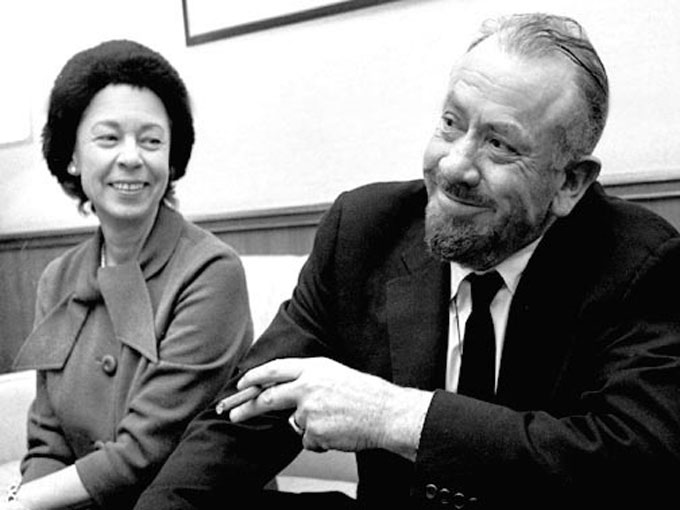
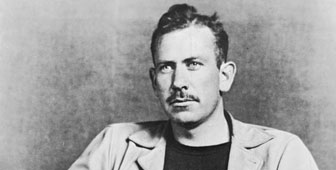
Image of Elaine and John Steinbeck

It was 1998. I had co-curated with Patricia Leach the inaugural art exhibition at the grand opening of the National Steinbeck Center in Salinas, California. A week or so after the opening I received a phone call from a woman with a Southwestern accent, or at least that’s what I judged it to be.

“Mr. Hauk, this is Elaine Steinbeck, the widow of the author John Steinbeck.”

“Hello, how do you do?”

“I am doing well, thank you. I was wondering if you would do me a favor, please.”

“Yes, of course.”

“Could you look in a Monterey County telephone book and tell me how many times you see my late husband’s name associated with a business or commercial enterprise?”

I opened my phone book to the businesses section and started flipping the pages to the S’s. I wondered how Mrs. Steinbeck picked me to call, then realized it must have been because she saw my name in conjunction with the exhibition at the National Steinbeck Center, This Side of Eden: Images from Steinbeck’s California.

Well, I found Steinbeck’s name tacked on to six or seven area enterprises. There was, I recall, a credit union, a used car dealership, and a dry cleaner, among other Steinbeck-somethings. As I read them off to Mrs. Steinbeck, she said, “Oh, my.” She said this or something similar several times in a charming sort of way. I joked that I might think of adopting the Steinbeck name for my business. She laughed, sort of. The commercialization of her husband’s name obviously bothered her, but she didn’t seem terribly upset, just mildly irritated and genuinely curious.

We talked for several minutes. She asked about the National Steinbeck Center and wondered how her husband was remembered in Monterey County. I found her a pleasant conversationalist. Over time, as I grew more interested in her late husband’s work, I regretted I didn’t ask for her phone number that day so I could call now and then to ask questions about his life.

The other day, I picked up the Monterey County phone book, turned to the business section, and flipped to the S’s. Some of the businesses with the Steinbeck name in 1998 had obviously closed, but new ones had sprouted up and the number using the author’s name was up eight, including a kennel (Steinbeck loved dogs), two realty firms (he owned houses in Monterey and Pacific Grove), a dental center (he said he met Ed Ricketts at the dentist’s), a café (think Bear Flag), a produce business (perfect fit), even an equine clinic for ponies, red and otherwise.

At her husband’s funeral in New York, Elaine Steinbeck asked his friends and mourners not to forget him. It isn’t what she had in mind at the time, but in a way that Steinbeck would probably appreciate, the continued commercial use of his name in Monterey County, 50 years after his death, is a sign of recognition and respect. I think she realized that and it’s the reason she called me 20 years ago. I’m glad I got to speak with her. She was smart and personable, like most Texans I know, and she was a theater person with an ear for poetry. When she died in 2003, her ashes joined John’s at the Salinas, California cemetery where, as she predicted (quoting Keats), she came to rest, like Ruth, “amid the alien corn” of her loved one’s people.

The voice I hear this passing night was heard
In ancient days by emperor and clown:
Perhaps the selfsame song that found a path
Through the sad heart of Ruth, when, sick for home,
She stood in tears amid the alien corn . . . .

      (from “Ode to a Nightingale”)

The New Florida Climate of No-Nothing Culture Rejects The Grapes of Wrath: Satire

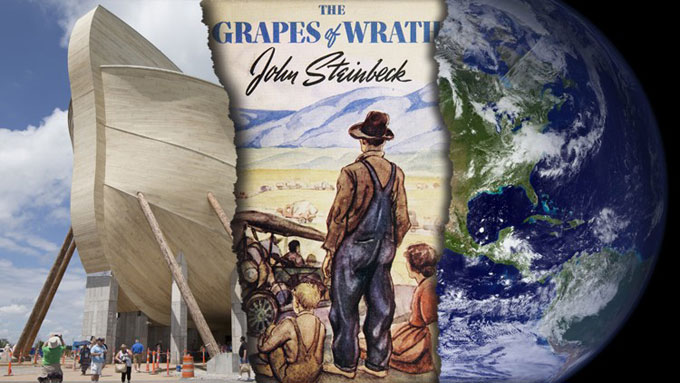
Composite image of The Grapes of Wrath, intelligent design, climate deniers

Frank Cerabino, the humor writer for the Palm Beach Post newspaper best known for book-length put-downs of condo captains and crooked politicians, seized on The Grapes of Wrath to satirize Sean Hannity, intelligent design, and Florida climate deniers in a July 7 column—“Florida’s evolution to complainer’s paradise for public schools”—excoriating the new Florida law authorizing state hearing officers to consider requests from “any resident, regardless of whether he or she has children in the public school system, to instigate a formal challenge to any textbook, library book, novel, or other kind of instructional material used in a public school.” Here is the letter from an imaginary retiree with too much time on his hands demanding the removal of The Grapes of Wrath from a South Florida school district.

Dear Unbiased and Qualified Hearing Officer:

It has come to my attention that some public school libraries in this district contain the novel “Grapes of Wrath” by John Steinbeck, a well-known socialist who visited the Soviet Union in 1947 and espoused biased opinions about capitalism.

By allowing students to read Steinbeck’s “Grapes of Wrath” you are exposing them to a work of art that shines a harsh light on American history and its ideals.

This is shameful, and obviously part of the school board’s liberal agenda. Which is why me and others in my morning Einstein’s Bagels discussion group hereby demand that unless you balance Steinbeck’s “Grapes of Wrath” in school libraries with Sean Hannity’s inspiring book, “Let Freedom Ring: Winning the War over Liberalism” we will be requesting a public hearing.

We’re not putting up with the school district’s Saul Alinsky tactics!

John Steinbeck Loved This Family Home in Watsonville, California, and So Will You

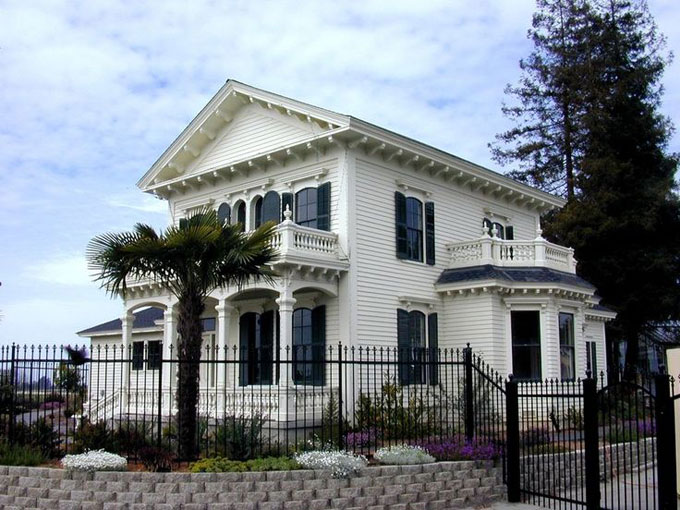
Image of Rodgers family home, Watsonville, California

For John Steinbeck, moving on in life meant leaving family homes—and friends—behind in California, starting with Salinas, where the Steinbeck family home on Central Avenue has become a living museum made possible in part by gifts of memorabilia from John Steinbeck’s oldest sister, Esther. The 11th Street cottage in Pacific Grove where Steinbeck often stayed when he was poor, single, or hurting remains in the extended family, but the pair of houses in Los Gatos where he lived with his wife Carol and wrote the books that made him famous both belong to strangers now. The bungalow he bought on Eardley Avenue in Pacific Grove when the marriage faltered and he needed writing space belongs to a bed and breakfast today, but it can be rented and is readily seen from the street. So is the historic adobe in Old Monterey that Steinbeck purchased with his second wife before abandoning California for New York, where he chose to live with Elaine, his third wife, until he died.

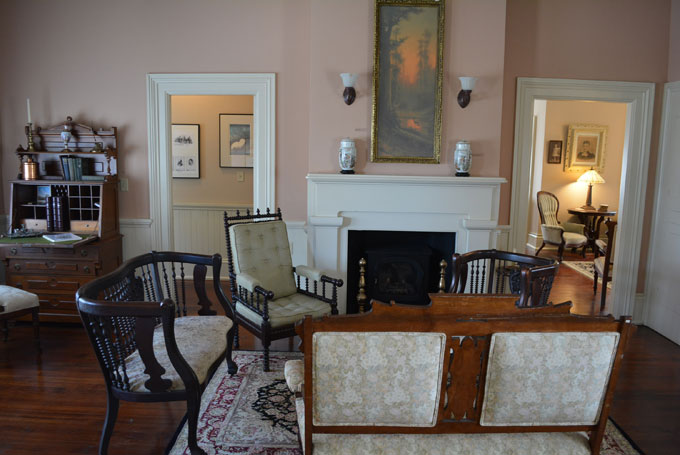
Image of Rodgers House interior today

Visit Rodgers House at Santa Cruz County Fairgrounds

Through it all, the family home John Steinbeck kept coming back to was his sister Esther’s house in Watsonville, California, the Pajaro Valley farming community nestled between the mountains and the sea northwest of Salinas, along the Monterey-Santa Cruz county line. Esther moved there to teach before marrying Carrol Rodgers, a prosperous rancher-farmer, and raising three daughters who called John Steinbeck uncle. The Rodgers family home on East Lake Avenue, built in the 1870s by Esther’s husband’s forebears, was bigger than any of the houses owned by Steinbecks in Salinas, Los Gatos, or Pacific Grove, but it was warm and inviting and popular with extended family members, including John. Though John Steinbeck became controversial and Carrol Rodgers remained distant, Esther loved her brother and welcomed him when he came to Watsonville. Evidence that Steinbeck enjoyed visiting the Rodgers household, wherever he happened to be living at the time, can found in letters and photographs from the 1930s to the 1960s on view at the home. After Esther died, friends and family members stepped in to preserve the house and move it to the Santa Cruz County Fairgrounds, where it’s open to the public by appointment. Call 831-724-5671.

Interior photo of Rodgers House today courtesy Dale Bartoletti.


Birds Do It, Bees Do It, and John Steinbeck Did It, Too

Poster image of Migrations, theme of 2017 John Steinbeck festival

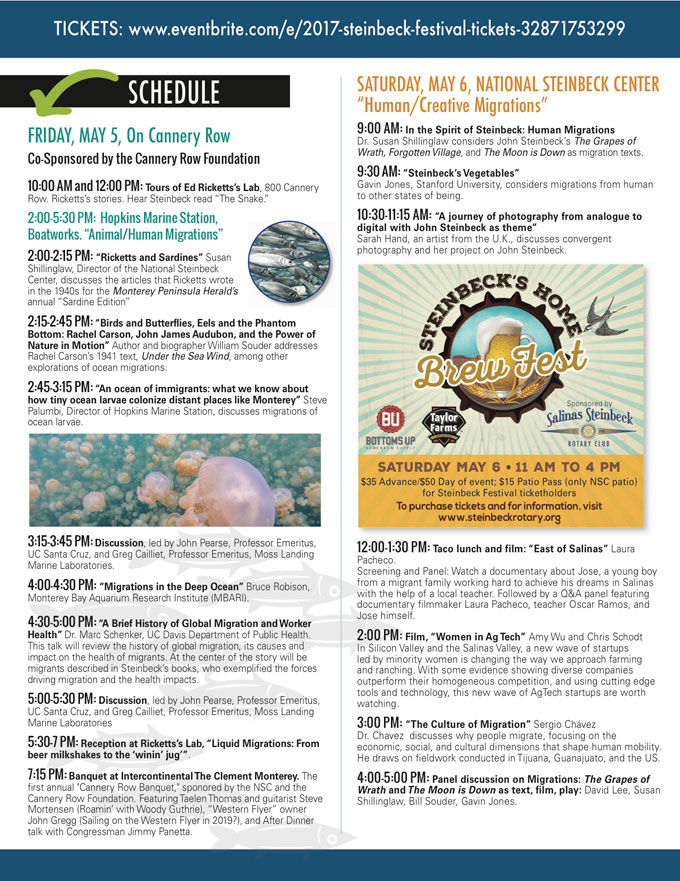
Movement was a major feature of John Steinbeck’s life and writing, and migration—human, animal, vegetable—is the focus of this year’s John Steinbeck festival in Salinas, California, scheduled May 5-7 to coincide with Cinco de Mayo, a favorite fiesta of the country Steinbeck visited often in the 1930s and 40s. Like the author himself, the 2017 John Steinbeck festival is peripatetic, moving between Salinas, Monterey, and Cannery Row, as Steinbeck did when he was writing the California books that made him famous. A three-day pass costs $180 and covers most Friday, Saturday, and Sunday events. A special concert in honor of the late Carol Robles—a frequent flyer and legendary tour planner—is free and features Dixieland music, an appropriate choice for a festival dedicated to John Steinbeck, a traveling man who loved jazz.

Image of 2017 John Steinbeck festival scheduleImage of 2017 John Steinbeck festival scheduleImage of 2017 John Steinbeck festival schedule

John Steinbeck Saw “Fake News” Coming When Donald Trump Was Still In Diapers

Image of "fake news' invasion

Did John Steinbeck discover “fake news” seven decades before President Donald Trump? Based on what he wrote about the mainstream media of his day in A Russian Journal, the author of The Grapes of Wrath came pretty close.

Cover image from John Steinbeck's 1948 book A Russian JournalA Russian Journal is Steinbeck’s first-person journalistic account of the trip he took with photographer Robert Capa in 1947 to the war-battered Soviet Union. In Chapter 1, before he sets off for Russia, Steinbeck describes why he and Capa mistrusted the way the news in America was being gathered, edited, and disseminated by the dominant print and electronic media of their day. It has a familiar ring:

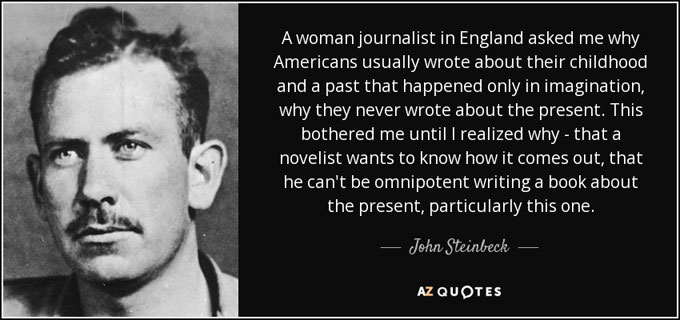
We were depressed, not so much by the news but by the handling of it. For news is no longer news, at least that part of it which draws the most attention. News has become a matter of punditry. A man sitting at a desk in Washington or New York reads the cables and rearranges them to fit his own mental pattern and his by-line. What we often read as news now is not news at all but the opinion of one of half a dozen pundits as to what that news means.

Steinbeck didn’t call it “fake news.” And he was complaining about bias in the media from a partisan New York liberal Democrat’s point of view. But anyone whose politics are not located in the dead center of the political spectrum today can feel his pain.

Claims of political bias or slanted news coverage from the left and right were nothing new when A Russian Journal was published in 1948, and they’ve been with us ever since. Conservatives have complained about the liberal East Coast media for half a century. In the babble of our Talk Radio/Cable News/Digital Age the mainstream media is criticized 24/7 from a thousand sane and insane places. No faction is happy with the spin of the news. In 2016 a Bernie supporter or a lifelong Nation magazine subscriber was just as likely to be unhappy with CNN’s coverage of the election as a member of the Tea Party.

Composite image of John Steinbeck on journalism

The Mainstream Media’s Loss was Literature’s Gain

Though the young John Steinbeck was sacked as a New York City newspaper reporter because he couldn’t stop using his literary skills to improve on the facts, he was basically a journalist. A literary journalist. He had a love-hate for the journalism profession and its practitioners. He envied the ability of reporters to parachute into a strange place and quickly come up with the basic facts for a news story. But he also knew from experience that no journalist or writer—no matter how great—ever gets the whole story or captures more than just a glint of what really happened in a bank robbery, a presidential campaign, or a world war. He wrote this in A Russian Journal:

Capa came back with about four thousand negatives, and I with several hundred pages of notes. We have wondered how to set this trip down and, after much discussion, have decided to write it as it happened, day by day, experience by experience, and sight by sight, without departmentalizing. We shall write what we saw and heard. I know that this is contrary to a large part of modern journalism, but for that very reason it might be a relief. . . . This is just what happened to us. It is not the Russian story, but simply a Russian story.

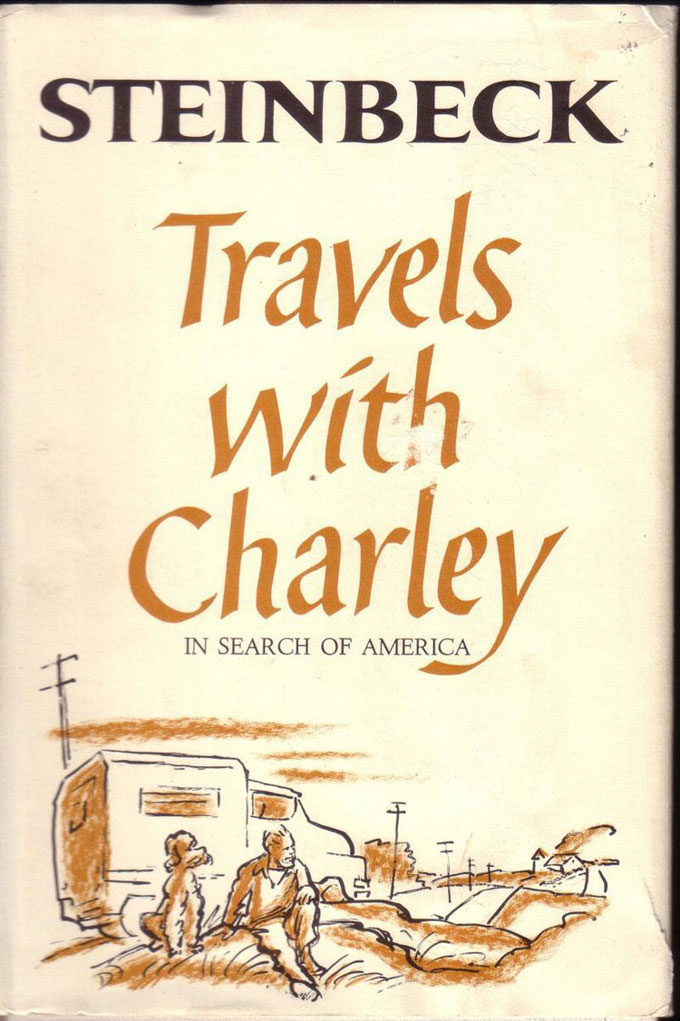
Cover image from John Steinbeck's 1962 book Travels with CharleySteinbeck’s journalism was super-subjective–sometimes to a fault. Russian Journal was his story about the backward, unfree, monstrous USSR he glimpsed in 1947, just as Travels with Charley was his subjective story about the 1960 America he saw on his iconic 10,000-mile road trip. Both books started out as works of nonfiction–as ambitious acts of serious, albeit personal, journalism. In Charley the many fictions Steinbeck slipped into his story about America overwhelmed the “true” facts, and after 50 years its publishers had to admit that it was so fictionalized Charley could not be considered a credible account of how he traveled or whom he really met.

A Russian Journal has suffered no such loss of credibility. It’s a great work of subjective journalism—a rare glimpse into a dark and alien world by a keen observer. Anyone teaching college students how to report and write in a precise, interesting, and powerful way would be smart to have them study how well Steinbeck did it—his way, and under trying circumstances .

An Artful Reminder of Japanese American Internment 75 Years Ago

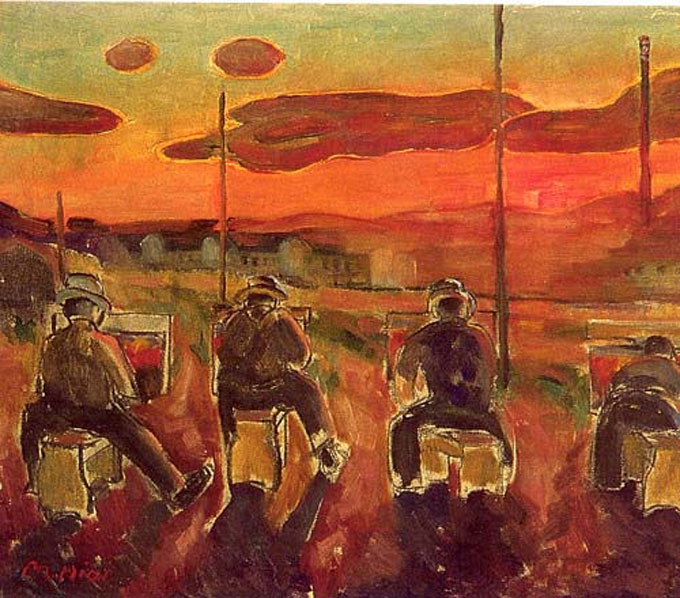
Image of George Matsasaburo Hibbi's painting from Topaz camp

The forced internment of 120,000 Japanese Americans two months after the bombing of Pearl Harbor distressed John Steinbeck, who admired Franklin Roosevelt, the president who signed the internment order. Today, exactly 75 years later, the memory of Executive Order 9066 continues to burden American history. An anniversary article on the World War II internment of Japanese Americans in the January 2017 issue of Smithsonian Magazine leads off with a profile of Jane Yanagi Diamond, a vibrant internment survivor I happen to know.

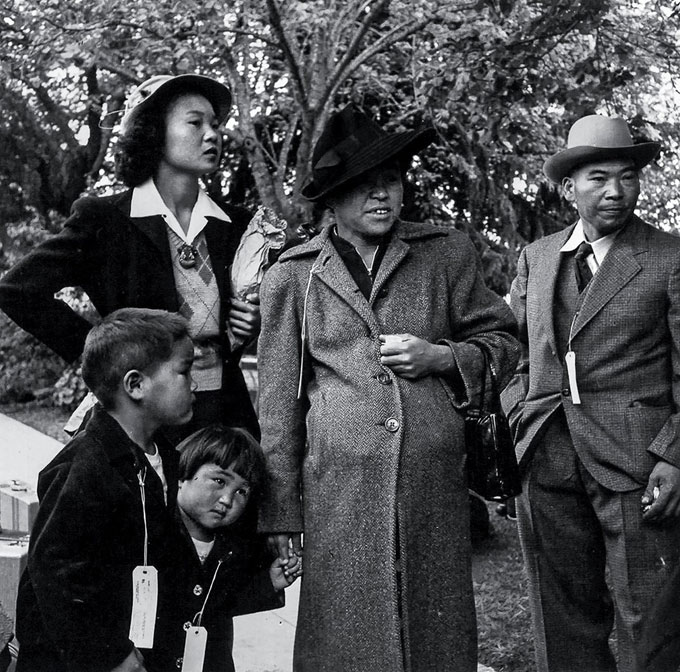
Image of Dorthea Lange's Photograph of young Jane Yanagi and family

The 1942 photograph taken by Steinbeck’s ally and contemporary Dorothea Lange (above) shows Jane as a sorrowing child holding on to her pregnant mother’s hand, moments before the Yanagi family boards a bus on the way to the emergency assembly center hastily set up by the federal government at a California racetrack. The family was then sent to Topaz, an internment camp in Utah that would also house two exceptional California artists, Chiura Obata and George Matsusaburo Hibi. Obata, an art instructor at UC Berkeley, and Hibi, a prolific painter from Hayward, California, founded an art school at Topaz that uncovered hidden talent and helped internees cope until the war ended and they could go home.

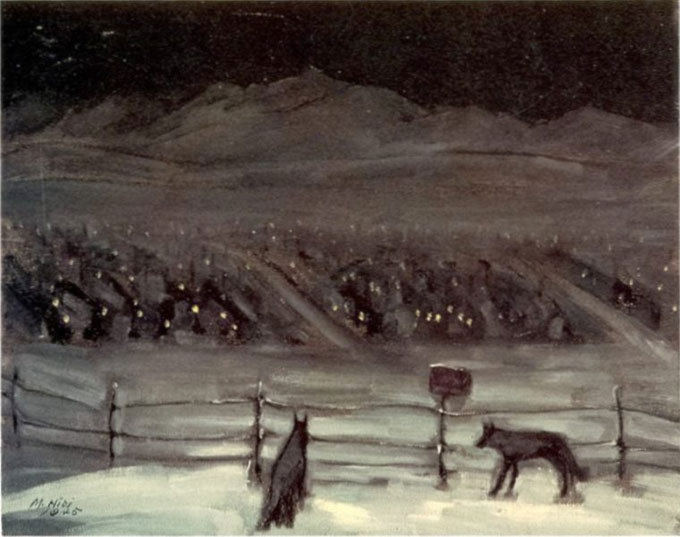
Image of George Matsasaburo Hibbi's painting of Topaz camp

Obata eventually returned to his teaching post at Cal and became famous for his Yosemite scenes. Hibi’s paintings included internment camp scenes like the one shown here. He was also magnanimous, donating 50 of his and his family paintings to the Hayward community before being sent to Topaz. Michael Brown, the author of Views from Asian California – 1920-1965, quotes Hibi as saying this about the gift: “There is no boundary in art. This is the only way I can show my appreciation to my many American friends here.’’ Obata died in 1975, Hibi in 1947, two years after his release from Topaz.

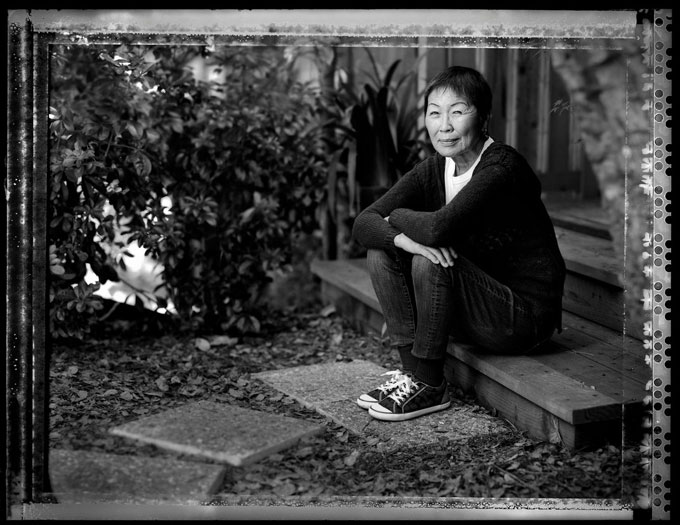
Image of Jane Yanagi Diamond at home in Carmel today

How Creating Art Helped Japanese Americans Survive

Obata and Hibi were part of a remarkable art movement in the Japanese American camps, most of which included professional artists who realized the importance of establishing a creative outlet for the internees. The work they produced–both professionals and students–was so moving, so powerful that in 1992 the Japanese American National Museum, the Wight Art Gallery at UCLA, and UCLA’s Asian American Studies Center assembled a landmark traveling exhibition, “The View from Within: Japanese American Art from the Internment Camps 1942-1945.” Hibi’s colorful painting of four Topaz internees seated at easels is testimony to the spirit of the movement he and Obata helped create.

Obata and Hibi were part of a remarkable art movement in the Japanese American camps, most of which included professional artists who realized the importance of establishing a creative outlet for the internees.

I was a reporter at the time, and I wrote several articles about the exhibition. My interest was initially stirred when I learned that a Japanese American artist named Miki Hayakawa was taken from my town of Pacific Grove, California, to an internment camp in Santa Fe, New Mexico. I knew Hayakawa was a superb artist because several of her exquisite paintings had come into the art gallery that my wife Nancy and I owned there. Hayakawa lived in Pacific Grove from 1939 until her removal to the camp and may well have known—or known of—John Steinbeck, who was in Pacific Grove off and on during that period. Hayakawa died in Santa Fe in 1953.

I was a reporter at the time, and I wrote several articles about the exhibition, ‘The World From Within: Japanese American Art from the Internment Camps, 1942-1945.’

I met Jane Yanagi Diamond (shown above at home) several years ago when she and her husband Tony came into the gallery. They live in Carmel and had a painting by Hibi that had hung at Topaz and that Hibi gave to Jane’s father when the family was released. Jane wanted to find a good home for the work and together we decided that it should return to Topaz, where a museum had been established to memorialize the internment of Japanese Americans like Jane. The piece was dramatic. Painted on four panels, it depicts three tigers stalking a brave antelope or gazelle, head down, determined to hold its ground in the face of an approaching threat. I wondered at the time if Hibi painted it to give children like Jane the courage they needed to go on.

I met Jane Yanagi Diamond when she and her husband Tony came into the gallery. They live in Carmel and had a painting by Hibi that had hung at the Topaz camp.

Jane developed a love of art, favoring the freedom of California plein air painting—work painted out of doors in an Impressionistic manner—and attending frequent art openings in and around Carmel with her husband. When an exhibition of Nancy’s paintings opened at the Pacific Grove Library several years ago, Tony and Jane were there. She recently shared a story about her father. “After Topaz,” she said, “whenever my father would get angry about something–sometimes something I might have done–I could always redirect his anger by mentioning Franklin Roosevelt because it brought back memories.”

Jane developed a love of art, favoring the freedom of California plein air painting and attending frequent art openings in and around Carmel with Tony. She recently shared a story about her father.

The Yanagi family also had the three tigers and the gazelle to help them hold onto a piece of personal history made less painful by art. But Hibi’s painting has now returned to Topaz, where it will continue to tell the story of artful courage and coping from a troubling episode in American history.

Photograph of Jane Yanagi Diamond by Paul Kitagaki Jr. courtesy Smithsonian Magazine.

Why John Steinbeck Matters In Donald Trump’s America

Image of Donald Trump as George Orwell's Big Brother

“Steinbeckian” hasn’t achieved the currency of “Orwellian” as a term of obloquy for despotic language or behavior, but a cheerfully statistical item in The Atlantic reports that sales of John Steinbeck’s novel The Winter of Our Discontent—like George Orwell’s 1984—have spiked under the authoritarian shadow of Donald Trump, a bully and a blowhard of Steinbeckian, if not Orwellian, stature. While less apocalyptic than George Orwell’s nightmare dystopia, the world of The Winter of Our Discontent seethes with rancid resentment, greed, and xenophobia of the noisy, feculent variety increasingly associated with Donald Trump’s resurgent, alt-right America. The Atlantic article explains: “If the links between the events of the recent year and Steinbeck’s last book don’t seem entirely clear, The Atlantic’s review, published in 1961, is illuminating: ‘What is genuine, familiar, and identifiable [about the book] is the way Americans beat the game: the land-taking before the airport is built, the quick bucks, the plagiarism, the abuse of trust, the near theft, which, if it succeeds, can be glossed over—these are the guilts with which Ethan will have to live in his coming prosperity, and one wonders how happily.’” Steinbeckian is a good term for a bad leader who beat the American game, achieving personal prosperity and political power through means that can only be described as Orwellian.

What I Learned from The Winter of Our Discontent

Image of high school students Googling

I’m a small-town high school teacher and newspaper columnist, and every month I pick a new book, usually a literary novel, to read and recommend to my followers, who seem to enjoy what I have to say. Recently I chose The Winter of Our Discontent, and I confess it was because of the title rather than the content. But John Steinbeck’s novel is an apt expression of what I see as the winter of our discontent in the United States today, and it reflects the reality I face every day in my classroom.

When I chose The Winter of Our Discontent, I confess it was because of the title rather than the content.

As John Steinbeck fans know, The Winter of Our Discontent tells the story of a simple grocery store clerk, an outwardly respectable man named Ethan Allen Hawley, and his moral descent into corruption and crime. Steinbeck’s moral tale gave me plenty of “ah-hah” and “why, yes” moments—the kind of experience one expects from excellent literature, and the reason I recommended it in my column. As Steinbeck notes in the novel, “A man who tells secrets or stories must think of who is hearing or reading, for a story has as many versions as it has readers. Everyone takes what he wants or can from it and thus changes it to his measure. Some pick out parts and reject the rest, some strain the story through their mesh of prejudice, some paint it with their own delight. A story must have some points of contact with the reader to make him feel at home in it. Only then can he accept wonders.”

Steinbeck’s moral tale gave me plenty of ‘ah-hah’ and ‘why, yes’ moments—the kind of experience one expects from excellent literature, and the reason I recommended it in my column.

Though written years before the invention of the internet and social media, Steinbeck’s cautionary words are well-suited to our digitally-driven era. At this point in Steinbeck’s narrative, Ethan is thinking about how he has to shape his stories, or lies, to fit his hearers, and about a king in another story who told his secrets down a well because “It only receives, and the echo it gives back is quiet and soon over.” If only that were true today. For every tweet sent, there is usually a careless reader who misunderstands, misinterprets, or misappropriates the sender’s message, creating a backlash that becomes a raging beast that takes on a life of its own.

For every tweet sent, there is usually a careless reader who misunderstands, misinterprets, or misappropriates the sender’s message.

I don’t spend much time reading the comments people leave below online news stories or Facebook posts, but when I do I’m amazed at how far they wander from the point of the story or post. As Steinbeck knew, we take things out of context and add our own prejudices when we read or listen, and while I enjoy friendly banter as much as he did, I’m tired of the nastiness to which people increasingly resort when they don’t understand or approve of someone else’s point. I’m especially disgruntled when negative comments come from leaders who ought to know better and set an example for others.

As Steinbeck knew, we take things out of context and add our own prejudices when we read or listen.

As a school teacher, I recognized the truth in John Steinbeck’s unflattering portrayal of Ethan’s teenage children, particularly Ethan’s son Allen, and this line from the novel really made me laugh: “Three things will never be believed–the true, the probable, and the logical.” Often my students don’t believe me when I tell them something that is demonstrably true, then give instant credence to the next rumor they hear or read online, repeating it as if it were gospel truth. Fewer and fewer adults seem capable of logical thinking, so I probably shouldn’t be surprised. If you’re a teenager who isn’t capable of sound reasoning, you’re unlikely to believe someone who uses it. Like their parents, too many adolescents today are prepared to accept negative surface propaganda while doubting deeper truths.

Like their parents, too many adolescents today are prepared to accept negative surface propaganda while doubting deeper truths.

Is this because people want to take the easy way out of every problem, as Steinbeck suggests in The Winter of Our Discontent? Ethan is appalled when he learns that the patriotic essay for which Allen has won a cash award has been plagiarized. But Ethan’s reaction is hypocritical, because by this point in the story he has stooped pretty low himself. Unlike his father however, Allen shows no remorse, defending his behavior in much the same way my students defend their reliance on the internet so that they don’t have to do any thinking for themselves. Instead, when Allen’s plagiarism is exposed he gets mad at the person who ratted on him and utters the rallying cry of all cheaters and thieves: “‘Who cares? Everybody does it.’” Like John Steinbeck, I care, and I care very much. I’m weary of calling out cheaters like Allen in my classroom. Like Ethan in the novel, I sometimes think about throwing in the towel and calling it quits.

I’m weary of calling out cheaters like Allen in my classroom. Like Ethan in the novel, I sometimes think about throwing in the towel and calling it quits.

Ethan has had his own “Who cares?” moments growing up, but he had the advantage of a perfect teacher in his Aunt Deborah, a character I liked because I love words, grammar, literature, and everything associated with language, just as she does. When Ethan comes across the word talisman and asks her what it means, she tells him to look it up. As a result, he recalls, “So many words are mine because Aunt Deborah first aroused my curiosity and then forced me to satisfy it by my own effort. . . . She cared deeply about words and she hated their misuse as she would hate the clumsy handling of any fine thing.” When he finds the definition of talisman he discovers new words that he is forced to look up, too. “It was always that way,” he says. “One word set off others like a string of firecrackers.”

Aunt Deborah is a character I liked because I love words, grammar, literature, and everything associated with language, just as she does.

I highlighted the passage in the novel because I love the simile, and I love the way Steinbeck manages to incorporate his passion for words into an otherwise depressing story. Now, more than ever, we need Aunt Deborahs in our lives to make us aware of the beauty and magic of words at an early age. No doubt this idea impressed me because of the prejudices I bring with me to when I read John Steinbeck: others might roll their eyes because they don’t share my experience. Steinbeck fully understood the limitation we bring to our reading, and he wrote The Winter of Our Discontent in part, I believe, to help readers participate in the remedy he offers. Much has changed since The Winter of Our Discontent was written, but the deep truths to be discovered in Ethan’s story apply today. The winter of our discontent in the United States will end eventually, I hope sooner rather than later , but The Winter of Our Discontent by John Steinbeck will always have lessons for us—if we have ears to listen and love words enough to understand.

Of Mice and Men In the News

Image of Weekend Update anchor Colin Jost on Saturday Night Live

The January 21 episode of Saturday Night Live gave a shout-out to John Steinbeck during the weekly fake-news feature “Weekend Update,” further substantiating Steinbeck’s pop-culture standing and sending Of Mice and Men students back to the book to find out what George really says to Lennie at the end. Two-and-a-half minutes into the skit, faux news-anchor Colin Jost compares Barack Obama’s parting comment about Donald Trump (“it’s going to be ok”) with the assurance George gives Lennie before he shoots Lennie in the head. It’s a safe bet that the latest Of Mice and Men moment on TV will be seen by millions of schoolkids, and by hipper teachers too.

No Room in Donald Trump’s Inn for Arts and Humanities

Image of Donald Trump and daughter at Washington, D.C. hotel groundbreaking

In 1965 John Steinbeck was a member of President Johnson’s council on the arts when Johnson signed legislation creating the National Endowment for the Arts, the federal agency charged with “bringing the arts to all Americans” and “providing leadership in arts education.” Steinbeck died before efforts in Congress to kill the infant agency got underway, in earnest, in 1981. Today, 35 years after arts-friendly Reaganites foiled that attempt, the ascendancy of Donald Trump appears to have handed anti-arts Republicans in Washington, D.C. the ammunition they need to finish the job. According to the website The Hill, “the Corporation for Public Broadcasting would be privatized, while the National Endowment for the Arts and National Endowment for the Humanities would be eliminated entirely” if the radical plan prevails.

In 1965 John Steinbeck was a member of President Johnson’s council on the arts when Johnson signed legislation creating the National Endowment for the Arts, the federal agency charged with ‘bringing the arts to all Americans’ and ‘providing leadership in arts education.’

It’s easy to imagine how John Steinbeck would react to the latest threat against the arts and humanities. He supported FDR’s New Deal and Johnson’s Great Society, applied “arts for all” as a principle in his writing, and—brought up on books, music, and art—demonstrated the value of arts and humanities education in almost every aspect of his life. Nearly 50 years after his death, his name and his novels continue to be cited when creativity is under attack by politicians, fanatics, and latter-day Mrs. Grundys. In an op-ed entitled “What Art Under Trump?” the novelist Margaret Atwood gives The Grapes of Wrath as an example of enduring art that outlasts the evils it was created to expose. Colson Whitehead, the 47-year-old author of The Underground Railroad, credited the research he did for his first high school term paper—on John Steinbeck—when he accepted the Andrew Carnegie Medal for Excellence in Fiction at yesterday’s meeting of the American Library Association.

Image of Donald Trump hotel at Old Post Office in Washington, D.C.

Rationalizing hatred of the arts and humanities of the kind on view in Donald Trump’s Washington, D.C. is harder than guessing where Steinbeck would stand. I know—I’ve tried—because at one time my job actually depended on it. Like John Steinbeck, I have an education in the arts and humanities to thank for whatever may be of value in my 35-year career as as a nonprofit executive and fundraiser for organizations in Florida and California. Unlike Steinbeck, I’m a middleman, not a creator. But the Washington, D.C. experience  I had while running the Palm Beach County Cultural Council gave me a preview of the arts under Donald Trump that I’m confident Steinbeck—who honored memory, history, and preservation—would appreciate.

Rationalizing hatred of the arts and humanities of the kind on view in Donald Trump’s Washington, D.C. is harder than guessing where Steinbeck would stand.

Image of the Old Post Office Pavilion in 1920When I visited Washington, D.C. during the 1980s and 90s, I usually stopped by the Old Post Office, famous for its soaring atrium, to listen, learn, and lobby. In the 1970s Nancy Hanks, chair of the National Endowment for the Arts under Nixon, saved the century-old building from demolition, and for 30 years—until Donald Trump signed the lease to turn it into a hotel—the Old Post Office served as a symbolically appropriate home for her agency. Some of my appointments were with successors to Nancy Hanks appointed by Republican presidents after Nixon. Frank Hodsoll, chair of the NEA under Reagan, was key to the regional initiative that advanced art creation, education, and marketing in my bailiwick, South Florida. Later on, in Miami, I interviewed John Frohnmayer, George H.W. Bush’s NEA chair, for a weekly public radio program I hosted in West Palm Beach. The subject of our talk was Leaving Town Alive, the book that Frohmayer (a Stanford-educated lawyer) wrote about his fight for survival in D.C.

In the 1970s Nancy Hanks, chair of the National Endowment for the Arts under Nixon, saved the Old Post Office from demolition, and for 30 years—until Donald Trump signed the lease to turn it into a hotel—the historic building served as a symbolically appropriate home for her agency.

Forced out of the home they helped save when it was closed to make way for Trump’s hotel, the NEA and NEH moved to Constitution Center, a modernist monstrosity in Washington, D.C. designed by the architect of the equally hideous Kennedy Center for the Performing Arts. Today Trump International Hotel occupies the historic building at 1100 Pennsylvania Avenue, Donald Trump occupies the historic house at 1600, and the agencies evicted from the Old Post Office in 2014 are experiencing the threat of their lives. The dreadful death cycle dramatized by John Steinbeck in The Grapes of Wrath—eviction and attack followed by extinction—faces the arts and humanities in Donald Trump’s Washington, D.C., where a great public building is now operated for private profit and the public agency responsible for preserving it is about to leave town permanently.