John Steinbeck-Robert Frost Biographer Jay Parini Writes New Life of Jesus Christ

Image of Jesus ChristWhat does Jesus Christ—or John Steinbeck or Robert Frost—really mean to me? John Steinbeck: A Biography by the writer Jay Parini helped me understand why Steinbeck’s life and work spoke to me so powerfully when I first began reading Steinbeck’s books. Robert Frost is another favorite, and Parini—a professor of creative writing at Middlebury College—brought his fellow New England poet’s interior landscape into focus for me with Robert Frost: A Life, his second work of biography. A celebrated Middlebury College faculty member for more than 30 years, Parini has employed his enviable skills as a poet, novelist, and scholar to re-imagine the life of Jesus Christ—the greatest story of them all—in Jesus: The Human Face of God.

The new book represents a progression, not a departure, for Parini. John Steinbeck was a lifelong Episcopalian who considered Jesus Christ a moral genius, read and raided the Bible for his fiction, and once thought about writing the screenplay for a Jesus Christ biopic based on the gospels that was never made. Like Robert Frost, Steinbeck valued personal privacy and resisted dogmatic assertions of belief, so we’ll never know how his Christ would have fared on film. For that matter, what do we really know about the details of Jesus’ life from historic records? American writers before and since Steinbeck—including the late Duke University novelist and poet Reynolds Price—have rescripted the Man from Galilee with intriguing angles and uneven results. Now an inspired and imaginative writer from Middlebury College—one of America’s oldest and finest schools—has succeeded where others failed.

Jay Parini: The Man from Middlebury College

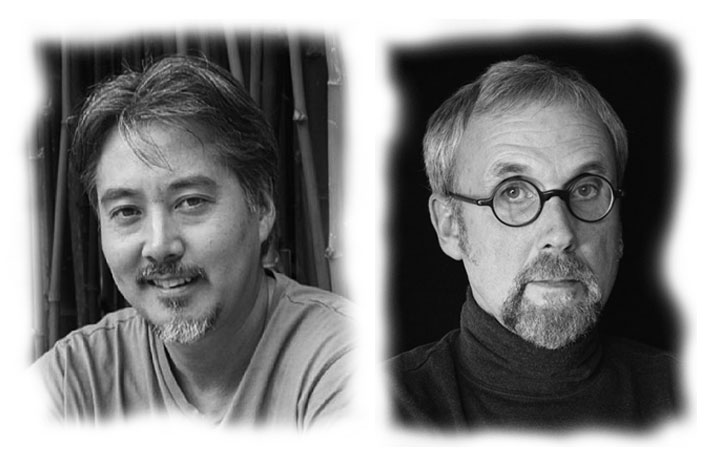
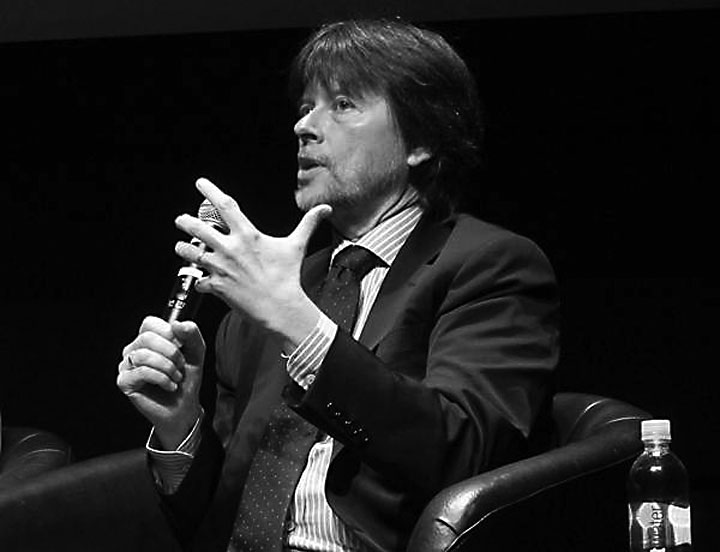
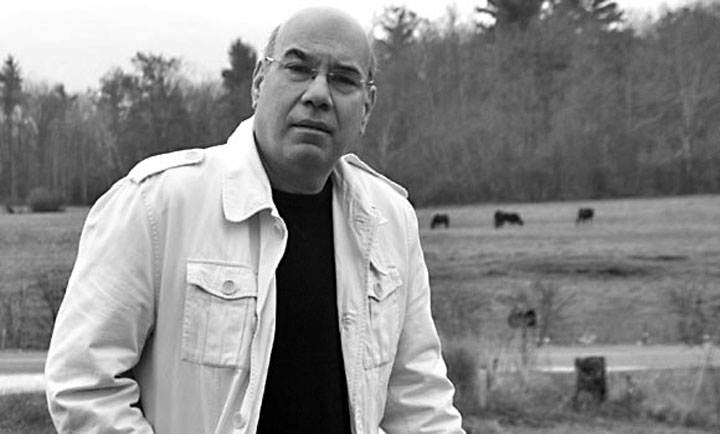
Image of Jay Parini, the author of "Jesus: The Human Face of God"Like young John Steinbeck growing up in what became Steinbeck Country, Jay Parini is active in his Episcopal church, located not far from Middlebury College in Robert Frost Country, the home turf of Steinbeck’s New England grandparents. Unlike Steinbeck, Parini is fluent in New Testament Greek; like the author, he knows his Bible and his theology and has explored other traditions—Taoism, Buddhism, Hinduism—in depth. But I suspect that none of that is unusual around Middlebury College, long a center of language and cultural studies without equal for its size. Resurrecting Jesus Christ from the tomb of time as Parini has done requires a tool more powerful than scholarship, even the industrial-strength form found in the halls of Middlebury College. Re-mythologizing (Parini’s term) requires an eye for the unseen, an ear for the unknowable, and a writer’s way with words. After three decades of practice writing for mainstream readers, Parini possesses these gifts in abundance. His first collection of poems appeared in 1982. His most recent novel was published in 2010. Four years ago his third novel—The Last Station—became an Academy Award-nominated movie.

Resurrecting Jesus Christ from the tomb of time as Parini has done requires a tool more powerful than scholarship . . . .

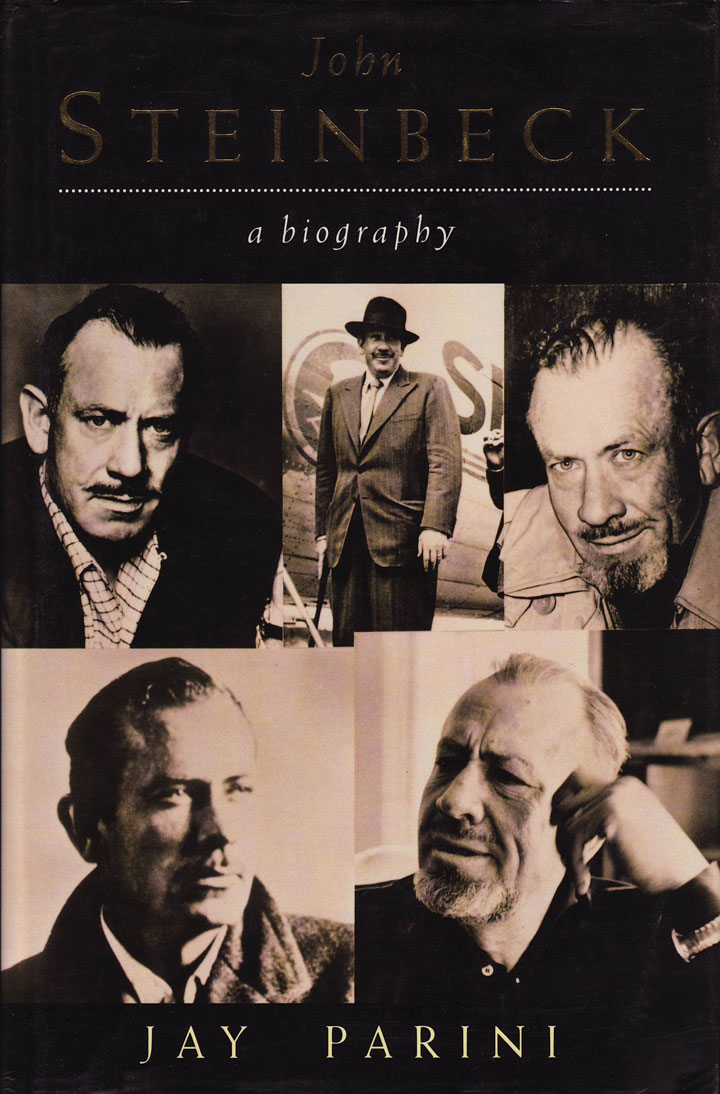
Parini’s first venture beyond poetry was his life of John Steinbeck, released in 1994 by Steinbeck’s English publisher (cover image below) and published in the USA in 1995. It was followed by two more literary lives, those of Robert Frost (2000) and William Faulkner (2004), making Jesus Christ Parini’s fourth act biography, a challenging art-form that doesn’t always produce miracles. Among the academically inclined, Parini’s The Art of Teaching (2005) and Why Poetry Matters (2008), plus a host of anthologies, have attracted acclaim. Promised Land: Thirteen Books That Changed America (2008) remains a vade mecum for those exploring the topography of American fiction for the first time. Film adaptations of a pair of Parini novels—Benjamin’s Crossing (1997) and The Passages of H.M. (2010)—are underway. Galliano’s Ghost, another novel, is in progress. So is Conversations with Jay Parini, a University of Mississippi Press publication edited by Michael Lackey. In case you’re counting, that puts him just about where John Steinbeck was at a comparable point in his dizzingly diverse career as a writer.

John Steinbeck: A Life

Cover image of "John Steinbeck: A Biography" by Jay PariniLike Steinbeck, Parini has his critics. I learned this when I answered a Steinbeck scholar’s recent query. What’s your favorite Steinbeck biography? I replied that I still loved the first one I ever read—John Steinbeck: A Biography. If looks could kill, Parini’s book and I both died that day. Had I spoken heresy? If so, I guess I understand. I too have found reason to quibble with minor points in Parini’s life, published years after another biographer’s much longer book, in my recent research into Steinbeck’s religious roots. But—pardon me—Jesus Christ! Do you want good footnotes or great style? Better than any other biographer I know of John Steinbeck or Robert Frost, Parini sees his subject steadily and sees him whole, telling a creative writer’s story as only a creative writer can. If you’re curious about the time the particular author you’re studying went to the bathroom in his publisher’s office on a given day, be my guest—find the longest biography you can. If you want to know how he recalibrated a certain character, re-imagined a significant scene, or overcame writer’s block to meet a deadline, ask another writer. For John Steinbeck and Robert Frost, Jay Parini more than meets this taste test.

Do you want good footnotes or great style?. . . For John Steinbeck and Robert Frost, Jay Parini more than meets this taste test.

Like Steinbeck’s fiction, Parini’s biography of John Steinbeck continues to be popular with readers who are not writing dissertations. I recommend it to anyone interested in learning how Steinbeck developed his craft and overcame his problems. I reread it so often it because it flows so well—unimpeded by anxious over-annotation, syntactical complexity, or current critical cant. Parini’s life of Robert Frost—a natural next subject for a Middlebury College poet-biographer—has the same value for non-natives entering Robert Frost Country for the first time. I’m a Southerner, but I’ll confess that I haven’t read Parini’s biography of William Faulkner, John Steinbeck’s fellow-Nobel Laureate and sometime competitor. My excuse? In graduate school ions ago I studied Faulkner under a meticulous biographer who read from his notes for the prodigious life of Faulkner he was writing. Information without imagination. Not Jay Parini’s problem.

Thinking about Jesus Christ with John Steinbeck in Mind

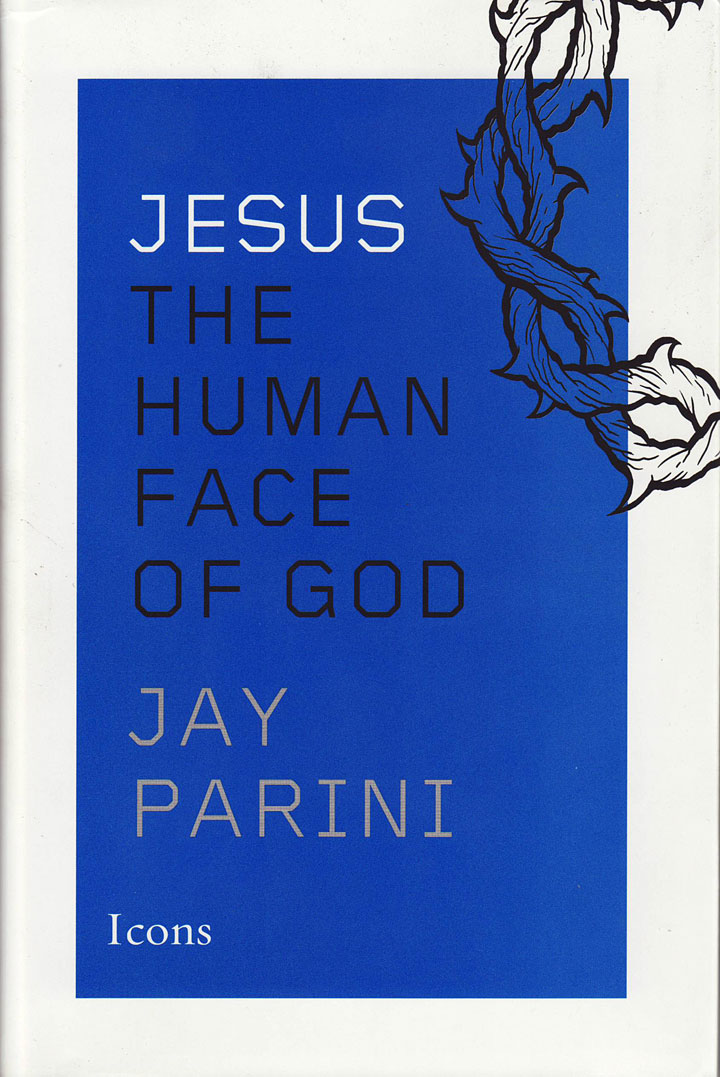
Cover image of "Jesus: The Human Face of God" by Jay PariniWe can’t know with confidence how Steinbeck’s film Christ would have acted or even looked. But the Jesus brought to fresh life in Parini’s new biography seems just like one of us, only more so. I kept thinking of Steinbeck as I read the book. Though Steinbeck claimed to have no religion (not that odd for an Episcopalian), he disliked reading scripture in any version other than King James, which he knew like, well, the bible. In his new narrative Parini sticks to King James for big stuff like the Beatitudes. But for most of the passages he quotes from or about Christ he provides his own translation—immediate, clear, compelling—in fulfillment of his promise to lift Jesus from the pile of dogma, myth, and demythologizing that have smothered the Christ story. Along the way he quotes other poets, cites other scholars, and acknowledges other teachers at Middlebury College, all without losing momentum or focus for a second. His Jesus Christ is a living teacher speaking in an existential now with something to say to all people. As a believer Parini is passionate about his subject. As a teacher he is careful about his approach. The result? Jesus: The Human Face of God is like a well-taught introductory course in a class of non-majors. No declared religion is required to participate, and doubt is more than welcome. In fact it’s advised.

His Jesus Christ is a living teacher speaking in an existential now with something to say to all people.

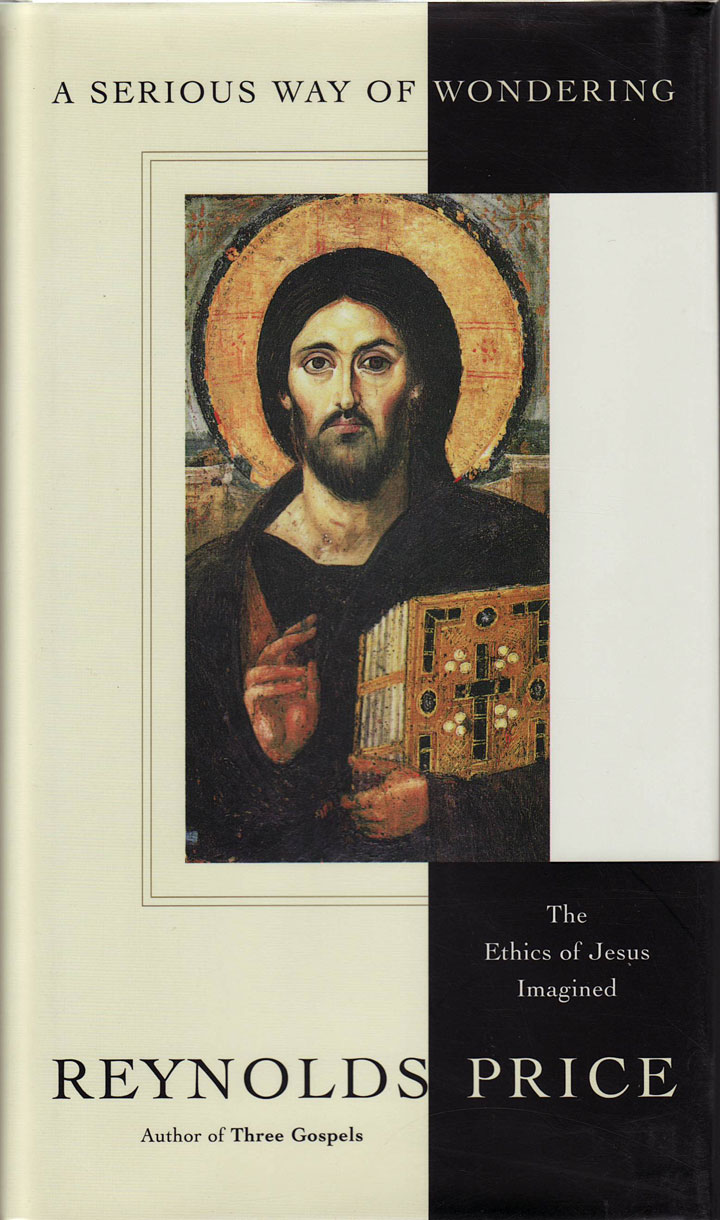
The unsmiling Jesus Christ depicted in classic Orthodox iconography (as in the cover image below) seems distant, two-dimensional, hard to embrace, at least for me. Parini’s Jesus, like John Steinbeck’s Ma Joad, is bigger than life but also fully formed, and in the end all-forgiving. The confusing nomenclature of the Bible presents another obstacle to understanding for many. Since I was a kid memorizing the books of the Bible for Sunday school to the time I took the required Old and New Testament courses (both excellent) in college, I’ve felt foggy about biblical names of greater complexity than Paul or Peter and theological ideas more complicated than I Am That I Am. Parini cleared some air in my head.

Parini’s Jesus, like John Steinbeck’s Ma Joad, is also bigger than life but fully formed, and in the end all-forgiving.

For example, I could never keep my Sadducees and my Pharisees straight. No longer! Parini traces the origin of the Sadducees to Saduc, “a legendary high priest from the time of King David,” and describes the group as an easygoing, cultured elite who looked down on their neighbors the Pharisees, seriously doubted the doctrine of bodily resurrection, and deeply enjoyed hobnobbing with foreigners: Episcopalians! The Pharisees? Puritanical, parochial, sure of their salvation—Presbyterians! That confusing half-human, half-divine thing about the true nature of Jesus Christ? Aha! It started with the Romans, maybe earlier. Virgin Birth? Greek and Persian, not Hebrew. Satan? Definitely Hebrew—ha-Satan. Marriage? Jesus Christ was single, but he loved women, knew how to kiss, and produced wine at a wedding over the objections of his mother, a miracle that would have moved a drinker like Steinbeck deeply.

Jesus Christ was single, but he loved women, knew how to kiss, and produced wine at a wedding over the objections of his mother, a miracle that would have moved a drinker like Steinbeck deeply.

In fact, Parini’s Jesus Christ embodies John Steinbeck’s most enviable qualities as a writer and his most admirable aspirations as a man. Listen:

You talked to women without troubling over gender rules. You confronted people about their past lives, their current situation. You didn’t worry about their racial or political origins but sought to bring them into a state of reconciliation with God, a condition of atonement that would fill them with “living water” that reached beyond physical thirst.

Parini’s Jesus Christ loves water, enjoys boats, and is at ultimate ease around fisherman, three constants in John Steinbeck’s sea-sotted life. Jesus is even friendly to tax-collectors (Steinbeck’s father was the county treasurer) and—like Steinbeck—he hated poverty, despised cruelty, and always stuck up for the underdog without starting a war. As Steinbeck, so Jesus: sin is Karma, and it starts inside: “Forgiveness leads to godly behavior”— “anger leads to murderous behavior.”  Like Cain and Abel in East of Eden, Parini’s Jesus “takes his listeners back to the origins of murder, anger itself.” Like John Steinbeck in his time, Parini’s Jesus considers affluence a cause of poverty, advising “insane generosity, especially if you love it.” More: “annoy, even outrage, the elite classes. . . .” That’s the mantra Middlebury College had back in my day. I hope it is now. It was certainly Steinbeck’s, starting at Stanford.

Both Jesus and John Made Their Own Myth

Cover image of "A Serious Way of Wondering" by Reynolds PriceLike John Steinbeck, Parini’s Jesus Christ is the maker of his own myth—a slippery term of art in literature that Parini nails down as story. It’s the same meaning Steinbeck had in mind when he resisted the idea of his life story being written while he was still alive, preferring instead to create his own life myth—and not just in novels. So, in his way, with Parini’s Jesus Christ: “One gets the sense that Jesus, knowing the plot of his own story, had arranged everything in advance.” Steinbeck was also skeptical of sudden revolution and instant redemption—much like Parini’s Jesus. Steinbeck on history: Man’s war is with himself. Progress is certain but slow. Peace starts with you.  Parini on Christ:
Recognition takes time, becoming in fact a process of uncovering, what I often refer to in this book as the gradually realizing kingdom: an awareness that grows deeper and more complex, more thrilling, as it evolves.

Parini’s life of Jesus Christ, like the fiction of John Steinbeck, engaged me as a participant, not on the sidelines. Occasionally I got so involved I even wanted to add things, as Steinbeck urges us to do when we participate in his stories and continue them in our lives, where they have their true ending. One example must suffice. Late in the his Jesus story Parini pauses to reflect on the unrecognized irony—“lost on our ears now”—implicit in the name of the rebel Bar-abbas, “son of the father,” freed by Pilate in place of Jesus. How I hoped Parini w0uld stop to savor another, deeper irony, spoken by Christ himself to the Sanhedrin shortly before he’s delivered to the Romans: “Render unto Caesar what is Caesar’s.” Hear what Jesus is saying? Your assumptions are all wrong. Nothing is Caesar’s. Everything belongs to God.

This life reminds this reader why Jesus Christ, like John Steinbeck and Robert Frost, has found an ideal biographer in the churchgoing poet-novelist from progressive Middlebury College. Like Jay Parini, John Steinbeck was a socially-conscious Episcopalian storyteller writing for the multitude. Like Robert Frost, Middlebury College sprang from the soil and salt of Steinbeck’s paternal New England, where Parini makes his home. And Jesus Christ loved us all. This book tells me that Jay does too.

Steinbeck Spirit in Children’s Art Created in Jacmel, Haiti

Image of Yolene Felix, children's art student in Jacmel HaitiThree young artists from Jacmel, Haiti never heard of John Steinbeck before visiting the Bay Area recently to exhibit their art at the Institute of Mosaic Art in downtown Berkeley. Like Steinbeck’s writing, the quality of their painting, papier-mache, and mosaic art—sampled here—speaks for itself. But the story of how three Kreyol-speaking youth found themselves in John Steinbeck’s back yard would have pleased the author, a global thinker and forceful advocate for social justice, individual freedom, and creative art in every imaginable medium.

Image of spirit of John Steinbeck painting from Jacmel, HaitiAs with John Steinbeck, Art is Our Youth’s Key to Survival

My business is marketing research. My passions are children, art, and travel, which led me to Haiti. Four weeks after returning from my first trip to Jacmel in 2002, I incorporated ACFFC, a grassroots nonprofit inspired by the renowned Haitian-American artist Turgo Bastien. Nurturing children’s art talents at an early age provides a path for survival, self-expression, and self-sufficiency, particularly in Haiti. When I started Art Creation Foundation for Children (ACFFC) more than 10 years ago to provide a place for Jacmel, Haiti’s poorest children, introducing them to John Steinbeck was probably the last thing on my mind. My mission at the time was first-things-first: clothing, feeding, and schooling a handful of kids with no resources, no future, and frequently no food, wandering the ancient streets of Jacmel.

Jacmel was the architectural model for New Orleans (where John Steinbeck wed his second wife and where my son was married for the first and only, thank God, time). Although located only 1,300 miles from New Orleans in the poorest nation of the Western Hemisphere, Jacmel was once a prosperous port. But like John Steinbeck’s Salinas, its most talented children tend to migrate elsewhere. Children’s art training and community art projects are contributing to the recent revival of the city’s economy, reputation, and quality of life. This is the entrepreneurial part of our educational purpose.

Image of papier-mache bowls by children's art students in Jacmel, HaitiArtists from Jacmel, Haiti Discover Steinbeck Country

Remember the Beatles’ line: “I get by with a little help from my friends”? That’s how Art Creation Foundation for Children grew.

From an initial group of four boys and four girls (we started and stayed with a 50/50 boy-girl rule), ACFFC has become an established organization that clothes, feeds, and schools more than 100 young people ages 3-22, also teaching older children how to make art and build homes using recycled materials such as styrofoam, bottles, and broken glass. Artists and businesses volunteer their time, money, and services, so ACFFC has remained extremely cost-effective. In Jacmel we employ an executive director, an assistant, kitchen and maintenance staff, an English teacher and three tutors, plus one full-time artist. Visiting artists and other professionals travel to Haiti from the U.S. to teach and lead children’s art programs for weeks at a time.

Laurel True, a celebrated mosaic artist and teacher who founded the Institute of Mosaic Art in Oakland and now lives in New Orleans, first brought the mosaic arts to our curriculum in Jacmel following the 2010 earthquake. She conceived and now directs our respected Mosaique Jacmel initiative, the reason 10 of our youth were invited to travel to the U.S. in November for a collaborative project with the Touissant L’Ouverture High School for Arts and Social Justice in Delray Beach, Florida. The American Embassy’s Office of Public Diplomacy in Port-au-Prince, Haiti was a project sponsor. U.S. Representative Lois Frankel, also an artist and advocate for children’s art, helped with arrangements and met with the group.

Image of mosaic art by young artists from Art Creation Foundation for ChildrenMosaic Art Celebration: John Steinbeck’s Kind of Party

Three ACFFC youth also made their way to the Bay Area as part of the tour: mosaic artists and team leaders Michou Joissaint and Jepte Milfort, along with photographer Fedno Lubin. More than 100 Bay Area mosaic artists, collectors, and supporters attended the reception in their honor at the Institute of Mosaic Arts hosted by Ilse Cordoni, IMA’s new owner, and Erin Rogers, the Hewlett-Packard Corporation’s Environment Program Officer and an ACFFC board member who traveled to Jacmel, Haiti, with Laurel True following the earthquake.

Some speculate that John Steinbeck was a citizen spy for the CIA. Whether that’s true or not, I think he would have liked the story of how three young artists from Haiti discovered Steinbeck Country on their cultural mission to California. He had an educated eye for art and loved to draw and make things, so I know that he would find these examples of ACFFC mosaic art, papier-mache, and painting equally appealing. I hope you do as well. If you would like to learn more, make suggestions, or support ACFFC’s work in Jacmel, we would love to hear from you.

John Steinbeck and John Kennedy: Heroes of Hope Joined at the Funny Bone

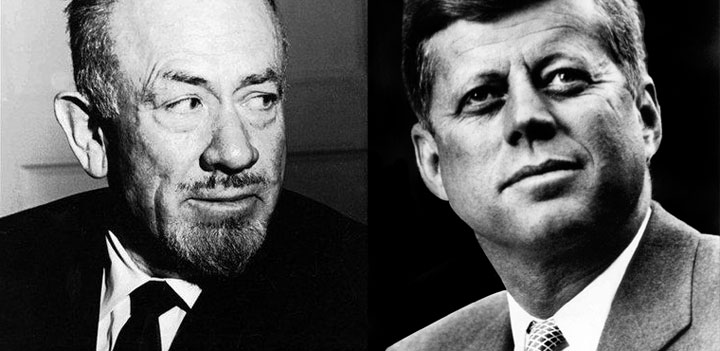
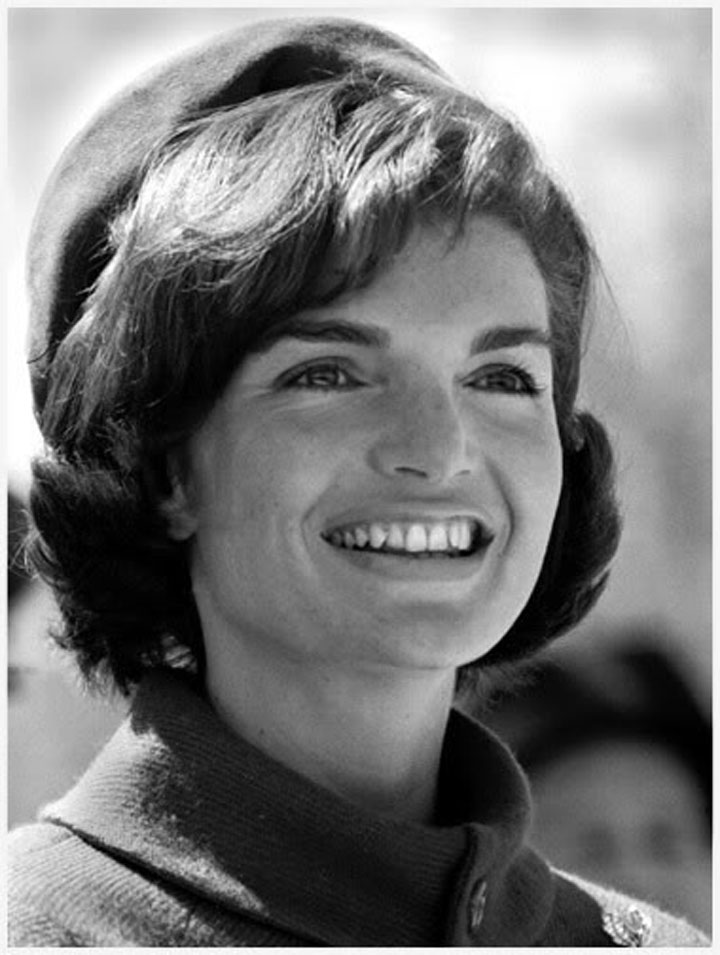
Composite image of John Steinbeck and John KennedyAnyone alive at the time always remembered the day John Kennedy died. John Steinbeck and his wife Elaine were in Warsaw on a U.S. cultural mission and helped embassy personnel deal with a flood of well-wishers while grieving quietly, inwardly, through the long November night. Though the John Kennedy-John Steinbeck bond was never as close as Steinbeck’s friendship with Adlai Stevenson, the previous Democratic presidential nominee, Steinbeck admired Kennedy’s warmth, wit, and wonderful way with words. It was the respect of one wordsmith for another, and it led to Jackie Kennedy’s suggestion that John Steinbeck write John Kennedy’s official biography.

John Steinbeck: Stevenson in ’52, ’56, and ’60!

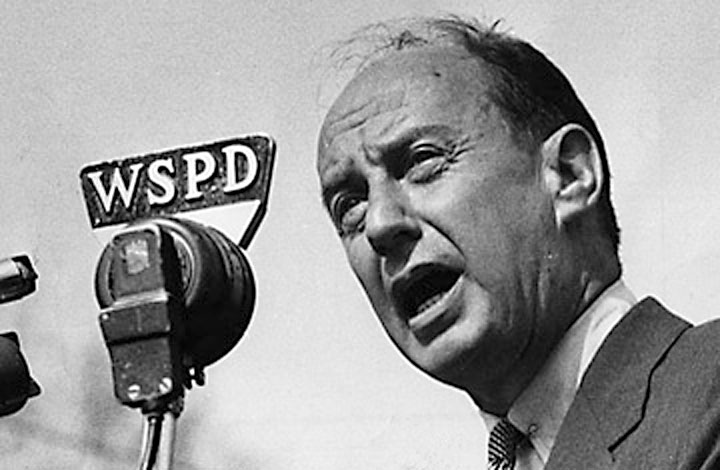
A staunch New Deal Democrat with small town Republican roots and a record of wartime advice and service to his hero Franklin Roosevelt, Steinbeck had little to say publicly about Harry Truman, FDR’s successor.  But he didn’t hold back when Eisenhower and Nixon emerged. He thought Ike was tongue-tied, under-informed, and unqualified to be president. How could anyone who mangled syntax and read westerns for entertainment possibly be fit for the White House? Nixon he deeply disliked and distrusted for reasons that proved prophetic. In the 1952 presidential election, Steinbeck supported Adlai Stevenson, but he didn’t meet Stevenson until the Democratic convention he covered as a special reporter in 1956.

Image of Adlai StevensonJackson Benson, John Steinbeck’s principal biographer, described the opening act of Steinbeck’s long-running friendship with Stevenson in The Adventures of John Steinbeck, Writer:

From the time of this meeting, the Steinbecks and Stevenson became close friends, visiting each other often in the years that followed. At the convention, Stevenson grabbed Steinbeck, pulled him into a little room, and said “Sit down. I need a drink.” The two sat talking for half an hour, John telling him of the humorous things he had heard on the floor. Every time he got up to go, Stevenson asked him to stay. It was the first time in days, Stevenson told him, that he had had a chance to relax.

John Steinbeck, who disliked funerals, attended Stevenson’s service in Ilinois in 1965. In 1960 he had hoped his friend would run again, this time against Dick (“I liked him better when he was a mug”) Nixon, adding his name to a list of celebrity authors and academics advocating for Stevenson over Kennedy, the Democrats’ rising star. But the charismatic young Senator from Massachusetts—the home state of Steinbeck’s paternal grandparents—swept the spring primaries and won the American presidency by a Chicago hair. Kennedy was Catholic, a writer, and a war hero, appealing qualities. The Steinbecks supported his campaign and were invited to his inauguration.

John Kennedy’s Inauguration and its Endless Invocations

John Kennedy once described Washington as combining Southern efficiency with Northern charm. He might have mentioned Southern humidity and Northern winters as well. The 1961 inauguration was marred by one of Washington’s worst snowstorms; while Kennedy’s acceptance speech warmed John Steinbeck’s heart, Elaine’s feet were freezing. In a section of the manuscript omitted from Travels with Charley when it was published, Steinbeck recorded the event with epic hilarity. (Given Kennedy’s constant back pain from disease and injury, Steinbeck’s reference to women’s “backache” seems especially ironic. Today we know more about Kennedy’s medical condition than anyone admitted at the time.)

I got us to our seats below the rostrum of the Capitol long before the ceremony—so long before that we nearly froze. Mark Twain defined women as lovely creatures with a backache. I wonder how he omitted the only other safe generality—goddesses with cold feet. A warm-footed woman would be a monstrosity. I think I was the only man who heard the inauguration while holding his wife’s feet in his lap, rubbing vigorously. With every sentence of the interminable prayers, I rubbed. And the prayers were interesting, if long. One sounded like general orders to the deity issued in a parade ground voice. One prayer brought God up to date on current events with a view to their revision. In the midst of one prayer, smoke issued from the lectern and I thought we had gone too far, but it turned out to be a short circuit.

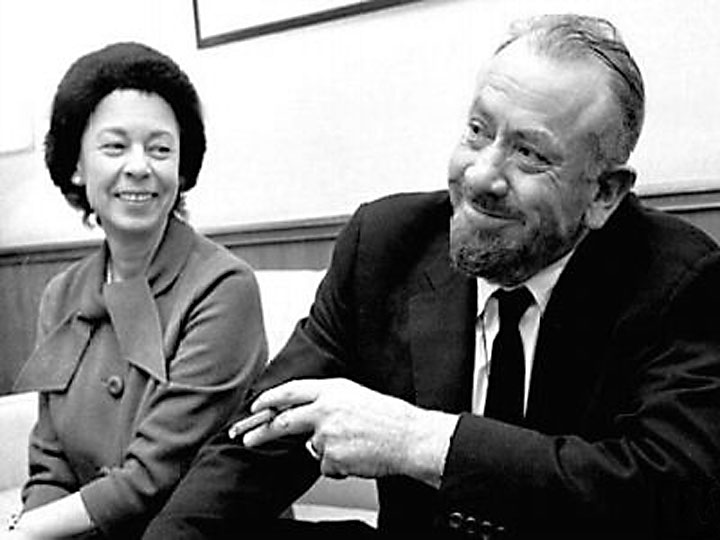
Image of Elaine and John SteinbeckJohn Kennedy—a Catholic in the same way that John Steinbeck was an Episcopalian, nominal and not by choice—secretly agreed with Steinbeck about the endless prayers. Below the official text of the letter sent to the “distinguished artists who were kind enough to be in Washington,” Kennedy provided a handwritten critique of the episode for Steinbeck’s private enjoyment: “No President was ever prayed over with such fervor. Evidently they felt that the country or I needed it—probably both.” Two witty Johns joined at the funny bone, sharing the same artery to America’s master of irreverence, Mark Twain. As quoted in Steinbeck: A Life in Letters (edited by Elaine Steinbeck and Robert Wallsten), John Steinbeck enlarged on the tale, which grew in height over time:

I had never seen this ceremony. I found it very moving when they finally got through the prayers to it. As Elaine says, most ministers are hams but they haven’t learned the first rule of the theatre—how to get off. When [Cardinal] Cushing got to whumping it up I thought how I’d hate to be God and have him on my tail. The good Cushing didn’t ask, he instructed; and I bet he takes no nonsense from the Virgin Mary either nor from the fruit of her womb, Jesus.

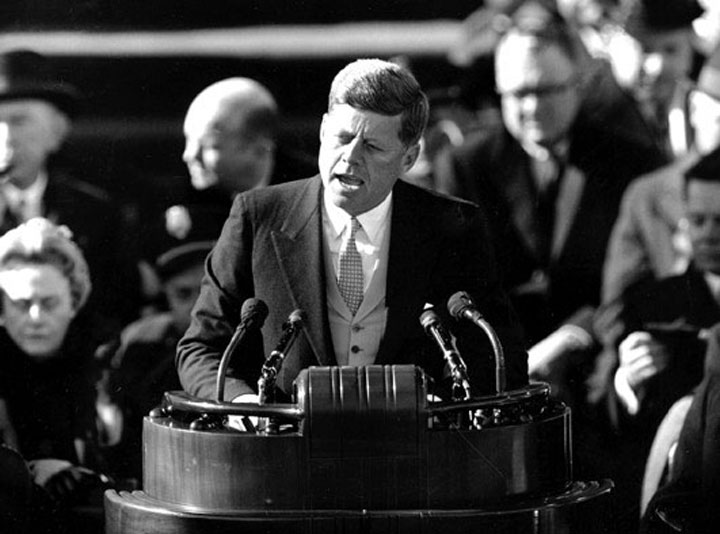
Image of John Kennedy's inaugural addressBut the young president’s address was stirring, and Steinbeck was more than moved. He admired Kennedy’s speech like a writer, for style as much as substance. The reason for his respect became the punch line of a literary joke, delivered dead-pan to reporters looking for a scoop about Steinbeck. Benson’s biography explains that the author answered their questions about the Steinbecks’ visibility around Washington with the same kind of humor shown by Kennedy in private:

Since he was [at the inauguration] and receiving all this attention, Steinbeck was assumed by some in the press to be up for some job in the administration. When he was asked, on one occasion he said that he had been named Chairman of the Joint Chiefs of Staff, but he had not yet got his uniform fitted. To others, he replied that he was the new Secretary of Public Health and Morals and Consumer Education. When asked his reaction to the inaugural address, he said, for the television audiences, “Syntax, my lad. It has been restored to the highest place in the Republic.”

Syntax—high praise for any politician, and music to Steinbeck’s ears after the painful atonality of the Eisenhower era.

Kennedy’s Assassination and Steinbeck’s Refusal

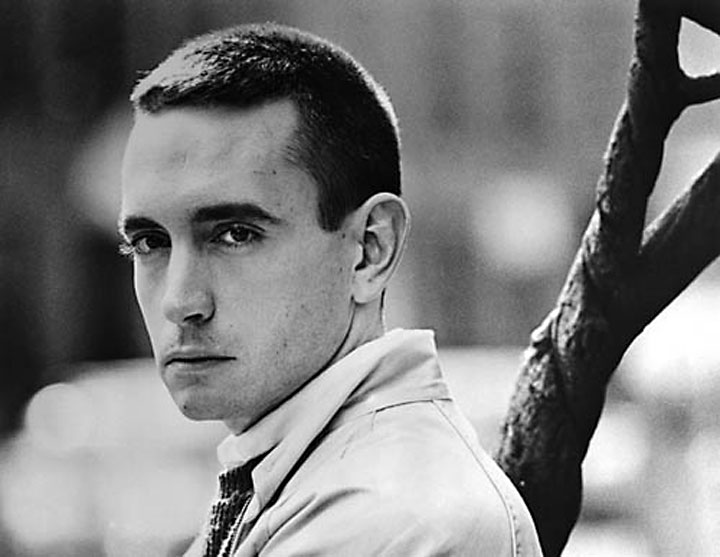
Following the inauguration John Steinbeck and John Kennedy met several times, and Steinbeck was later selected to receive the Medal of Freedom—an honor the President would not live to bestow. In the spring of 1963, the author and his wife accepted the invitation to travel behind the Iron Curtain as cultural emissaries for the high-culture administration where a francophone First Lady set a sophisticated European tone. Remarkably, in retrospect, Steinbeck insisted that another writer accompany them: Edward Albee, the young creator of the biting Broadway stage hit, Who’s Afraid of Virginia Woolf? Albee was acerbic, audacious, and gay; his sharp-edged play lacerated marital monogamy and introduced audiences to vocabulary formerly reserved for the drill field. Hard to believe today, but Steinbeck’s demand was granted and the trip to the Soviet bloc took place as planned, Albee (below) included.

Image of Edward AlbeeThe Steinbecks had reached Poland when they heard the news from America on November 22. Jay Parini quotes Elaine’s version in John Steinbeck: A Biography:

“That was a day none of us would ever forget,” says Elaine. “John and I had just gotten back to Warsaw when the news broke on the radio that John Kennedy had been shot in Dallas. The first report was that he was wounded, and we were horrified. Then we heard he was dead. It was so moving what happened: the Poles all surrounded us and hugged us, saying how sorry they were to hear this terrible, terrible news [and we] needed time to mourn. We called the State Department, and they suggested that we go to Vienna for a few days. There was a funeral service for Kennedy at the cathedral there. It was a memorable and moving day.”

Cutting short their itinerary, the Steinbecks returned to Washington for debriefing by the State Department over three days in late December, precisely five years before Steinbeck would die in New York at the age of 66. The Steinbecks’ letter of sympathy to Jackie Kennedy, written a few days earlier, received a surprising response from the former First Lady. Benson explains:

In the meantime, [Mrs. Kennedy] wanted someone to write a definitive biography of her husband, and she had thought Steinbeck the writer most suitable. She got in touch with mutual friends and made some inquiries and then wrote the Steinbecks to come see her in Washington. When John and Elaine called on her, they could see that, although she had herself under control, she was still obviously in a state of shock. She talked to them about the kind of book she had in mind and very openly and movingly about the President and about her relationship to him. At one point Elaine began to cry, and Mrs. Kennedy said, “Please, Elaine, if you must cry, go to the bathroom and pull yourself together. I can’t bear it now, and I’ll go to pieces.” Their visit stretched into a stay of several hours, as every time they started to leave, Mrs. Kennedy would beg them to stay—“I’ve nothing in the world to do.”

Image of Jackie Kennedy as First LadyAfter careful consideration and more meetings, John Steinbeck declined Mrs. Kennedy’s suggestion that he write her husband’s book. As Benson observes, “what he had in mind does not seem to have been an orthodox biography.” Steinbeck never produced his planned autobiography either, and for much the same reason. Writing to his college friend Carlton Sheffield a few days before the February meeting with Mrs. Kennedy, Steinbeck said that if he ever wrote his own life story he wanted to make it a “real one”—“since after a passage of time I don’t know what happened and what I made up, it would be nearer the truth to set both down.” As Benson suggests, the novelist “never found solutions to the problems of form presented” by factual biography. In April he gave Mrs. Kennedy his answer—not now: “One day I do hope to write what we spoke of—how this man who was the best of his people, by his life and death gave the best back to them for their own.”

John Steinbeck’s Arthur and John Kennedy’s Camelot

Steinbeck didn’t invent the Camelot trope for the Kennedy years, but as a serious student of Arthurian literature he could use it convincingly. When read today, the letter he wrote Mrs. Kennedy after their initial meeting about her husband’s book is—in its poetry, power, and prescience—better than “an orthodox biography” could ever be:

The 15th century and our own have so much in common—loss of authority, loss of gods, loss of heroes, and loss of lovely pride. When such a hopeless muddled need occurs, it does seem to me that the hungry hearts of men distill their best and truest essence, and that essence becomes a man, and that man a hero so that all men can be reassured that such things are possible. The fact that all of these words—hero, myth, pride, even victory, have been muddled and sicklied by the confusion and permission of the times only describes the times. . . .

Steinbeck wrote the closing moral trilogy of his career—The Winter of Our Discontent, Travels with Charley, America and Americans—in the reflected light of Kennedy’s Camelot and the sudden shadow that fell across America following his death. I wonder. Has it occurred to others that John Steinbeck died so soon after the abdication of his friend Lyndon Johnson and the election of Richard Nixon in 1968? Death spared Steinbeck the Watergate scandal, Reaganism, and the retrograde racism of today’s insurgent Tea Party. Surely he would have detested and denounced each, not merely for mendacity, but also for lacking any trace of Kennedy’s intellect, warmth, or wit.

The quality of educated humor went out of the body politic with the death of John Kennedy, and I think Steinbeck knew it as it was happening. His most memorable epitaph for the elegant president who joked with him, Twain-like, about priests and public prayers appears near the end of the letter just quoted. Fifty years after John Kennedy’s assassination, John Steinbeck’s words of comfort to the slain president’s widow still thrill with hope for the return of an American Camelot:

At our best we live by legend. And when our belief gets pale and weak, there comes a man out of our need who puts on the shining armor and everyone living reflects a little of that light, yes, and stores some up against the time when he has gone. . . .

.

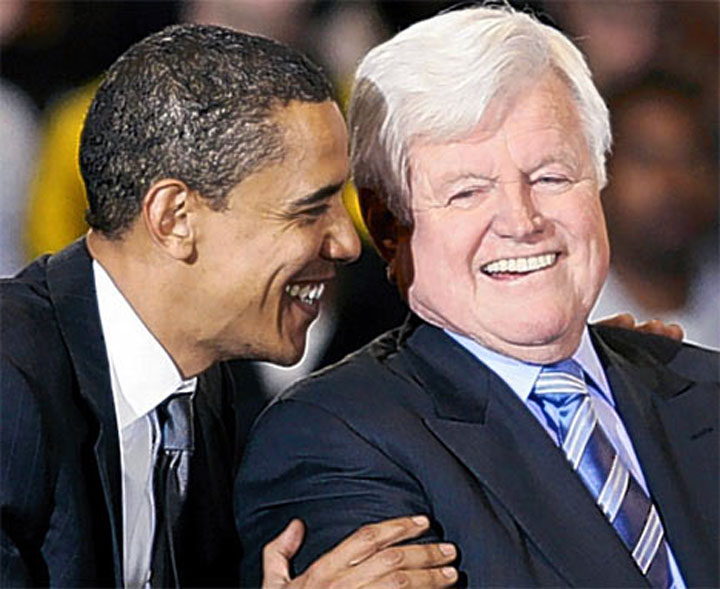
Image of Barack Obama and Ted Kennedy

John Steinbeck, Carl Jung, and Phalanx in Tortilla Flat

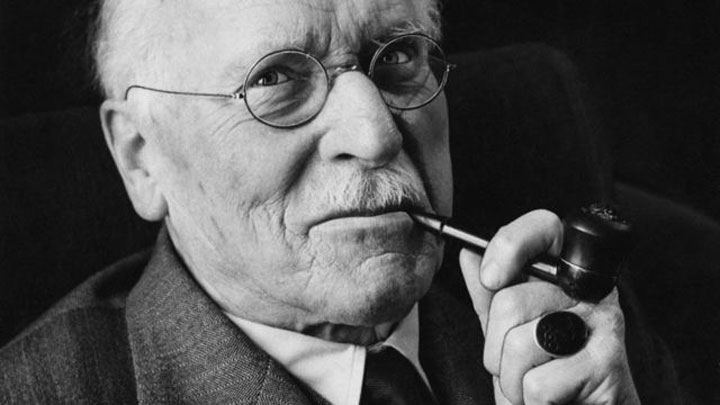
Image of Carl JungJohn Steinbeck was ambivalent about psychology. In 1962 he lashed out at his country’s modern “psychiatric priesthood” in Travels with Charley. But 30 years earlier he had stayed up nights discussing the psychological insights of Carl Jung, the great Swiss psychologist-psychiatrist shown here, with Ed Ricketts, Joseph Campbell, and other members of the bohemian Cannery Row circle in the Monterey of his youth. As a result, Jungian principles of a collective human unconscious, the meaning of symbols and myths, and the essential role of certain types of individuals in group behavior inform Steinbeck’s most successful fiction of the 1930s. To a God Unknown and In Dubious Battle are frequently cited examples. As I will show, the insights of Jung in advancing Steinbeck and Ricketts’ phalanx theory are equally evident in Tortilla Flat, the book that launched Steinbeck’s reputation as a promising new writer.

Carl Jung, John Steinbeck, and the Problem of Language

I reached this conclusion not through studying literary theory in a classroom but by reading Carl Jung and John Steinbeck and applying their insights in my three-decade career designing, developing, and leading critical skills and management training programs for corporations such as RCA, KPMG Peat Marwick, Honeywell, AT&T, Blue Cross/Blue Shield of New Jersey, and others. In business, critical skills include tasks where failure to properly perform may cause death, serious injury, or financial loss. Central to the development of cost-effective critical skills training programs in my work was assuring clearly and uniformly understood terms, concepts, and models. To do this, a good instructional designer must define terms and concepts so that training objectives and process are easily communicated and comprehended.

This is usually not too much of a problem in industries and professions that have well-defined lexicons, such as law, engineering, and accounting. It is more difficult when training enters more the ambiguous arena of consulting, marketing, management, and sales. But these activities also require clearly-understood language for personal, interpersonal, team, and group-related tasks. Naturally the field of psychology seems an appropriate place to handle individual, interpersonal, and teaming challenges that arise in the process of doing business and improving outcomes. Yet key terms and basic concepts vary greatly throughout psychology from one school of thought and practice to another. For instance, the essential term ego is defined quite differently by followers of Carl Jung and Sigmund Freud and was ignored completely by later behaviorists such as B.F. Skinner.

Because reliable sources to develop a useful lexicon for applying psychological theories outside the box of clinical psychotherapy are few—and because individual psychologists frequently employ esoteric language and the terms, concepts, and models commonly used are often misunderstood between different schools of psychology—the study and practice of psychology in its various fields and forms is almost universally looked down upon by more precise sciences as fundamentally unscientific. The language problem inherent in psychology is a major reason why empirically-minded biologists and chemists—the sciences that attracted and engaged John Steinbeck and Ed Ricketts—continue to hold psychology in low esteem.

Discovering the John Steinbeck-Carl Jung Connection

I have been a Steinbeck fan since I first read his fiction, which I found irresistibly unpretentious, down-to-earth, and clear in style and story. Who could argue with the humor and accessibility of Tortilla Flat, his earliest best seller, for example? As in Steinbeck’s later novels, the characters in Tortilla Flat are so thoroughly defined that you felt you had known them all your life.

After rereading Tortilla Flat approximately 30 years ago, I began to sense a Jungian influence in its narrative flow and structure, an observation that was confirmed when I read the biographies of John Steinbeck that started to appear in the 1980s. When I learned that the young mythologist Joseph Campbell was part of the Cannery Row scene swirling around Steinbeck’s friend Ed Ricketts In 1932, and that Campbell’s correspondence with Ricketts continued until Ricketts’ death in 1948, there was no doubt in my mind about the influence of Carl Jung on Steinbeck’s writing—including Tortilla Flat—during the years that followed. I was equally intrigued to discover that the influence of Carl Jung on John Steinbeck did not originate with Ricketts or Campbell as some have supposed. John Steinbeck was a deep reader with wide interests who took philosophy as a student at Stanford. As a result, he came to Cannery Row in the early 1930s with knowledge about modern psychology.

The Phalanx and “Breaking Through”

The unconscious influence on behavior of individuals—Steinbeck’s “human units”—within an objective focused gathering, group, or MOB that Steinbeck called the phalanx is, I believe, worthy of closer examination today. As mentioned, To a God Unknown and In Dubious Battle are frequently adduced as examples from the fiction of the 1930s. But a piece of nonfiction published by Steinbeck in 1942, Bombs Away: The Story of a Bomber Team, includes a description of the phalanx in the training and development of bomber crews by the wartime Army Air Corps, and The Log from Sea of Cortez explains the phalanx more fully than any other work of nonfiction published in Steinbeck’s lifetime.

The MOB’s objective may seem simply unreasonable or illusionary, such as group bullying or scapegoating those who disagree with the MOB’s belief or creed. But however irrational or inexplicable, it can produce horrors like the Holocaust. Given the explosion of MOB violence around the world in our time and the reported incidence of  bullying in our schools, better understanding the phalanx as Steinbeck developed and used the term seems to me to be more important than ever before.

Steinbeck’s phalanx is based in part on Carl Jung’s collective unconscious, as well as on the ideas of philosophers familiar to Steinbeck from his studies at Stanford, such as those of William James—an important influence on Jung himself in my opinion. As a result of Steinbeck’s reading, discussion, and understanding of Jung, James, and others, I believe that he consciously coined the term phalanx, clearly defined it in his thinking, and applied it in his work, including Tortilla Flat.

As also mentioned, the concept is not something Steinbeck acquired from Ricketts but came to him as a result of his personal awakening to a thread connecting random notes that he kept in a cigar box beginning as early as the 1920s. When I read about the writer’s habit of jotting ideas on bits of paper in a leading John Steinbeck biography, I thought to myself, “what a great example of Jung’s Intuition!”  Significantly, the connection occurred to Steinbeck during his mother’s long illness and the crisis of caring for the parent who dominated his family and his boyhood.

To use Ed Ricketts’ term, this was a “breaking through” for John Steinbeck at age 33—a life-changing epiphany or event resulting in a leap of personal growth. Practitioners of Carl Jung’s method of psychology recognize how a personal tragedy like the death of a parent can awaken the mind’s eye to a new perspective, a deeper consciousness, and greater understanding. Importantly for my point, such an awakening proportionally reduces an individual’s susceptibility to the negative influence of the phalanx, sometimes by raising his or her resistance to participation in MOB violence and destruction. A desire to break through to deeper knowledge is a defining trait of each of the fictional characters created by Steinbeck, beginning with In Dubious Battle, based on Ed Ricketts.

Levels of Adult Maturity and the Influence of the Phalanx

In developing his phalanx concept, Steinbeck articulated two key characteristics:

* A group, gathering or MOB can take on an autonomous psychology and behave in a manner that may be quite different from what would be displayed by individual members under the same circumstances.

* The psychology of the group frequently appears to be in antagonistic counterpoint to the individual psychology of its human units.

I would add a third point: The higher the development or maturity of the group’s individual members, the less the negative influence exerted by the MOB on the group’s behavior. T

The levels of this development or maturity are fourfold:

Level 1.  Level 1 persons are almost completely unaware of their uniqueness as individuals. They have no ego as the term is used in the clinical sense—that is, the psychological object within which an individual defines himself or herself. Those who exist at this level lead lives that revolve around basic survival, shelter, safety, and procreation. They leave decisions on important matters up to authority figures such as a father or mother. During Jung’s research among African and North American Native tribes, tribal members told him that they leave all thinking and decision-making to their tribal chief or medicine person. They could not distinguish between their dream state and conscious state. They told Jung that they thought anyone charged with the burden of thinking was crazy. They were mainly unconscious.

Level 2. Level 2 individuals awaken to the differences between themselves and others. This is the beginning of the existence of their ego: their awakening to their uniqueness in the world or the universe. An individual at this level typically projects onto external gods and devils. As a result of their development they gradually learn to participate in their personal path, create goals, and use individual tools in dealing with life and its issues. But for the most part they are driven to self-serving aims with their newly discovered skills. They still are mainly unconscious.

Level 3. To understand my description of Level 3, we must agree on the definition of the term ego I intend: one’s conscious image of himself or herself. When we reflect upon ourselves, the image we perceive is the ego. The term is often mistakenly used to refer to an inflated ego where the self-image of an individual exceeds reality. But in truth, the ego is the focal point to which all objects of perception must relate to become conscious. Persons at Level 3 have a nearly completely developed ego and view it as their center, denying the existence of anything about themselves outside its circumference. While the Level 3 individual denies the unconscious, they are nonetheless the victim of unconscious influences in their behavior. Examples include embarrassing slips-of-the tongue or falling in love with a person who is wrong for many reasons. They may also be victims of irrational fears or hates—the Shadow, to use another term from Carl Jung, Level 3 persons are apt to become victims of group influence at the MOB phalanx, however emphatically they may deny this possibility.

Level 4.  For a variety reasons, some painful, Level 4 individuals have awakened to the reality that there is more to themselves than their ego. Accompanying this realization is a curiosity about their newly revealed psychological territory. It     usually doesn’t take them long to explore this uncharted terrain within themselves. Ideally, when they do so they will seek to integrate what they discover about themselves into their existing self-image and further build their ego on stronger ground. The previously unintegrated elements of Self found in their exploration likely were the source of many of the projections they suffered at earlier stages of their development on the way to Level 4 self-knowledge. Level 4 people are thus the most conscious and least vulnerable to phalanx influence. They are truly their own man or woman.

Readers may recognize the differences in persona presented by individuals at the levels I have described. These differences can be perceived through interpersonal dialogue and interaction or through observing behavior. Strong caution must be suggested to avoid pigeon holing another and then acting on that classification. Remember, we are also responsible for the persona we perceive of others and it may be very wrong. Individuals at Level 4 (Ed Ricketts, for example) often appear peaceful, content, friendly, and kind. Those at lower levels may be more easily influenced by fear, hatred, and ignorance. The fiction of John Steinbeck, who I believe intuited this truth about humans, offers unforgettable examples of people at every level of evolution.

The Phalanx in Tortilla Flat

In Tortilla Flat, I believe that phalanx can first be observed in action among Steinbeck’s paisanos as verbalized by the character Pilon, who expresses the group’s feeling that Danny, the “group caretaker,” has abandoned them. Characters like Danny—and later Doc and Fauna in Cannery Row—play the essential group-caretaker role ably articulated and applied in his work as an international management consultant by my friend James Kent, a Steinbeck lover of profound learning and understanding.

Pilon thinks that Danny is spending too much time with Sweets Ramiriz—the grateful recipient of the gift of a vacuum cleaner she can’t use—with the result that the group feels abandoned by their leader: “At first his friends ignored his absence, for it is the right of every man to have these little affairs. But as the weeks went on, and as a rather violent domestic life began to make Danny listless and pale, his friends became convinced that Sweets’ gratitude for the sweeping-machine was not to Danny’s best physical interests.”

The verbalized concern for Danny’s physical health is a rationalization—a banner-call to action—although its actual value-driven inspiration is jealousy about a relationship that has taken Danny away from the group. This distinction is important. In judging group or team behavior in business, logical rationalizations and value-judgments are significant factors in analyzing and predicting group or team actions; since they are functionally different, they require different responses. The distinction is revealed in Steinbeck’s description of the group’s decision to do something about the situation that confronts them: “Wherefore the friends, in despair, organized a group, formed for and dedicated to [Sweets’] destruction.”

As dramatized in John Steinbeck’s Tortilla Flat, the phalanx is an unconscious complex within a group drawn together with a commonly-held objective by forces from within the collective unconscious. But the attempt to effectively influence the illusionary driving forces of a MOB or community—a common response by authority to such conditions around the world—remains, in practice, a mistake. Targeting the consciously stated objective rather than the unconscious motivation of the group wastes time, resources, and—when force is involved— human lives. Steinbeck learned about the collective unconscious from Carl Jung. We have much to learn about group behavior from John Steinbeck, starting with Tortilla Flat.

This is the first in Wesley Stillwagon’s series on the application of John Steinbeck and Carl Jung’s insights in innovative corporate training program design. To be continued.

John Steinbeck Celebrated in Old and New Public Art

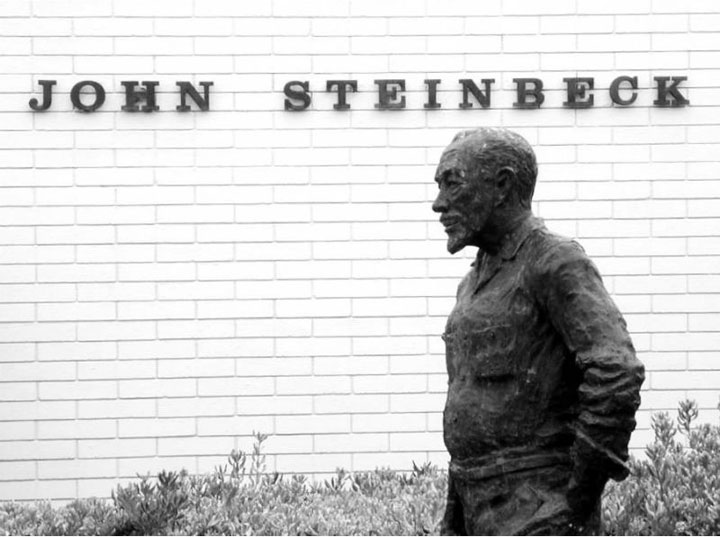
John Steinbeck statue at Salinas Public Library shownSalinas and Monterey—the two cities most closely associated with John Steinbeck and his California stories—both celebrate the life and work of the writer though a variety of public art projects. Although few of the murals and sculptures along Cannery Row in Monterey or in Steinbeck’s home town of Salinas approach the level of fine art, they enhance their surroundings while serving social, educational, and sponsorship interests in Steinbeck Country. When Steinbeck lovers visit, most view the works in a spirit of understanding.

The tradition of spreading political and religious messages through large-scale mural paintings originated with the Olmec civilization, the first major civilization in Mexico, and continued through the Spanish Colonial period to the time of the Mexican Revolution and beyond. With a current Hispanic population approaching 75 per cent, it is not surprising that mural representations of Steinbeck and his works are found in the City of Salinas. Thanks to financial support from the Cannery Row Company, works of sculpture predominate in nearby Monterey. Best of all, new art inspired by Steinbeck continues to be produced.

John Steinbeck mural at National Steinbeck Center shown

Detail of the mural outside the National Steinbeck Center

John Steinbeck Murals in Downtown Salinas

Public agencies have played a role, funding the One Voice Murals Project to develop community pride and provide summer work experience for youth throughout Monterey County. Of more than a dozen large-scale murals from Castroville to Greenfield funded by the One Voice Project Arts & Leadership Project, four of the finished pieces—all in Salinas—portray Steinbeck-related themes.

With the help of eight young painters in 1998, supervising muralists Patrizia Johnson and Mel Mathewson created the mural that has become familiar to visitors to the National Steinbeck Center. Dominated by a portrait of the bearded writer, the work is comprised of a collage of images from books and movies including The Grapes of Wrath, Cannery Row, East of Eden, and The Red Pony. It greets passersby on a wall facing the entrance to the Center at 127 Main Street.

John Steinbeck mural Salinas Chamber of Commerce shown

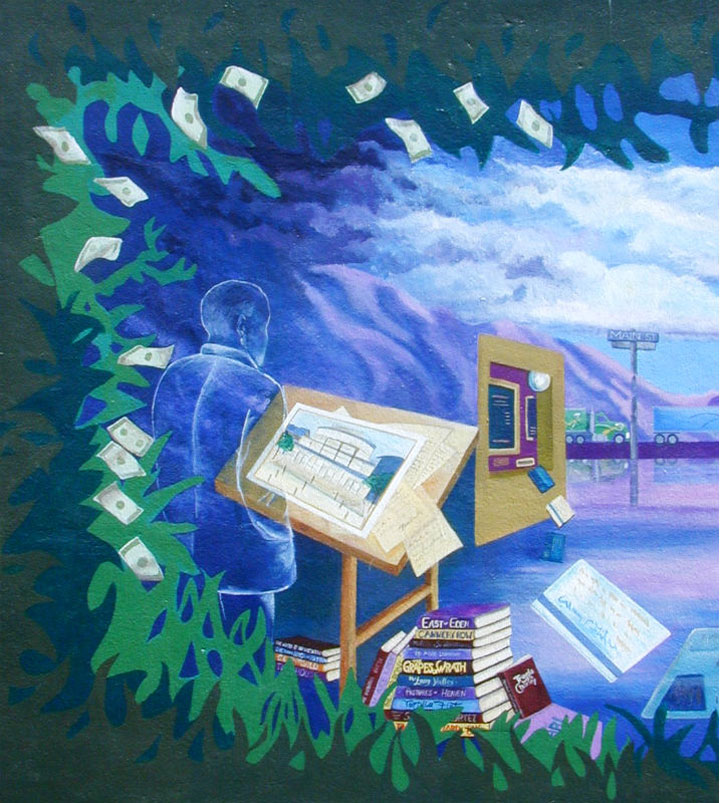
The ghost of John Steinbeck reflects on the artifacts of area commerce.

Two murals sponsored by One Voice were completed in 2001. Designed by Linda Galusha, the wall of the Salinas Valley Chamber of Commerce building at 119 East Alisal Street shows Steinbeck surrounded by dollar bills and important elements of commerce in the Salinas Valley, from an abacus to an ATM machine, as well as the transportation systems employed to move area agricultural products to world markets. Texas artist Christine Martin led the team that recreated mythical scenes from Steinbeck’s The Acts of King Arthur and His Noble Knights on the wall of the Grapes & Grains liquor store at 385 Salinas Street.

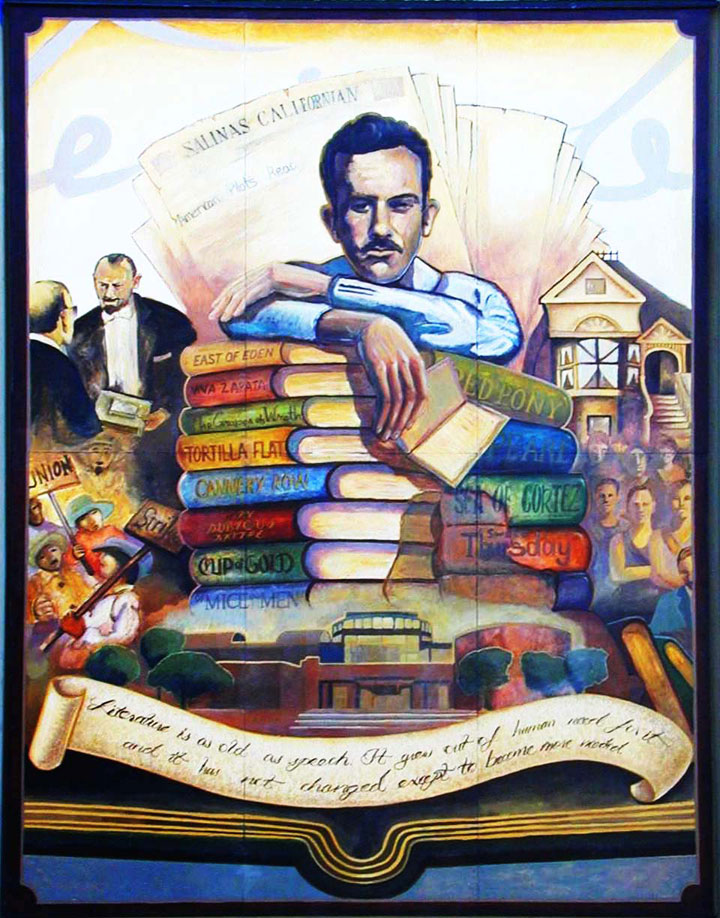
In 2002 a Macedonian-born artist named Blagojce Stojanovki supervised the completion of what is billed as the largest mural in California. Covering four huge wall panels of the Salinas Californian Newspaper Building at 123 West Alisal Street, the work depicts the writer with his books surrounded by images of scenes from his life.

John Steinbeck mural at Salinas Californian Newspaper Building shown

Detail of the Blagojce Stojanovki mural in Salinas

The oldest Steinbeck-related art in Steinbeck’s home town is a bronze sculpture of the author (top of page) created in the early 1970s by Tom Fitzwater—a Greenfield native studying art at Cal State, Long Beach—and donated by the Soroptimist Club of Salinas. The larger-than-life statue stands at the entrance to the John Steinbeck Library at 350 Lincoln Avenue. The identity of the iconoclast who hack-sawed the cigarette from Steinbeck’s hand remains a mystery, along with his, her, or their motivation. Was it a do-gooder intent on protecting youth visiting the library from the evils of tobacco?  A vandal bent on mindless destruction? Not all citizens appreciated the work when it was created.  A photograph of Fitzwater in the collection of the Martha Heasley Cox Center for Steinbeck Studies at San Jose State University is captioned “the godawful bronze statue of Steinbeck that birds still gladly poop on today.”

John Steinbeck & Company in Public Art at Cannery Row

Through the Cannery Row Foundation, the Cannery Row Company—owner of real estate along the former ocean-front canning district featured in Steinbeck’s novel of the name—has supported much of the public art that graces this popular Monterey tourist destination, including bronze figures of several of Cannery Row’s most famous characters.

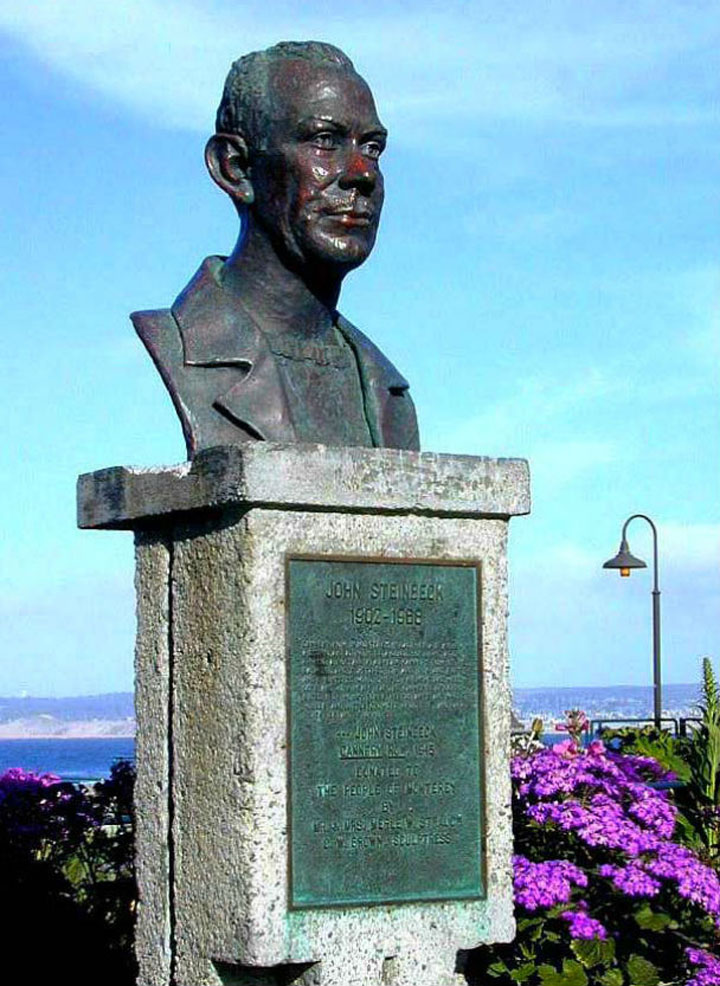
A bronze bust of the writer welcomes visitors to the Steinbeck Plaza at the foot of Prescott Avenue overlooking Monterey Bay. A plaque mounted on the base quotes the novel’s familiar opening paragraph: “Cannery Row in Monterey in California is a poem, a stink, a grating noise, a quality of light, a tone . . . .” The sculptor, Carol W. Brown, reported that, still embittered by her desertion and divorce, Steinbeck’s first wife—Carol Steinbeck Brown—delayed the work in progress with numerous requests that the artist portray her husband’s features unflatteringly. Some say she even claimed credit as co-creator of the work.

John Steinbeck bust by Carol Brown at Cannery Row shown

Bust of John Steinbeck by Carol Brown at Cannery Row

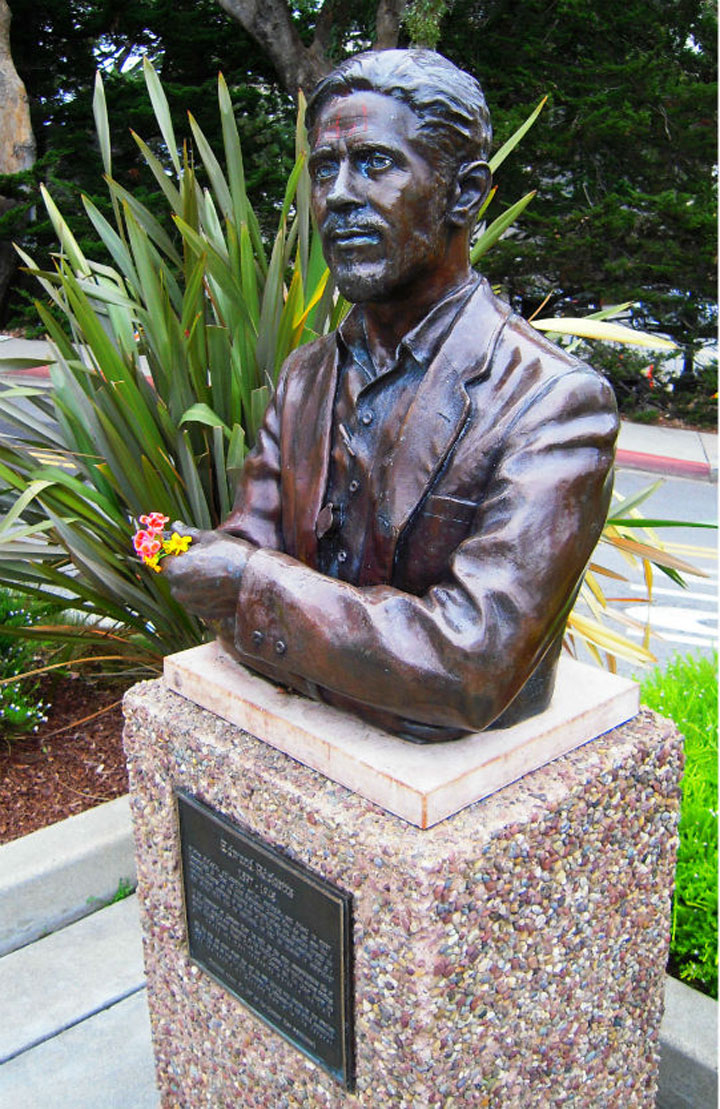
Three years after the publication of Cannery Row in 1945, Steinbeck’s close friend and collaborator—the pioneering marine biologist, ecologist, and philosopher Ed Ricketts—died following an automobile accident at a railroad crossing near Cannery Row. Local sculptor Jesse Corsaut created a bronze commemorative bust of Ricketts that is installed in a mini-park at Wave Street and Drake Avenue a few yards from the crossing site. Ricketts holds a star fish in his left hand and has had better luck than the bronze likeness of Steinbeck in Salinas. The star fish is frequently adorned with fresh flowers.

Ed Ricketts bust at Cannery Row in Monterey shown

The Cannery Row memorial bust celebrating Ed Ricketts

Ricketts and Steinbeck were accompanied on excursions to Mexico to collect marine specimens by the artist Bruce Ariss, a member of their charmed Cannery Row circle. The pencil sketches of his companions made by Ariss recently appeared on festive banners placed along the Row. The only public work by Ariss that survives—a panel illustrating the Lone Star Café and discarded boilers featured in Steinbeck’s novel—was salvaged from a larger temporary mural painted by later artists hired to block the view of the Clement Hotel when it was under construction. The Ariss mural stands at the foot of Bruce Ariss Way, opposite Ricketts’ lab, at 800 Cannery Row.

Mural and bust of Kalisa Moore in Monterey shown

Salvaged mural panel and bust of Kalisa Moore at Bruce Ariss Way

In 1957 the Latvian-born entrepreneur Kalisa Moore opened a restaurant in the former La Ida Café, another venue immortalized in Cannery Row. Catering to musicians, writers, and visitors in quest of the Row’s magic mixture of hardscrabble and bohemian lifestyles, she hosted an annual Steinbeck birthday celebration beginning in 1970. After she died in 2008 she was honored as the Queen of Cannery Row with a commemorative bronze bust by Jesse Corsaut. Appropriately, it is located next to the Bruce Aris mural.

Cannery Row Mural of Mack and the Boys shown

Mural of Mack and the Boys by artist John Cerney

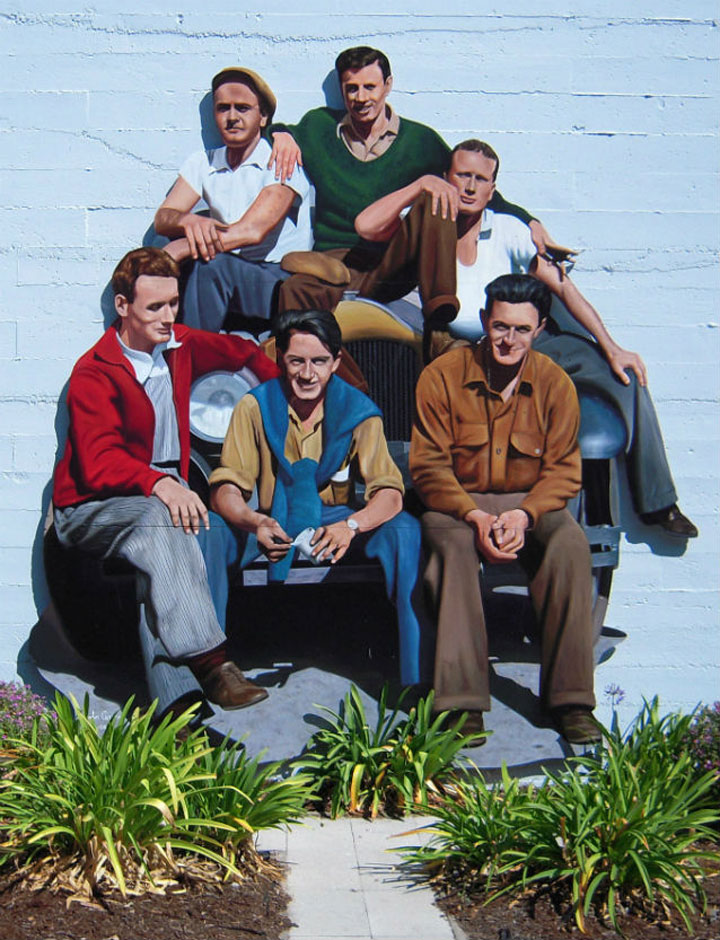
Today three photo-realistic murals by Salinas artist John Cerney overlook the Monterey Bay Coastal Recreational Trail, built over the former route of the Southern Pacific Railroad. Each mural features a group of workers relaxing after a day laboring in the canneries, along with an extended caption taken from the text of Steinbeck’s novel. The painting of Mack and the Boys at the rear of 711 and 799 Cannery Row is based on a photograph of the original “boys” including Gabe Bicknell, the inspiration for Steinbeck’s character Mack in Cannery Row.

And the Art Goes On

Tributes to Steinbeck in art continue to attract area interest and support. For example, plans for a sculpture depicting the writer seated on a rock with imagined figures from local history were recently approved by the Monterey Architectural Review Committee. When completed, the work by Carmel sculptor Steven Whyte—“Monument to John Steinbeck and Cannery Row”—will be installed at Steinbeck Plaza, where it is certain to draw new attention to the life and work of Monterey County’s most famous son.

Photos by David A. Laws

Susan Shillinglaw Details John Steinbeck’s Dramatic Marriage to Carol Henning

Susan Shillinglaw, writer about the life of Steinbeck, shown at the Steinbeck Studies CenterNobody knows more or writes better about the life of Steinbeck than Susan Shillinglaw, professor of English at San Jose State University, former director of the Martha Heasley Cox Center for Steinbeck Studies, and scholar-in-residence at the National Steinbeck Center. Her superb scholarship and elegant style are equally evident in Carol and John Steinbeck: Portrait of a Marriage, the biography of Steinbeck’s marriage to Carol Henning, a Jazz Age rebel with a Great Depression conscience. As Shillinglaw observes, John and Carol were no Scott and Zelda. But their dramatic story book reads like a novel—unfortunately, one with a similarly unhappy ending.

carol-john-steinbeck-susan-shillinglaw

From Jazz Age Joy to Great Depression Decline

Meticulously researched over a period of 20 years, Shillinglaw’s life of Steinbeck and his first wife, from Jazz Age joy through Great Depression decline, describes a companionable marriage of equals and opposites, revealing intimate details of a relationship that began in 1928, at the cusp of Steinbeck’s career, and dissolved following the success of The Grapes of Wrath. Using Steinbeck’s phalanx metaphor, she demonstrates how such a relationship becomes a kind of third person, with characteristics, dynamics, and patterns of development and decay distinct from both partners and ultimately beyond their control. Her subject is the life and death of a relationship, but her protagonist is clearly Carol, a shining figure in the life of Steinbeck who has remained in her husband’s shadow until now.

Years after his divorce from Carol, Steinbeck advised another writer that “your work is your only weapon.” As Shillinglaw shows, John and Carol’s collaboration in Steinbeck’s signature work of the 1930s—always his work, rarely hers—was their mutual weapon against poverty and insecurity until fortune and fame—his, not hers—intervened. The title of Steinbeck’s anthem of the Great Depression, The Grapes of Wrath, was her idea. The progressive politics of the protest novels that preceded it—In Dubious Battle and Of Mice and Men—were hers before they were his. She became his muse and motivator, typist and editor, connector and companion. But the 12-year experience drained and disoriented her, leaving her ill-equipped to cope with wealth, notoriety, and competition from the woman who became Steinbeck’s second wife in 1943.

A Life of Steinbeck Story Told by the Perfect Narrator

Carol and John Steinbeck: Portrait of a Marriage is a book only Susan Shillinglaw could have written. The life of Steinbeck has been chronicled by men—notably Jackson Benson, the author of The True Adventures of John Steinbeck, Writer—with an emotional detachment from their distant, difficult subject. Unlike her husband, Carol demanded attention, engagement, and shared context, qualities that Shillinglaw brings to the story of her life before, with, and after Steinbeck. A resident of Pacific Grove and Los Gatos—towns where the Steinbecks lived for most of their marriage—Shillinglaw teaches in the city where Carol was born, raised, and rooted. Married to a biologist at the Hopkins Marine Station, the Monterey outpost of Stanford University where Steinbeck took summer courses, Shillinglaw collaborates with her husband in a imaginative summer program for high school teachers passionate about Steinbeck. The author of an upcoming book on The Grapes of Wrath, she shares context with the woman who—in Steinbeck’s words—“willed it.”

"The Swan" drawing shown from Carol Steinbeck's sportswomen seriesTo the credit of Shillinglaw’s publisher, her life of Steinbeck and Carol Henning’s marriage is affordable, attractive, and accessible to non-academics. Unfortunately, small inconsistencies were overlooked, marring an otherwise masterful achievement. Several sentences introduce names left unexplained until later, end without punctuation, and place closing quotation marks on the wrong side of the period. End notes are copious and unobtrusive, but the name of Dick Hayman is printed twice in a sentence thanking sources, and the index seems incomplete. (Mary Dole, the pineapple-heiress acquaintance of Carol’s estranged sister Idell, is included, but Bennett Cerf—the publisher who arranged the Steinbecks’ introduction to the poet Robinson Jeffers—is omitted.) Jazz Age children of musical families, Carol and John both loved music, a pursuit—like Carol’s drawing and sculpting—documented in satisfying detail. Yet Carol’s talented mother is described as attending music school in San Jose to improve her “piano techniques,” not technique, and Gregorian chant (a collective noun, like opera) is referred to as “Gregorian chants.”

"The Swimmer" drawing shown from Carol Steinbeck's sportswomen seriesMinor errors in major works can be corrected in subsequent editions. I predict that Susan Shillinglaw’s life of Steinbeck and Carol Henning’s together from Jazz Age joy to Great Depression decline—a dramatic story told by the perfect narrator—will have many.

Drawings by Carol Henning Steinbeck courtesy of the Martha Heasley Cox Center for Steinbeck Studies, San Jose State University.

Ed Ricketts and the Episcopal Church

Ed Ricketts, child of the Episcopal Church, shown as an adultLike John Steinbeck, the writer’s friend Ed Ricketts was reared in the Episcopal Church, a coincidence of some importance. Described in Cannery Row as “half satyr, half Christ,” “Doc” Ricketts inspired the creation of identifiably Doc-like characters in works of fiction written by Steinbeck over two decades, including In Dubious Battle and Sweet Thursday. The friendship with Ricketts was fundamental to Steinbeck’s thinking through the 1930s and 40s, and the Bay of California scientific expedition undertaken by the men in 1940 produced Sea of Cortez, a collaborative meditation on the meaning of life that reaches an emotional peak on Easter morning in a passage foreshadowing The Winter of Our Discontent, a later Holy Week narrative with an Episcopal church setting.

Intimate Lives That Included Episcopal Church Training

Reared in Chicago, Ed Ricketts—like Steinbeck—attended Episcopal church services as a boy and received Christian training in Episcopal church Sunday school and confirmation classes. Intelligent, introspective, and independent-minded college dropouts, both men outgrew Episcopal Church teaching as adults, becoming skeptical about religion, passionate about science, and unconventional in behavior. When they met in 1930, Ricketts was running a biological-specimen business in Pacific Grove, California, and working on a pioneering textbook of coastal ecology eventually published by Stanford University. Steinbeck, recently married and undiscovered as a writer, was younger and less sophisticated. As he noted in his profile of Ricketts years later, Steinbeck learned deeply about many subjects, including music, from the man with whom he shared a deep personal connection based in part on shared experience in the Episcopal Church.

Reared in Chicago, Ed Ricketts—like Steinbeck—attended Episcopal church services as a boy and received Christian training in Episcopal church Sunday school and confirmation classes.

Their surviving letters demonstrate the intimacy of their relationship and their familiarity with Episcopal church doctrine, custom, and culture. Writing to Steinbeck in 1946, for example, Ricketts reflected with characteristic irony and humor on his mother’s recent death: “Directly after mother was taken very sick, she wanted an Episcopal priest. Terribly unfortunate that a few months before this, the satyr [in him] caught up with him again. . . . The wicked old women, of the church that was founded by charitable Christ, turned on him viciously.”  The parish in question was All Saints’ Episcopal Church in Carmel, the same Episcopal church where Steinbeck served as the godfather for his sister Mary’s younger daughter in 1935.

‘The wicked old women, of the church that was founded by charitable Christ, turned on him viciously.’

As a result of the clerical misbehavior detailed in the letter, Ricketts’ dying mother was visited by the rector of St.-Mary’s-by-the-Sea Episcopal Church in Pacific Grove, the same Episcopal church where Thom Steinbeck, the author’s son, would be married 50 years later. The Steinbeck family cottage where the writer and his wife were living when Ricketts and Steinbeck first met—and to which Steinbeck retreated when Ricketts died—is located only two blocks from St. Mary’s Episcopal Church. Both literally and figuratively, the Episcopal Church loomed over the lives of John Steinbeck and Ed Ricketts—the man he called his soul mate—from the beginning to the end of their intimate, intriguing relationship.

Photo by Bryant Fitch (October 1939) http://www.caviews.com/ed.htm

Did John Steinbeck Work as A Citizen Spy for the CIA?

Redacted CIA memo mentioning John Steinbeck shownMy discovery of John Steinbeck’s connection to the CIA could be described as payback for a youthful indiscretion—my own, not the author’s. While reading The Grapes of Wrath in high school, I skipped the “turtle” and other chapters that seemed to me superfluous to the plot line of the Joads’ journey west. The punishment for my teenage sin of omission came years later, when it first occurred to me that John Steinbeck was a CIA spy. The insane-sounding proposition grew from incongruities in Steinbeck’s life that—unlike Tom Joads’ turtle—I found I couldn’t ignore.

Steinbeck: Citizen Spy book cover shown with subtitle: The Untold Story of John Steinbeck and the CIA

FOIA to the CIA: What Do You Have on John Steinbeck?

Why was Steinbeck never called before the House Select Committee on Un-American Activities, despite his alleged ties to Communist organizations? Why did the CIA admit to the Church Committee in 1975 that Steinbeck had been a subject of the illegal CIA mail-opening program known as HTLINGUAL? Did Steinbeck’s connections to known CIA front organizations, such as the Congress of Cultural Freedom and the Ford Foundation, amount to more than mere coincidence? Did the synchronicity continue when Steinbeck did freelance writing for the Louisville Courier-Journal and New York Herald Tribune? Both newspapers were linked to MOCKINGBIRD, another CIA operation, in Carl Bernstein’s 1977 Rolling Stone article “The CIA and the Media.” Why did the CIA redact portions of Steinbeck’s FBI files before they were released under the 1966 Freedom of Information Act (FOIA), the law that permits full or partial disclosure by government agencies of previously classified documents on request?

Why was Steinbeck never called before the House Select Committee on Un-American Activities, despite his alleged ties to Communist organizations?

There was only one source—the CIA itself—that could definitively answer my questions and confirm or disprove my developing conclusions. I submitted my FOIA request to the CIA in January 2012. With characteristic bureaucratic speed, the CIA responded after eight months, in August 2012, sending me copies of two letters written in 1952. In the first, penned on personal stationery in his own handwriting, Steinbeck offers to work for the CIA. In the second, then-CIA Director Walter Bedell Smith accepts Steinbeck’s offer. The text of these letters and others can be found in my book, Steinbeck: Citizen Spy, at my website or in the FOIA Electronic Reading Room.

The CIA Director Accepts the Author’s Offer of Help

Jan 28, 1952

Dear General Smith:

Toward the end of February I am going to the Mediterranean area and afterwards to all of the countries of Europe not out of bounds. I am commissioned by Collier’s Magazine to do a series of articles—subjects and areas to be chosen by myself. I shall move slowly going only where interest draws. The trip will take six to eight months.

If during this period I can be of any service whatever to yourself or to the Agency you direct, I shall be only too glad.

I saw Herbert Bayard Swope recently and he told me that your health had improved. I hope this is so.

Also I wear the “Lou for 52” button concealed under the lapel as that shy candidate suggests.

Again—I shall be pleased to be of service. The pace and method of my junket together with my intention of talking with great numbers of people of all classes may offer peculiar advantages.

Yours sincerely,
John Steinbeck

‘If during this period I can be of any service whatever to yourself or to the Agency you direct, I shall be only too glad.’

ER 2-5603
6 February 1952
Mr. John Steinbeck
206 East 72nd Street
New York 21, New York

Dear Mr. Steinbeck:

I greatly appreciate the offer of assistance made in your note of January 28th.

You can, indeed, be of help to us by keeping your eyes and ears open on any political developments in the areas through which you travel, and, in addition, on any other matters which seem to you of significance, particularly those which might be overlooked in routine reports.

It would be helpful, too, if you could come down to Washington for a talk with us before you leave. We might then discuss any special matters on which you may feel that you can assist us.

Since I am certain that you will have some very interesting things to say, I trust, also, that you will be able to reserve some time for us on your return.

Sincerely,
Walter B. Smith
Director

O/DCI:REL:leb
Rewritten: LEBecker:mlk
Distribution:
Orig – Addressee
2 – DCI (Reading Official) [“w/Basic” has been handwritten beside this line and scratched out]
1 – DD/P [a check mark and w/Basic handwritten in]
1 – Admin [This has been scratched out] handwritten is “w/Basic”

‘You can, indeed, be of help to us by keeping your eyes and ears open on any political developments in the areas through which you travel.’

Did Steinbeck’s CIA Connection Start in Russia?

Reread A Russian Journal  with the possibility that Steinbeck was working for the CIA prior to 1952 in mind. When Steinbeck traveled to the USSR with Robert Capa in 1947—the second of three trips the author made to the Communist state during his lifetime—Walter Bedell Smith happened to be the U.S. Ambassador to Russia. Steinbeck notes in his account of his and Capa’s Russian journey that they dined with Smith during their stay.

This experience helps explain the personal tone of familiarity expressed in Steinbeck’s 1952 letter to Smith offering to help the CIA. It also suggests the possibility that Steinbeck used his access while in the USSR to gather intelligence for the U.S. government from the Russian interior. While visiting a factory in Stalingrad, Steinbeck observes that the Russians are still melting down hulls from German tanks to make tractors fully two years after the end of World War II, lamenting his frustration at not being able to get current production figures for the facility. Such information would have been particularly important to the U.S. government in 1947, as the Cold War became hotter and American travel behind the Iron Curtain more difficult.

While visiting a factory in Stalingrad, Steinbeck observes that the Russians are still melting down hulls from German tanks to make tractors fully two years after the end of World War II, lamenting his frustration at not being able to get current production figures for the facility.

The 1952 exchange between the author of The Grapes of Wrath and the Director of the CIA provides a new set of parameters for understanding John Steinbeck’s life. In my book I carefully examine each of the letters resulting from my FOIA request to the CIA, the writer’s heavily CIA-redacted FBI files, Thomas Steinbeck’s thoughts on the matter, and likely avenues through which the elder Steinbeck could have served his government covertly both before and after 1952. Viewing the author’s life in terms of possible links to the CIA opens vistas for better comprehending certain works, such as The Short Reign of Pippin IV, that his literary agent, editor, and others discouraged him from writing. In recommending my book to a Steinbeck blogger, a noted Steinbeck scholar described the possible CIA-Steinbeck connection detailed in Steinbeck: Citizen Spy as “a potential game-changer.”

Time will tell.

Father Junipero’s Confessor

Father Junipero's Confessor book cover with image of Father SerraWhatever you think you know about Junipero Serra—the 18th century founder of California missions and current candidate for Catholic sainthood—hold that thought. Father Junipero’s Confessor, Nick Taylor’s second novel, won’t shatter your faith if you’re the kind of Catholic who still believes that ends justify means in the work of the Lord. But whether your inner space is sacred, secular, or skeptical about religion, this taut theological thriller will blow your mind.

San Francisco de Asis, Junipero Serra, and God Almighty

A five-foot Franciscan zealot on a 40-year Mission Impossible from Almighty God, Junipero Serra became the most famous follower of San Francisco de Asis since Clare, Francis’s hometown sister saint, and St. Bonaventure, the order’s greatest Doctor of Theology. Theologian and evangelist, mendicant and manipulator, flagellant and force unstoppable by soldier, serpent, or state, Junipero Serra made Monterey’s Carmel Mission headquarters for Operation God in Spanish California. Juan Crespi, Serra’s seminary student back in Majorca, became his closest companion in the quest to win souls for Christ among the native people of Old California. Francisco Palou—Juan Crespi’s fellow seminarian and competitor for Serra’s affection—became the boss’s COO, administering the dearest of California missions to Serra’s heart—San Francisco de Asis, aka Mission Dolores—and serving as his personal confessor. He needed one.

Nick Taylor shown reading from his novel about Junipero Serra

Nick Taylor: Born to Bring California Missions to Life

The author of The Disagreement—a celebrated first novel with a Civil War setting—Nick Taylor is a popular creative writing teacher at San Jose State University, where he is on sabbatical as director of the Martha Heasley Cox Center for Steinbeck Studies. A Californian reared in a Catholic home, he’s perfect for the task of bringing Junipero Serra back to life through the consciousness of his right-hand man, a talented manager and self-doubter born before his time. Junipero Serra, a figure molded by the High Middle Ages of San Francisco de Asis, founded California missions and feared neither man nor mountain in his fight with the world, flesh, and devil. Polou, Taylor’s protagonist, is a modern type who learns too little too late.

Nick Taylor's first novel cover, The Disagreement

In the End, a Stunning Secret That Survives Junipero Serra

It reminded me of Watergate. What did Francisco Polou know and when did he know it? Like Deep Throat, Taylor saves his secret for the last page. Enjoy the journey, savor the moment, and don’t look ahead. But be warned before you begin: I finished reading Father Junipero’s Confessor long after midnight, in a hotel room near one of Serra’s nine California missions. I didn’t sleep well.

Autumn Is Steinbeck Country

Joseph McKenna shown at computer pondering Travels with CharleyAs I sit at my computer, a single sentence from Travels with Charley perfectly frames autumn in my mind: “It isn’t only color but a glowing, as though the leaves gobbled the light of the autumn sun and then released it slowly.”

Over the years I’ve marveled at Steinbeck’s description of autumn light, as well as other lyrical and poignant passages of Travels with Charley in Search of America. Words, Steinbeck writes, “should be wind or water or thunder.” So it’s no surprise that this particular book, written in the autumn of the author’s life, is a wonderfully colorful and welcome recasting of our seasonal landscape. Travels with Charley is the compline of an exceptional American wordsmith.

Without question, autumn is Steinbeck Country.

It isn’t only color but a glowing, as though the leaves gobbled the light of the autumn sun and then released it slowly.

The moment I sense the season sidestepping toward center stage, I fetch my copy of Steinbeck’s travelogue and hitch a ride. Mine is an irresistible ritual that goes back more than a few autumns; the trip never gets old, which speaks well of our country and its core character and says much about the enduring influence of Steinbeck himself. As The Saturday Review noted in 1962, Travels with Charley is “a book to be read slowly for its savor, and one which, like Thoreau, will be quoted and measured by our own experience”:

“When I was very young and the urge to be someplace else was on me, I was assured by mature people that maturity would cure this itch. When years described me as mature, the remedy prescribed was middle age. In middle age I was assured greater age would calm my fever and now that I am fifty-eight perhaps senility will do the job. Nothing has worked. Four hoarse blasts of a ships’s whistle still raise the hair on my neck and set my feet to tapping. The sound of a jet, an engine warming up, even the clopping of shod hooves on pavement brings on the ancient shudder, the dry mouth and vacant eye, the hot palms and the churn of stomach high up under the rib cage. In other words, once a bum always a bum. I fear this disease incurable. I set this matter down not to instruct others but to inform myself.”

When I was very young and the urge to be someplace else was on me, I was assured by mature people that maturity would cure this itch.

And so begin my travels, again, with Steinbeck and Charles le Chien, “a very big poodle, of a color called bleu.”  Once more I relish the notion of keeping company with such knights of the road, even if only vicariously. I suspect I have not been alone with my two peripatetic companions these many decades. Admitting guilt to having “at best a faulty, warpy reservoir” of a memory, the mature and celebrated author decided to visit his nation afresh in 1960. The journey covered almost 10,000 miles and aimed to ferret out “the small diagnostic truths which are the foundations of the larger truth.” For today’s aspiring and established writers alike, there can be no better standard of integrity than that set by the ailing author of The Grapes of Wrath and East of Eden:

“I stayed as much as possible on secondary roads where there was much to see and hear and smell, and avoided the great wide traffic slashes which promote the self by fostering daydreams. I drove this wide eventless way called U.S. 90 which bypassed Buffalo and Erie to Madison, Ohio, and then found the equally wide fast U.S. 20 past Cleveland and Toledo, and so on into Michigan.”

I stayed as much as possible on secondary roads where there was much to see and hear and smell.

Folks ask why Travels with Charley remains my favorite book. To read it carefully, I respond, is to learn—and relearn—that the so-called American character has not been transformed wholesale by faster fast food or personal high-tech hardware, only disguised. Midway, Steinbeck talks aloud to Charley and makes my point with conviction:

“In the eating places along the roads the food has been clean, tasteless, colorless, and of a complete sameness. It is almost as though the customers had no interest in what they ate as long as it had no character to embarrass them….We’ve listened to local radio all across the country. And apart from a few reportings of football games, the mental fare has been as generalized, as packaged, and as undistinguished as the food.”

In the eating places along the roads the food has been clean, tasteless, colorless, and of a complete sameness.

During this analysis Steinbeck acknowledges that he has to use his foot to keep Charley awake. Unlike my own unimpressed canine companion, I eagerly take in Steinbeck’s every word and observation:

“In the bathroom two water tumblers were sealed in cellophane sacks with the words: ‘These glasses are sterilized for your protection.’ Across the toilet seat a strip of paper bore the message: “This seat has been sterilized with ultraviolet light for your protection.” Everyone was protecting me and it was horrible.”

“It is possible, even probable, to be told a truth about a place, to accept it, to know it and at the same time not to know anything about it.”

“They refused seconds and I insisted. And the division of thirds was put on the basis that there wasn’t enough to save. And with the few divided drops of that third there came into Rocinante a triumphant human magic that can bless a house, or a truck for that matter– nine people gathered in complete silence and the nine parts making a whole as surely as my arms and legs are a part of me, separate and inseparable.”

It is possible, even probable, to be told a truth about a place, to accept it, to know it and at the same time not to know anything about it.

At the risk of revealing my bias for the author and his book, I am not surprised that Travels with Charley was and remains a commercial publishing success. Nor am I overly concerned with recent reports that Steinbeck took liberties with fact in a book categorized as non-fiction. As Steinbeck biographer Jay Parini noted in Steinbeck’s defense, “I have always assumed that to some degree it’s a work of fiction. Steinbeck was a fiction writer, and here he’s shaping events, massaging them. He probably wasn’t using a tape recorder. But I still feel there’s an authenticity there. Does this shake my faith in the book? Quite the opposite. I would say hooray for Steinbeck. If you want to get at the spirit of something, sometimes it’s important to use the techniques of a fiction writer.”

Be it resolved, therefore, that Steinbeck never claimed to be recreating the Congressional Record: his is just one man’s astute perceptions of his country, and his country-to-be.

Holly, Joseph McKenna's beagle, shown before reliving Travels with CharleyFor this scribbler, Travels with Charley has been a lucky charm and a writing model. In 1989, a Penton Publishing executive who was handling the final phase of my job interview process at Industry Week magazine asked me to tell him about my favorite book. Within a week I was passing my fellow Steinbeckian on the corporate floor. Two years ago Travels with Charley was my inspiration for an article I wrote about regular turnpike shuttles between Cleveland and Pittsburgh. The hook of this human-interest feature was our family’s loud and loveable Beagle, Holly, aka The Duchess of Hollingsworth.

Upon her arrival on Route 22 in Pennsylvania, Holly prepares for days of adulation lavished upon her by family and strangers alike. As Steinbeck relates in his tales,“many conversations en route began with ‘What degree of a dog is that?” In 2011 America, the Duchess of Hollingsworth cocks her head at all she meets and elicits,‘”My, what a sweet dog! Do you live around here?”

“No, we’re just visiting from Cleveland,” Carol explains. “We’re here to visit family. Aren’t we, Holly?”

The typical response goes something like this: “So you’re part of the Browns’ Dawg Pound, eh? You’re a real cutie. Enjoy your visit, Holly.”

And the ancient animosity between Cleveland and Pittsburgh is momentarily forgotten.

Many conversations en route began with ‘What degree of a dog is that?’

For readers everywhere, Travels with Charley is a keystone of what another Steinbeck biographer, Jackson Benson, has called the moral trilogy comprised by Travels with Charley, The Winter of Our Discontent, and America and Americans. From his three-book literary bully pulpit in the 1960s, Steinbeck warned that “it is historically true that a nation whose people take out more than they put in will collapse and disappear.” Steinbeck could have written that just this morning.

It is historically true that a nation whose people take out more than they put in will collapse and disappear.

Here’s a final, timely observation shared by Charley’s owner with this reader in the early autumn of 2013:

“In the beginning of this record I tried to explore the nature of journeys, how they are things in themselves. . . .  I speculated with a kind of wonder on the strength of the individuality of journeys and stopped on the postulate that people don’t take trips—trips take people. That discussion, however, did not go into the life span of journeys. This seems to be variable and unpredictable. Who has not known a journey to be over and dead before the traveler returns? The reverse is also true: many a trip continues long after movement in time and space has ceased.”