From New Paltz to Noel Coward: The Versatile Voice of the Actor Alan Brasington

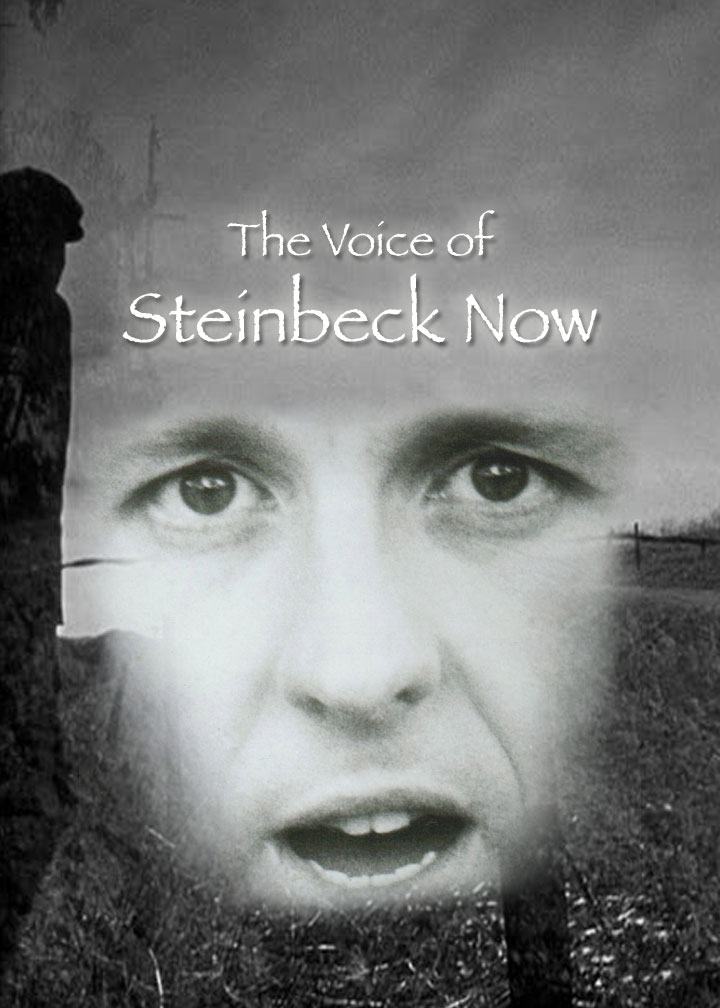
Image of Alan Brasington reading short stories by Steve HaukAlan Brasington is an American actor and writer from New Paltz who trained at London’s Royal Academy of Dramatic Art and lives in New York City. This week he begins his latest role as the voice of Steinbeck Now, reading the first of two short stories by Steve Hauk about John Steinbeck.

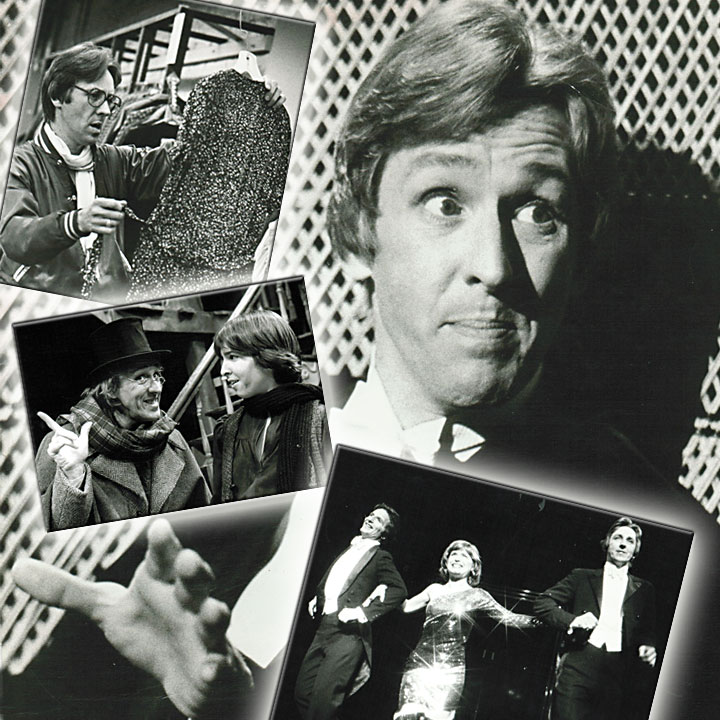
The road from college at SUNY New Paltz led through training in London to roles in Hollywood and on Broadway, where Alan performed in productions including the celebrated Noel Coward musical Oh Coward! Along the way he sang and danced, recorded and directed, and built a side business providing period props and costumes for major movies, commercial shows, and name-brand retailers. His current writing project is a novel. Like Steinbeck, he loves England and returns often. Like Steinbeck, his short stories and plays reflect universal human experience from an American point of view.

Image of Alan Brasington as Noel Coward, Scrooge, and costume designerOn stage Alan has played Scrooge and Shakespeare, danced and sung Noel Coward, and developed a distinctive Vincent-Price baritone rich in resonance, range, and New Paltz neutrality—an ability to reproduce multiple characters in recorded dialog without a give-away regional accent. John and Elaine Steinbeck’s New York ascendency coincided with Alan’s years in high school and college and at the Royal Academy, so the famous couple never met the aspiring young actor from New Paltz. But if they had, it’s easy to imagine Elaine spotting Alan (shown here performing in Oh Coward!) as a talent to watch.

Thanks to Alan Brasington’s literary leaning and Royal Academy training, Steve Hauk’s California short stories have found their ideal speaking voice. It happens to belong to a New Yorker from New Paltz with an ear for dialog, an eye for design, and a hand for writing imaginative short stories of his own. Ladies and gentlemen—meet Alan Brasington, the versatile voice of Steinbeck Now. Now sit back and enjoy his performance of “John and the River“—the first of Steve Hauk’s short stories about Steinbeck posted at SteinbeckNow.com.
Grapes of Wrath Views from the University of Oklahoma: Two Photographers, Two Novels, and Two Migrations

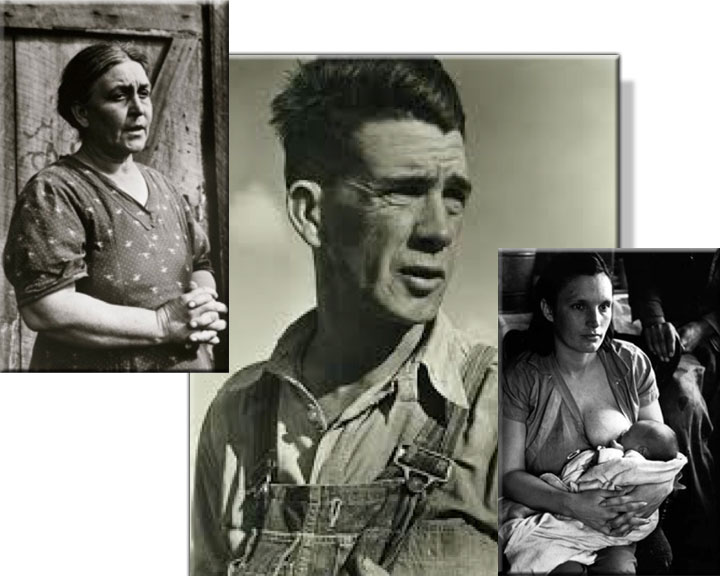
Image of Great Depression photos of migrant Joad figures made by Horace BristolThe day after John Steinbeck’s recent birthday, I spoke to an audience at the University of Oklahoma in Norman, where I teach, about three forgotten stories behind the writing, impact, and unintended consequences of The Grapes of Wrath. The occasion was an exhibition of works by the Great Depression photojournalist Horace Bristol, one of Steinbeck’s collaborators in the run-up to The Grapes of Wrath.

The venue was the Fred Jones Museum of Art at the University of Oklahoma, which figures significantly in the narrative behind John Steinbeck’s novel. Steinbeck may not have visited the state before he wrote The Grapes of Wrath, but Oklahoma cared deeply about his work—and not just in the negative way portrayed by the press. Closer consideration of John Steinbeck, his collaborators, and his fictionalized migrants seemed appropriate in preparing my talk as I contemplated the 75th anniversary of The Grapes of Wrath. What I uncovered wasn’t new but hidden. Here is a summary of my remarks to my University of Oklahoma audience.

Unequal Collaborators: John Steinbeck and Horace Bristol

Traveling on weekends on assignment for Life magazine from the end of 1937 to March 1938, Horace Bristol accompanied John Steinbeck to migrant camps in California’s Central Valley. The Steinbeck-Bristol partnership proved less than equal. Bristol needed the collaboration with Steinbeck more than the writer needed the photographer.

In Dubious Battle, the 1936 novel in which Steinbeck charted the anatomy of a Central Valley fruit pickers’ strike, hit sore nerves at both ends of America’s political spectrum and attracted noisy criticism from communists and conservatives alike. In August he moved on to the San Joaquin Valley to examine the living conditions of California migrant workers and their families for the left-leaning San Francisco News. His hard-hitting account of the struggle for survival of Great Depression migrants from the country’s ravaged heartland was serialized in the paper under the title “The Harvest Gypsies.” It was reprinted (with an additional chapter) in pamphlet form by the Simon J. Lubin Society in 1938 under the title Their Blood is Strong, with revenues going to migrant relief.

The Steinbeck-Bristol partnership proved less than equal. Bristol needed the collaboration with Steinbeck more than the writer needed the photographer.

Steinbeck’s 1937 novella Of Mice and Men—the searing story of the daily labors, fragile hopes, and ultimate tragedy that befall the itinerant ranch hands George and Lennie—became a national sensation; the New York stage version played to critical acclaim and ran for more than 200 performances. Clearly, Horace Bristol saw the professional benefits of collaborating with John Steinbeck, despite differences. Like the writer, however, the photographer was drawn on a deeply personal level to the suffering migrants they observed living in tents, makeshift shacks, and broken down vehicles, hidden along California’s byways and back roads.

The Horace Bristol-John Steinbeck collaboration for Life resulted in unforgettable examples of Great Depression photojournalism. But Bristol’s goal for the project—a book of his photographs accompanied by Steinbeck’s text—never materialized. By late May, Steinbeck had begun the hectic hundred days of writing that produced The Grapes of Wrath: Steinbeck’s sprawling manuscript, completed in November, was published in April 1939 to acclaim and attack. Clearly, one reason the Bristol-Steinbeck partnership never achieved full fruition is that Steinbeck was too busy writing his novel and dealing with the celebrity and controversy that ensued.

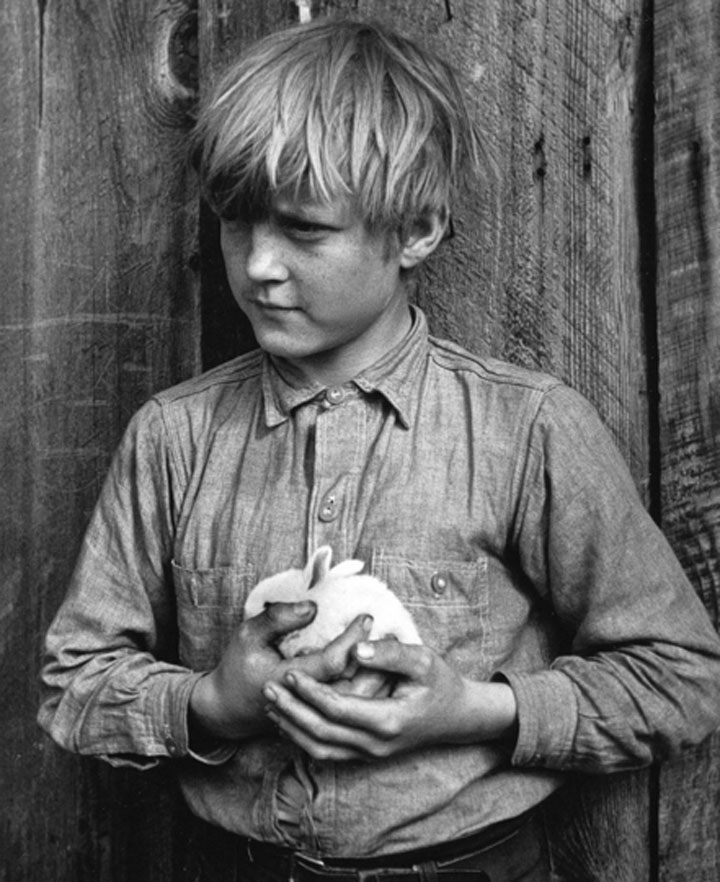
Image of another Grapes of Wrath migrant photo taken by Horace Bristol

But there is another reason: John Steinbeck could be an undependable collaborator. A proposed partnership with the photojournalist Dorothea Lange, whose pictures of Great Depression migrants deeply moved the author, also failed to materialize. And there was a third reason, too: Life refused to publish the text written by Steinbeck to accompany Bristol’s photographs. Although some of Bristol’s pictures appeared, the author’s language was too liberal for the magazine’s conservative tastes. John Steinbeck’s relationship with the Time-Life publishing empire never recovered; almost without exception, his books were panned by Time’s reviewers, despite the Pulitzer Prize he received for The Grapes of Wrath and the Nobel Prize for Literature he was awarded in 1962.

John Steinbeck could be an undependable collaborator. A proposed partnership with the photojournalist Dorothea Lange, whose pictures of Great Depression migrants deeply moved the author, also failed to materialize.

It is also worth noting that, while Steinbeck appreciated the visual arts and understood the power of words wedded to images, as a writer he may have doubted that documentary photography was the most desirable medium to illustrate his powerful prose. Indeed, as pointed out by James Swensen—whose manuscript “Picturing Migrants” is scheduled for publication by the University of Oklahoma Press—the 1939 dust jacket of The Grapes of Wrath featured, not a real-life image by Bristol, Lange, or any of the other Farm Security Administration photographers documenting the Great Depression in disturbing detail, but a made-to-order painting by the commercial illustrator Elmer Hader. To the chagrin of Ron Stryker, head of the Historical Section of the Farm Security Administration, the deluxe two-volume version of The Grapes of Wrath published in 1940 by Viking Press featured a series of paintings by the Midwestern artist Thomas Hart Benton, not the photographs of Bristol, Lee, or Lange.

As a writer he may have doubted that documentary photography was the most desirable medium to illustrate his powerful prose.

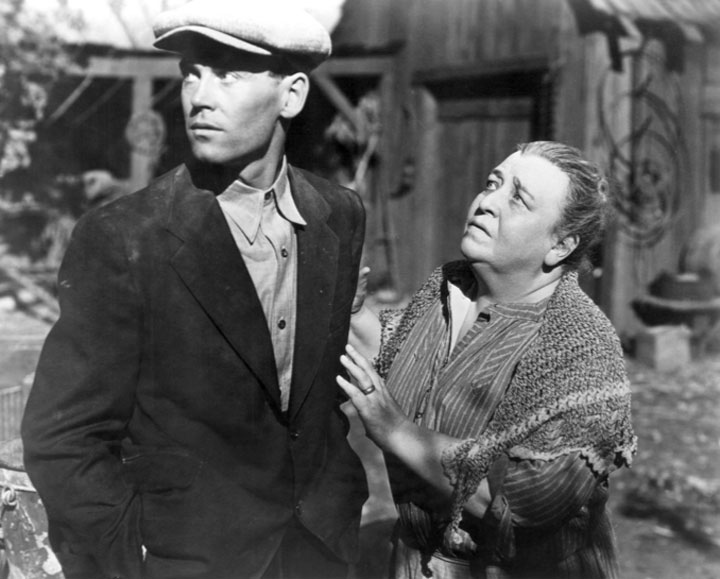
The pictures Bristol took on his travels with Steinbeck became famous anyway, thanks to their publication—along with images by Lange—in the April 1939 issue of Fortune and the June issue of Life, popular magazines with wide readership. As a result, Bristol’s photographs were used by the director John Ford in casting and costuming Ford’s award-winning movie adaptation of The Grapes of Wrath, released in January 1940. A second Life magazine article followed a month later. It featured Bristol’s “Joads” (shown above and at the top of the page) and the movie’s characters (shown below), displayed side by side with the telling tag, “Speaking of Pictures. . . these by Life prove facts in ‘Grapes of Wrath.’”  However reluctantly the editors recognized the truth of Steinbeck’s book, they never approved of its author.

Image of fictional Joads from film version of The Grapes of Wrath

Russell Lee, The Grapes of Wrath, and a Great Depression Photography Exhibition at the University of Oklahoma

Now to an unfamiliar twist in this oft-told tale, one that is explored by James Swensen in his forthcoming study for the University of Oklahoma Press. To capitalize on the success of John Steinbeck’s novel and John Ford’s film, Ron Stryker’s Historical Section began mounting Grapes of Wrath exhibitions of work by the agency’s various photographers—with text taken from the novel—showing the conditions in Oklahoma and other parts of America’s Southern Plains that precipitated the exodus of native farm families, the problems they faced on the road, and their plight once they reached California. In March 1940, an FSA exhibition of 48 works by Russell Lee, Dorothea Lange, Arthur Rothstein, and Ben Shahn (although none by Horace Bristol) appeared in the University of Oklahoma’s Memorial Student Lounge, sponsored by the departments of Sociology and Anthropology.

Willard Z. Park, an Anthropology Department faculty member, was the person most responsible for bringing the exhibition to campus.  Park—whose brief tenure at the University of Oklahoma lasted from 1938 to 1942—was also part of a faculty group that purchased four copies of The Grapes of Wrath for the university library to help meet demand for the book—more than 100 University of Oklahoma students were on the waiting list to check out John Steinbeck’s novel. Swensen notes that in the wake of the campus exhibit “several [University of Oklahoma] students made trips to a local migrant colony in Norman, called ‘Tower Town,’ to see the plight of the migrants themselves.” Tower Town was located near 804 East Symmes Street, just east of Porter Avenue.

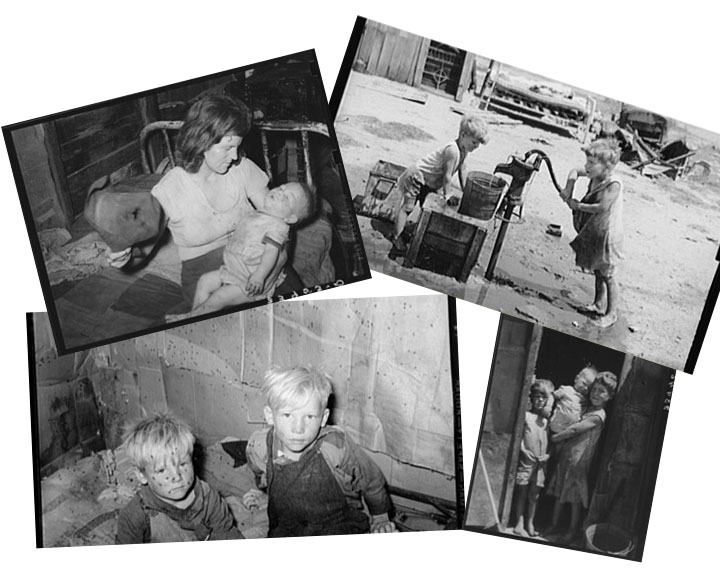
Image of Great Depression photographs taken in Oklahoma City by Russell Lee

As poor as living conditions were for some Norman residents, Swensen explains that the FSA photographers who documented the plight of displaced Oklahomans during the latter years of the Great Depression traveled instead to the banks of the Canadian River in Oklahoma City, where more than 3,000 homeless Oklahomans had camped out. The University of Oklahoma Grapes of Wrath exhibition featured photographs of the Oklahoma City camps made by Russell Lee in 1939. Four examples of Lee’s harrowing images are shown above. They bear visual witness to Henry Hill Collins’ description of Oklahoma poverty in his 1941 book America’s Own Refugees: Our 400,000 Homeless Migrants (Princeton University Press):

Many of the inhabitants of this camp, a rent-free shack-town fashioned over and out of a former dump, were drought and tractor refugees from farms elsewhere in the State. . . . The ‘Housing’ . . . was almost entirely pieced together out of junk-yard materials by the unfortunates . . . . Neither camp provided sanitary facilities; children, looking like savages, played in the dumps, wandered along the neighboring, muddy banks of the half-stagnant Canadian River. . . . [S]o foul were these human habitations and so vast their extent that some authorities reluctantly expressed the belief that Oklahoma City contained the largest and worst congregation of migrant hovels between the Mississippi River and the Sierras.

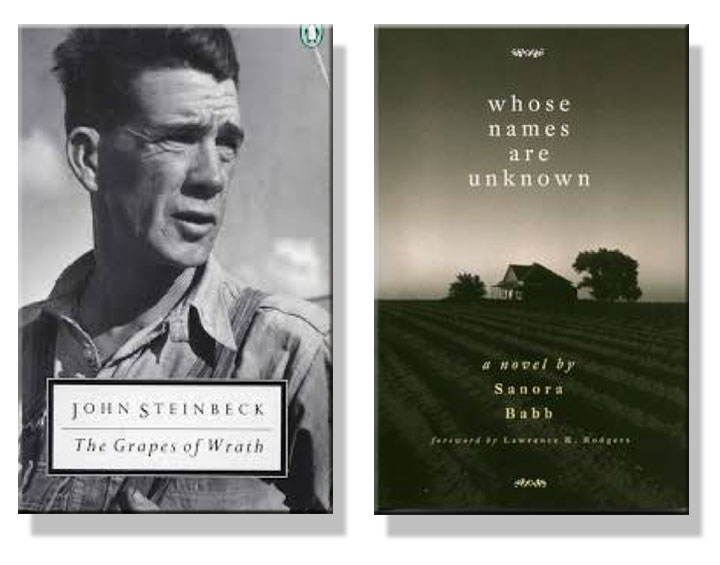
Image of John Steinbeck's Grapes of Wrath and Sanora Babb's Whose Names are Unknown

Whose Names are Unknown: Oklahoma’s Forgotten Novel

Our next story concerns a Great Depression novel written at the time of The Grapes of Wrath that remained unpublished until 2004. Its author was the remarkable Oklahoma native Sanora Babb. Born in the Territory’s Otoe Indian community in April 1907, seven months before Oklahoma became a state, Babb was living in California in 1938 and working for the Farm Security Administration. A contemporary of John Steinbeck, she actually met the author twice. She also kept detailed notes on what she observed in the California camps, copies of which were loaned by her boss Tom Collins—the man to whom Steinbeck dedicated The Grapes of Wrath—along with the meticulous reports Collins wrote about Oklahoma migrant culture and dialect.

John Steinbeck used Collins’ anecdotes and statistics to research The Grapes of Wrath. Sanora Babb used the stories she gathered to write her own novel, Whose Names are Unknown. Its title and subject attracted the attention of Bennett Cerf, the editor at Random House, who wanted to publish her book. Cerf abandoned his plans when The Grapes of Wrath became an overnight bestseller, another collateral casualty of John Steinbeck’s phenomenal success. When Babb approached Pascal Covici, Steinbeck’s loyal editor at Viking, he also declined.

As a result, Whose Names are Unknown was unread for 65 years years before being published by the University of Oklahoma Press. But Babb’s book stands on its own feet as a classic of Great Depression fiction with significant differences from Steinbeck. While The Grapes of Wrath deals with migrants from far east-central Oklahoma—Sallisaw, in Sequoyah County, which was affected by drought and decline but wasn’t a Dust Bowl environmental disaster—Babb’s novel is set in Cimarron, the state’s westernmost county, roughly 450 miles from Sallisaw and squarely within the area of America’s Dust Bowl devastation. Unlike the author of The Grapes of Wrath, Babb was an Oklahoma native who experienced extreme poverty as a child and knew her people and their land firsthand.

Whose Names are Unknown was unread for 65 years before being published by the University of Oklahoma Press.

Babb had moved to California in 1929 to take a job at the Los Angeles Times. When she arrived the stock market had crashed, the Great Depression had begun, and the promised job dried up. A migrant without a home, she slept in a city park before leaving for Oklahoma in the mid-1930s, where she witnessed the terrible poverty gripping her native state. Eventually she returned to California to work for the FSA, serving migrant families stranded without a home or a job, just as she had been years earlier. In contrast, John Steinbeck gained much of his understanding of Great Depression conditions in Oklahoma second hand, through reading reports by federal aid workers like Babb and Collins and from his experience delivering food and aid to California migrants from the Southern Plains.

Still, the John Steinbeck-Sanora Babb story sounds like a classic smash-and-grab: celebrated California author steals the material of unknown Oklahoma writer, resulting in his financial success and her failure to get her work published. Ken Burns’ 2012 documentary The Dust Bowl touches on the subject, devoting space to Babb’s life and book in The Grapes of Wrath’s giant shadow. But Steinbeck absorbed field information from many sources, primarily Tom Collins and Eric H. Thomsen, regional director of the federal migrant camp program in California, who accompanied Steinbeck on missions of mercy.

As noted, John Steinbeck acknowledged Collins’ importance in his research for The Grapes of Wrath, although his promise to write an introduction and help Collins’ get his reports published failed—not unlike John Steinbeck’s book project with Horace Bristol. If Steinbeck read Babb’s extensive notes as carefully as he did the reports of Collins, he would certainly have found them useful. His interaction with Collins and Thomsen—and their influence on the writing of The Grapes of Wrath—is documented because Steinbeck acknowledged both. Sanora Babb went unmentioned.

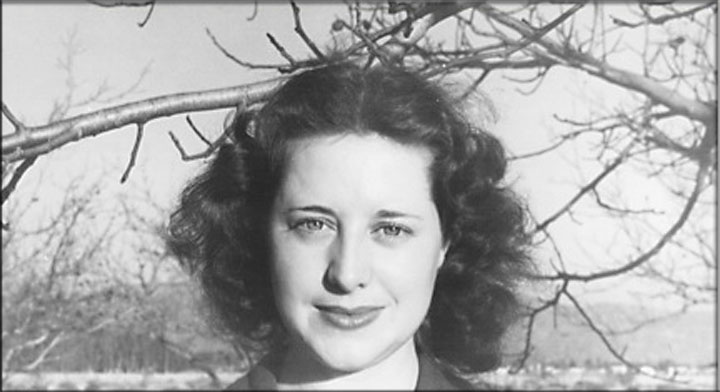
Image of Tom Collins and Sanora Babb in Great Depression photographImage of Sanora Babb with migrant organizer and girlImage of Sanora Babb with Grapes of Wrath migrant group

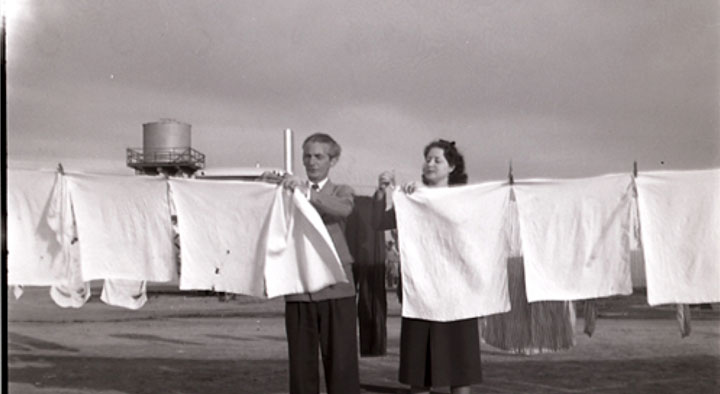
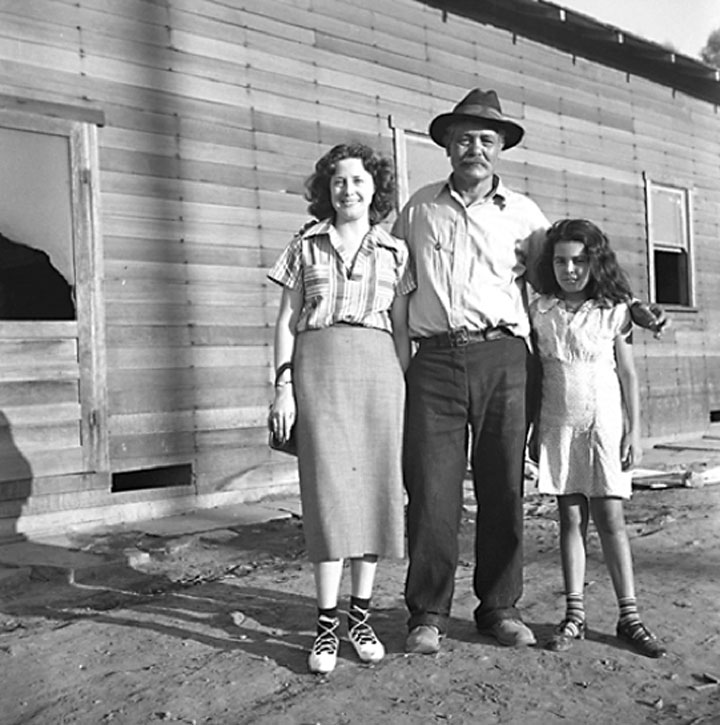
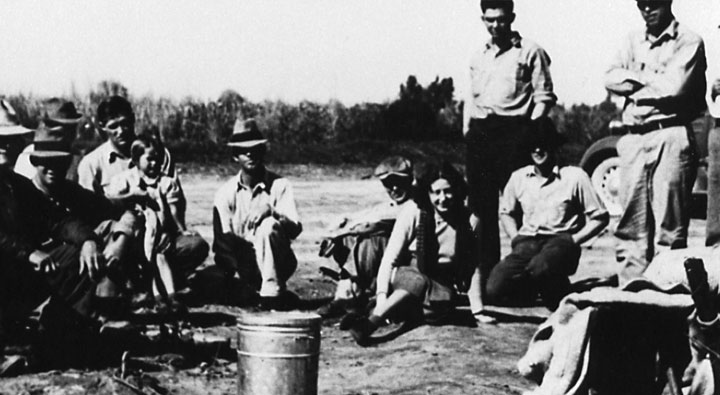
Whose Names are Unknown was published by the University of Oklahoma Press shortly before Babb (shown above hanging wash with Tom Collins, standing beside an identified labor organizer and girl, and sitting with a group of migrants) passed away at 98. Like The Grapes of Wrath, Babb’s novel is must-reading for serious students of the Dust Bowl and Great Depression in Oklahoma. Its primary characters are Julia and Milt Dunne, an Oklahoma couple with two daughters—Lonnie and Myra—who are caught outside with their pregnant mother when a sudden storm blows up and Julia takes a fall. As a result, Julia’s third child is still-born, like Rose of Sharon’s infant in The Grapes of Wrath, and Milt buries the baby in the yard. Rose of Sharon’s abandonment by her husband in Steinbeck’s story is physical. Julia’s growing distance from Milt Babb’s narrative is psychological:

Sometimes Julia thought of the little boy who was so nearly born, saying in her mind it was better that he was dead, but in spite of this reasonable comfort, she felt the monotonous ache of grief and of Milt’s frustration. That peculiar ripening joy she had felt—with the child filling her and moving strongly with his secret life—had left her. The emptiness of her womb crept into her emotions, and she went through the days and nights feeling numb and alone. Milt was morose and easily angered, and although he spoke of the boy only once or twice, she felt coming from him some undetermined blame toward her.

Parallel Migrations: The Southern and the Northern Plains

Unlike our focus on two novels and two photographers in exploring the background of The Grapes of Wrath, our view of their Great Depression context requires a wide-angle perspective on the contrasting demographics of migration patterns from the Great Plains to the promised lands of the American West in the 1930s. I say promised lands because migration to California from Oklahoma and other Southern Plains states wasn’t the only instance of mass westward movement during the decade recorded in John Steinbeck and Sanora Babb’s writing and the photographs made by Horace Bristol and Russell Lee.

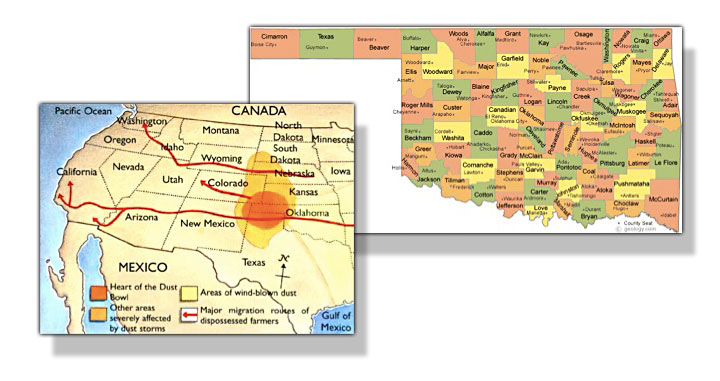
James Gregory, the preeminent historian of the migration of Southwesterners to California during the Great Depression, places the total figure for out-migration to the Golden State in the 1930s from the Arkansas, Missouri, Oklahoma, and Texas at 315,000-400,000.  (California received about a million American migrants during the decade, and they came from all over America, not just the Southern Plains.) Notably, fewer than 16,000 of these Great Depression refugees—less than six percent of the total number of migrants from the four states mentioned who ended up in California—came from the area of the Dust Bowl.  Gregory notes that journalists of the period are primarily to blame for “confusing drought with dust” and oversimplifying the facts: “the press created the dramatic but misleading association between the Dust Bowl and the Southwestern migration.” The subtitle of Gregory’s excellent book—American Exodus: The Dust Bowl Migration and Okie Culture in California (Oxford University Press, 1991)—makes this critical point.

Migration to California from Oklahoma and other Southern Plains states wasn’t the only instance of mass westward movement during the decade recorded in John Steinbeck and Sanora Babb’s writing and the photographs made by Horace Bristol and Russell Lee.

So it isn’t surprising that the role played by Oklahoma and its residents looms so large in the public memory of the Southern Plains migration to California during the Great Depression. The Federal Writers Project’s publication Oklahoma: A Guide to the Sooner State (1941) reported that half of the state’s population was on relief by the late 1930s. In his remarkable 1942 study, Ill Fares the Land: Migrants and Migratory Labor in the United States, California’s progressive journalist Carey McWilliams stated that by 1935, “61.2 per cent of farms in Oklahoma were operated by tenants” and between 1935 and 1940 Oklahoma lost a total of 32,000 farms or more at a rate of 18 per day.  Moreover, McWilliams noted, from July 1, 1935 to June 30, 1939, almost 71,000 Oklahomans crossed the Arizona border into California. Interestingly, the bulk of this exodus came from Oklahoma’s populous central counties; the four counties with the highest number of outbound migrants were Oklahoma, Caddo, Muskogee, and Tulsa.

As Oklahomans, Californians, and readers of The Grapes of Wrath quickly learned, the term “Okie” became a derisive identifier for all  migrants to California, not only from Oklahoma but from other Southwestern states as well. “Little Oklahoma” was the local name for the Alisal, the area east of John Steinbeck’s hometown of Salinas where white migrants from the Plains states were clustered, out of sight and out of mind of respectable Salinians—as Steinbeck noted in his letters and in L’Affaire Lettuceberg, the angry satire he wrote (and destroyed) before beginning The Grapes of Wrath.

‘Okie’ became a derisive identifier for all migrants to California, not only from Oklahoma but from other Southwestern states as well.

Even today, it is hard to avoid perpetuating the “Okie” and “Dust Bowl” stereotypes and the oversimplifications that they represent. These became so  pervasive that historians of the Great Depression have paid little attention to a parallel migration of similar size—approximately 300,000 individuals—from the Northern Plains states of Nebraska, South Dakota, and North Dakota to the Pacific Northwest states of Washington, Oregon, and Idaho. One historian, Rolland Dewing, has helped correct the record, explaining that Northern Plains migrants left their home states because of drought conditions and economic collapse, much like their counterparts to the south. In Regions in Transition: The Northern Great Plains and the Pacific Northwest in the Great Depression (University Press of America, 2006), Dewing notes that approximately two-fifths came from North Dakota, two-fifths from South Dakota, and one-fifth from Nebraska.

Image of maps showing Great Depression migration patterns

Steinbeck’s Oklahomans and America’s “Other Migrants”

But as massive in scale as the migration from the Northern Plains to the Pacific Northwest became during the Great Depression, the particulars of this phenomenon have for a variety of reasons remained largely forgotten. As Rolland Dewing explains in his book, there was no agribusiness equivalent to California’s Central and Imperial valleys in the Pacific Northwest—no foundation for the systematic economic exploitation and mistreatment of the newcomers.

The Northwest timber industry was doing quite well as the Northern Plains economy collapsed, and this stability—along with other positive economic factors in Washington, Oregon, and Idaho—helped ease the transition of Northern Plains migrants, which peaked in 1936, when the economy of the host region was picking up. Because the population of the Pacific Northwest was aging at the time of the Great Depression, younger migrants were welcomed by many as a demographic addition, unlike those arriving in California from Oklahoma and other Southern Plains states, like the Joads in The Grapes of Wrath.

Because the population of the Pacific Northwest was aging at the time of the Great Depression, younger migrants were welcomed by many as a demographic addition, unlike those arriving in California from Oklahoma and other Southern Plains states, like the Joads in The Grapes of Wrath.

Then, too, the socioeconomic and educational levels of Northern Plains migrants were closer to those of the Pacific Northwest states, so newcomers and hosts shared more in common than Southern Plains migrants did with less friendly Anglo-Californians. Indeed, many residents of the Pacific Northwest had been born or maintained family roots in the upper-Midwest: Northern Plains migrants seemed more alike than different in background and behavior to their hosts.

Like Steinbeck’s migrants in The Grapes of Wrath, Northern Plains residents suffered terribly during the Great Depression. South Dakota, for example, experienced a seven percent population decline in the 1930s. The population loss for Oklahoma was much less: the state’s population was 2,396,040 in 1930 and 2,336,434 in 1940 (a 2.5 percent decline). But migrants from the Northern Plains to the Pacific Northwest never experienced suffering on the scale of their southern counterparts who migrated to California. No one wrote a Grapes of Wrath about them. As a consequence their stories have been largely forgotten.

Image of Sanora Babb, author overshadowed by John Steinbeck

Rescuing Sanora Babb from John Steinbeck’s Shadow

Horace Bristol and Russell Lee were among the most important documentary photographers of Great Depression America. Like the pictures of migrant mother and children made by Dorothea Lange, their images helped sear the truth behind The Grapes of Wrath into America’s collective consciousness. The photographs Bristol took on assignment with Steinbeck for Life proved essential to the casting and costuming of the Joads in the movie version of the novel. But if The Grapes of Wrath hadn’t been so successful, Sanora Babb’s novel of Oklahoma would probably have been published as promised and might have become a Great Depression classic being celebrated, like The Grapes of Wrath, on its 75th anniversary.

Finally, if Steinbeck’s timeless prose—along with photographs by Bristol, Lee, and Lange and John Ford’s movie—hadn’t evoked the Southern Plains exodus to California so powerfully for Americans living through the Great Depression, our memory of migration in the 1930s might include the parallel movement of Northern Plains refugees to the Pacific Northwest. But the migration of these displaced Americans wasn’t chronicled by a John Steinbeck or a Sanora Babb: their suffering was on a smaller scale and they encountered less hostility. Thus art copies history but also reflects it. New light on Great Depression migration and the forgotten background of The Grapes of Wrath from the University of Oklahoma further illuminates Steinbeck’s masterpiece. It also helps rescue a forgotten work, written by a native Oklahoman, from the shadow of a greater writer.

SteinbeckNow.com is proud to publish David Wrobel’s feature as the 80th post produced by our website in its first eight months. A scholar of United States history, David is also an avid reader and deep thinker on the writing of John Steinbeck. He contributed a chapter about Steinbeck’s social-protest fiction to Regionalists on the Left, an anthology of essays edited by Michael C. Steiner, and he gave a lecture, John Steinbeck’s America: A Cultural History of the Great Depression and World War II, to a large audience at the University of Oklahoma’s 2013 Teach-In on the Great Depression and World War II. He is currently working on “John Steinbeck’s America: A Cultural History, 1930-1968.”

Roger Williams University Honors The Grapes of Wrath in Liberty’s Rhode Island

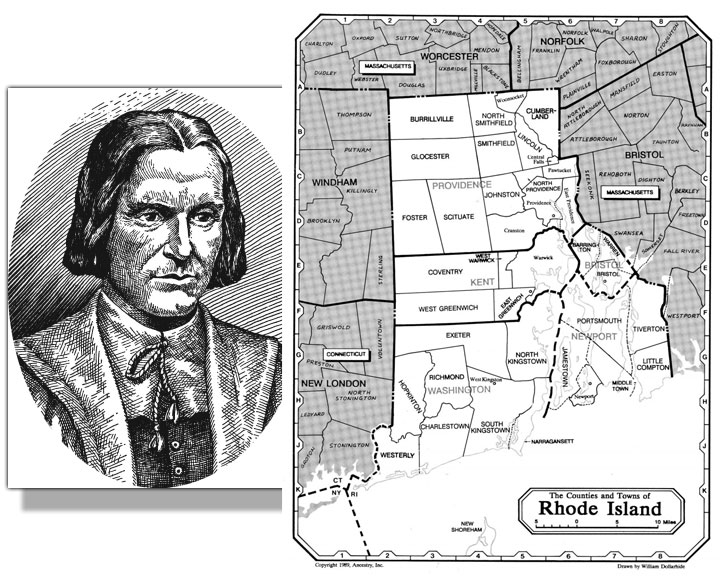
Image of founder Roger Williams with map of Rhode IslandAmerica’s 2014 celebration of The Grapes of Wrath, written in California and published in 1939, became bicoastal on February 1, when Roger Williams University kicked off a two-month exhibition devoted to the novel’s historical context and contemporary relevance with a lecture by Robert DeMott, an international authority on John Steinbeck’s life and work. The location was propitious: Rhode Island, the home of Roger Williams University, began in 1636 as Providence Plantation, a refuge for minorities fleeing religious persecution in neighboring colonies. Rhode Island retains the progressive spirit of Roger Williams, its colonial founder—a spirit that permeates The Grapes of Wrath and the literature of social protest.

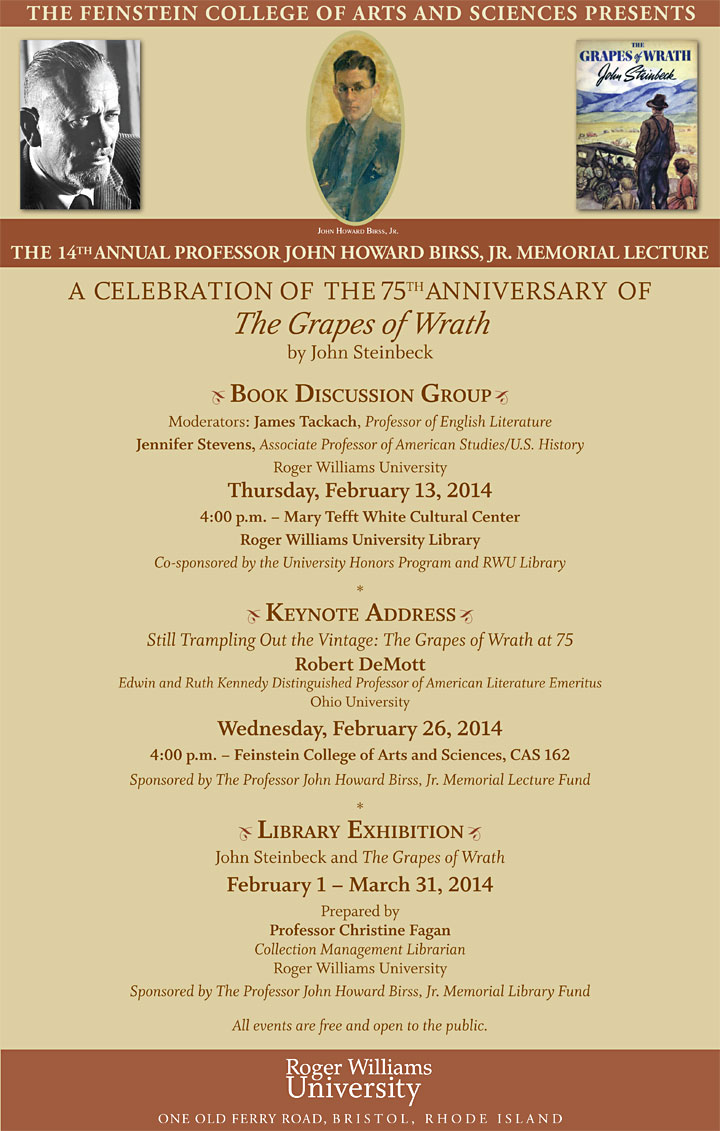
Image of Grapes of Wrath poster from Rhode Island's Roger Williams UniversityAs a collections and exhibitions manager for the Roger Williams University Library, I had the pleasure of collaborating in curating the exhibition with west coast colleagues at San Jose State University and with partners closer to Rhode Island: the Library of Congress; the University of Virginia; Redwood Library in Newport, near the Roger Williams campus; and individuals including Robert DeMott, a distinguished professor emeritus at Ohio University. Rhode Island’s celebration of The Grapes of Wrath is part of Roger Williams University’s Professor John Howard Birss, Jr. Memorial Program, an annual series of events honoring great works of literature now in its 14th year.

The Grapes of Wrath in Image, Text, and Facsimile

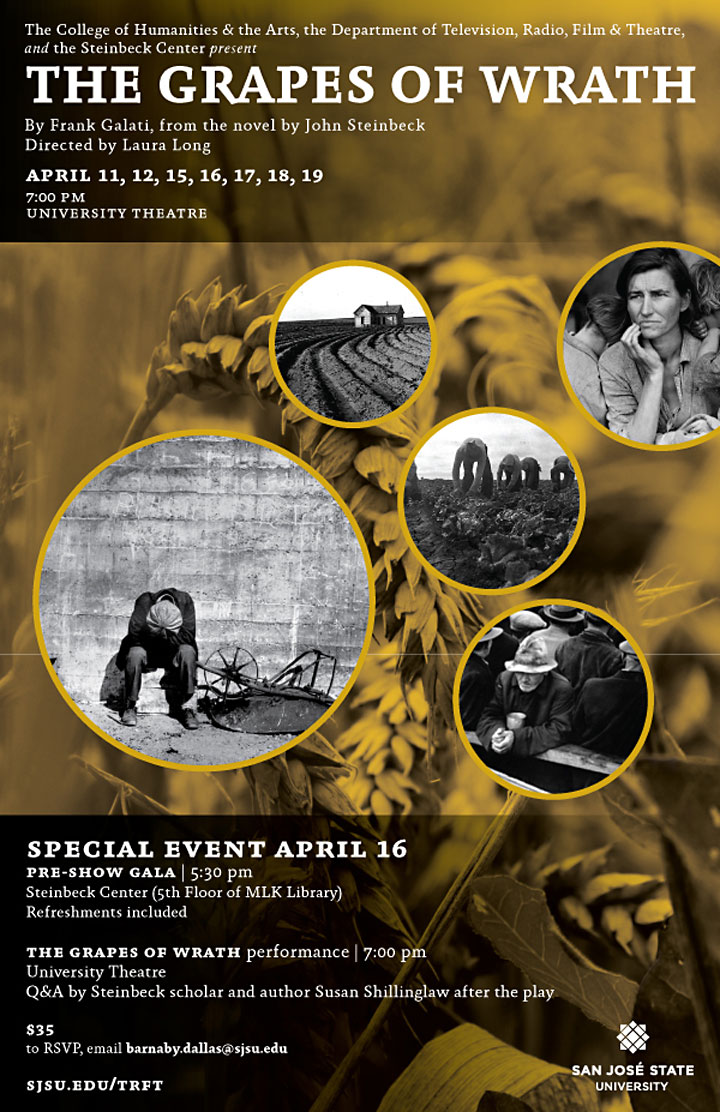
The exhibition—open to the public through March 31—is designed around themes such as the Dust Bowl and migrant workers and employs historical and contemporary photographs to document the background of the writing, publication, and aftermath of The Grapes of Wrath. The Dust Bowl section is composed primarily of Farm Security Administration photographs from the period. The section on California migrant workers today includes photographs from The Migrant Project: Contemporary California Farm Workers by Rick Nahmias. The book focus of the exhibition features facsimile selections from the digitized manuscript of The Grapes of Wrath, written in Steinbeck’s cramped, hard-to-read hand at his home in the Santa Cruz mountains, far from Rhode Island but close to his novel’s California context.

Why Rhode Island Loves Carol Henning Steinbeck

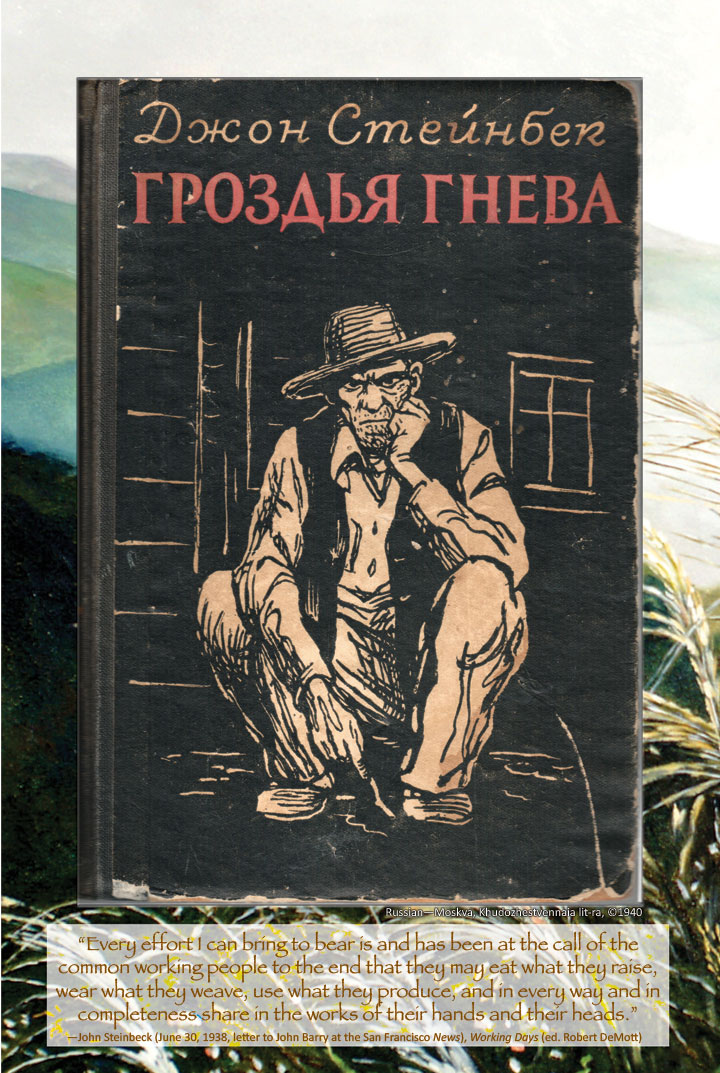
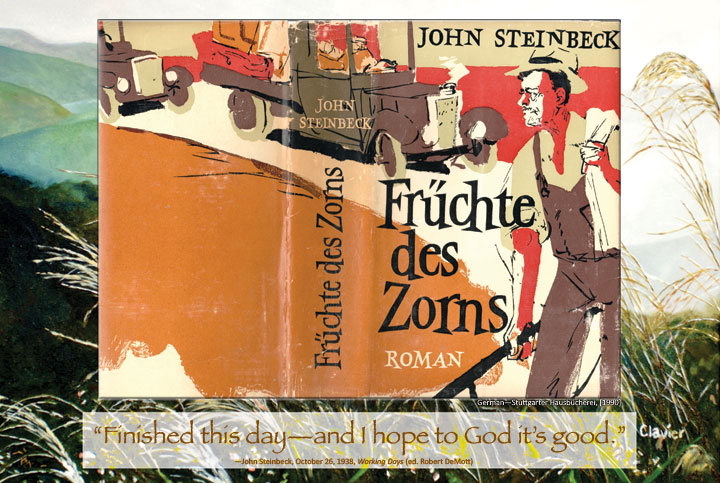
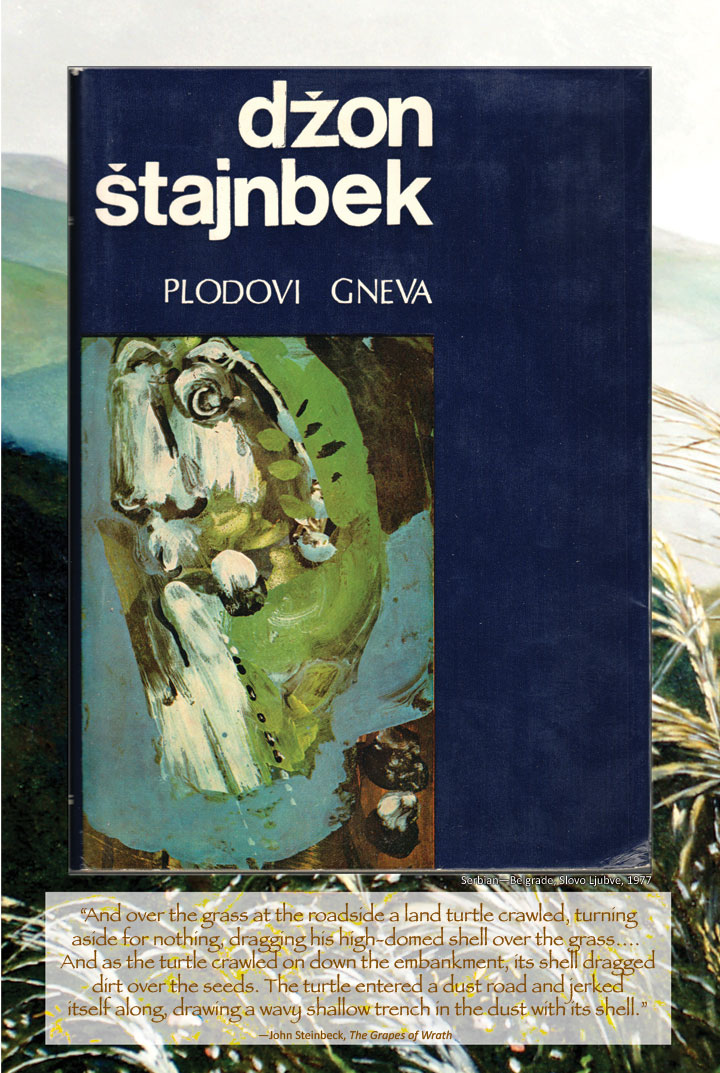
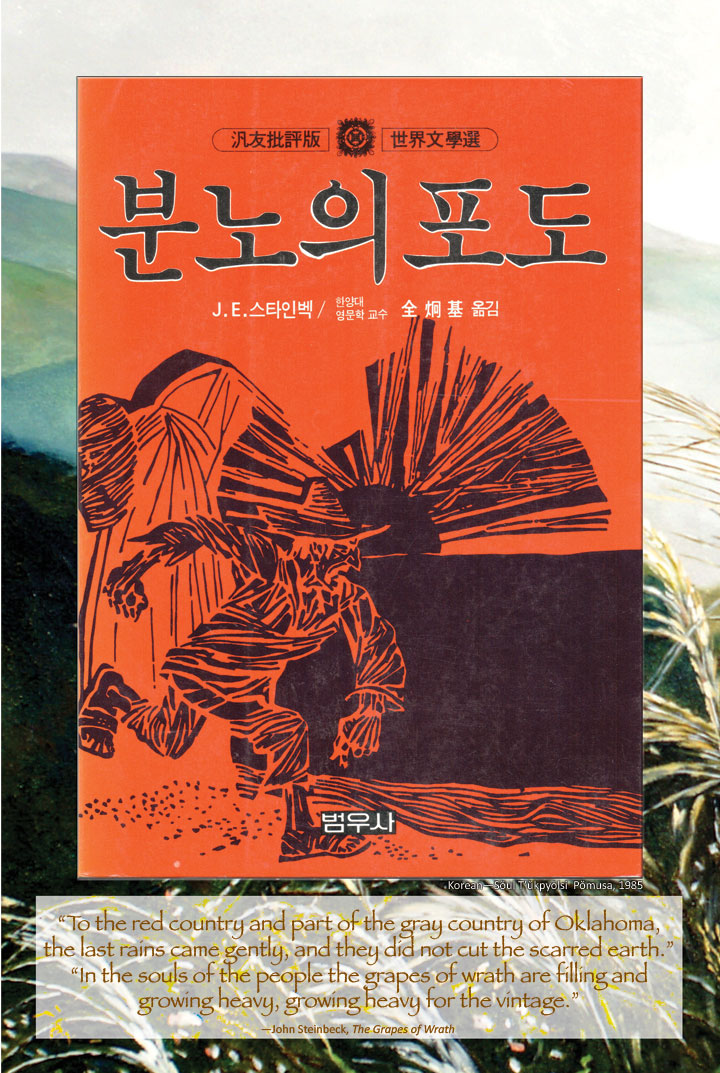
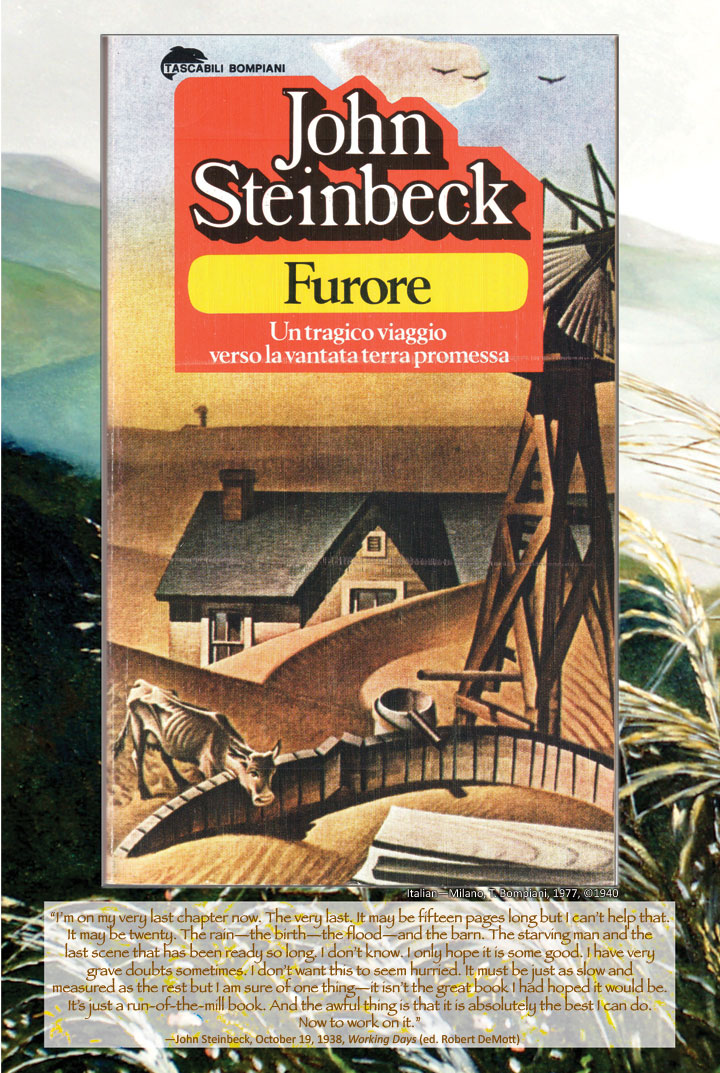
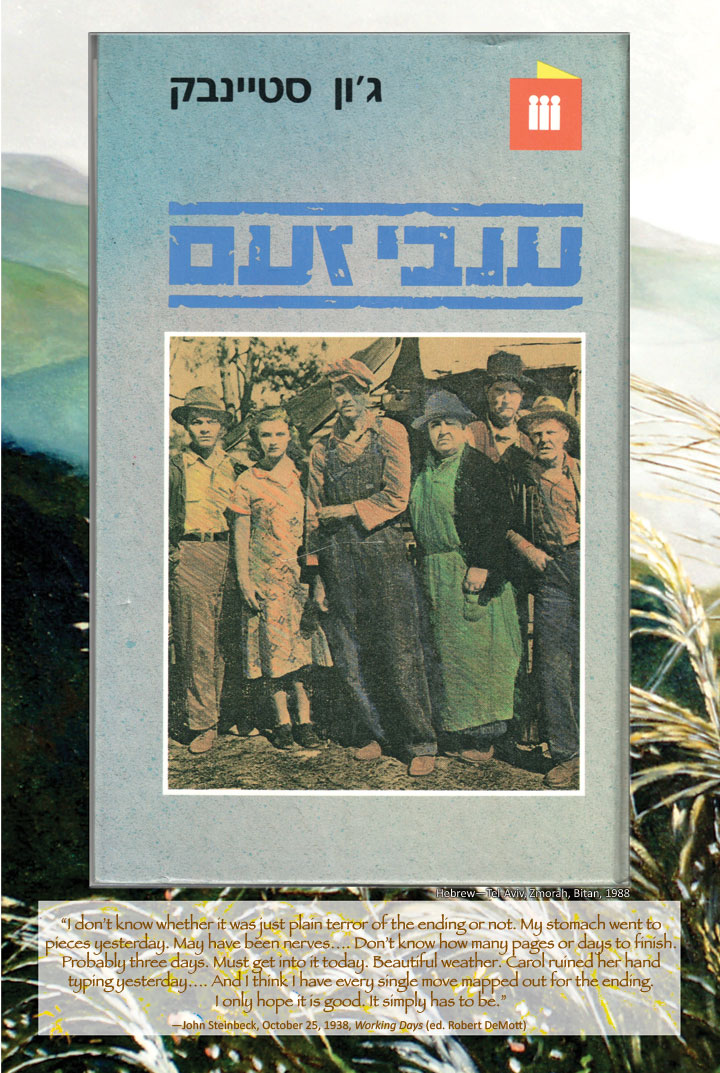
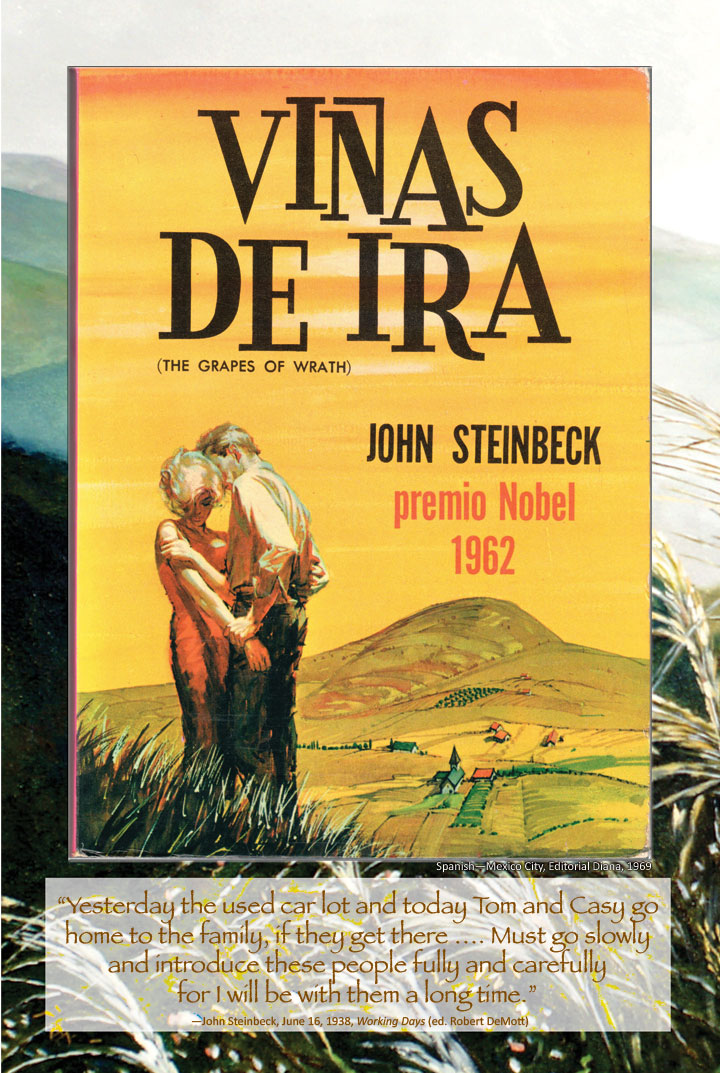
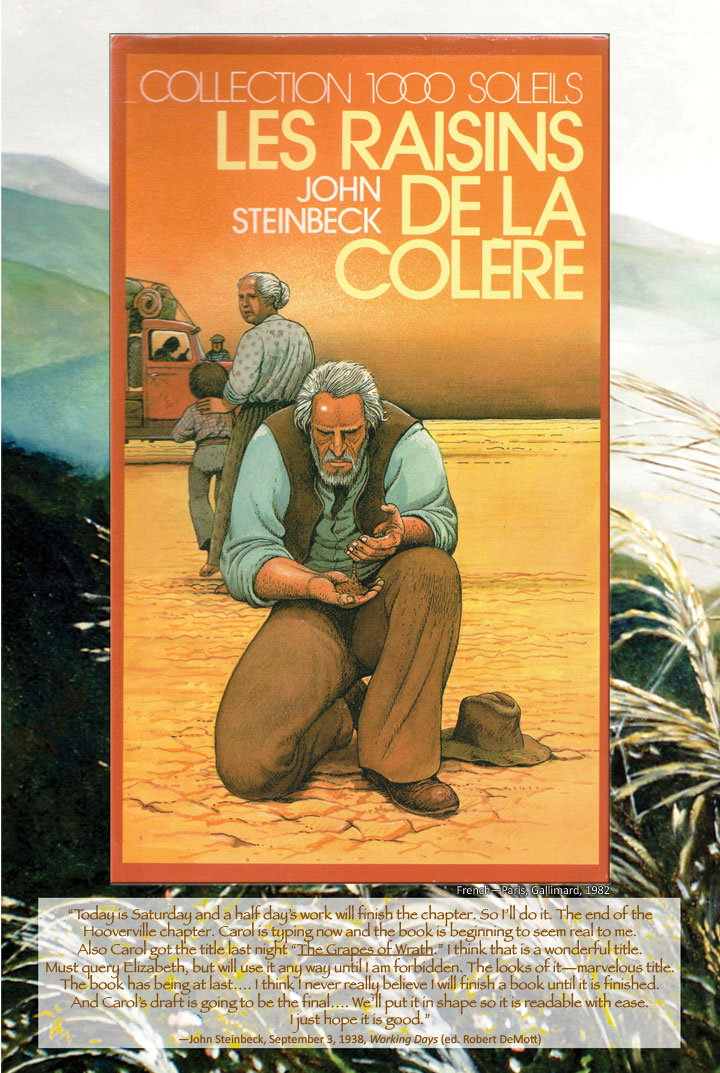
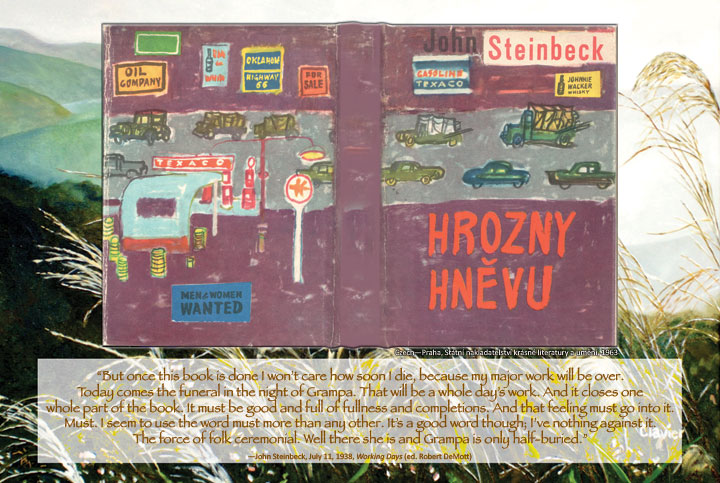
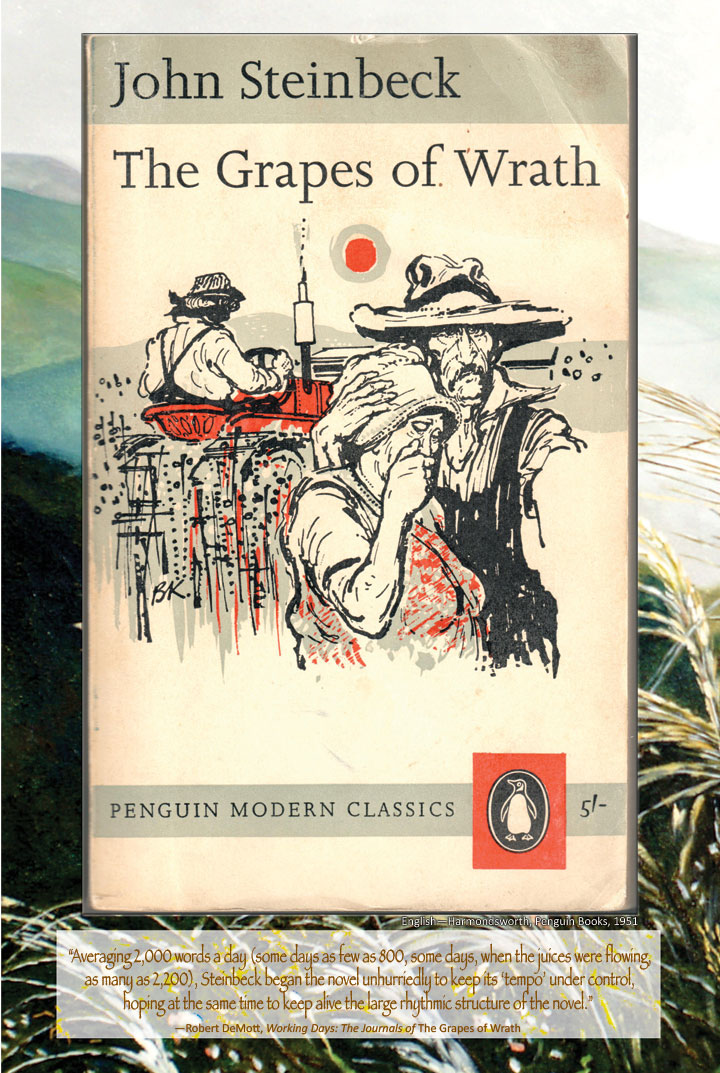
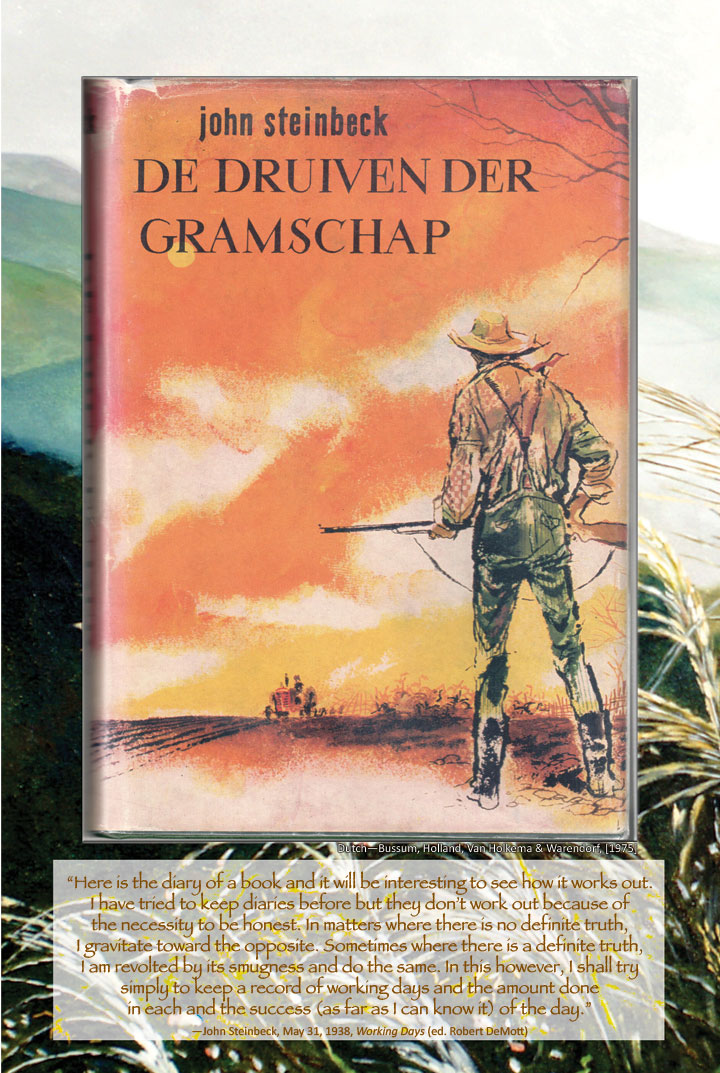
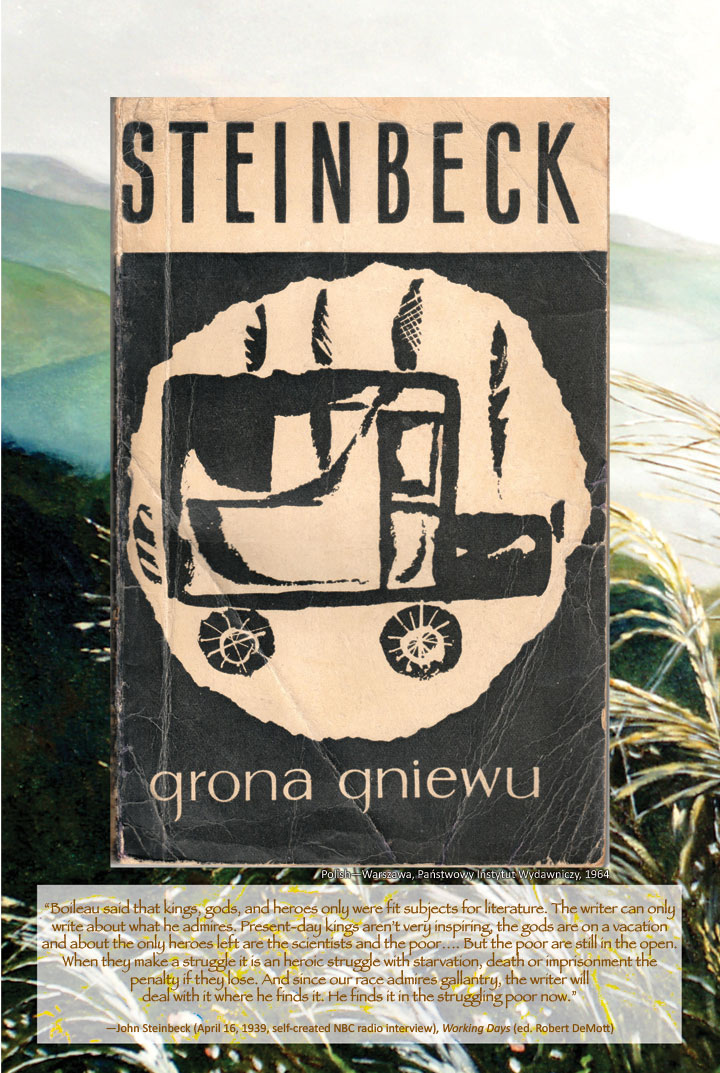
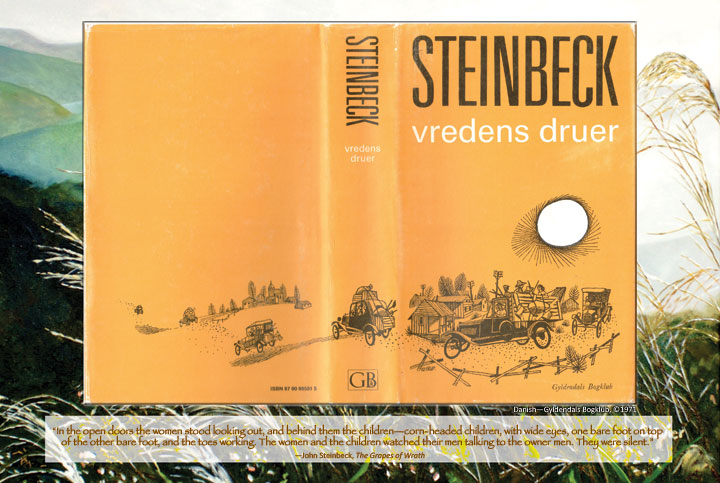
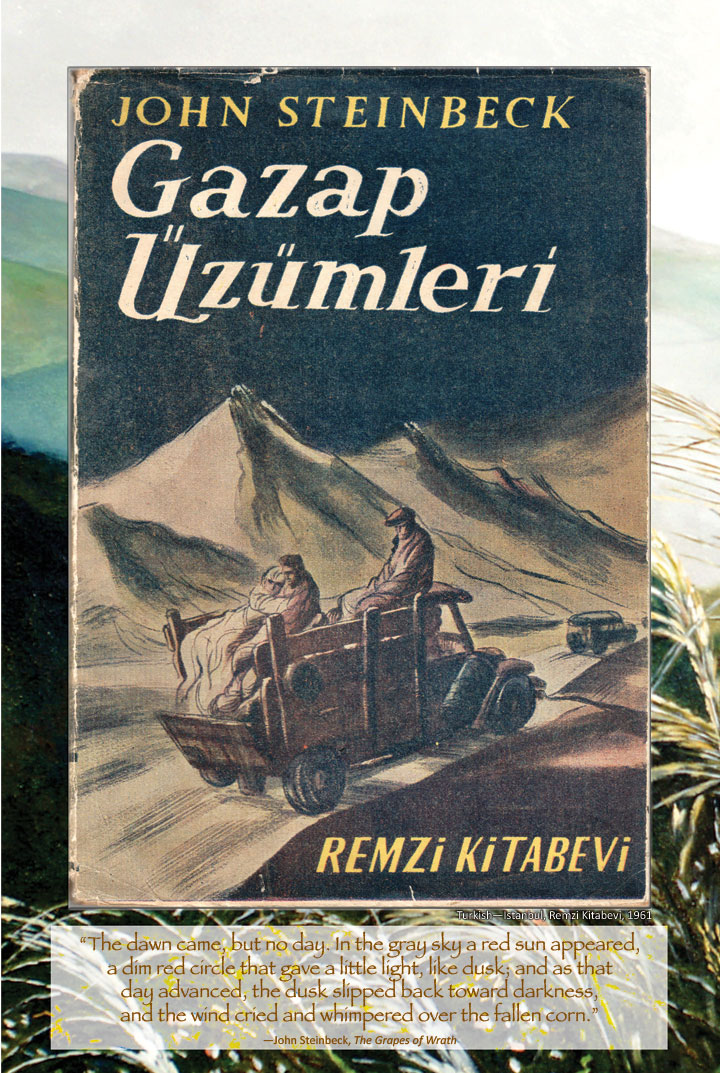
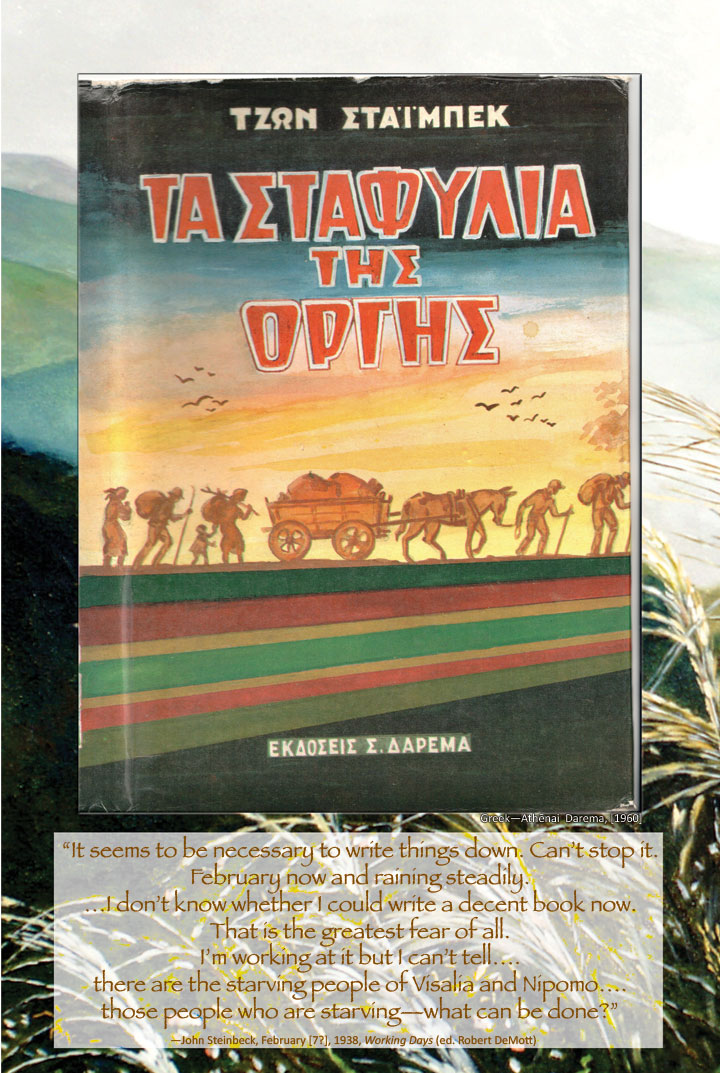
Carol Henning, Steinbeck’s first wife, was an artist and activist who served as the author’s amanuensis and adviser. The title of The Grapes of Wrath was her idea, and she was an intuitive editor. At Roger Williams University, we chose to honor her talent and independence with samples of her drawings and sculpture. Along with Susan Shillinglaw’s recent biography of the Steinbeck-Henning marriage, the book section includes Working Days, Robert DeMott’s meticulous edition of the journal entries made by Steinbeck during and following the writing of The Grapes of Wrath. Like our colleagues at the Martha Heasley Cox Center for Steinbeck Studies in San Jose, California, we chose cover art from foreign-language editions of The Grapes of Wrath that illustrate specific passages from Working Days.

Roger Williams Welcomes You in Person or Online

Rhode Island is small, friendly, and accessible. Visit us as we celebrate The Grapes of Wrath in the state with the motto Hope founded by Roger Williams—like Steinbeck, an advocate of liberty and apostle of hope who changed the course of history. If you can’t come to the Roger Williams University campus, share the experience online. Our exhibition page features a section not included in the physical exhibition: the adoption of the Library Bill of Rights by the American Library Association. A direct result of the censorship issues associated with The Grapes of Wrath, this pioneering document is powerful proof that The Grapes of Wrath matters, the point and purpose of liberty-loving Rhode Island’s bicoastal collaboration.

Hear The Grapes of Wrath—Steinbeck Suite for Organ

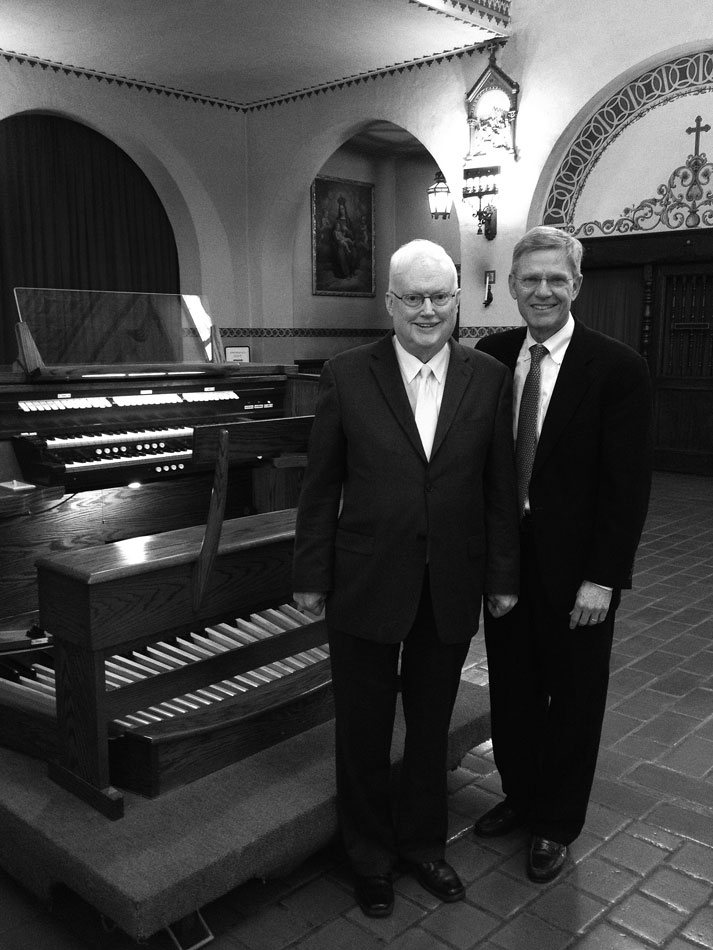
Image of Franklin Ashdown and James Welch at Mission Santa ClaraSanta Clara University recently hosted a celebration in sound for the 75th anniversary of The Grapes of Wrath at California’s Mission Santa Clara—the world premiere of Steinbeck Suite for Organ by Franklin D. Ashdown (at left in photo), a prolific composer of popular contemporary organ music. As University Organist at Santa Clara University and a fan of Steinbeck’s fiction, I had the pleasure of performing the world premiere of Frank’s work in the program of American organ music that I played to conclude Santa Clara University’s 2014 Festival of American Music on February 16. Inspired by passages from The Grapes of Wrath and Tortilla Flat, Steinbeck Suite for Organ brought the Mission Santa Clara audience—which included Lothar Bandermann, a distinguished composer of orchestral, choral, and organ music who shares John Steinbeck’s German heritage—to its feet. (Scroll down to play audio.)

Organ Music for The Grapes of Wrath and Randall Ray

Steinbeck’s biographers say that the writer studied piano, sang in choirs, and appreciated organ music, particularly Bach. Since The Grapes of Wrath appeared, the music-minded author’s spirit has inspired almost every kind of music—including Aaron Copland’s musical setting of The Red Pony— except that written for the pipe organ. Thanks to a fan who lives near Santa Clara University and appreciates Frank’s organ music as much as he does Steinbeck’s writing, this condition ended with the commission of Steinbeck Suite for Organ in celebration of The Grapes of Wrath and in memory of Randall Ray, a North Carolinian who admired the novel and visited Steinbeck Country shortly before his untimely death in 2013. Members of the family present for the performance felt that the passages selected by the composer perfectly reflected Randall’s generous spirit and sympathy for the poor.

A World Premiere at California’s Mission Santa Clara

But hearing is worth a hundred words. Listen for yourself by clicking to enjoy each of the five movements of Steinbeck Suite for Organ recorded live on February 16 at Mission Santa Clara—music that reverberates with the pathos and exuberance of Tortilla Flat, The Grapes of Wrath, and John Steinbeck’s humanism. As I explained to the Mission Santa Clara audience, this organ music expresses energy, drama, and transcendence, qualities of Steinbeck’s writing, in colorful cascades of sound that rise and fall with the emotion of the passage being portrayed. Mission Santa Clara was a perfect venue for the world premiere, located on the Santa Clara University campus midway between Steinbeck’s home town of Salinas and San Francisco, the city where he attended opera and concerts as a boy. The program notes excerpted below were provided by the composer in the original organ music score.

I. Preambolo: “The Humanity of John Steinbeck”

In Preambolo, the first movement of this organ suite, Steinbeck’s sympathy for the individual and the common man is represented by the Trumpet stop which sounds a melody similar in character to Copland’s Fanfare for the Common Man. As the piece develops, a secondary theme builds to full organ, reflecting the immense influence of Steinbeck’s prose in American culture and politics.


II. Divertimento: The Grapes of Wrath

The Joad family joins a makeshift camp of fellow migrant pilgrims headed on Route 66 for the verdant valleys of California. They enjoy instant community as they trade stories, sit around the camp fire, sing folk songs and gospel songs, and finally join in a spirited square dance.


III. Miserere: The Grapes of Wrath

Ma Joad presents groceries for her large family at the check out counter. The clerk, a man with his own family to feed, cannot extend her credit. But he is sympathetic to her plight and pulls out a dime from his pocket to make up the difference. Miserere creates a somber tone which later brightens in response to the kindness of a stranger.


IV. Musica de los Paisanos: Tortilla Flat

Danny and his friends are a mixed Latino and Caucasian band of brothers living above Monterey, paisonos who spend their days adventuring and drinking booze. Musica de los Paisanos begins with a mellow haze and moves through a patchwork of stylized Spanish and Mexican folk tunes.


V. Toccata: Tortilla Flat

Danny, the central character of Tortilla Flat, inherited two houses. The smaller one, which he gave for the use of his paisanos, burned to the ground due to their carelessness. In a forgiving gesture, Danny let them move into his main home, where they enjoyed rich and colorful camaraderie, like the Knights of the Round Table. But it all ended when Danny died and his main house was consumed by flames. Toccata is emblematic of both houses burning.


Playing the Pipe Organ is a Family Affair

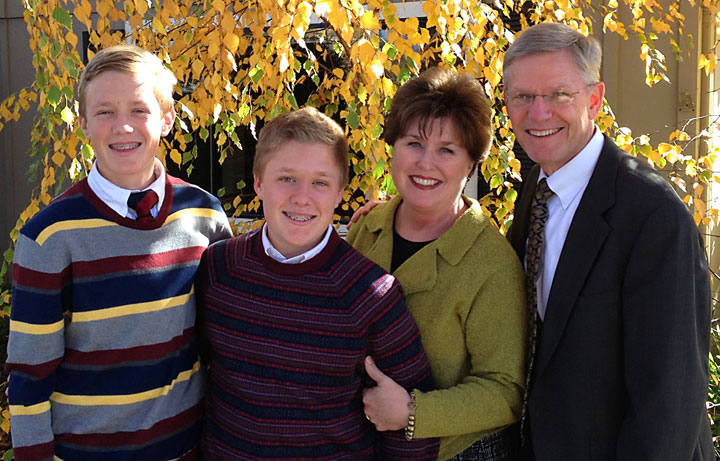
In addition to the world premiere of this piece, my February 16 program at Santa Clara University included organ music by American composers, such as Horatio Parker and Richard Purvis, that Steinbeck might have heard. As noted, the writer took piano lessons as a boy and enjoyed a variety of music, particularly the great American genres of jazz and Broadway, throughout his life. Following Steinbeck Suite for Organ on the Mission Santa Clara program, my son Nicholas, age 15, played the piano part for Clifford Demarest’s Fantasie for Piano and Organ, composed in 1917 when John Steinbeck was the very same age. Nicholas is shown at the far left of the photo with our son Jamison, 14, my wife Deanne, and me. Both boys are high school students in Palo Alto, California, where Steinbeck attended Stanford University. Like the writer John Steinbeck and the composer Frank Ashdown, our sons started piano early, and Nicholas now plays the pipe organ at church, as Frank and I did when we were growing up. Enjoying music was a family affair at the Steinbeck home in Salinas. It is at ours, too.

Image of the pipe organ-playing James Welch family

Recording provided by Santa Clara University with the permission of the composer and the performer. Program notes paraphrased by permission of Franklin D. Ashdown. The Mission Santa Clara pipe organ was built by Schantz Organ Company. Frank Ashdown’s choral and organ music is published by Morningstar, Augsburg Fortress, Alfred, Adoro, Concordia, and others. His distinctive compositions for choirs,  pipe organ, and other instruments have been performed in concert halls, churches, and cathedrals including the Mormon Tabernacle, Notre Dame de Paris, and St. Paul’s Cathedral in London. He was born in Utah, grew up in Texas, and lives in New Mexico, where he directs his church choir and composes on an ingenious digital organ, installed in his home, that produces convincing sampled pipe organ sounds.

San Jose State University Has The Grapes of Wrath Covered for 75th Anniversary

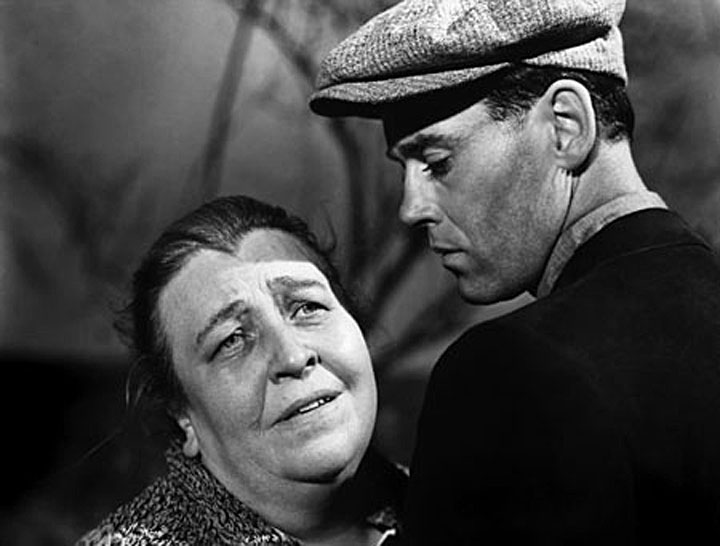
Image of Jane Darwell and Henry Fonda in movie version of The Grapes of WrathSince 1938, The Grapes of Wrath has been translated into more than 25 languages. In February, San Jose State University kicked off the novel’s 75th anniversary with an exhibit of 15 colorful covers selected from foreign editions of The Grapes of Wrath housed at San Jose State University’s Martha Heasley Cox Center for Steinbeck Studies. Each cover is featured on a different poster designed specifically for the exhibit; each poster includes a quotation from The Grapes of Wrath or from Working Days, Steinbeck scholar Robert DeMott’s edition of journal entries made by Steinbeck during the writing and controversial aftermath of the novel and movie starring Jane Darwell and Henry Fonda (shown here). Unfortunately for collectors, the posters are one-of-a-kind items destined for the Center’s extensive archive of Grapes of Wrath manuscripts and memorabilia. Fortunately, the 75th anniversary Grapes of Wrath exhibit is free and open to the public on the fifth floor of the Martin Luther King, Jr., Library, a joint venture of San Jose State University and the City of San Jose, California.

Cover image from The Grapes of Wrath German editionCover image from The Grapes of Wrath Serbian editionCover image from The Grapes of Wrath Korean editionCover image from The Grapes of Wrath Italian editionCover image from The Grapes of Wrath Hebrew editionCover image from The Grapes of Wrath Spanish editionCover image from The Grapes of Wrath French editionCover image from The Grapes of Wrath Czech editionCover image from The Grapes of Wrath English editionCover image from The Grapes of Wrath Turkish editionCover image from The Grapes of Wrath Greek editionCover image from The Grapes of Wrath Russian editionCover image from The Grapes of Wrath Dutch editionCover image from The Grapes of Wrath Polish editionCover image from The Grapes of Wrath Danish edition

His Greatest Generation: The Lessons of John Steinbeck’s World War II Reporting

Image from cover of Roy Simmonds' World War II John Steinbeck biographyIn staid Victorian England, Matthew Arnold, the author of Dover Beach, described journalism as “literature in a hurry.” Six decades and two world wars later, John Steinbeck confirmed Arnold’s lofty assessment of the correspondent’s craft, creating an enduring account of what he saw in Europe and Africa during the darkest days of World War II.

The Greatest Generation Goes to War

A member of the Greatest Generation who wrote and read poetry throughout his life, Steinbeck understood Arnold’s image of “a darkling plain/Swept with confused alarms of struggle and flight,/Where ignorant armies clash by night.” In his Steinbeck biography, the poet-novelist Jay Parini points out the acknowledgment by Newsweek magazine that the famous novelist was also a capable journalist, that his “cold grey eyes didn’t miss a trick, that with scarcely any note-taking he soaked up information like a sponge, wrote very fast on a portable typewriter, and became haywire if interrupted.”

Steinbeck understood Arnold’s image of ‘a darkling plain/Swept with confused alarms of struggle and flight,/Where ignorant armies clash by night.’

More than a decade after World War II, Viking Press released Once There Was a War, a collection of Steinbeck’s war reporting from June to December 1943—reporting that inserted the 41-year-old author of The Grapes of Wrath into the global madness that began when France and England declared war on Nazi Germany in 1938 and ended seven years later with the surrender of Japan, Germany’s chief ally.

Filing human interest stories in the gritty, humorous style of the American war correspondent Ernie Pyle, Steinbeck was stationed in London before shipping off to North Africa, where he experienced first hand the immediate aftermath of the Allied liberation of southern Italy. By that time Italy, the third element in the Axis triangle, had formally surrendered, although the battle for Nazi-occupied northern Italy would continue into 1944, costing literally countless British, American, and European lives.

Writing Steinbeck Biography in the World War II Years

Although considered by some a minor component of the Steinbeck canon, Once There Was a War nonetheless illustrates how John Steinbeck, working under the most difficult and dangerous professional conditions, was always conscious of leveraging his strengths as a writer engaged with the world. Steinbeck biography written since World War II acknowledges this facet of the author’s diverse career in varied ways.

In The Adventures of John Steinbeck, Writer—the Bible of Steinbeck biography—Jackson Benson notes of Steinbeck’s World War II reporting that the author “would not try to compete for the hard news but would work to see things that had been overlooked or to see differently things that had already been reported.” Benson convincingly connects Steinbeck’s qualities as a fiction writer to his journalism: “He would become a correspondent of perspective, just as he had been a novelist of perspective—not telling us new, but seeing it new. In his concern for the commonplace and in his preference for the ordinary soldier, he became in many ways a correspondent much like the war journalist he admired the most, Ernie Pyle.”

‘He became in many ways a correspondent much like the war journalist he admired the most, Ernie Pyle.’

Focusing on a perturbed period of Steinbeck biography in John Steinbeck: The War Years, 1939-1944, Roy Simmonds speculates about the aging author’s ulterior motive in signing on as a front line correspondent at the height of World War II: “There is little doubt that within defined parameters he seized the opportunity to use the dispatches—through the mouths of the servicemen he met, or sometimes writing on their general behalf—to draw attention to many matters he felt needed publicity and urgent rectification.”

‘There is little doubt that within defined parameters he seized the opportunity to use the dispatches—through the mouths of the servicemen he met, or sometimes writing on their general behalf—to draw attention to many matters he felt needed publicity and urgent rectification.’

Whatever his motivation, however, John Steinbeck knew how to enfold moments of simple human existence in a lyricism that rises above the horror of modern slaughter, as almost any sample of his World War II dispatches demonstrates:

“LONDON, July 10, 1943—People who try to tell you what the blitz was like in London start with fire and explosion and then almost invariably end up with some very tiny detail which crept in and set and became the symbol of the whole thing for them.

“’It’s the glass,’ says one man, ‘the sound in the morning of the broken glass being swept up, the vicious, flat tinkle. . . . My dog broke a window the other day and my wife swept up the glass and a cold shiver went over me. It was a moment before I could trace the reason for it.’

“The bombing itself grows vague and dreamlike. The little pictures remain as sharp as they were when they were new.”

. . . .

“On the imaginary line the children stand and watch the cargo come out. . . . How they cluster about an American soldier who has come off the ship! They want gum. Much as the British may deplore the gum-chewing habit, their children find it delightful. There are semi-professional gum beggars among the children.

“’Penny, mister?’ has given way to ‘Goom, mister?’

“When you have gum you have something permanent, something you can use day after day and even trade when you are tired of it. Candy is ephemeral. One moment you have candy, and the next moment you haven’t. But gum is real property.

“The grubby little hands are held up to the soldier and the chorus swells.’Goom, mister?’”

. . . .

“MEDITERRANEAN THEATER, October 6, 1943—You can’t see much of a battle. Those paintings reproduced in history books which show long lines of advancing troops are either idealized or else times and battles have changed. The account in the morning papers of the battle of yesterday was not seen by the correspondent, but was put together from reports.

“What the correspondent really saw was dust and the nasty burst of shells, low bushes and slit trenches. He lay on his stomach, if he had any sense, and watched ants crawling among the little sticks on the sand dune, and his nose was so close to the ants that their progress was interfered by it.”

John Steinbeck and Dad: Why World War III is Unthinkable

As John Steinbeck noted in his introduction, his World War II dispatches for the New York Herald Tribune record events as they occurred. “But on reading this reportage,” Steinbeck adds, “my memory becomes alive to the other things, which also did happen and were not reported. That they were not reported was partly a matter of orders, partly traditional, and largely because there was a huge and gassy thing called the War Effort.”

Roy Simmonds, the author of the only Steinbeck biography by an Englishman and a survivor of the Blitz, notes that Steinbeck understood but resented the “huge and gassy thing” produced by the fog of war: “Talking to [enlisted] men, Steinbeck discovers that what also troubles many of them are the lies, both of commission and omission, being fed to the folks back home.”

Steinbeck understood but resented the ‘huge and gassy thing’ produced by the fog of war.

From the body of the writer’s World War II reporting, one thing can be said for certain: John Steinbeck chronicled and explored humanity’s most destructive behavior with the same honesty and intensity that he invested in mankind’s most noble pursuits. Despite his reluctance to revisit his war reporting for publication in 1958—a reticence confirmed by every Steinbeck biography of note—the dispatches he produced for immediate domestic consumption stand as an enduring testament, not only for the Greatest Generation but for every generation that followed.

The dispatches he produced for immediate domestic consumption stand as an enduring testament, not only for the Greatest Generation but for every generation that followed.

My father-in-law, a proud World War II naval veteran named Jerry Hollingsworth, believes that another global war is simply unthinkable. In a recent message he echoed John Steinbeck, who explained this belief in 1958, in the introduction to Viking’s collection of his World War II dispatches:

“The next war, if we are so stupid as to let it happen, will be the last of any kind. There will be no one left to remember anything. And if that is how stupid we are, we do not, in a biologic sense, deserve to survive.”

John Steinbeck’s Disappearing Act after Travels with Charley

Image of Elaine and John Steinbeck following JFK's inaugurationAbout six weeks after John Steinbeck returned to New York following his 1960 Travels With Charley road trip, he attended John F. Kennedy’s January 20 inauguration in Washington. Steinbeck, then 58, and his wife Elaine shared a limo ride that famously bitter-cold day with Kennedy adviser John Kenneth Galbraith, the celebrated economist, and Galbraith’s wife Catherine. The photo and video are from a documentary produced for an ABC Close Up TV program called Adventures on the New Frontier. In it the Steinbecks and the Galbraiths are seen praising Kennedy’s inauguration speech and making jokes. Although the Galbraiths went to the inaugural ball in Washington that night, the Steinbecks decided to stay warm and watch the affair on TV.

The Missing Last Chapter of Travels with Charley

John Steinbeck describes his and Elaine’s adventures in DC (although he fails to mention John Kenneth Galbraith) in “L’Envoi,” the short chapter he intended to be the ending of Travels with Charley. When the book was released, however, the last chapter—like the Steinbecks at the ball—was missing. It was finally published in 2002 by John Steinbeck’s biographer Jackson Benson and John Steinbeck scholar Susan Shillinglaw in America and Americans and Selected Nonfiction, more than 40 years after Travels with Charley.

How I Discovered the Truth about Travels with Charley

In 2012 I carefully compared Steinbeck’s travel narrative with his actual road trip in my own book, Dogging Steinbeck. Subtitled “How I went in search of John Steinbeck’s America, found my own America, and exposed the truth about Travels with Charley,” Dogging Steinbeck tells how I learned by reading Steinbeck’s own correspondence and his original “Charley” manuscript that his published account contains so many dramatizations, elaborations, and fabrications that it should no longer be considered a work of nonfiction, but fiction. For the latest edition of Travels With Charley, Penguin Group had Jay Parini amend his introduction to warn readers that the book was the work of a novelist and should not be taken literally.


John Steinbeck Inspires Monterey County Visual Arts Masters, Past and Present

Image of Monterey County painters Warren Chang and David LigareThe rugged coast and majestic mountains of Monterey County, California, inspired awe-struck visual arts professionals and amateurs long before John Steinbeck appeared on the scene. So it seems natural that Steinbeck, born and raised in Monterey County, was attracted to the visual arts and met well-known artists of the period, such as E. Charlton Fortune and Armin Hansen, California Impressionist painters who lived and created much of their most popular work in Monterey County.

Writing in and about Monterey County in the 1930s and 40s, Steinbeck befriended a host of younger artists who were, like the author, perfecting their craft in the company of colleagues, friends, and lovers. But the ripening John Steinbeck-Monterey County-visual arts connection didn’t end with the author’s death. Forty-five years later it continues in the work of contemporary Monterey County painters including Warren Chang (above left) and David Ligare (above right), successful artists who differ in technique but share a source of inspiration in the literary landscapes of John Steinbeck.

John Steinbeck and the Visual Arts in Monterey County

Steve Hauk—the Monterey County writer and art dealer who co-curated This Side of Eden – Images of Steinbeck’s California, the inaugural exhibition of the National Steinbeck Center in Salinas—is an expert on John Steinbeck and the visual arts, past and present, in Monterey County. He was interviewed for films on E. Charlton Fortune and on John Steinbeck and his Monterey County artist circle for the 100-Story Project, an archival narrative of Monterey County history and culture. Among the best known members of Steinbeck’s circle were several artists—notably James Fitzgerald, Ellwood Graham, Judith Deim, and Bruce Ariss—who created notable portraits of the author, a shy person who enjoyed being painted but didn’t like to be photographed.

Image of John Steinbeck portrait by James Fitzgerald

Portrait of John Steinbeck by James Fitzgerald
Charcoal on paper (1935)

John Steinbeck also befriended artists beyond Monterey County. Among his closest confidantes was Bo Beskow, the Swedish painter who completed portraits of the author at Steinbeck’s request in the 1940s, 50s, and 60s. The American painter Thomas Hart Benton, whose perspective on his native Midwest mirrored Steinbeck’s passion for Monterey County, never met the writer but shared his populist politics and anti-elitist aesthetics. Benton’s illustrations for a special edition of The Grapes of Wrath captured the book’s spirit so well that the writer and the artist became synonyms for sentimentality among critics of their work. 

Today the Canadian painter Ron Clavier continues the John Steinbeck-visual arts tradition beyond Monterey County in paintings that portray passages from The Grapes of Wrath. A neuropsychologist by training, Clavier unites science and the visual arts in painting that would have appealed strongly to Steinbeck’s sense of unity, universality, and nature. “As a visual artist,” says Clavier, “I dream that I might replicate the magnificent imagery of the world, and by doing so, remind others of their own core decency,” adding that “each day, I try to experience what American author and Nobel Laureate John Steinbeck described as awe, humility, and joy.”

The Visual Arts in Action: Warren Chang and David Ligare

David Ligare and Warren Chang are leading examples of contemporary Monterey County artists whose work reflects Steinbeck’s empathy for the dispossessed and the author’s love of the Monterey County landscape. River/Mountain/Sea—Ligare’s current exhibition at the Monterey Museum of Art—is a compelling example of the John Steinbeck-Monterey County-visual arts phenomenon that has made Monterey County a mecca for aficionados of the visual arts and Steinbeck fans alike. Similarly, Warren Chang’s 2012 ten-year retrospective at the Pacific Grove Art Center shows the inspiration provided by Steinbeck’s rich human material—in Chang’s case, Steinbeck’s stories of marginalized Monterey County farm workers, a major subject of the author’s early writing.

Like John Steinbeck’s fiction, the paintings of David Ligare and Warren Chang are technically superb, thematically coherent, and emotionally riveting. While acknowledging Steinbeck’s impact on the development of their very different versions of visual-arts realism, each also notes the influence of European classicism in their work. Chang’s style owes much to the paintings of Jean-Francois Millet, Rembrandt, and Vermeer. Ligare notes the rules of visual arts structure exemplified by Nicolas Poussin as an influence, along with classical art and literature—a lifelong interest of John Steinbeck, who acknowledged the role of Greek and Roman authors in his literary development, as Ligare does in the visual arts.

Like Steinbeck, Chang portrays the pain of the human condition and the triumph of the human spirit: his paintings of farm workers toiling in Monterey County fields depict disenfranchised members of modern society, as Steinbeck did in his most memorable fiction of the 1930s. By contrast, Ligare’s Monterey County landscapes are devoid of human artifact or activity, relying on dramatic lighting and carefully crafted composition to suggest the tension and complexity beneath the pastoral surface.  Steinbeck achieved a similar effect with words, notably the extended description of the Salinas Valley that opens East of Eden, as well as the stories, letters, and essays in which he described the Salinas of his boyhood as a placid town with an undertone of evil.

Warren Chang’s Stories on Canvas

Chang was born and raised in Monterey County and attended the Art Center College of Design in Pasadena, California, where he received his BFA in illustration in 1981. After working as an award-winning illustrator in California and New York, he eventually returned to Monterey and transitioned to an equally successful career as a fine artist. Today he is one of only 50 artists recognized as a Master Signature member of Oil Painters of America.

Chang’s portfolio features interior and landscape subjects including portraits, still-life paintings, and scenes from his home, studio, and the San Francisco Academy of Art University classroom where he teaches. As Steinbeck observed, the visual arts, like literature, can tell dramatic stories that draw viewers into the picture—a truth demonstrated in Chang’s Monterey County landscapes, where a single moment captured on canvas suggests the ongoing narrative of which it is a part. Chang’s paintings of Monterey County field workers have been compared to the Flemish master Pieter Bruegel the Elder. Examples from Warren Chang Narrative Paintings (Flesk Publications, 2012) are shown here with the permission of the artist, whose paintings can also be seen at Hauk Fine Arts in Pacific Grove and at the Winfield Gallery in nearby Carmel. (For more information, visit Chang’s website.)

Image of "Approaching Storm," painting by Warren Chang

Approaching Storm
Oil on canvas by Warren Chang, 30” x 40” (2006)
Courtesy of the artist. ©Warren Chang

Approaching Storm is a dramatic study of Monterey County workers hurrying to complete the broccoli harvest before an unseasonable storm that could destroy the crop and their livelihood. Agriculture is a major Monterey County industry: the fields dotting Monterey County’s coastline and valleys produce lettuce, broccoli, and artichokes in abundance.

Image of "Day's End," painting by Warren Chang

Day’s End
Oil on canvas by Warren Chang, 20” x 30” (2008)
Courtesy of the artist. ©Warren Chang

Day’s End portrays laborers leaving the artichoke fields near the Monterey County town of Castroville at the end of the work day. John Steinbeck, who worked alongside migrant laborers as a young man, conveyed the mood and feeling of Monterey County’s farm fields in carefully chosen words. Chang accomplishes the same purpose through deep shadows and late afternoon lighting rendered in subdued colors.

Image of "Fall Tilling," painting by Warren Chang

Fall Tilling
Oil on canvas by Warren Chang, 34” x 40” (2010)
Courtesy of the artist. ©Warren Chang

Fall Tilling recently won Best of Show in the 2013 RayMar Fine Art Competition. Except for the cell phone and Coke clutched by the female figure in the foreground of the painting, this characteristic Monterey County scene could have been painted using the same essential elements—mountains, fields, workers—at any time in the past 200 years. Chang’s reply to a question about the meaning of his works could have come from John Steinbeck, a writer who demurred when asked about the meaning of his books. “No one interpretation is necessarily more accurate than another,” says Chang. “You have the freedom to take from each painting what you will.”  Ut pictura poesis: the visual arts, like literature, create images that invite us to draw our own conclusions.

David Ligare’s Paintings from the Pastures of Heaven

Unlike John Steinbeck and Warren Chang, David Ligare is not a Monterey County native. Born in Oak Park, Illinois, he traveled to Los Angeles to study at the Art Center College of Design. From there—inspired, he recalls, by the writings of John Steinbeck and Robinson Jeffers—he moved to Monterey County, where he lived and worked in a small house on the Big Sur coastline, experimenting “as young artists do, with new styles and concepts.”

Ligare’s experimentation led to a distinctive style that he describes as “Post-Modern, Neo-Classical American,” weaving contemporary retelling of Greek myths into landscapes that are instantly familiar to Monterey County residents. His paintings have appeared in numerous solo exhibitions and can be found in the collections of New York’s Museum of Modern Art, the Fine Arts Museums of San Francisco, the Gabinetto Disegni e Stampe degli Uffizi in Florence, and the Thyssen-Bornemisza Museum of Art in Madrid.

The following examples of the artist’s work span the period from 1988 to the present and are shown with the artist’s permission. Several recent paintings appear in River/Mountain/Sea, the exhibition showing at the Monterey Museum of Art through April 27, 2014. Others can be viewed at the Hirschl & Adler Modern Gallery in New York and at the Winfield Gallery in Carmel. (For more information, visit Ligare’s website.)

In “John Steinbeck and the Pastoral Landscape: An Artist’s Viewpoint,” a lecture delivered in 2002 at the National Steinbeck Center, Ligare explained his purpose: “I have basically made a career of pulling the past into the present.” Landscape with a Man Drinking from a Spring is set in the Gabilan Mountains, not far from the site of Steinbeck’s novella The Red Pony. Ligare’s depiction of “a celebration of a wholesomeness that embraces both life and death”—a pervasive theme of Greek and Roman writing—shares two key symbols with Steinbeck’s description of the boy Jody, drinking from a mossy tub on the Tiflin Ranch, in the first part of The Red Pony. In both painting and story, the clear spring represents life while the cypress tree beneath which Carl Tiflin slaughters his pigs signifies death, unavoidable and often dirty.

Image of "Landscape with a Man Drinking from a Spring," painting by David Ligare

Landscape with a Man Drinking from a Spring
Oil on canvas by David Ligare, 60 x 90 (1988)
Courtesy of the artist. ©David Ligare

After Ligare moved to Monterey County’s Corral de Tierra, the setting of John Steinbeck’s novel The Pastures of Heaven, the Monterey County landscape emerged from the background to dominate his paintings. David Ligare, a catalog published by the Hackett-Freedman Gallery in 1999, contains nine plates; six are panoramic views of Steinbeck’s heavenly valley by the artist that could easily serve as illustrations for the novel. The subject of the catalog’s cover illustration—Landscape with a Red Pony—refers to Steinbeck’s story of adolescent initiation in rural Monterey County, written when the struggling author and his wife Carol were intimately involved with Monterey County’s Depression-era visual arts scene.

Image of "Landscape with a Red Pony," painting by David Ligare

Landscape with a Red Pony
Oil on canvas by David Ligare, 32” x 48” (1999)
Courtesy of the artist. ©David Ligare

Ligare explains why he likes to paint in the “golden hour” of the late Monterey County afternoon: “No matter whether I’m painting a simple rock or a figure in a landscape or a still life, it’s important to me to use the late afternoon sunlight and to create a sense of wholeness by recognizing all of the direct and indirect light sources. Everything in nature is a reflection in one way or another of everything around it.”

Image of "River," painting by David Ligare

River
Oil on canvas by David Ligare, 60” x 90” (2012)
Courtesy of the artist. ©David Ligare

River is one of three monumental paintings in the River/Mountain/Sea exhibition created by the artist in homage to his adopted Monterey County. Like Mountain and Sea, it represents an iconic Monterey County location featured in Steinbeck’s fiction. Ligare’s river scene shows the Salinas River as it emerges from the valley’s mouth into its broad agricultural plain. Mountain depicts majestic Mount Toro and Castle Rock—the rock formation that fired John Steinbeck’s boyhood imagination—as shadows fill the folds on Mount Toro’s western flank. In Sea, the third painting, granite tidal rocks are lit by the last rays of the evening sun near Lover’s Point in Pacific Grove.

Visiting Monterey County? Don’t Miss Masters in Miniature

Miniatures, the Monterey Museum of Art’s annual holiday exhibition and fundraiser, features 300 paintings, photographs, prints, sculptures, and mixed media works contributed by Monterey County artists for purchase through the sale of raffle tickets. Paintings by David Ligare and Warren Chang are among the most highly sought-after works featured at the event each year. Chang and Ligare’s 2013 offerings capture the essence of their art in the 7 x 9 inch-limit format mandated by the museum for paintings contributed to the show: Ligare’s Pinax, a meticulously rendered image of a Monterey County pine cone on a polished pine wood mount, refers to Dionysus, the Greek god of wine who sported a pine cone on top of his staff. Chang’s Master Study of Velazquez’s “The Fable of Arachne” displays the artist’s trademark use of highlights and shadows in an intimate portrait of a woman winding a ball of wool. Miniatures is open through December 31. If you’re visiting Monterey County during the holidays, don’t miss it.

Photo of Warren Chang by Sonya Chang, courtesy of Warren Chang. Photo of David Ligare courtesy of David Ligare.

Love New Short Stories and Novels? Good Books from Center’s Steinbeck Fellows

Image of Dallas Woodburn, a 2013-14 Steinbeck FellowJohn Steinbeck books abound at San Jose State University, home of the Martha Heasley Cox Center for Steinbeck Studies. But not all of the good books found there are about John Steinbeck. Thanks to the Center’s generous founder, Martha Heasley Cox, San Jose State University supports the creation of good books by young writers at a rate far beyond its size. Short stories, novels, memoirs, articles and essays, anthologies: good books of every variety blossom like spring flowers from the Steinbeck Fellows program, an important incubator of up-and-coming writers mentored by San Jose State University’s top creative writing faculty.

San Jose State University Nurtures Writers in Many Forms

The University’s busy Steinbeck Center—the most concentrated collection of John Steinbeck books and manuscripts available to readers and researchers anywhere—initiated the Steinbeck Fellows program in 2001 with a generous gift from San Jose State University Professor of English Martha Heasley Cox, a beloved Steinbeck scholar with vision, energy, and means. To date more than a baker’s dozen of new novels, numerous prize-winning short stories, and a variety of good books about Ed Ricketts, outdoor survival, life in Iran, and other compelling topics have issued from writers who apprenticed in San Jose as Steinbeck Fellows. Charles McLeod, one of 15 fellows in the program’s brief history, won a 2009 Pushcart Prize, had his first novel published by Random House UK within two years, and appeared in an anthology of best new short stories published by Norton in 2012. Sarah Houghteling, a Fellow in 2006, published Pictures at an Exhibition (Knopf, 2009), reviewed in The New York Times. Peter Nathaniel Malae, a 2008 Fellow, has published What We Are (Grove, 2010)—also reviewed in The New York Times—and Our Frail Blood (Grove, 2013).

Public Events Celebrate Spirit of John Steinbeck Books

Good books by the best young writers continue to germinate in the rich Steinbeck soil of San Jose State University, where three current Steinbeck Fellows read from their work recently for a group of eager students, fellow writers, and admiring fans. The talented trio—Vanessa Hua, Tommy Mouton, and Dallas Woodburn (shown here)—were introduced by Paul Douglass, professor of English at San Jose State University and interim director of the Steinbeck Center, where John Steinbeck books, values, and ideas are celebrated year-round in appearances by authors and artists such as Ken Burns, the boyish filmmaker who received the 2013 John Steinbeck Award for creative work embodying the progressive spirit of Steinbeck’s novels, short stories, and nonfiction. The Steinbeck Fellows reading and Ken Burns event occurred within a single week, ample evidence of San Jose State University’s extraordinary commitment to public programming. An energetic official named Ted Cady is the University’s secret weapon in the competition for marquee-event audiences from an ethnically diverse, sensory-overloaded metropolitan market of more than 2 million residents.

Short Stories and Novels in Progress Captivate Audiences

Two of the three Steinbeck Fellows read from new novels nearing completion: Vanessa, a globe-trotting journalist published in major papers including The New York Times, and Tommy, a Louisiana native with an uncanny ear for regional speech. Dallas read from one of her recent short stories, a character study of individual isolation called “Living Alone.”  Each writer’s voice—pitch-perfect, in character, unmistakably original—fit like a glove. Taken together, they exemplified an essential feature of John Steinbeck books at a similar stage of development: good books are best judged at their birth, not by lines in manuscript, but by the writer’s voice, reading aloud to a group of friends like those who gathered at San Jose State University to hear the current crop of Steinbeck Fellows share their recent work. Interested? Read Dallas Woodburn’s “Living Alone,” published in its entirety for the first time online. An upcoming audio blog of Dallas reading her story is—as print publishers say of good books by promising authors—in progress. Watch this space for it early in 2014.

Civil War-Dust Bowl Director Ken Burns Receives 2013 John Steinbeck Award

Image of Ken Burns, recipient of the 2013 John Steinbeck AwardKen Burns, America’s greatest living documentary filmmaker, discussed his Civil War and Dust Bowl classics and previewed his new film, The Roosevelts, during San Jose State University’s December 6 event honoring him with the 2013 John Steinbeck Award. Burns joins a pantheon of progressive American artists—Bruce Springsteen, Arthur Miller, Sean Penn, Studs Terkel, John Sayles, Joan Baez, Michael Moore, Garrison Keillor, Rachel Maddow, John Mellancamp—previously honored by SJSU’s Martha Heasley Cox Steinbeck Studies Center for inspiring hope “in the souls of the people” through their creative work. Steinbeck’s timeless phrase—also the name of the award—appears in Chapter 25 of The Grapes of Wrath.

From the Civil War to the Dust Bowl and the Roosevelts

During an onstage conversation with public TV-radio host Michael Krasny of San Francisco’s KQED, co-sponsor of the John Steinbeck Award event, Ken Burns described his four-decade directorial career as a voyage of self-discovery among subjects  selected after months of planning from a diversity of tempting topics. Rather than teaching viewers didactically, he noted, “We say, ‘Watch what we just discovered.’” He admitted that he interviewed Arthur Miller for his first film, on the Brooklyn Bridge, without reading Miller’s play A View from the Bridge before driving to the reclusive author’s Connecticut getaway, where the 6-foot, 6-inch Miller refused to let him inside the house. The small, slim filmmaker, in his 20s  and lugging a heavy camera in the dying rural light, recovered fast, using Miller’s entire interview to conclude the documentary. It was the first and last time he included a complete interview with anyone in a film on any subject.

Ken Burns described his four-decade directorial career as a voyage of self-discovery among subjects selected after months of planning from a diversity of tempting topics.

Ken Burns’ Civil War and Dust Bowl documentaries have become classics—along with films on Lewis & Clark, World War II, Vietnam, country music, jazz, and baseball—running frequently on PBS and used regularly in classrooms across America. He noted that several series, including the Civil War and Dust Bowl, have been viewed by schools more than 2,000 times. He said he collected 25,000 still images for his new series on the Roosevelts and used only 2,300 in the final film, describing the intimacy of “hearing the photograph” when holding it in your hand. Comparing John Steinbeck and Mark Twain, he added that the stage-setting “White Town Drowsing” section of his film on Twain, inspired by Twain’s lyrical sketch about his Missouri home town, ended up on the cutting room floor, a casualty of too much footage and too little time. Asked to name America’s greatest president, he replied, “I’m a Lincoln man.”

Ken Burns on the Roosevelts—TR, FDR, and Eleanor

Why the new series on the Roosevelts, scheduled for broadcast on PBS in 2014 with the voice of Meryl Streep as Eleanor? Noting John Steinbeck’s deep connection with FDR, Ken Burns replied that both Roosevelt presidents died early looking much older than their age: TR at 60, FDR at 63. He characterized the Roosevelts as “incandescent light bulbs that burned very brightly”—a phrase some future biographer is certain to appropriate to describe John Steinbeck, who also died in his 60s. Defining his art as “emotional archeology,” Burns added that professional historians aren’t always the best faces or voices for his films. “Experts can get in the way,” particularly in films about war. In his Vietnam documentary, for example, he used only men and women who had fought, resisted, or were directly effected—including Vietnamese soldiers and civilians who survived Vietnam’s civil war.

He characterized the Roosevelts as ‘incandescent light bulbs that burned very brightly’—a phrase some future biographer is certain to appropriate to describe John Steinbeck . . . .

The riveting segment from “The Roosevelts” screened for Ken Burns’ audience showed rare footage of FDR speaking off-the-record from his automobile at the unveiling of Thomas Jefferson’s face on Mount Rushmore in 1936. Cigarette holder in hand, FDR voices his vibrant optimism for America “10,000 years from now,” displaying the survivor’s spirit that, according to Ken Burns, made him our second greatest president. “Lincoln got us through our greatest crisis, the Civil War. Roosevelt saw us through the Great Depression and World War II, the worst crises, after the Civil War, in our history.” Noting that books on both the Roosevelts who became president, fifth cousins from different parties, continue to be produced today, Burns added that First Lady Eleanor Roosevelt—TR’s favorite niece and FDR’s sixth cousin—never received the attention she deserved as the essential link in the Roosevelts’ enchanted family chain. “She was the linchpin” in the Roosevelts’ dynastic life, Burns concluded. “Her story carries the film for the final 45 minutes.”

John Steinbeck and Eleanor Roosevelt: Allies and Friends

For Paul Douglass, professor of English and interim director of the Martha Heasley Cox Center for Steinbeck Studies, the Ken Burns event was a personal moment. Visibly moved while giving the John Steinbeck Award, Douglass attended Amherst College as an undergraduate; Ken Burns—a friend of the popular John Steinbeck biographer, Middlebury College writer-professor Jay Parini—was at nearby Hampshire College at the same time. Under Douglass and his predecessors, the Steinbeck Studies Center collection has acquired numerous items related to Eleanor Roosevelt, who defended John Steinbeck during the bitter controversy surrounding The Grapes of Wrath. She praised The Forgotten Village in her My Day newspaper column in 1941 and interviewed the author for her radio program in 1950. A video clip recorded Mrs. Roosevelt chatting with John Steinbeck and his wife Elaine in a New York restaurant circa 1952. All three supported Adlai Stevenson for president that year. Each would applaud Ken Burns—the Adlai Stevenson of socially progressive filmmaking—today. Like Stevenson in his letters to John Steinbeck, Burns was gracious in crediting “we,” not “I” in accepting the John Steinbeck Award, a tribute to the behind-the-scenes team he says he depends on, and to the unpresidential modesty that he obviously shares with John Steinbeck.