John Steinbeck Returns to American Literature Lineup (And to San Francisco)

Image of early editions of American writers

Following an absence of four years, John Steinbeck will return to the annual program of the American Literature Association when the organization holds its May 26-29, 2016 conference in San Francisco, the city where Steinbeck spent time as a Stanford student and struggling writer. A coalition of academic societies devoted to American writers from the 18th century to the present, the American Literature Association—like Steinbeck—began in California. It was founded in San Diego, the site of the most recent conference that featured Steinbeck, and its membership includes societies devoted to American writers—Raymond Carver, Percival Everett, Robinson Jeffers, Jack Kerouac, Sinclair Lewis, Jack London, Frank Norris, William Saroyan, Wallace Stegner, Gertrude Stein, John Steinbeck, Mark Twain, Thornton Wilder—with a California connection. “Steinbeck in Salinas and Abroad,” the subject of the May 26 panel organized by the International Society of Steinbeck Scholars, will focus on historical, ethnic, and ethical aspects of Steinbeck’s life and writing. Register at the American Literature Association conference website.


East of Eden Comes Alive at Brigham Young University

Image of Brigham Young University in Provo, Utah

Image of Brigham Young University professor Steve LiddleThe information systems professor who heads the entrepreneurship program at Brigham Young University’s Marriott School of Business probably isn’t the first person who comes to mind when thinking about how to explain Steinbeck’s novel East of Eden to an academic audience. But that’s exactly what Steve Liddle—a California native who first read The Grapes of Wrath as a boy—brought off brilliantly in a stirring speech about free will and personal responsibility to Brigham Young University faculty and students on May 3. Non-members of the Mormon Church, with which the Provo, Utah university is affiliated, might consider Latter-Day Saints (the accurate term for Mormons) too conservative for Steinbeck, but Steve Liddle explains timshel better than anyone we’ve heard anywhere. Listen to the address at Brigham Young University’s podcast site to learn how. (To get to the East of Eden part quickly, advance the podcast dial to 20 minutes. But Liddle’s full speech is inspiring, even for non-Mormons.)

Report on Japanese-Americans in Monterey Herald Recalls John Steinbeck, Internationalist

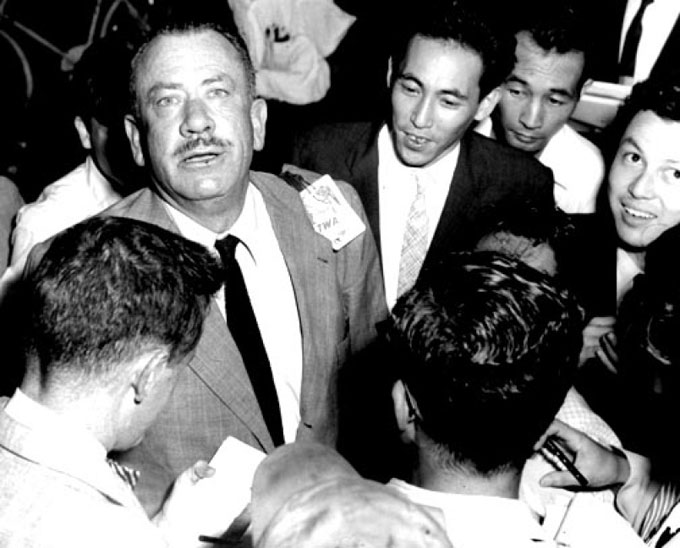
Image of John Steinbeck with reporters at 1957 PEN conference in Tokyo

According to a report by Monterey Herald writer Carly Mayberry, the Japanese American Citizens League Hall in Monterey, California has a World War II-era letter, signed by (among others) John Steinbeck, welcoming the Japanese to the city Steinbeck later left because, he said, he no longer felt welcome there. The April 25 Monterey Herald story notes that the 90-year old building was given to the Monterey chapter of the Japanese American Citizens League by an organization called the Japan Businessman Association in 1942, the year the United States entered World War II after the Japanese attack on Pearl Harbor.  Steinbeck—an advocate of constitutional rights for all citizens—protested the Japanese internment that followed as immoral and unnecessary. But he was also a realist. During their 1940 expedition to the Sea of Cortez, he and his friend Ed Ricketts (who also signed the welcome letter) lamented the damage being done to the fragile ocean floor by Japanese commercial fishing. Later they tried unsuccessfully to interest the U.S. government in Japanese-sponsored scientific research documenting the underwater geography of the Pacific, where Japanese and American forces fought bitterly for supremacy throughout World War II. That conflict ended in August 1945, when American bombers dropped nuclear weapons on the Japanese cities of Hiroshima and Nagasaki. Japan eventually recovered, and Steinbeck eventually visited Tokyo, speaking at a 1957 writers’ meeting ten years after the trip he made to Soviet Russia with another international-minded friend, the French-Hungarian photographer Robert Capa. Ten years later he traveled to Southeast Asia, the final leg in a life journey that ended back on the Monterey Peninsula, where his wife, sons, and sisters scattered his ashes in 1968. Observing the family’s wish for privacy, the Monterey Herald declined to report on the event.

International Relations Explored at John Steinbeck Conference in San Jose

Cover image from Dutch edition of John Steinbeck's The Grapes of Wrath

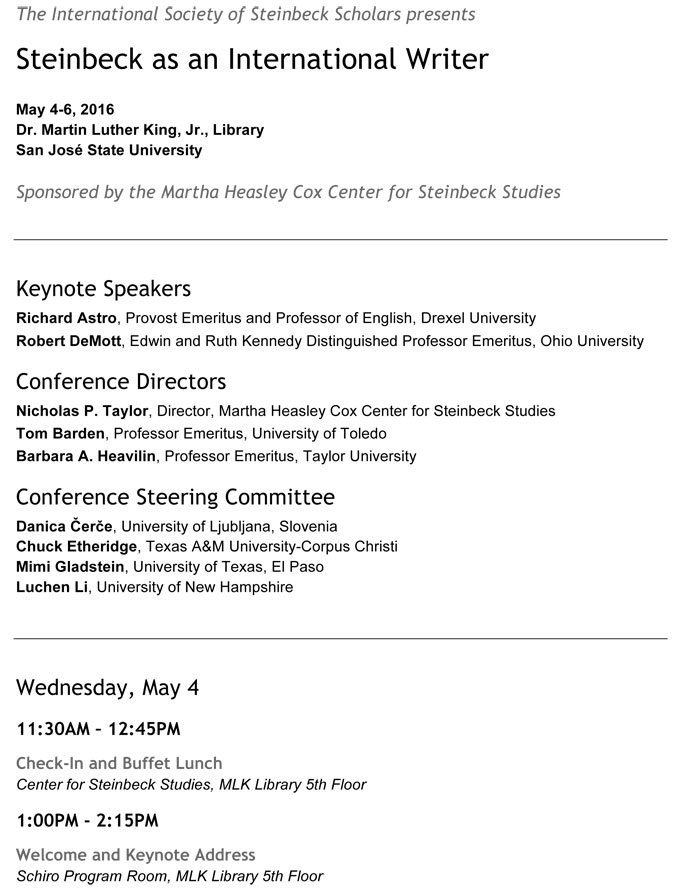
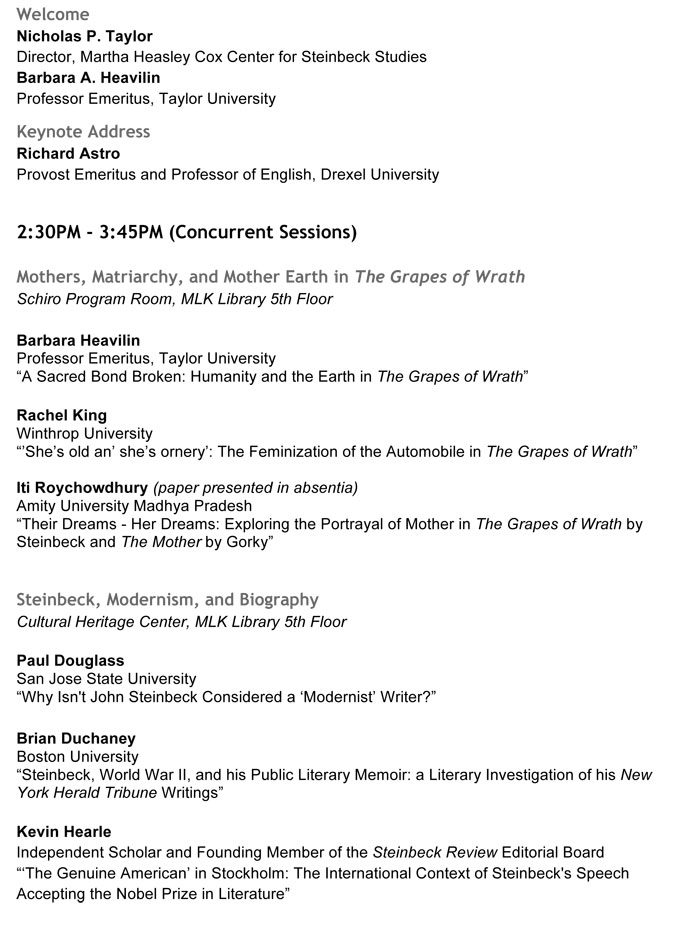
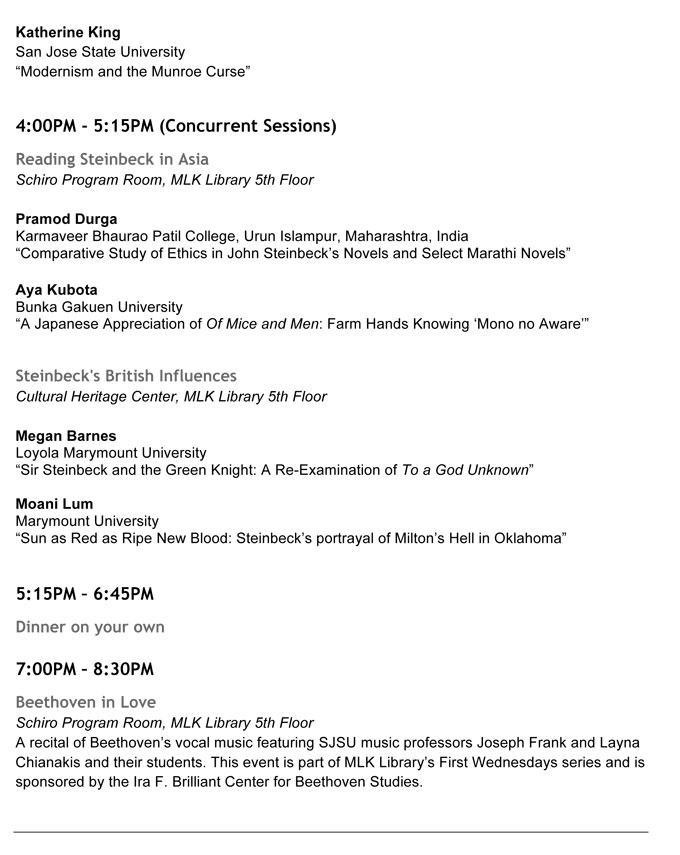
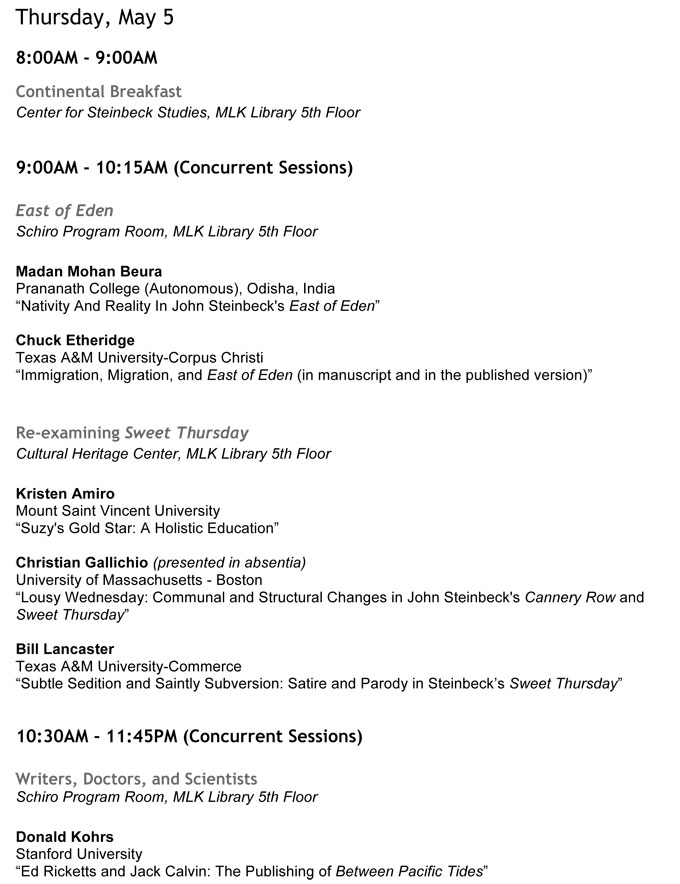
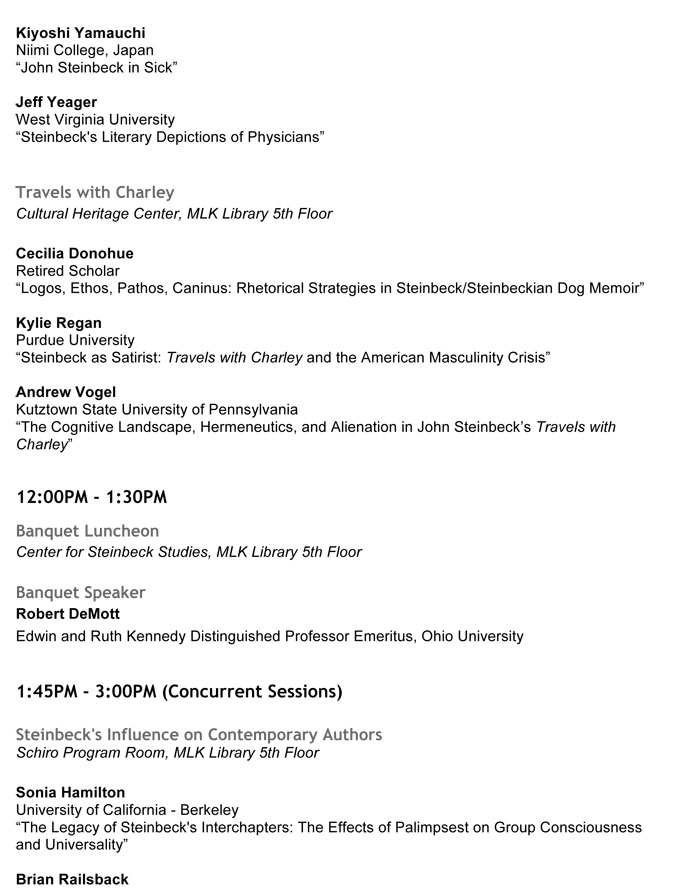
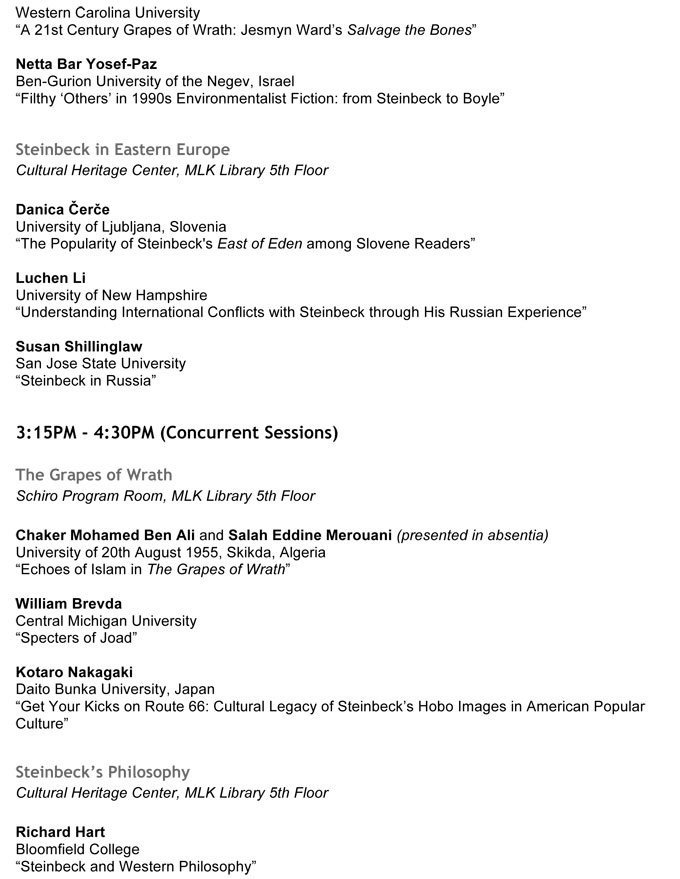
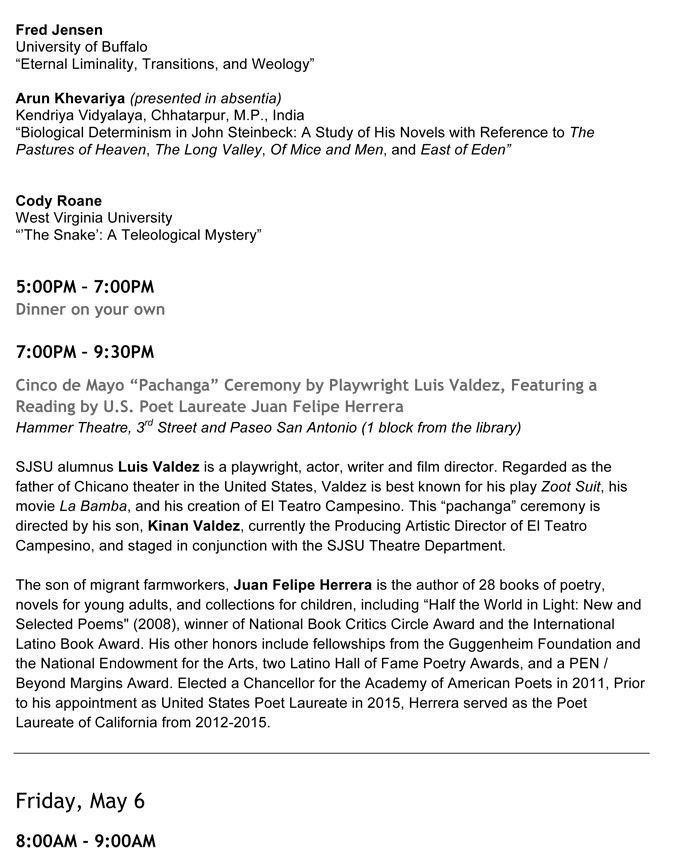
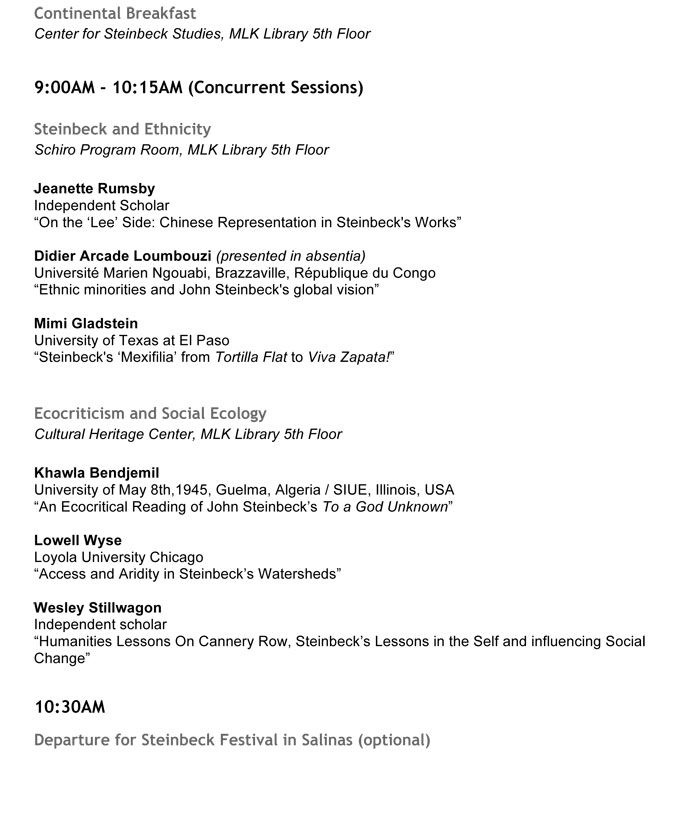
Steinbeck lovers from all over convene this Wednesday at San Jose State University’s Martin Luther King, Jr. Library, where Steinbeck experts will probe literary influences, international relations, and various cultural collisions found in the author’s controversial writing and reputation. Speakers for the May 4-6 conference, hosted by the International Society of Steinbeck Scholars, include Robert DeMott and Susan Shillinglaw—former directors of the Martha Heasley Cox Center for Steinbeck Studies at San Jose State and authors of major books on Steinbeck’s life and work—as well Richard Astro, a pioneer in the study of Steinbeck’s friend and collaborator Ed Ricketts; Mimi Gladstein, a Texas theater and English professor who writes about Steinbeck’s depiction of women; and Paul Douglass, an expert on modern literature and philosophy at San Jose State who served as the Steinbeck Center’s director from 2005 to 2013. The conference organizers—led by Nick Taylor, the center’s current director, and Barbara Heavilin, the editor of Steinbeck Review—are prepared for sparks to fly and made plans accordingly. When the conference closes on Friday, attendees will have the option of boarding a bus for Salinas, 90 minutes south of San Jose, where they can decompress by enjoying the 2016 Steinbeck Festival, “Steinbeck on Land and Sea.”

john-steinbeck-san-jose-conference-1john-steinbeck-san-jose-conference-2john-steinbeck-san-jose-conference-3john-steinbeck-san-jose-conference-4john-steinbeck-san-jose-conference-5john-steinbeck-san-jose-conference-6john-steinbeck-san-jose-conference-7john-steinbeck-san-jose-conference-8

$4.8 Million Gift to John Steinbeck Center Reported By San Jose Mercury News

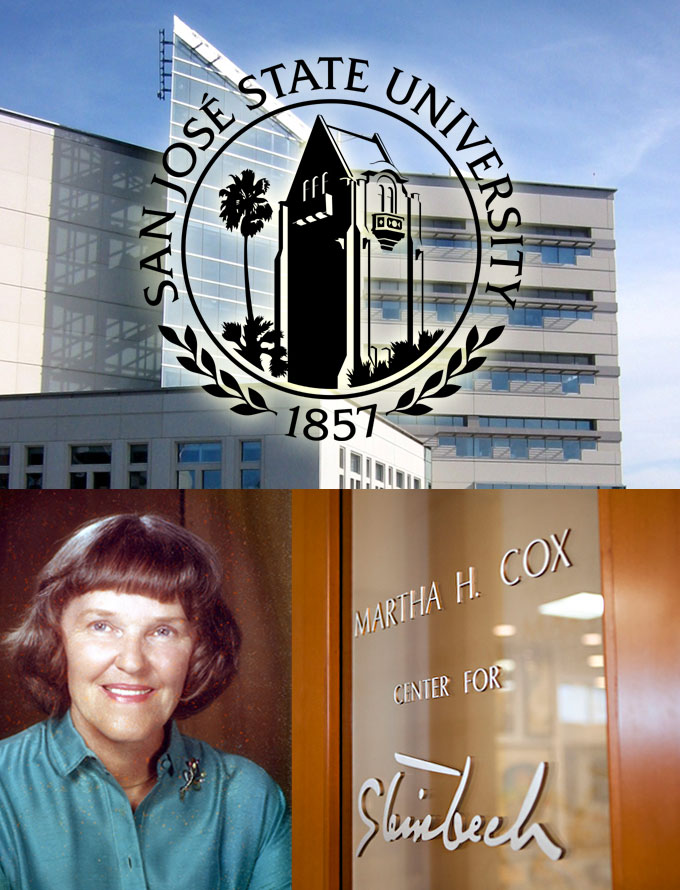
Image of the Martha Heasley Cox Center for John Steinbeck Studies

The April 20, 2016 San Jose Mercury News reports a record-breaking gift to San Jose State University by Martha Heasley Cox, a retired English professor with a love for John Steinbeck. In 1955—the year East of Eden became a movie—Cox arrived in San Jose from Arkansas with a new PhD to work at San Jose State, where she taught courses and organized conferences devoted to Steinbeck, wrote best-selling college textbooks, and invested the proceeds to support her passion for Steinbeck and her university. Her collection of books by and about Steinbeck became the core of the school’s Steinbeck Studies Center, the oldest academic enterprise devoted to the author in America, and she provided start-up funding for the organization, which was named in her honor. According to the San Jose Mercury News story, $3.1 million of Cox’s posthumous gift will fund the center’s Steinbeck Fellows program for young writers, and $1 million will augment the endowment of a lecture series, also bearing her name, that brings major authors—including Norman Mailer, Toni Morrison, and Andre Dubus III—to the San Jose State University campus each year. The balance of Cox’s bequest will support an online database of Steinbeck materials. As noted by the Mercury News, her gift is the largest made by a faculty member in the school’s history.

Steven Spielberg, Daniel Day-Lewis Grapes of Wrath Motion Picture Off or On?

Cover image of The Hollywood Reporter with Steven Spielberg and Daniel Day-Lewis

Steven Spielberg’s motion picture remake of The Grapes of Wrath with Daniel Day-Lewis may finally happen if a suit by Waverly Scott Kaffaga, the daughter of John Steinbeck’s widow Elaine, is successful. The legal filing against Steinbeck’s son Thom and others—the latest in a war of litigation among Steinbeck’s various heirs—was reported on April 4, 2016 by the motion-picture news magazine The Hollywood Reporter. According to the report, Universal Studios abandoned plans in 2014 for a motion picture remake of East of Eden because of alleged interference by quarreling heirs, but Steven Spielberg’s interest in remaking The Grapes of Wrath, with Daniel Day-Lewis in a starring role, appears to be the cause of the latest filing by Kaffaga and Steinbeck’s literary agents, MacIntosh and Otis. (James Franco’s interest in making a motion picture adaptation of Tortilla Flat was also mentioned in the piece.) Read The Hollywood Reporter for details, and stay tuned for the next chapter in the ongoing Steinbeck family saga.


Phoenix, Arizona Toasts Of Mice and Men with a Ward 8

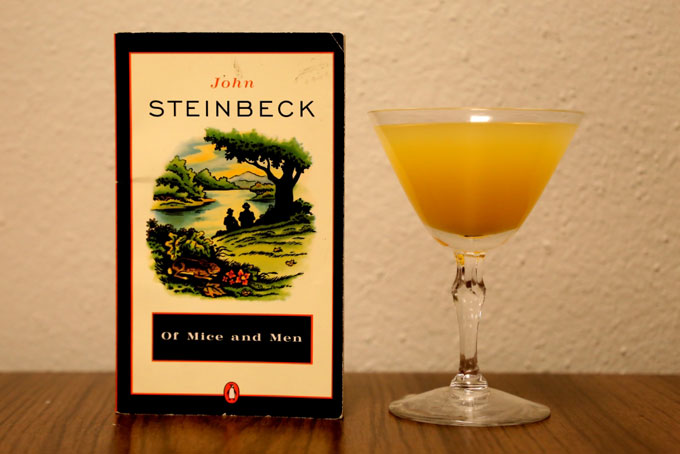
Image of a Ward 8 cocktail paired with Of Mice and Men

The new production of Steinbeck’s Of Mice and Men by the Arizona Theatre Company got more than a 10-out-of-10 review from The State Press, the Tempe and Phoenix, Arizona newspaper published by students at Arizona State University. “Books & Booze: ‘Of Mice and Men’ by John Steinbeck,” this week’s column by Carson Abernathy, pairs Steinbeck’s Depression-era work with a Gilded Age cocktail called Ward 8, composed of whiskey, lemon juice, orange juice, and grenadine. Abernathy’s novel concept for making modern fiction palatable to college readers is appealing: he ties the book in question to a drink from the past and rates the writing for style, characterization, cohesiveness, and relevance. (Lolita and The Sun Also Rises were similarly paired and reviewed in recent columns.) We think Steinbeck, Hemingway, and Nabokov would drink to Abernathy’s bright idea.

Photo for The State Press by Johanna Huckeba.

A John Steinbeck Waterfront Park in Sag Harbor’s Future?

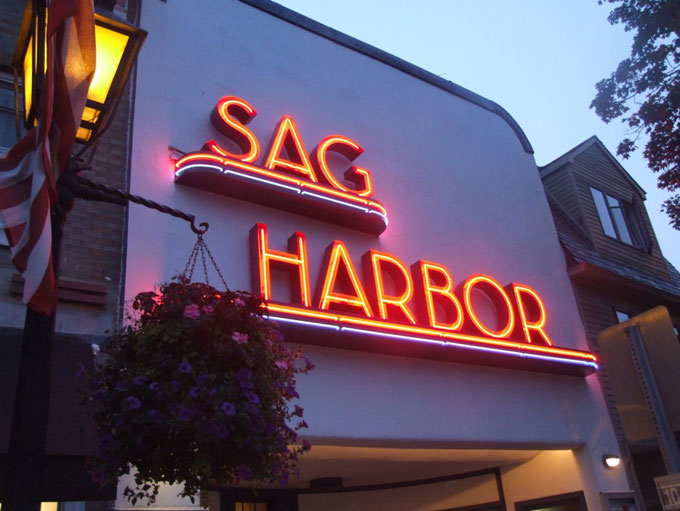
Image of Sag Harbor sign

John Steinbeck liked Sag Harbor, the Long Island fishing village where he lived and wrote The Winter of Our Discontent, his last novel. He even set the story in Sag Harbor, which in Steinbeck’s time was still the kind of place—like Salinas, his home town—where neighbors stayed on speaking terms and the day’s news could be heard at the downtown coffee shop Steinbeck frequented when he finished his morning writing. Last week the East End Beacon, a Sag Harbor area paper, reported on plans to build a waterfront park named for the writer on property the town is considering condemning. Ed Hollander, the landscape architect hired to propose public use for the land when acquired, “envisions a literary trail, perhaps in collaboration with Sag Harbor’s John Jermain Memorial Library, which would include references to Steinbeck’s work.” In his writing Steinbeck worried aloud about over-development and ecology. So does Sag Harbor’s mayor, Sandra Schroeder. “The village does not need or want more condominiums,” she said. “What we want and need is a transformative park plan that will build on our maritime heritage and protect it for our children, their children, and their children’s children into the future.” Letters of support are welcome.

Always Something to Do in Salinas: 2016 John Steinbeck Festival Celebrates Main Street and Sea of Cortez

Image of the National Steinbeck Center in Salinas, California

The National Steinbeck Center will celebrate John Steinbeck’s life, time, and work May 6, 7, and 8 in Salinas, California, the writer’s home town. The 2016 John Steinbeck Festival—“From Salinas to Sea of Cortez: Steinbeck on Land and Sea”—boasts an all-star lineup (the Steinbeck scholar, poet, and fisherman Robert DeMott; Steinbeck’s biographer William Souder; Susan Shillinglaw, the Steinbeck center’s executive director) and a variety of topics, including Steinbeck’s 1940 voyage to the Sea of Cortez, Latino culture and writing in California, and the living heritage of Main Street Salinas. Says Shillinglaw, “There’s ‘always something to do in Salinas,’ as Steinbeck wryly noted in an essay by the same name, and there’s much that is ‘festive’ in the 2016 festival, with Steinbeck Rotary sponsoring Main Street’s first ‘Steinbeck’s Home Brew Fest’ and a beer garden on the NSC patio. In his 1955 essay, Steinbeck noted that the town’s motto was ‘Salinas is,’ adding, ‘I don’t know what that means, but there is no doubt of its compelling tone.’”

Some Walls Are Built as Bridges: San Jose State University Celebrates John Steinbeck and Civil Rights

Image of John Steinbeck award wall at San Jose State University

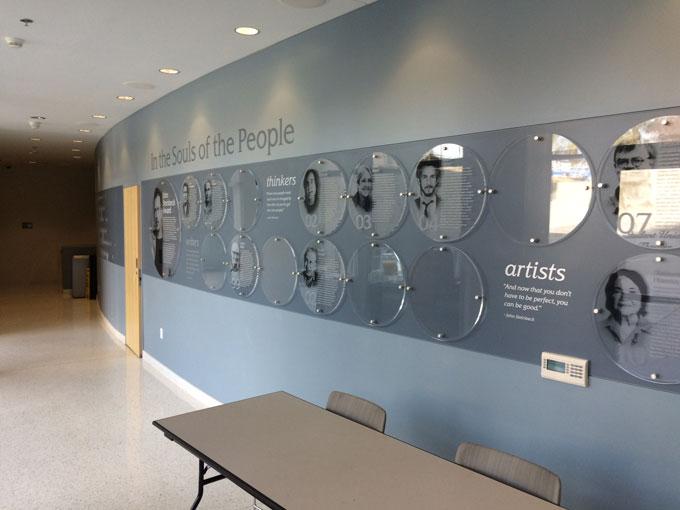
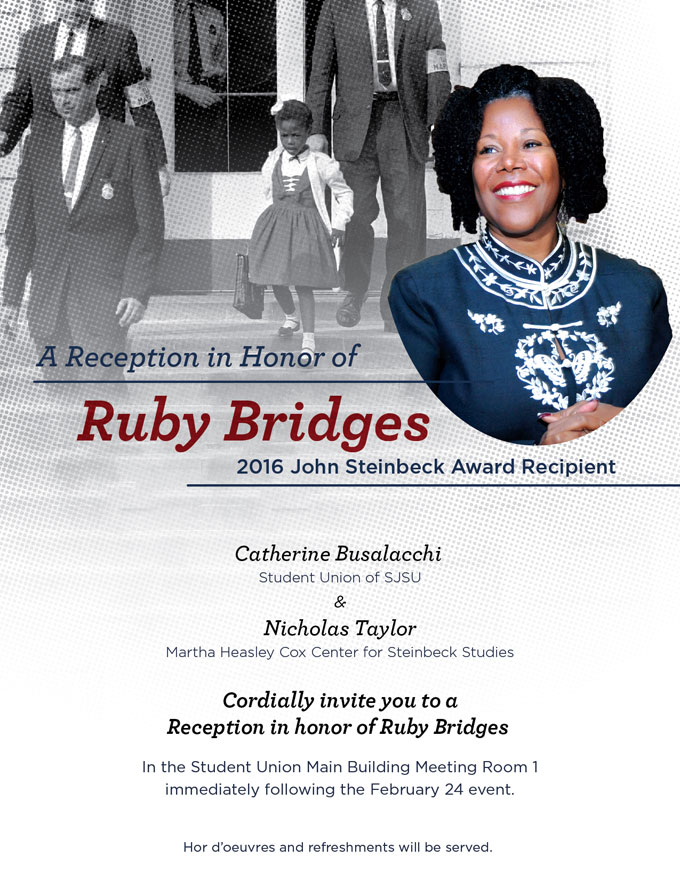
Some walls separate. Others connect. Admirers at San Jose State University have built a handsome wall to commemorate John Steinbeck’s enduring connection with social justice and civil rights, a tie that is celebrated in the John Steinbeck “In the souls of people” Award, given 15 times since 1996 to artists, actors, writers, and activists whose work involves social change. The award ceremony is always a happy occasion, and the February 24 event honoring civil rights leader Ruby Bridges, the brave little schoolgirl described in Travels with Charley, was no exception.

The John Steinbeck award ceremony is always a happy occasion, and the February 24 event honoring Ruby Bridges, the brave little schoolgirl described in Travels with Charley, was no exception.

The Steinbeck award commemorative wall was created by the San Jose University Student Union and is located in the busy student activity building where most award events are held. Explains Nick Taylor, director of the Martha Heasley Cox Center for Steinbeck Studies at San Jose State University, “The wall consists of a series of disks tracing the timeline of the Steinbeck Award, with background on the rationale for each selection and a few details about each ceremony.” The California civil rights leader Dolores Huerta, an advocate for farm workers’ rights, is a past recipient. Bruce Springsteen received the first award in 1996.

Image of February 24, 2016 John Steinbeck award event announcement

Jim Kent, a member of the John Steinbeck center’s advisory board, traveled to San Jose from Denver for the February 24 event. “As a fan of Travels with Charley,” he said, “I was thrilled to meet the young lady Steinbeck observed as she braved white hecklers during the integration of the New Orleans elementary school where she was the first black student, back in 1960.” A social ecologist who uses Steinbeck in his work empowering citizens to control their own environments, Kent was helping to write federal legislation for Lyndon Johnson’s War on Poverty when the Civil Rights Act of 1965—which owed much to writers like John Steinbeck—passed Congress. “Ruby Bridges was the perfect choice for this year’s award,” he added. “Like Steinbeck, she is a master storyteller. She attracted a capacity crowd made up of all ages and races, and her elegance inspired five standing ovations. There’s clearly a hunger for continued engagement with civil rights in our time. This was proof.”