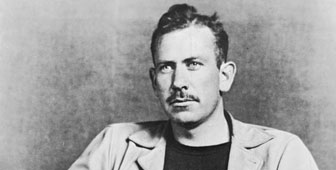
In 1965 John Steinbeck was a member of President Johnson’s council on the arts when Johnson signed legislation creating the National Endowment for the Arts, the federal agency charged with “bringing the arts to all Americans” and “providing leadership in arts education.” Steinbeck died before efforts in Congress to kill the infant agency got underway, in earnest, in 1981. Today, 35 years after arts-friendly Reaganites foiled that attempt, the ascendancy of Donald Trump appears to have handed anti-arts Republicans in Washington, D.C. the ammunition they need to finish the job. According to the website The Hill, “the Corporation for Public Broadcasting would be privatized, while the National Endowment for the Arts and National Endowment for the Humanities would be eliminated entirely” if the radical plan prevails.
In 1965 John Steinbeck was a member of President Johnson’s council on the arts when Johnson signed legislation creating the National Endowment for the Arts, the federal agency charged with ‘bringing the arts to all Americans’ and ‘providing leadership in arts education.’
It’s easy to imagine how John Steinbeck would react to the latest threat against the arts and humanities. He supported FDR’s New Deal and Johnson’s Great Society, applied “arts for all” as a principle in his writing, and—brought up on books, music, and art—demonstrated the value of arts and humanities education in almost every aspect of his life. Nearly 50 years after his death, his name and his novels continue to be cited when creativity is under attack by politicians, fanatics, and latter-day Mrs. Grundys. In an op-ed entitled “What Art Under Trump?” the novelist Margaret Atwood gives The Grapes of Wrath as an example of enduring art that outlasts the evils it was created to expose. Colson Whitehead, the 47-year-old author of The Underground Railroad, credited the research he did for his first high school term paper—on John Steinbeck—when he accepted the Andrew Carnegie Medal for Excellence in Fiction at yesterday’s meeting of the American Library Association.
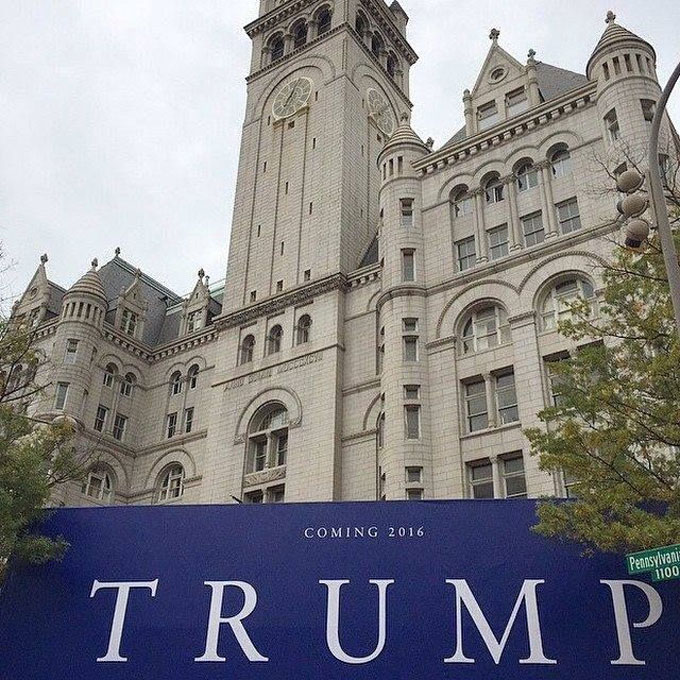
Rationalizing hatred of the arts and humanities of the kind on view in Donald Trump’s Washington, D.C. is harder than guessing where Steinbeck would stand. I know—I’ve tried—because at one time my job actually depended on it. Like John Steinbeck, I have an education in the arts and humanities to thank for whatever may be of value in my 35-year career as as a nonprofit executive and fundraiser for organizations in Florida and California. Unlike Steinbeck, I’m a middleman, not a creator. But the Washington, D.C. experience I had while running the Palm Beach County Cultural Council gave me a preview of the arts under Donald Trump that I’m confident Steinbeck—who honored memory, history, and preservation—would appreciate.
Rationalizing hatred of the arts and humanities of the kind on view in Donald Trump’s Washington, D.C. is harder than guessing where Steinbeck would stand.
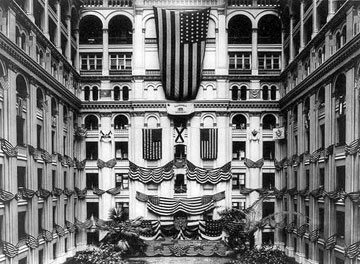 When I visited Washington, D.C. during the 1980s and 90s, I usually stopped by the Old Post Office, famous for its soaring atrium, to listen, learn, and lobby. In the 1970s Nancy Hanks, chair of the National Endowment for the Arts under Nixon, saved the century-old building from demolition, and for 30 years—until Donald Trump signed the lease to turn it into a hotel—the Old Post Office served as a symbolically appropriate home for her agency. Some of my appointments were with successors to Nancy Hanks appointed by Republican presidents after Nixon. Frank Hodsoll, chair of the NEA under Reagan, was key to the regional initiative that advanced art creation, education, and marketing in my bailiwick, South Florida. Later on, in Miami, I interviewed John Frohnmayer, George H.W. Bush’s NEA chair, for a weekly public radio program I hosted in West Palm Beach. The subject of our talk was Leaving Town Alive, the book that Frohmayer (a Stanford-educated lawyer) wrote about his fight for survival in D.C.
In the 1970s Nancy Hanks, chair of the National Endowment for the Arts under Nixon, saved the Old Post Office from demolition, and for 30 years—until Donald Trump signed the lease to turn it into a hotel—the historic building served as a symbolically appropriate home for her agency.
Forced out of the home they helped save when it was closed to make way for Trump’s hotel, the NEA and NEH moved to Constitution Center, a modernist monstrosity in Washington, D.C. designed by the architect of the equally hideous Kennedy Center for the Performing Arts. Today Trump International Hotel occupies the historic building at 1100 Pennsylvania Avenue, Donald Trump occupies the historic house at 1600, and the agencies evicted from the Old Post Office in 2014 are experiencing the threat of their lives. The dreadful death cycle dramatized by John Steinbeck in The Grapes of Wrath—eviction and attack followed by extinction—faces the arts and humanities in Donald Trump’s Washington, D.C., where a great public building is now operated for private profit and the public agency responsible for preserving it is about to leave town permanently.
 About William Ray