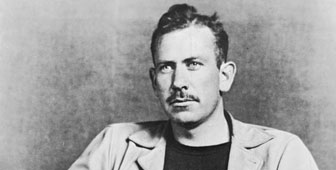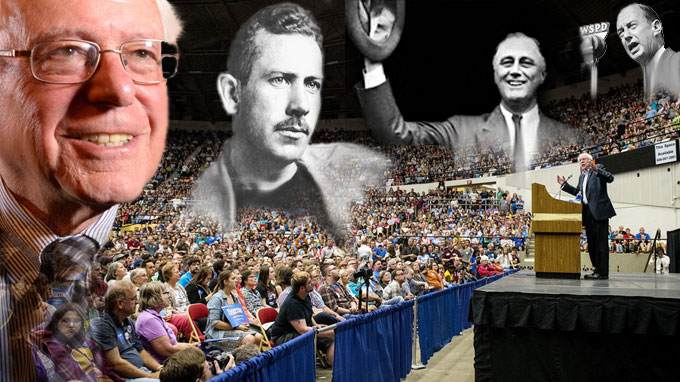
If John Steinbeck were alive today he would support Bernie Sanders for president.
Why? Because Bernie Sanders is the kind of outspoken progressive the author of The Grapes of Wrath enthusiastically embraced during his controversial career as a prize-winning writer of popular fiction. A passionate believer in fair play, Steinbeck endorsed presidential candidates committed to populist causes, actively campaigning for Franklin Roosevelt, who was elected four times, and Adlai Stevenson, who ran twice but lost both races. More than either man, Bernie Sanders talks straight in plain language about equality and integrity, Steinbeck’s core values—a New England character trait that Steinbeck both admired and inherited. The Sanders movement is about issues, not personality; Steinbeck wanted to be remembered for his books, not his life. But his life was public and political, and a little biography is needed to show why he’d be for Bernie Sanders today.
Why John Steinbeck and Bernie Sanders Would Get Along
Steinbeck was born in Salinas, California, in 1902, and grew up in the small town during the era of Theodore Roosevelt, the Republican President who busted the big business trusts and moved to curtail private exploitation of public lands by creating parks such as Yosemite. John’s mother was an ex-schoolteacher and tireless civic volunteer. His father was a failed small-businessman who became the elected Treasurer of Monterey County. His mother’s parents emigrated from Ireland, while his father’s people were New Englanders—half-English and half-German. Both parents were Party-of-Lincoln Republicans who believed in social improvement, access to education, and reforming government to make it work better. Steinbeck was proud of these roots, later writing that everybody in Salinas was a Republican back then, and that if he had stayed in Salinas he would have become one, too.
Steinbeck was proud of his roots, later writing that everybody in Salinas was a Republican back then, and that if he had stayed in Salinas he would have become one, too.
Like Bernie Sanders, John Steinbeck grew to distrust the corrupting influence of corporations and how working people were manipulated to vote against their economic self-interest—urban vs. rural, native- vs. foreign-born, small farmers and white laborers vs. Mexicans, Chinese, Filipinos, and refugees from the Dust Bowl. He hated the social snobbery he encountered as a student at Stanford University in the 1920s, working as a field hand and night watchman in summers and off-semesters to help pay his way but quitting before getting a degree. In 1925 he left for New York to find his own way. There, like Bernie Sanders, he failed at more than one job before returning to California to make ends meet as a caretaker-handyman on a rich man’s estate. The Great Depression that resulted from Wall Street’s collapse in 1929 gave Steinbeck the subject he needed to become a politically engaged writer: the brutal suppression of non-union workers by California’s big business interests. The state’s powerful industrial-agriculture complex became the target of his 1939 masterpiece, The Grapes of Wrath.
The Great Depression that resulted from Wall Street’s collapse in 1929 gave Steinbeck the subject he needed to become a politically engaged writer: the brutal suppression of non-union workers by California’s big business interests.
Also like Bernie Sanders today—and most Americans at the time—Steinbeck believed in gun-rights, but was too tenderhearted to hunt. Instead, he kept a gun for self-protection. Hired thugs threatened to break his legs or worse for what he was writing about workers’ rights, even before The Grapes of Wrath, and the sheriff warned him of a plot to set him up for a rape charge. Threats failed to change his mind, and the celebrity he achieved through his writing changed his behavior but not his character. Like Bernie Sanders, he remained pro-labor all his life and more at ease with working people than with billionaires. He refused to own a Ford because Henry Ford was an anti-union anti-Semite whose cars Steinbeck thought inferior. Steinbeck described another billionaire as so driven by avarice that late-life regret forced him to try buying his way into heaven through philanthropy.
Like Bernie Sanders, he remained pro-labor all his life and more at ease with working people than with billionaires. He refused to own a Ford because Henry Ford was an anti-union anti-Semite whose cars Steinbeck thought inferior.
The greatest influence on Steinbeck’s thinking about politics was probably his first wife, Carol Henning, a progressive activist who suggested the title of The Grapes of Wrath. Together they supported the New Deal programs of President Franklin Roosevelt, whose First Lady became Steinbeck’s friend and ally. Like Bernie Sanders, however, Steinbeck had a wise way of not rejecting those who disagreed with him about party affiliation. He remained loyal to his Republican sisters, though he deeply disliked their fellow Californian Richard Nixon, and he despised William Randolph Hearst, the father of yellow journalism—the Fox News of American politics at the time. Steinbeck died in New York the month after Nixon was elected president in 1968. If Steinbeck and Bernie Sanders had met in the ’60s, unlikely but conceivable, they would have agreed about the movement for desegregation and voting rights and disagreed about the war in Vietnam, an issue that eventually got Steinbeck in trouble with his friends.
John Steinbeck, Franklin Roosevelt, and Adlai Stevenson
When Steinbeck’s enemies accused him of being Jewish because of his surname and his sympathies, he replied that he would be pleased if it were so. In reality his religious roots were Protestant, and he grew up in the Episcopal Church—the church of Franklin Roosevelt, a New York aristocrat of Dutch descent whom detractors also accused of being a Jew. Just as Steinbeck’s parents had supported the progressive policies of Teddy Roosevelt, FDR’s Republican cousin, Steinbeck advocated Franklin Roosevelt’s New Deal as a way out of the pain and suffering caused by Wall Street in the Great Depression. When world war broke out the year The Grapes of Wrath was published, Steinbeck found himself blackballed by military bureaucrats in Washington and abused by his local draft board. Despite his support for FDR and the fight against Fascism, he questioned the government’s internment of Japanese-Americans and criticized pro-war propaganda created by New York ad men and Hollywood studio warriors. After showing courage under fire as an embedded newspaper correspondent on the Italian front, he was refused the award for valor that many thought he deserved. When he returned to the United States he said the worst thing about war was its dishonesty.
Despite his support for FDR and the fight against Fascism, he questioned the government’s internment of Japanese-Americans and criticized pro-war propaganda created by New York ad men and Hollywood studio warriors.
Doubts about the Cold War, plus Eleanor Roosevelt’s endorsement, motivated John Steinbeck to support Adlai Stevenson over Dwight Eisenhower in 1952 and 1956. Stevenson’s cool intelligence and firm grip on fact-based reality appealed to Steinbeck’s intellect, which he developed by dialogue and research. The same traits made Stevenson a target of Cold Warriors from both parties connected to what Eisenhower later called out as the military-industrial complex in his last State of the Union address. Stevenson was an independent-minded politician with a consistent message, an activist following, and an aversion to the kind of character assassination used against him when he ran for president. Like Franklin Roosevelt and Bernie Sanders, he was John Steinbeck’s idea of an authentic progressive.
Adlai Stevenson was an independent-minded politician with a consistent message, an activist following, and an aversion to the kind of character assassination used against him when he ran for president. Like Franklin Roosevelt and Bernie Sanders, he was John Steinbeck’s idea of an authentic progressive.
Along with Eleanor Roosevelt, Steinbeck encouraged Stevenson to run again in 1960 before shifting his support to John Kennedy. After the election Stevenson and Steinbeck grew close, closer than Steinbeck ever was to Franklin Roosevelt. Like Bernie Sanders, Stevenson had a scientific, secular worldview that attracted Steinbeck but invited opponents to characterize Stevenson as an egghead who was unqualified to be president because he read books and liked culture. Steinbeck, who wrote long books, shared Stevenson’s enthusiasm for music and reading. Cool Bach was playing in the background as Steinbeck wrote The Grapes of Wrath. So was the edgy music of Igor Stravinsky, a Russian refugee with a wild, insistent sound more like Bernie Sanders than Bach or Adlai Stevenson.
But Couldn’t John Steinbeck Be for Hillary Clinton?
Answer: If Bernie Sanders weren’t running, yes, but with reservations. Here’s why.
John Steinbeck’s third wife was a Texas friend of Lady Bird Johnson, and the Steinbecks were White House guests when LBJ needed help with the intellectuals he thought Steinbeck, like Stevenson, represented. It’s easy enough to imagine Elaine Steinbeck, the first non-male stage manager in Broadway history, favoring a female candidate for president today. But the influence she exerted turned out badly for her husband in the 1960s. Steinbeck’s sense of loyalty to the Johnsons led him to get the Vietnam War very wrong, despite the lesson he learned in World War II. He kept his mouth shut in public after touring Southeast Asia at Johnson’s urging. In private he confessed that the government had no business interfering in the civil war of a country that hadn’t attacked America.
Today John Steinbeck would be for Bernie Sanders, the no-nonsense New Englander with a consistent record on everything that mattered most to Steinbeck: social justice, individual integrity, and saving the people and the planet Steinbeck celebrated in The Grapes of Wrath.
If he’d lived, Steinbeck would have opposed the Bush-Cheney wars for the same reason—plus the deceit and dishonesty used to justify the invasion of Iraq. At the time, Bernie Sanders joined Barack Obama in opposing the Iraq war from the floor of the U.S. Senate. Like a Cold War Democrat in the days of Lyndon Johnson, however, Senator Clinton went along with the crowd and voted yes. Steinbeck paid dearly, in reputation and in conscience, for following the White House line on Vietnam, despite his distrust of Wall Street and warmongering and his understanding of their connection. Given that experience, he’d distrust Clinton—for her Wall Street friends as much as for her flip-flopping on Iraq. In 2008 Steinbeck would have supported Obama—an egghead from Illinois, like Adlai Stevenson—and rejoiced in the result. Today he’d be for Bernie Sanders, the no-nonsense New Englander with a consistent record on everything that mattered most to Steinbeck: social justice, individual integrity, and saving the people and the planet Steinbeck celebrated in The Grapes of Wrath.
 About Administrative Team