The Scottish Lord and Pearl Harbor—Winston Churchill’s Protected Spy: A True Story

Image of Winston Churchill mug

A Story of Betrayal in John Steinbeck’s Time

Winston Churchill’s mug? Odd connections to John Steinbeck’s life continue to appear at SteinbeckNow.com, thanks to authors like John Bell Smithback, a Far East expert and former resident of the neighborhood in Pacific Grove, California, where Sea of Cortez was written in 1941. His true story of the spy who contributed to the attack on Pearl Harbor—the 200th post since SteinbeckNow.com started—combines compelling narrative, imaginative investigation, and a streak of ornery independence, features that appeal to our readers and attract web surfers to John Steinbeck. Who knew that Winston Churchill colluded, through his silence, with a high-ranking Scottish spy to provide Franklin Roosevelt a reason to join Britain’s war with Germany? The true story begins in the spring of 1941, as Steinbeck sat writing Sea of Cortez while his marriage collapsed, Europe fell, and Japanese aggression threatened the Far East. On December 7, within days of the book’s publication, Japan attacked America at Pearl Harbor and Franklin Roosevelt declared war, as Winston Churchill had every reason to hope. Pearl Harbor swamped Sea of Cortez, which as John Steinbeck predicted it would, sold poorly. Blackballed from receiving a military commission by brass in Franklin Roosevelt’s war office, Steinbeck—remarried and living in New York in 1943—enlisted as a foreign war correspondent for American newspapers, reporting first from England, then from North Africa and Italy. In London he got leads and told stories other reporters overlooked. Did he hear rumors of a high-ranking spy in Winston Churchill’s government? “Certain people could not be criticized or even questioned,” he wrote years later in Once There Was a War, a collection of his World War II correspondence: “It is in the things not mentioned that the untruth lies.”—Ed.
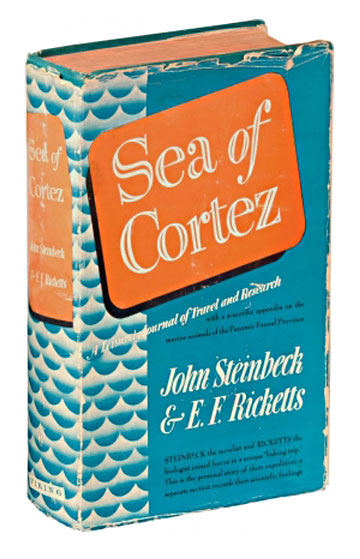
Cover image of the first edition of Sea of Cortez

Watching Churchill’s Funeral: An Incident in Pacific Grove

“Ambition, not so much for vulgar ends, but for fame, glints in every mind.”

                                                                     Winston Churchill, The Second World War

John Steinbeck lived just around the corner. He was on Eardley Avenue and I was on Laurel. Of course, we lived there at different times—so different, in fact, that it might be said we inhabited Pacific Grove in different eras. When John was there in the spring of 1941, he and Ed Ricketts were working on Sea of Cortez and World War II was underway. Most of Europe was occupied by German forces, and Hitler had begun his invasion of the Soviet Union. General Rommel’s Desert Afrika Korps had taken Benghazi, President Franklin Roosevelt announced that he’d run for a third term, and the Japanese looked more and more menacing in the Far East. Glenn Miller’s Chattanooga Choo Choo would be playing on John Steinbeck’s radio, and Cheerios had just been invented.

During my time in Pacific Grove, Lyndon B. Johnson was President, Martin Luther King was leading the march from Selma to Montgomery, Dr. Benjamin Spock, Norman Mailer, and Norman Thomas were holding a teach-in in Berkeley to protest Johnson’s war in Vietnam, and a publication put out by the John Birch Society claimed that Negroes in America were better off than ever because of the good will of whites. The Byrds were singing Mr. Tambourine Man and television had replaced radio.

It’s January 30, 1965, and outside my door I notice a small woman moving back and forth with uncertainty. She studies my house, bends forward to read my address, then moves on. I turn on my television and find there is wall-to-wall coverage of Winston Churchill’s funeral. A barge with his coffin is moving slowly up the Thames past Tower Bridge, and the event is being described as one of the most moving tributes in modern history.

John Steinbeck lived just around the corner. He was on Eardley Avenue and I was on Laurel.

It’s at that moment that my doorbell rings and I open the door to find a frail and  bewildered woman standing there. She’s the same one I’d seen earlier, and she says she’s visiting from England. She’s lost, she exclaims, and says she can’t seem to find her family’s house. I ask the address and assure her the house she’s looking for is nearby, just around the corner and down the block. She’s obviously exhausted so I open the door and invite her in, offering her a cup of tea and a chance to rest. “Winston Churchill’s funeral is on television, live and direct from London,” I say. “Come in and watch, and then I’ll drive you home.”

She stiffens and makes a disagreeable face. “Young man,” she scowls, “those of us who lived through the horrible days of the war owe everything to that great man. We stood alone, and his speech about fighting the Germans on the beaches strengthened us and led us through those terrible times. Even now, I can remember listening to his words on the wireless, and no thank you, I will not come in. I wouldn’t think of watching Sir Winston Churchill’s funeral on American television!”

Such determination. And such a mistake. The truth is that few of Churchill’s speeches were broadcast during World War II: they were spoken in the House of Commons at Westminster to members of Parliament. Only after the warin some cases, nine years after itsensing the historical, political, and financial gains to be had, did Churchill record them in a studio for posterity. It wasn’t the first time the public had been duped into believing what Winston Churchill wanted history to believe.  A true-story timeline of his long career would be made up of an unbroken series of serious errors, horrendous blunders, and Machiavellian maneuvers made to cover his many mistakes and further his vast ambitions.
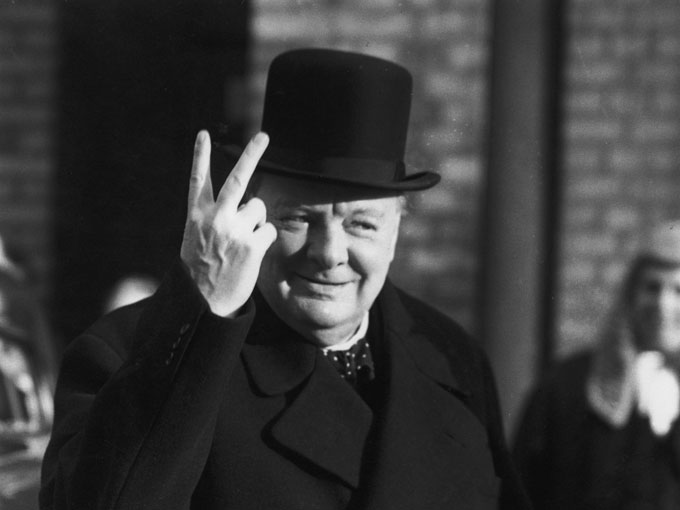
Image of Winston Churchill V-ing for victory

Churchill the Manipulator, Wrong About Almost Everything

Several years ago the late Christopher Hitchens wrote a revisionist version of Churchillian history for The Atlantic magazine, describing Winston Churchill as “ruthless, boorish, manipulative, alcoholic, myopic, and wrong about almost everything” and noting that Churchill himself admitted he “never stood so high upon a principle that he could not lower it to suit the circumstances.” And lower it he did. So far, in fact, that had anyone else been Prime Minister when World War II ended, Winston Churchill—a Tory turned out of office by a Labor Party sweep—would in all likelihood have been arrested and tried for high treason.

Churchill was a master manipulator—ignoring the truth, bungling the facts, and rearranging historical events to enhance his deeply flawed role in a political career spanning nearly half a century. In his Atlantic article, Hitchens short-listed the worst mistakes, misdeeds, and deceptions and explained Churchill’s method: “A sort of alternate bookkeeping was undertaken, whereby the huge deficits of his grand story (Gallipoli, the calamitous return to the gold standard, his ruling-class thuggery against the labor movement, his diehard imperialism over India, and his pre-war sympathy for fascism) were kept in a separate column that was sharply ruled off from ‘The Valiant Years.'”

While the calculatedly slow release of official papers of the British government has helped Hitchens write Winston Churchill down, neither Hitchens nor anyone else to my knowledge exposed two acts of calculated treachery that facilitated Japanese imperial aggressions in the Far East, a deceit designed to drag the United States into World War II and give Franklin Roosevelt the justification needed to overcome domestic resistance. The first involved a Scottish lord, the second a slow-moving steamship.
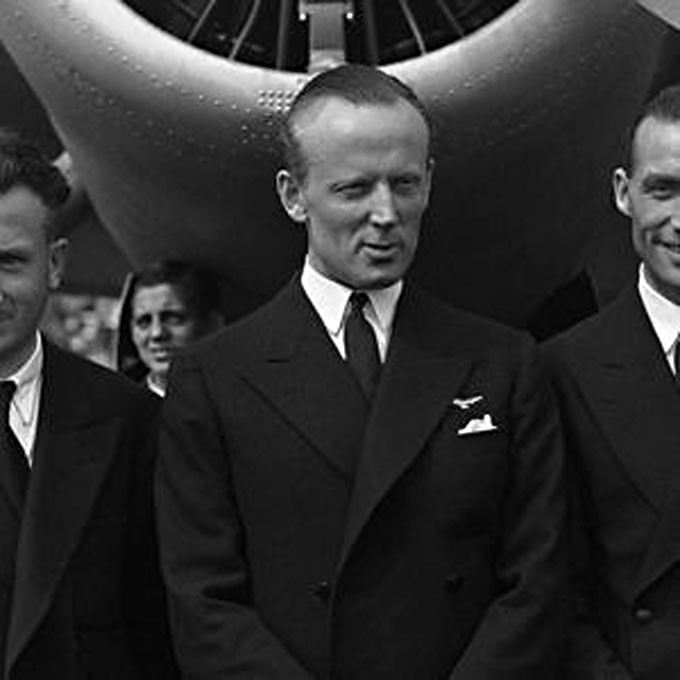
Image of the Scottish lord, William Francis Forbes-Sempill

Churchill’s Spy, At Work For Japan

The Scotsman was a hereditary member of the British House of Lords named William Forbes-Sempill, the 19th Baronet of Craigievar. A decorated Royal Flying Corps pilot in World War I, Sempill transferred to the Royal Navy Air Service when World War I ended in 1918. In 1921, the Imperial Japanese Navy requested England’s help in setting up its nascent naval air service. In the hope of negotiating a number of lucrative arms deals, the British Admiralty appointed Sempill to lead the government’s advisory delegation to Tokyo.

When he left for Japan, Sempill took with him the plans for two new British aircraft carriers, the HMS Argus and the HMS Hermes. Once he arrived, he proceeded to persuade the Japanese of the advantage of basing naval warplanes on ocean-going carriers instead of on airfields. Sempill was so pleased with his success in convincing the Japanese that he remained in Japan for 18 months, training pilots in techniques of flight control and shallow-water torpedo bombing—skills that 20 years later the Japanese Empire was to employ to disastrous advantage in attacking the United States fleet at Pearl Harbor.

Acknowledging Sempill’s “epoch-making service” to the Empire, Prime Minister Tomosaburo Kato awarded the Scottish lord Japan’s highest honor, the Order of the Rising Sun, “for his especially meritorious military service.”  Sempill faithfully returned the favor: for the next two decades he was paid to provide the Japanese with secret information on the latest British aviation technology, helping Japan become a world-class naval power. It was only when Franklin Roosevelt’s administration raised concern over Japan’s growing naval strength that the British government questioned Sempill about leaking secrets to Tokyo. A resulting investigation revealed that Sempill was an active member of several far-right, anti-Semitic organizations in England, including the fascistic Anglo-German Fellowship, a secretive group dedicated to ridding the Tory Party of Jews.
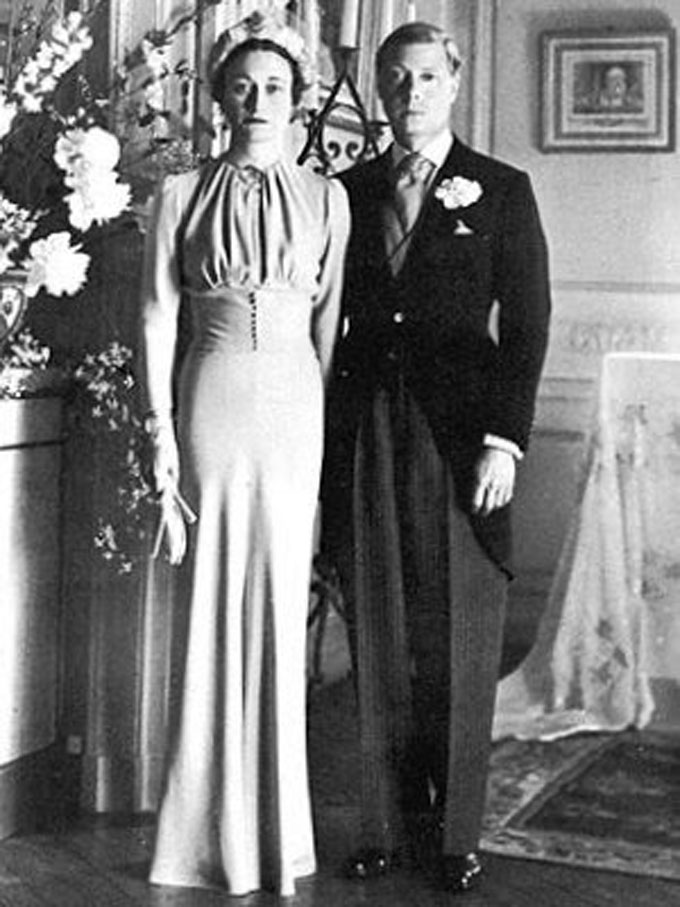
Image of the Duke and Duchess of Windsor

The House of Windsor’s High Hopes for Germany

But Sempill wasn’t the only member of England’s establishment elite who embraced fascist ideology. The most famous—Sir Oswald Mosley, the 6th Baronet of Ascoats—founded the British Union of Fascists, and its activities received positive press from London’s Daily Mirror newspaper owned by the billionaire Lord Rothsmere, a Viscount. As Hitler rose to power in Germany, Mosley’s organization attracted dozens of viscounts and dukes, earls and barons, and a wide assortment of Lords and Ladies of the realm who were sympathetic to fascism and opposed to the rising Labor Party.

Even the Royal House of Windsor—formerly the German House of Saxe-Coburg and Gotha—contained ardent supporters of Hitler’s cause. Until being forced to renounce his throne “for the woman I love,” Edward VIII, later Duke of Windsor, maintained such friendly relations with the Nazis that Albert Speer, Hitler’s arms minister, lamented his abdication: “I am certain that through him, permanent friendly relations could have been achieved. If he had stayed, everything would have been different. His abdication was a severe loss.” Two years after the outbreak of World War II, the disgraced Duke of Windsor and his American wife were living in neutral Portugal, where they met with Hitler’s representatives to negotiate a Nazi-sponsored return to the British throne. The twice-divorced Duchess stated that she would become Queen of England “at any price.”

Sempill wasn’t the only member of England’s establishment elite who embraced fascist ideology.

In Britain, the appeasement policy of Prime Minister Neville Chamberlain had been quietly encouraged by members of the House of Windsor who feared Britain’s involvement in the war would spell the loss of the British colonial empire. When the Duke of Windsor’s brother became King George VI, his Queen was heard to say she’d be happy enough if the Nazis invaded—”as long as they kept the royal family.”

For a time, neighboring Norway (the unnamed nation in John Steinbeck’s The Moon Is Down) entertained hopes that an arrangement with Hitler to remain neutral would keep the Nazis at bay and the monarchy intact. But when Norwegian royalty and the entire Norwegian cabinet suddenly showed up on England’s shores as refugees, barely escaping the Nazi occupation, Neville Chamberlain finally submitted his resignation to Buckingham Palace. The date was May 10, 1940, and at the pleasure of the King on England, the First Lord of the Admiralty Winston Spencer Churchill was instated as Prime Minister.
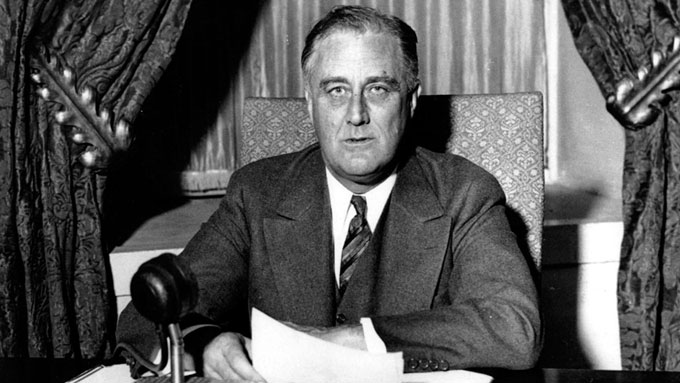
Image of President Franklin Roosevelt

Churchill and Franklin Roosevelt’s Fateful Atlantic Meeting

As Winston Churchill prepared to move into No. 10 Downing Street, he was handed a document from the war government’s new Bletchley Park Code and Deciphering Unit. The report showed that Sempill was still receiving payments, funneled through the Mitsubishi Corporation, to spy for the government of Japan from his position in the Admiralty office. For reasons of his own, Churchill chose to ignore the evidence and Sempill kept his post at Admiralty, where he continued to have unlimited access to sensitive information about military hardware and official secrets.

Though nearly all of the intelligence files on Sempill’s subsequent activities mysteriously  disappeared, surviving records show that he traveled with Churchill to meet with Franklin Roosevelt at the Atlantic Conference, held in Newfoundland in August of 1941. Four months earlier, a Gallop Poll indicated that three-quarters of Americans would support joining England’s war, but only if they believed there was no other way to defeat Germany. Bolstered by the poll, Roosevelt sent his close friend and special adviser, Harry Hopkins, to deliver a private message to Winston Churchill in London: “The President is determined that we shall win this war together. Make no mistake about it: he has sent me here to tell you that at all costs and by all means he will carry you through.”

At the Atlantic Conference, however, Roosevelt reminded Churchill that the 1937 Neutrality Act enacted by Congress prevented direct intervention, and that the strong isolationist element in Washington still tied his hands.  America First, a conservative anti-war movement formed after 1919, persuaded many citizens that enough American blood had already been shed in Europe, and the sentiment was shared by progressives within the President’s own party, many of them isolationists who expressed disappointment that Europe was “acting so tribal” and seemed unable to attend to its own affairs. A Republican Senator, Robert Taft, the son of a former President, spelled it out bluntly: “Even the collapse of England is to be preferred to the participation for the rest of our lives in European wars. If we enter the war today to save England, we will be involved in her wars the rest of our lives.”

Though details of what transpired at the Atlantic Conference remain cloudy at best, we know that two weeks before the meeting Franklin Roosevelt had closed the Panama Canal to Japanese traffic; and in retaliation for the Japanese occupation of French Indo-China, he ordered the seizure of Japanese assets in the United States. The governments of Britain and the Dutch East Indies quickly followed suit, with the result that, virtually overnight, Japan was deprived of 88 percent of its imported oil supply.

We also know Roosevelt again reminded Churchill  that because of the Neutrality Act, the U.S. could only offer a token contribution to the British war effort.

“At least for now,” Roosevelt said.

“Unless,” Churchill asserted, “you are attacked.”

Roosevelt agreed: “Unless we are attacked first.”

And if that attack on America came from Japan? At Guam or Wake Island? Or in the Philippines, or even Pearl Harbor? Would the United States concentrate its forces in the Pacific rather than in Europe? In other words, when could England count on America’s attention?

Franklin Roosevelt, a New York patrician of Dutch-English descent, reassured Winston Churchill—the son of an American mother—that the United States was “with him all the way.” In the event of such an attack, America would throw her full weight behind Britain to defeat Germany and liberate Europe. Until then, fighting a war in the Pacific would be put on hold.

Churchill had cause to press his point: he knew that in a matter of months—even weeks—the United States would, somewhere in the Pacific, be attacked by Japan. Even Roosevelt knew something ominous was transpiring, for at that very moment all Japanese merchant vessels were being called home, presumably in preparation to transport troops and war material to points in the Far East targeted in Japan’s invasion plans.

But Churchill had other, more personal reasons for bringing Sempill to the meeting with Roosevelt. In the first instance, Sempill’s paymasters in Tokyo would learn that Roosevelt was giving them a considerable period of grace—as long as two or even three years—in which to solidify their gains. And secondly, Sempill’s boss, Winston Churchill, knew he would need a scapegoat for what was about to happen to Britain’s colonies in the Far East. It was, after all, a matter of political preservation, for at that point only he knew about the capture of the English steamship, the SS Automedon . . . .
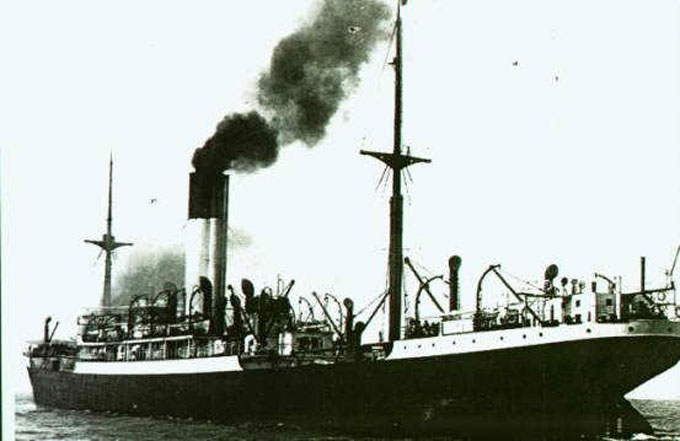
Image of the SS Automedon

The SS Automedon: The Ship That Launched a Thousand Lies and Would Lead to the Death of Millions in the War

Within five days of the Atlantic Conference, Bletchley Park experts decoded a series of messages to Tokyo from the Japanese embassy in London containing nearly word for word the conversations that had occurred between Franklin Roosevelt and Winston Churchill aboard the USS Augusta and the HMS Prince of Wales off the coast of Newfoundland. When Churchill read the transcript, he acknowledged it was “pretty accurate stuff,” then signaled for Sempill’s removal: “Clear him out while there is still time.”

Called before the Chief of Naval Air Services, Sempill received an ultimatum: quit or get sacked. Before Sempill could clear his desk, however, Churchill reversed his order to fire the spy. “I had not contemplated Lord Sempill being required to resign his commission,” he explained, “only that he be assigned elsewhere in the Admiralty.”

The story of the SS Automedon had yet to be disclosed. Best to keep a first-class spy like Sempill close at hand for a future bailout.

Best to keep a first-class spy like Sempill close at hand for a future bailout.

Outside John Steinbeck’s cottage beneath the oaks on Eardley Avenue, scrub jays call to one another in the trees, the California sun is warming the fragrant pines, and the monarch butterflies are making their annual pilgrimage to Pacific Grove. The writer has learned that The Grapes of Wrath has been awarded the 1940 Pulitzer Prize for Fiction, the controversial novel selling more than 430,000 copies, and Viking Press had ordered another printing. Steinbeck is spending his mornings working on a new book, one he and Ed Ricketts will call Sea of Cortez: A Leisurely Journey of Travel and Research.

But John Steinbeck doesn’t appear happy. There is a melancholy air about him as he makes manuscript corrections, sips a beer, and listens to Tommy Dorsey’s I’ll Never Smile Again on the radio. War clouds hover figuratively over his narrative of adventure and discovery, co-authored with Ricketts. Though Steinbeck’s wife Carol accompanied them on the expedition, he has just written her out of the book. Very soon he will write her out of his life.

John Steinbeck doesn’t appear happy. There is a melancholy air about him as he makes manuscript corrections.

Under a lead-colored sky in a more somber part of the world, a merchant ship flying the British ensign leaves the port of Liverpool bound for the tropical waters of Singapore. Hugging the coastline to avoid detection by German submarines, the slow-moving vessel eventually steams around the Horn of Africa into the relative safety of the Indian Ocean. Three days later, making its way east through calm seas, the SS Automedon is detected by a German military ship, the Atlantis—part of a fleet of surface raiders known as “ghost ships” that seek out and destroy merchant vessels carrying cargo to the Far East.

During a short encounter, the wireless operator aboard the Automedon has time to send a distress call that is picked up by two nearby merchant ships flying the British flag. They immediately send coded messages detailing the incident to naval listening stations in Singapore and Durban, South Africa. In turn, both stations relay word of the ship’s imminent capture to London. Overwhelming evidence indicates that British military authorities at the highest level are made fully aware of the Automedon’s fate.

At the scene of the encounter, a  boarding party from the German ship finds the Automedon’s captain dead at the helm. A report filed by the leader, First Lieutenant Ulrich Mohr, states that “the ship proved to be unarmed and the crew gave up without a struggle. Unobstructed, we got to work on the strong room where we found fifteen bags of secret mail, including one hundredweight of decoding tables, fleet orders, gunnery instructions, and various British Naval Intelligence reports, including all the top-secret post en route for the Far Eastern Command, Singapore.”

Included in the haul is a complete set of Royal Navy fleet ciphers, New Merchant Navy ciphers scheduled to become valid in two months, a wealth of British Admiralty shipping and intelligence summaries, and several green bags containing 6,000,000 freshly minted New Straits Singapore dollars.

Lieutenant Mohr’s report continues: “Our search of the Chart Room brought us far greater rewards. Our real prize was a long narrow envelope enclosed in a green bag marked HIGHLY CONFIDENTIAL – SAFE HANDS – TO BE DESTROYED. It was addressed to the Commander in Chief, Far East, with the words TO BE OPENED PERSONALLY. It was equipped with brass eyelets to let water in to facilitate its sinking should it prove necessary to dispose of it at sea.”

Under a lead-colored sky in a more somber part of the world, a merchant ship flying the British ensign leaves the port of Liverpool.

The money, the reports, the codes, the intelligence reports, the green bags, the crew—the entire haul—was taken aboard the Atlantis. Then, stripped of its information and valuables, the Automedon is dispatched to the bottom of the Indian Ocean by German explosives. As the captain of the Atlantis sorts through the haul, he realizes that he’s looking at a mountain of intelligence information—a cache so vast, so significant, that he aborted his raiding mission and turned his ship to Truk Island, the nearest safe port in the Japanese-mandated island group.

There he transferred the secret documents and surviving crew of the Automedon onto a captured Norwegian tanker that was leaving for Kobe, Japan with 10,000 tons of aviation gasoline. As evening fell over Japan on December 5, 1940, the haul from the Automedon arrived at the German Embassy in Tokyo.

Over the next three days, Admiral Paul Wenneker, a German naval attaché, carefully photographs the codes and Chief of Staff reports taken from the Automedon before turning the haul over to a fellow officer, Captain Paul Karmenz, for delivery to Berlin. Karmenz went first to Vladivostok in Russia—for the moment a neutral nation—then crossed Russia  by train, traveling day and night on his urgent mission.

If there was  trouble, Admiral Wanneker planned to send a four-part coded telegram to Naval Command Headquarters in Berlin summarizing each of the captured reports. But the plan wouldn’t be needed. Safely delivered and deciphered, the messages were circulated among the Nazi top brass, and on December 12, under orders from Hitler, the Japanese naval attaché in Berlin was summoned to German Naval Command Headquarters. When he arrived, Captain Yokai was  shown a copy of Wanneker’s summary which he immediately relayed to his superiors in Tokyo.

Yokai’s message to Tokyo was intercepted by an American listening station in the Pacific, probably on Guam or in Hawaii, where it was to sit in someone’s in-basket. It wasn’t to be deciphered until August 19, 1945, four days after Japan surrendered.
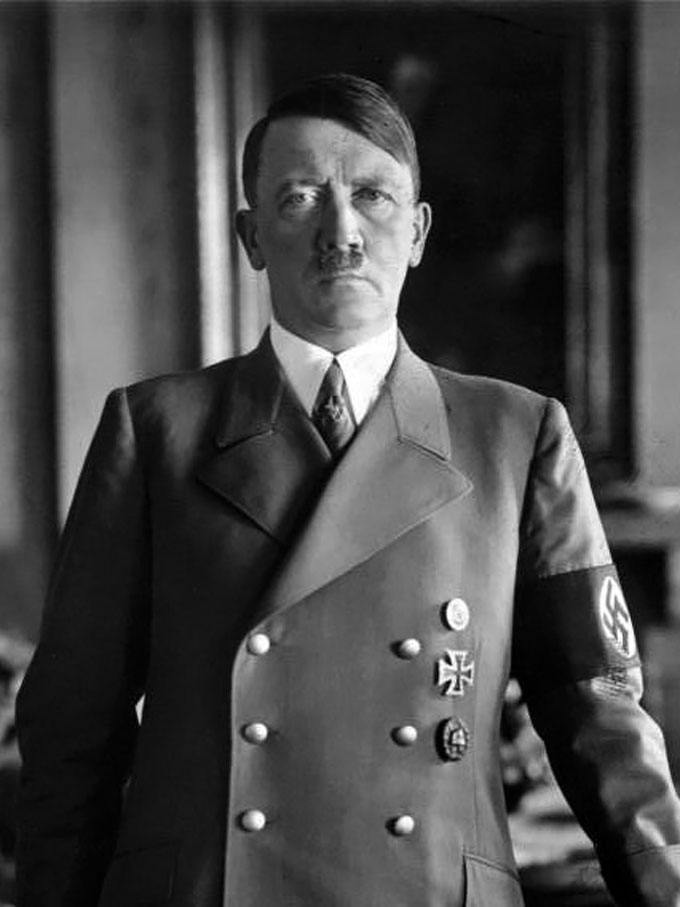
Image of Adolph Hitler

The German-Japanese Connection in the Wartime Far East

But in Tokyo, things were moving considerably faster. On December 12, Admiral Wanneker presented copies of the report to the Japanese Naval Chief  of General Staff, Vice Admiral Kondo. The Admiral read the contents and shrugged. “These codes and position documents,” he remarked, “they have been allowed to fall into our hands to mislead both the Germans and the Japanese governments. This, of course, is a deception.”

“I doubt that emphatically,” replied Wanneker. “The Automedon was an unarmed merchant vessel whose captain was killed outright in our initial shelling. To a man, the crew surrendered without a fight, and upon boarding her First Lieutenant Mohr went directly to the captain’s quarters, where he found the sealed bags containing these documents. No, this is hardly a deception. The plain truth is that the ship’s encounter with the Atlantis was too short and swift to afford anyone an opportunity to destroy them.”

To make his point, Wanneker showed Kondo photographs of the green bag and a copy of the SAFE HANDS report that was to be handed over personally to the Far East Commander-in-Chief.

“This information is marked to the personal attention of Air Marshal Robert Brooke-Popham,” Wanneker adds, “And what we have here is an intimate view inside the British War Cabinet. These, Admiral, are the full minutes of the Cabinet’s meeting of 8 August 1940, a meeting in which a complete assessment of the Far East situation was presented. Included in it is a highly confidential Chief-of-Staff report on the defense of Hong Kong, Singapore, and the Far East with respect to their defenses against any Japanese attack.”

Kondo was silent, perhaps overwhelmed. “So,” he said slowly, clicking his heels sharply and bowing generously to Wanneker. “So, these are the minutes of the British War Cabinet, with their diplomatic and naval codes.” He whispered as if only half-believing his eyes and ears: “And, of course, full information on the defense of Hong Kong and Singapore.”

“Perhaps I can remind you, Admiral,” Wanneker said, giving weight to his words, “that it was Herr Hitler himself who directed that this information be shared with you.”

“Certainly, Admiral. I assure you that this material shall be given careful scrutiny. And you must extend Japan’s gratitude to your Führer,” replied Kendo, clicking his heels and making his exit.
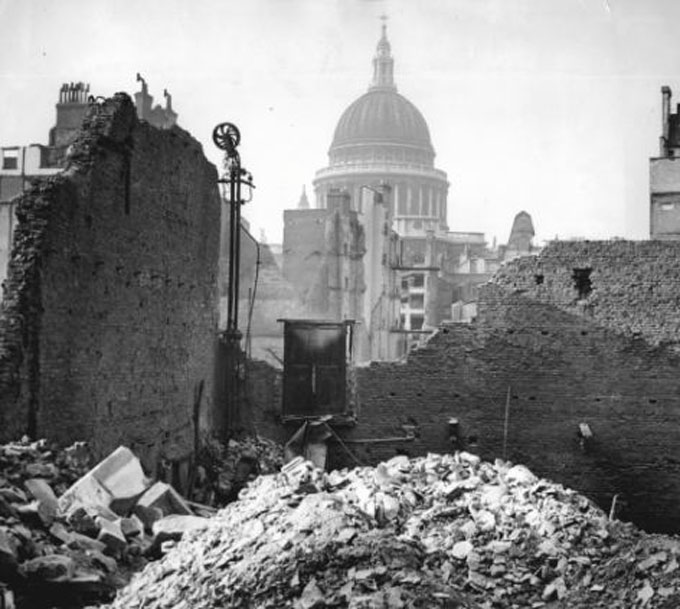
Image of the bombing of Britain

The London Blitz and Japan’s Good Fortune

Three years earlier, Konto had been part of the military coalition that swept out the civilian cabinet in Tokyo and took control of the government, making Japan a military dictatorship much like Nazi Germany. Within five months, the coalition had put together a war plan and, on July 7, 1937—in the dead of night and without warning—Japanese troops launched an undeclared war against China.

As the coalition had surmised, the Chinese would be no match, and by 1940 Japan controlled every important city in China. There was only one exception, and that was the British Crown Colony of Hong Kong. Putting one boot across the border would, the invaders realized, incur the wrath and power of the British Empire. Instead, Japan turned its attention to nearby Siam (today’s Thailand), where by diplomacy and threat it established a large naval base and built a number of military airstrips.

Then, quite unexpectedly, on June 22, 1940 France surrendered to Germany and Nazi troops occupied Paris. Seizing the opportunity, Japan presented an audacious request to the collaborationist Vichy government: “As Germany’s ally, we demand that France relinquish immediate control of all its colonial possessions in French Indo-China.” When a positive reply was forthcoming, Japan’s military leaders made preparations to take over Vietnam, Laos, and Cambodia.

Putting one boot across the border would, the invaders realized, incur the wrath and power of the British Empire.

Back in England, Winston Churchill had just become Prime Minister, and as war raged across Europe, Japan’s expansionist policies began to encroach on Great Britain’s Far East possessions. Directing his War Cabinet to evaluate the situation with respect to Hong Kong, Malaya (Malaysia), and Singapore, Churchill wanted to know the size of the fleet that would be required to safeguard England’s Far East outposts in the event of war with Japan. Referring to a study made a year earlier, it was determined that the minimum needed to meet Japanese aggression would be a flotilla of 10 battleships and two battle cruisers, plus several cruisers and escort destroyers. It might even be necessary as well to send an aircraft carrier or two—an action requiring 70 days or more.

As if by chance, the German Luftwaffe chose that same moment to send 348 bombers and 617 fighter planes across the channel to bomb England. The first raid would last two hours, followed by a second, then by a third wave of bombers. They came by daylight, they came at night, and the bombing of England continued for 57 days. Homes vanished, factories were destroyed, cathedrals burned. Entire cities were devastated.

Back in England, Winston Churchill had just become Prime Minister.

In Berlin, Hitler issued Directive #16 setting in motion preparations for Operation Sea Lion, the Nazi plan for an event unprecedented since the Spanish Armada—a military invasion of the British Isles by sea. “As England still shows no signs of willingness to come to terms,” Hitler explained, “I have decided to prepare and, if necessary, to carry out a landing operation against her. The aim of this operation is to eliminate the English Motherland as a base from which the war against Germany can be continued.”

Meanwhile, urgent pleas were arriving in London from the Governors of Singapore and Hong Kong: “Where are the promised troops? Where are the promised ships? Where are the promised aeroplanes of the RAF?’’ The governments of Australia and New Zealand were asking the same questions.

In response, Winston Churchill convened his top advisers, ordering the British Chiefs of Staff to update their earlier estimates about the size of the fleet needed to protect Hong Kong and Singapore. The new report, 87 pages long, was gloomier than anyone could have imagined: Britain was in no position to resort to war if Japan attacked Hong Kong, Malaya, Singapore, or the Dutch East Indies. The Far East was indefensible, and without the active involvement of the United States, Britain’s remaining colonies were doomed. In the event of a Japanese attack, the Prime Minister was advised, Britain must make concessions and adapt a delaying strategy.

Churchill’s reaction was to dispatch a copy of the report to his newly-appointed Commander-in-Chief of the British Far Eastern Command. It was a new command, making Air Marshal Robert Brooke-Popham responsible for all defense matters in Singapore, Malaya, Burma, and Hong Kong. In the interest of secrecy, Churchill’s decision was to hand the bag containing the full diplomatic report over to the captain of the S.S. Automedon for delivery.

Britain was in no position to resort to war if Japan attacked Hong Kong, Malaya, Singapore, or the Dutch East Indies.

Six thousand miles away in Tokyo, a military committee called the Council for the Conduct of the War poured over the intelligence report drawn up after careful review of the documents captured by the Germans from the Automedon. Captain Yamaguchi Bujiro (Head of 5th Intelligence Section, dealing with the U.SA.) and Captain Horiuchi Shigetada (Head of 8th Intelligence Section, dealing with Britain and India) offered this prediction to the Japanese General Staff: “Even if Japan sends forces into Indo-China or beyond, Britain will not go to war.”

The Council then sent the following message to Naval Marshal Admiral Yamamoto: “In the event it is decided to go to war in Southeast Asia, to neutralize the United States Pacific Fleet it is imperative that you begin drawing up plans to attack Pearl Harbor.”

On November 26, 1941, a Japanese attack force consisting of six aircraft carriers, nine destroyers, two battleships, two heavy cruisers, one light cruiser, and three submarines left Iturop Island in the Kurils northeast of Japan and began the 3,000-mile journey across the Pacific Ocean to its American target.
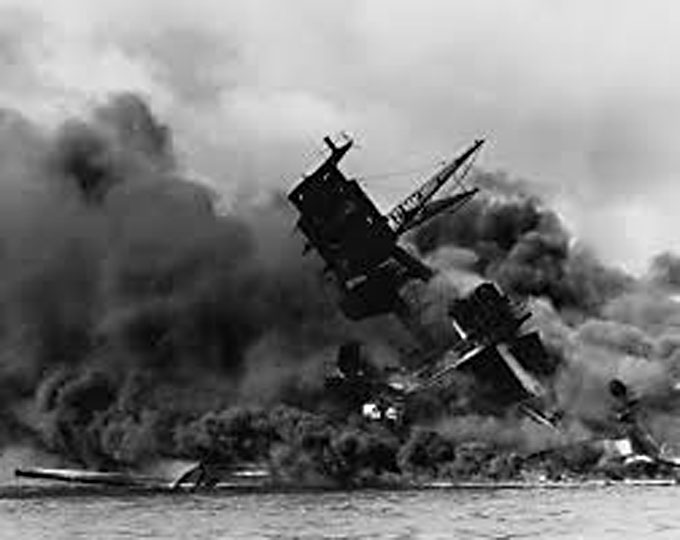
Image of the attack on Pearl Harbor

Before Pearl Harbor: The Great British Double-Cross

Within a week of the Atlantic Conference, a joint Army-Navy board in Washington had presented the results of an ongoing study to the White House: in the event of War Plan Orange (war with Japan), the Philippines could not be defended and would have to be yielded by default. The following day, Roosevelt signed a bill permitting the Army to keep men currently in service for an additional 18 months. Then, perhaps on a hunch, he ordered four of the seven aircraft carriers out of Pearl Harbor, along with a number of cruisers and destroyer escort vessels, three battleships, and 21 tenders, fuel ships, and minesweepers. The carriers left at Pearl Harbor were to be assigned missions away from Hawaii.

After Churchill’s meeting with Roosevelt, British ships loaded with Hurricane fighters en route to Singapore were abruptly ordered to change course. The planes promised to Singapore were dispatched to Libya instead. Experienced troops in Malaya and Singapore—the men best prepared to defend the Peninsula and save it from Japanese conquest—were put aboard ships and diverted to India, the Crown Jewel of the dissolving British Empire.

Churchill’s earlier authorization to send a fleet of fast torpedo boats to defend Singapore was similarly rescinded. In Hong Kong, Royal Air Force combat planes were ordered out and dispersed to Burma and India. Munitions and supplies from Canada meant for Hong Kong’s defense were inexplicably sidetracked to the Philippines, and the Bank of Hong Kong, which printed and controlled the colony’s currency, was spirited out of the colony. Additionally, every ranking government official in Hong Kong—from the Governor down to the Director of Public Works—was abruptly recalled to England or transferred to a safer location. Next, nearly all merchant and naval ships received orders to leave the harbors of Singapore and Hong Kong—immediately.

After Churchill’s meeting with Roosevelt, British ships loaded with Hurricane fighters en route to Singapore were abruptly ordered to change course.

Sometime between the hours of 2:30 and 3:00 the morning of December 7, at the very moment the fleet of merchant ships was hurrying out of Hong Kong harbor,  Madame Sun Yet-Sen, widow of the Republic of China’s first president, plus the head of the London Times Newspaper Bureau and a number of other notables who had been visiting Hong Kong, were hurriedly piling their luggage outside their doors at the Hong Kong Hotel and desperately summoning help to get them and their luggage to a ship that was waiting in the harbor. When someone asked them why they were leaving in such a mad rush, they replied that he “had to be a dumb mutt not to know that the Japanese were going to attack Hong Kong at any moment.” Madame Sun Yet-Sen and the rest of the visitors got clean away; the “dumb mutt” didn’t.  Like thousands upon thousands of others, he was to spend the next 3 years and 8 months being starved and beaten by Japanese guards behind barbed wire in a prisoner of war camp.

Clearly, the man behind the desk at No. 10 Downing Street knew not only what was about to happen in Hong Kong but when, and he was making last-minute adjustments.

Clearly, the man behind the desk at No. 10 Downing Street knew not only what was about to happen in Hong Kong but when, and he was making last-minute adjustments.

When the attack came, the defense of Hong Kong was left to a volunteer militia comprised of civilian businessmen, lawyers, merchants, bankers, and other professionals armed with pistols and World War I rifles. Canada, which had been asked to provide support troops, had responded by sending two battalions of fresh recruits–the Royal Rifles from Quebec and the Winnipeg Grenadiers—that had been training in the cool autumn climate of Newfoundland. Through a bureaucratic blunder, the young soldiers arrived in Hong Kong while their baggage and gear was sidetracked to Manila in the Philippines. They had disembarked in the tropical heat wearing their woolen winter uniforms, and nearly all of them were seasick. Three days later, the bombs fell. They were at war.

From London, Winston Churchill took to the airwaves to warn the military planners in Japan that, though under constant attack from the Germans, England had no intention of abandoning “one single centimeter of soil” in the Far East. As a consequence of its aggression, he said, Japan would have to reckon with the fearsome might of Great Britain. As proof, he said he’d already dispatched two of Britain’s newest, fastest, and virtually unsinkable battleships, the HMS Prince of Wales and the HMS Repulse, to the region.

On the third day of the war, the two major battleships were quickly and almost effortlessly sent to the bottom of the South China Sea by a squadron of Japanese torpedo bombers.
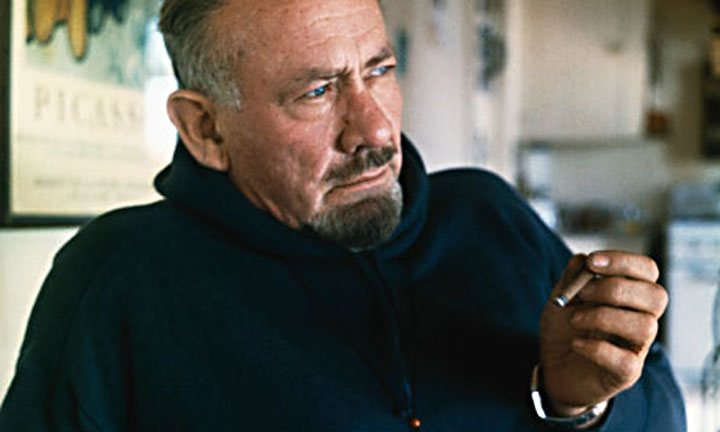
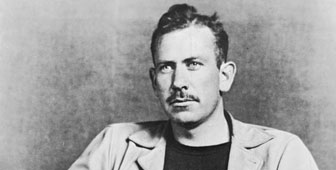
Image of John Steinbeck

The Cost Of the War John Steinbeck Called Dishonest

In Pacific Grove, it would have been 10:55 a.m. on Sunday. Monarch butterflies clustered on the trunks of the pines, and from the shore came the sound of the surf rolling over rocks on the beach at the foot of Eardley Avenue. Gulls screeched, sea lions barked, and the noise of fishing boats returning from their morning sardine run came from Monterey Bay. In the distance, hawks soared in wide circles seeking thermals above Jack’s Peak, and as it was a day of rest, Cannery Row was silent. It was December 7, 1941, and Japan had gone on the attack. Across the Pacific, Asia was on fire and Pearl Harbor was burning. Though he couldn’t have known it, John Steinbeck would soon be leaving the scents and the sounds of Pacific Grove for a very long time.

To a shocked world, Pearl Harbor would be universally described as a surprise attack, and for the next 44 months America and the world would be at war. Thanks to a Scottish lord, Winston Churchill, and the easy capture of a slow-moving steamship, these are the territories that would be swiftly occupied  by the Empire of the Rising Sun:

  • Hong Kong
  • British New Guinea
  • The Philippines
  • Guam
  • Dutch East Indies
  • Portuguese Timor
  • Malaya
  • Andaman and Nicobar Islands
  • Straits Settlements (Singapore)
  • Kingdom of Sarawak
  • Brunei
  • North Borneo
  • Nauru
  • Imphal
  • Wake Island
  • Gilbert and Ellice Islands
  • Christmas Islands
  • Attu and Kiska Islands

One year after the capture of the Automedon, the crew of the Atlantis would be invited to the Emperor’s Palace in Tokyo where Captain Rogge would be presented with a samurai sword by Emperor Hirohito. Only two other Germans had received such an honor: Field Marshal Hermann Goering, and Field Marshal Erwin Rommel, the Desert Fox.

Franklin Roosevelt, the 32nd President of the United States, died while still in office, at Warm Springs, Georgia on April 12, 1945, age 63. The President from Hyde Park, New York was mourned by millions around the world.

Sir Winston Churchill, KG, OM, CH, TD, DL, FRS, RA, lived 20 years longer, passing away peacefully in his own bed in London, age 90, on January 24, 1965. His state funeral would be described as the largest in the world. In Britain, the Secrets Act protects official papers from public scrutiny for a period of thirty years. Before leaving office, Churchill locked his official and personal papers out of public reach for a period of 50 years after his death.

Churchill carried the secrets about Sempill and the Automedon to his grave, but during the terrible days that Singapore and Hong Kong were under attack, he issued these words to their doomed defenders: “There must be no thought of sparing the troops or population; commanders and senior officers should die with their troops. The honor of the British Empire and the British Army is at stake.”

The man in Singapore to whom the order was addressed, Air Marshal Robert Brooke-Popham, was in such a hurry to flee the burning island in the final days of its siege that he broke a leg scurrying down a ramp to board the speedboat that would take him to the safety of Australia. It was he, the Far East Commander-in-Chief, to whom Winston Churchill had sent the TOP SECRET, HIGHLY CONFIDENTIAL documents. Via the SS Automedon.

Churchill carried the secrets about Sempill and the Automedon to his grave.

William Forbes-Sempill—19th Lord Sempill and Baronet of Craigevar, AFC, Third Class Commander in the Order of the Raising Sun (Japan)—died 11 months after the death of the Prime Minister who protected him, at his Craigevar Castle in Aberdeenshire, Scotland, at the age of 72.  Ten days following the outbreak of war in the Pacific, at the moment Hong Kong was on the verge of surrendering, Sempill was discovered making calls to the Japanese Embassy in London. The Admiralty asked him to retire immediately, and that time he did. Unfortunately, his ruling-class connections saved him from the hangman’s noose.

Most of the documents relating to Sempill’s spying activities, like a great many of Winston Churchill’s papers, have disappeared from government archives, as have those relating to the SS Automedon. The depth of one man’s treachery, and the collaboration of another, only came to partial light in 2002. But the following statistics suggest the scale of destruction caused by this forgotten man of history, and by the Prime Minister who protected him.

Casualties in the Pacific War numbered approximately 36,000,000, half of the total casualties of the Second World War.

The estimated number of civilian victims of Japanese democide is 20,365,000:

  • China12,392,000
  • Indochina1,500,000
  • Indonesia375,000
  • Dutch East Indies3,000,000
  • Malaya and Singapore283,000
  • Thailand60,000
  • Philippines500,000
  • Burma170,000
  • Pacific Islands57,000
  • Timor60,000

The number of POW deaths in Japanese captivity is estimated at 539,000:

  • Netherlands8,500
  • Britain12,433
  • Canada273
  • Philippines23,000
  • Australia7,412
  • New Zealand31
  • United States12,935

Out of 60,000 Indian Army POWs taken at the Fall of Singapore, 12,000 died in captivity.

Not long after the war ended, John Steinbeck issued his own statement about the war that he had reported on from London, North Africa, and Italy: “The crap I wrote overseas had a profoundly nauseating effect on me.  Among other unpleasant things, war is the most dishonest thing imaginable.”  One wonders if, in the course of his foreign travels, he had discovered the true story of treachery and deceit recorded here.
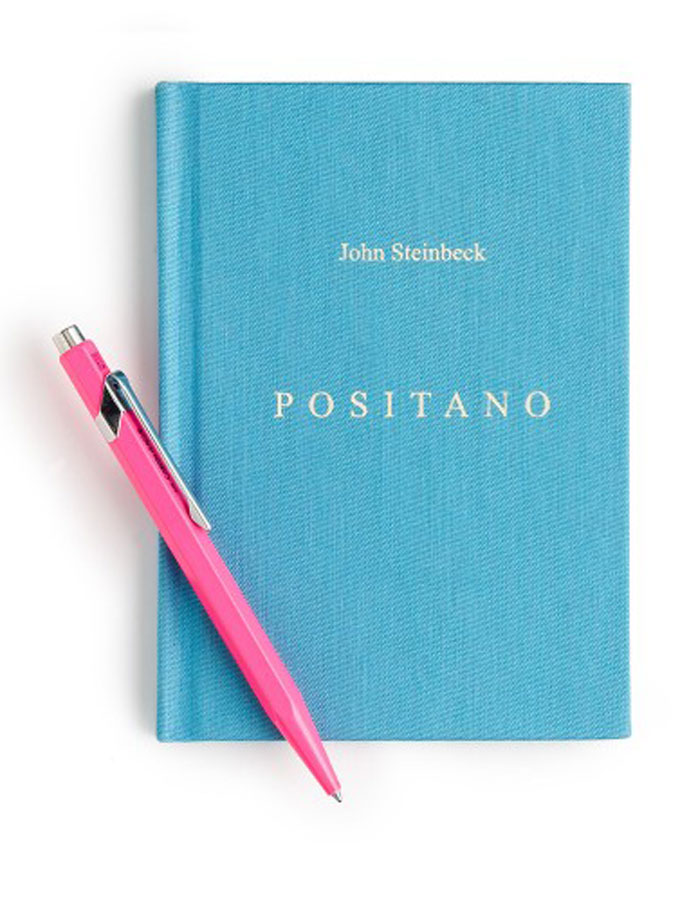
J. Crew Recalls Steinbeck’s 1953 Trip to Positano, Italy

J. Crew's image of specially bound John Steinbeck travel piece

John Steinbeck’s brand remains a resilient commodity with commercial uses that continue to surprise. Steve Hauk alerts Steinbeck lovers to J. Crew’s online profile of Carla Sersale, a clothing designer whose family owns a summer resort on the Amalfi Coast, a magical place visited by John Steinbeck in 1953. Along with the view, the hotel’s rooms feature specially bound copies of John Steinbeck’s piece on Positano, Italy, written for Harper’s Bazaar magazine—a reminder that Steinbeck knew how to travel well and commercialize, too.

Pulitzer Prize Finalist Writing John Steinbeck Biography: Talk With William Souder

Image of Pulitzer Prize finalist William Souder

Plans to publish a new John Steinbeck biography by William Souder, a Pulitzer Prize finalist for Under a Wild Sky: John James Audubon and the Making of The Birds of America, received wide attention for good reason. When Souder’s John Steinbeck biography is released by W.W. Norton & Company in 2019, Jackson Benson’s classic life of Steinbeck will already be 35 years old. Jay Parini’s 1995 John Steinbeck biography covered some of the same ground, but Benson’s experience with Steinbeck’s heirs may have intimidated other biographers, delaying reinterpretation of Steinbeck’s life and work for contemporary readers more interested in new information than old quarrels. On a Farther Shore: The Life and Legacy of Rachel Carson, Souder’s brilliant biography of the crusading ecologist who wrote the 1962 book that made environmentalism a burning issue, promises to connect ecology, Steinbeck, and the so-called American century, renewing appreciation and deepening our understanding of a troubled writer who seemed, almost equally, behind and ahead of his turbulent time. Like John James Audubon, John Steinbeck was a complicated man who sometimes managed to cover his tracks. Like Rachel Carson, Steinbeck was a passionate dissident who championed change, challenged power, and suffered the consequences. In this interview, William Souder explores the connections and compares the three figures, explaining why (and how) he is writing a new John Steinbeck biography now.

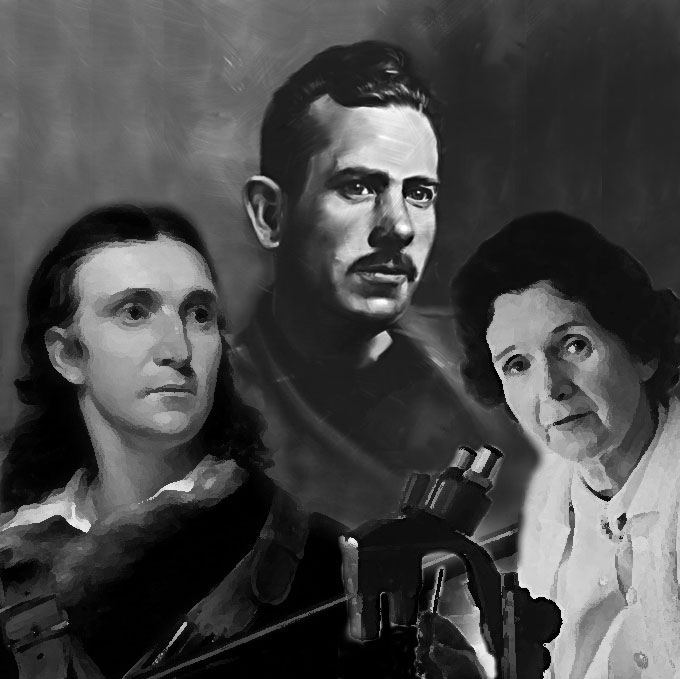
Composite image of John James Audubon, John Steinbeck, and Rachel Carson

WR: Your John Steinbeck biography will be titled “Mad at the World: John Steinbeck and the American Century.” How was this title chosen, and what does it tell us about your approach?

WS: Titles are important. Sometimes it comes to you easily at the start, and other times you struggle to find the right one. With Steinbeck I had this title almost from the moment I decided to write about him. There’s the obvious meaning—that Steinbeck wrote in response to the injustice and evil he saw in the world. That’s clearly true in books such as In Dubious Battle, The Grapes of Wrath, East of Eden, and The Winter of Our Discontent, a book I regard highly, and that contains some of Steinbeck’s most elegant prose. Of course, most writers concern themselves in some way with the ills of the world. Steinbeck seemed to take it more personally. He was, especially when he was young, prickly. Not bad-tempered, but running a couple of degrees hotter than everyone else. He bridled at conformity—his deep friendship with Ed Ricketts was based in large part on their shared hatred of convention. Steinbeck didn’t like school, didn’t like Salinas, didn’t like working as a reporter in New York. And all of those things didn’t like him back. Stanford was happy to be rid of him when he finally gave it up. Later, people in California thought The Grapes of Wrath was obscene and filled with lies. Steinbeck pretended to ignore criticism, but no writer actually can. When he said he didn’t think he deserved the Nobel Prize I don’t believe he really meant it. I think he just wanted to disarm the critics who were lining up to say as much. Of course, they said it anyway.

One of the things that attracted me to Steinbeck is that he was far from perfect—as a man, a husband, a writer, he had issues. He had a permanent chip on his shoulder. He got sidetracked by ideas that were a waste of his time and talent. Some of his work is brilliant and some of it is awful. That’s what you want in a subject—a hero with flaws. Steinbeck was a literary giant who wouldn’t play along with the idea that he was important. I love that. He was mad at the world because it seemed somehow mad at him.

Anyway, I think it’s a strong, provocative title. And I hope it explains that I want to place Steinbeck firmly in the historical context that was the wellspring for so much of his work.

WR: Like Steinbeck’s father, you spent your early life in Florida but moved away. Where, when, and how did you become a writer?

WS: I did grow up in Florida, but I was actually born in Minnesota. My dad was an aerospace engineer, and we moved to Florida when the space program got going in the late 1950s. I loved it there, the beaches and the Gulf of Mexico, and the scent of orange blossoms in the warm night air. Florida will always be home to me, but I’ve lived in a lot of places. I married a girl from St. Paul and once you do that you’re committed to the tundra. I’ve been in Minnesota now for longer than anywhere else. It has a lot going for it, though in the winter it’s like living on another planet. We’re out in the country, with the coyotes and the wide open spaces, and the dark, dark starry nights. Our neighbor still cuts hay on our property. But we can see the Minneapolis skyline from our house—in fact I’m looking that way right now.

I got interested in film and photography and writing after I got out of the Navy. I went to the journalism school at the University of Minnesota, which at the time was among the best j-schools in the country, and where you could study all of those things. This was right after Woodward and Bernstein had turned journalism into a glamorous profession. There was a legendary professor there named George Hage—he’s long deceased, but still remembered here as an inspiration to several generations of journalists—who was a mentor to me and who convinced me to become a reporter. Which I did. Then, in 1996, a story I wrote for the Washington Post turned into my first book. I was 50 when it came out four years later and I didn’t look back.

WR: Your first book was about a local ecological catastrophe. How did that lead to writing a life of John James Audubon, who could hardly be characterized as an environmentalist?

Let’s pull the curtain back. For many writers, it only looks like one book naturally follows another. The truth is that, in between, there are often false starts and dead ends. Ideas that don’t pan out. Concepts that your agent or your editor—or both—don’t like. I’ve sold four books to publishers, but I’ve had probably twice that number rejected, though most of them in the early, talking stages, when I had little invested. Some of those ideas probably deserved to die, but with others I wonder what might have been. At one point I was determined to write a book about hurricanes. I had plenty of firsthand experience with hurricanes growing up in Florida, and I wanted to get inside a big storm by flying with the Hurricane Hunters out of Miami. But my editor didn’t think it would work and I moved on. Later that year, Katrina hit New Orleans.

My interests are science—especially biology—the environment, history, and writers. So I look for subjects that embody those interests. That’s the common thread in all of my books, and it applies to John Steinbeck, too. It’s true that Audubon was no environmentalist. Nobody was back then. But he was, in addition to being a great painter, a naturalist and explorer and ornithologist who was immersed in what we call “the environment,” which is really just the world as it is—including the damage we do to it.

WR: Your biography of John James Audubon was a Pulitzer Prize book finalist. Winning the Pulitzer Prize seemed to surprise Steinbeck and disrupt relationships in his life. Did making the Pulitzer Prize short list influence your choice of subject for your next book?

WS: Being a finalist for the Pulitzer means your book was one of three nominees for up for consideration. One book wins, the other two are the finalists. So it’s a select group and an honor. And it did have one important effect on my future work: It confirmed for me that I could write biography, a discipline I didn’t know anything about until I did the Audubon book, but which I fell in love with. It turns out that I have that gene that makes you willing to spend weeks or months in an archive crawling around inside someone else’s life. And when you do that, and that other life becomes a story you have to tell, you know you’re cut out for biography.

You do choose your subjects. Absolutely. And there can be a lot of calculation in it. You’re searching for a book that you want to write and that people will also want to read. But for it all to come together, on some level your subject has to choose you. I started thinking about writing about Rachel Carson around 2005. But I wanted to time that book so it would come out in 2012, on the 50th anniversary of Carson’s Silent Spring. I figured I had time to write one, or maybe two other books before turning to Carson. But a couple of ideas didn’t work and by 2008 I realized it was time to start on Carson. She left a rich paper trail—most of it is at the Beinecke library at Yale, one of my favorite places in the world—and the more I looked at the material the more insistent it became. Once someone’s life gets inside your head you can’t shut it off. It’s like hearing a voice. Let’s do this now.

WR: Your John James Audubon book is also a biography of frontier America’s adolescence. What motivated the leap from 19th century to 20th century America in your decision to write about Rachel Carson?

WS: In my mind, Audubon and Carson have deep connections to each other. Audubon recorded, in his remarkable bird paintings and in what he wrote to accompany those images, an American landscape largely unmarred by civilization. A century later, Rachel Carson surveyed that same landscape—first as a writer for the U.S. Fish and Wildlife Service and later as the author of Silent Spring—and found it damaged. With Silent Spring, she almost singlehandedly launched the modern environmental movement. And that movement has as its objective the preservation of a natural order that Audubon took for granted. We will never get there, but Carson started us in the right direction. A good friend of mine who is a biologist once told me that our job is not to save the world, but to save ourselves. Audubon showed us why; Carson showed us how.

WR: What were the hardest parts of researching the lives of Rachel Carson and John James Audubon for publication, and how did your research methods differ in writing the two books?

WS: I’ve got a good answer, which sort of true, and a boring answer, which is totally true.

The good answer is that although biographical research is work, it is never hard if you’ve chosen your subject wisely. The test comes after the first year or two. Are you still intrigued? Do you still have the fever that set you off in the first place? I’ve been lucky (so far) that the answer has been yes. So the work is enjoyable and in no way “hard.”

The boring answer is that the hard part is organizing the material. How do you keep track of everything? There are ways, things you learn from others and things you invent for yourself.  For Rachel Carson, I ended up with 100 pages of single-spaced notes and more than 3,000 documents on microfilm, plus a medium-sized library of books. Knowing where to find the one fact that you need from somewhere in all of that is the art of biography. Being clever helps, but sometimes it’s a matter of brute force. I can keep track of an amazing amount of stuff in my head.

You asked only about the research, not the writing. Now the writing—that is hard. I love it, but it is difficult. I had an editor once who liked to say that good writing is simple—but not easy. So true. Good writing involves several processes, but the most important is taking out the words that don’t belong. John Steinbeck knew this. In a well-known letter to his son Thom he apologized for going on for 18 pages. “I’d have written you a note,” he said, “but I didn’t have time.”

WR: John Steinbeck comes into your Rachel Carson book because of Ed Ricketts. How did Ricketts’s story contribute to your understanding of Rachel Carson?

WS: Ricketts and Carson were opposites—except in the way they looked at the ecology of the seashore. Ricketts invented himself, devised a personal philosophy that corresponded to his bohemian tastes and voracious appetites. Ricketts devoured life. Carson was the product of university training and the studious contemplation of scientific research. She lived quietly with her mother and a couple of cats. Both Ricketts and Carson died young. Carson succumbed to cancer. Ricketts was run over by a train. Had the two of them ever met face-to-face I think it might have opened a worm-hole in the universe. But they agreed utterly on the nature of the world they inhabited so differently. Each understood that every living creature is part of an ecosystem that is maintained collectively by every entity within. When Carson began work on The Edge of the Sea, which had started out as only a guidebook for beachcombers, she consciously modeled it on Ricketts’s Between Pacific Tides

WR: When did you decide to write a new John Steinbeck biography, and why?

WS: I didn’t find Steinbeck. He found me. And, as you suggest, it happened when I was researching Ed Ricketts for the Carson book, especially the collecting trip Ricketts and Steinbeck undertook to the Sea of Cortez.

This is how it begins: You come across a name you know a few things about—he was from California, he wrote The Grapes of Wrath—and you get curious. And because you’re always on the lookout for your next subject you are always trying to fit the pieces of someone’s life into a narrative. And in Steinbeck’s case it was easy. His story cuts right across the headlong march of 20th century American history, which I find fascinating. Steinbeck is born just after the close of the Victorian era—and he dies a few months before Neil Armstrong steps onto the moon. So that was his material. I was hooked.

WR: What other similarities, differences, or patterns attracted you to Audubon, Carson, and Steinbeck as subjects?

WS: Writers and artists don’t have to be writers and artists. But they feel compelled. It’s in the nature of a calling, a feeling that you’re meant to do something particular with your time on earth. I don’t mean that in any religious sense. No greater being taps you on the shoulder and makes you understand that you should write East of Eden. It’s more like you can’t help yourself. I think that’s the common trait among Audubon, Carson, and Steinbeck. They couldn’t help themselves. They became stories worth telling.

WR: How does researching Steinbeck’s life differ from your research on Carson and Audubon?

WS: I don’t know yet. There will be many similarities. All three were prolific correspondents, and letters are a biographer’s most important resource. I guess the main difference will be contextual, in exploring the history more closely with Steinbeck. I know what I want to get into my book. It’s a specific feeling that is hard to describe. There is a government retreat in Shepherdstown, West Virginia called the National Conservation Training Center. It belongs to the U.S Fish and Wildlife Service, Rachel Carson’s old outfit. It’s a beautiful campus in the rolling hills not too far from Harper’s Ferry. All of the buildings are lined with big, black-and-white photos, many from the agency’s glory days in the 1940s and 50s, of FWS personnel in the field. I’ve visited this place twice, and both times those photos got to me—elicited an ache. Like I could feel a connection to something that happened decades ago that would have been a great story to be part of. That’s the feeling you strive for in biography, the feeling that you are close to an earlier time, a different place, a person who lived in that time and place.

When I was in Scotland working on Audubon, I noticed that the library at the University of Edinburgh had a map room. I asked them if they had a map of the city from 1826, the year Audubon was there. And they did—a postal carrier’s map that was small and portable. I had them make a photocopy—I’d never been to Edinburgh—and then used that map to navigate around the city while I was there. And because Edinburgh is old, the map was still quite accurate. It helped me to see the city as Audubon saw it—to feel closer to my subject. One fog-bound night as I walked back to my hotel along one of the ancient cobbled streets I heard footsteps approaching and for a minute I let myself think it might be him.

WR: What is your research plan for the John Steinbeck biography, and how can readers of SteinbeckNow.com help?

WS: I’m just starting. There are important collections at Stanford, San Jose State, and in Salinas, as well as other places. And there are many Steinbeck experts and scholars I hope to talk with, and places he lived or that were important to him that I plan to visit. I expect to spend most of the next two years on research, and will write the book the year after that. It’s due to the publisher in the spring of 2018 and will be out sometime in 2019.

I’m happy to hear from anyone in the far-flung Steinbeck community with tips or leads about things I need to know.

Hookers With Hearts of Gold: John Steinbeck’s Prostitutes

Paperback cover image from John Steinbeck's Cannery Row

John Steinbeck’s split-screen picture of women—Mother Virgin vs. Vestibule Whore—continues to trouble contemporary readers of East of Eden and his Cannery Row fiction. Male characters like Doc, Lee, and Sam Hamilton are complex . . . intelligent men, like Steinbeck, with mixed moral motives. Dora, Suzy, and Cathy, all prostitutes of one type or another, also show a range of feeling and behavior, but far narrower. Steinbeck’s depiction of whores almost seems bipoloar, flat and forced and, the case of Cathy, not completely convincing. Was Steinbeck, with the shining exception of Ma Joad, a male chauvinist whose writing failed to understand or value women equally with men? Reading East of Eden and Steinbeck’s Cannery Row novels in the context of Steinbeck’s contempt for conventional morality suggests that he was far from it.

Was Steinbeck, with the shining exception of Ma Joad, a male chauvinist whose writing failed to understand or value women equally with men?

John Steinbeck was, in fact, atypical of his gender and time in reversing the status of “churchy” mother-wives and the “ladies of the night” with hearts of gold who were their moral superior from Steinbeck’s point of view. In Steinbeck’s Cannery Row books, “nice women” are gossipy, negative Nancies living lives of hypocrisy, while the “working girls” offering sexual services to husbands and single men are positive, contributing members of society who display compassion and honesty without shame. Cathy, the sociopathic madam in East of Eden, is the exception who proves the rule.

In Steinbeck’s Cannery Row books, ‘nice women’ are gossipy, negative Nancies living lives of hypocrisy, while the ‘working girls’ offering sexual services to husbands and single men are positive.

But this begs a nagging question: Is it sexist to sort women into dramatically opposed categories of character, behavior, and moral worth, however heavily weighed in favor of whores? From a feminist point of view, probably so. In the context of Steinbeck’s age, however, the writer’s inversion of current values was both radical and, by today’s standards, agreeably accepting. Depicting prostitutes as positive role models was intended to shock Steinbeck’s readers, and did. But even from the perspective of modern feminism, his portrayal of their status was ahead of its time. Steinbeck’s Cannery Row whores and East of Eden prostitutes were, exceptions noted, more financially secure and less dependent on men than the wives and mothers whose husbands and son used their services.

In the context of Steinbeck’s age, his inversion of current values was both radical and, by today’s standards, agreeably accepting. Even from the perspective of modern feminism, his portrayal of women’s status was ahead of its time.

Steinbeck’s upside-down vision was no doubt rooted in his upbringing by a repressed, retiring father and a strong-minded mother with social ambitions in a small frontier town. To his way of thinking, the moral framework and sentiments about sex he learned at home and in Sunday School lacked logic and, worse, justification in the natural scheme of things. To Steinbeck, the worst aspect of Salinas culture was its hypocrisy, especially with regard to sex, but also money. Salinas hypocrites of both kinds (often the same people) populate his fiction, particularly East of Eden, one reason the novel still feels so fresh to contemporary readers.

To his way of thinking, the moral framework and sentiments about sex he learned at home and in Sunday School lacked logic and, worse, justification in the natural scheme of things.

The inspiration for Steinbeck’s characters wasn’t limited to Salinas. His Cannery Row prostitutes—notably Dora, the madam with a heart of gold—were based on real-life figures from nearby Monterey, a place he much preferred to the town where he grew up. In Sweet Thursday, a Christian Science official arrives on Cannery Row to check on a group of female Christian Science followers who, to his dismay, he learns are working for Dora, the heart-of-gold madam of a popular brothel. The idea for this over-the-top incident originated in Steinbeck’s experience, decades earlier, as a struggling writer in New York City. During his time there he dated a chorus girl and met her chorine friends, many of whom belonged to a large Christian Science church, probably the one led in the 1920s by a charismatic female Christian Science practitioner with a prosperous following.

A Christian Science official arrives on Cannery Row to check on a group of female Christian Science followers who, to his dismay, he learns are working for Dora, the heart-of-gold madam of a popular brothel.

But what of Cathy, the murderous madam in East of Eden? Christian Science was farthest thing from her deeply disturbed mind. Steinbeck biographers have suggested that Cathy’s inspiration was Steinbeck’s second wife, though that’s less important to this discussion than the profile Steinbeck creates of a heartless character—irrespective of gender—born bad. Cathy isn’t condemned because she’s a whore who refuses to remain with her husband and babies. Clearly, she was never the parenting type (nor, for that matter, was John Steinbeck). Her sin isn’t whoring; it’s monstrous, premeditated murder. Exploiting the affections of the kindhearted madam who takes her in after she abandons her home, Cathy poisons her heart-of-gold host and takes over her business, running a notorious house where anything sexual goes . . . for a price. Blackmail is on her mind, too, and her desire to expose the town’s hypocritical citizens seems somehow justified and strangely satisfying, despite her dark motives.

But what of Cathy, the murderous madam in East of Eden? Christian Science was farthest thing from her deeply disturbed mind.

And yet . . . Despite Steinbeck’s ironic moral inversion of virgin and whore, can the prostitutes who populate his fiction still be seen as stereotypes? The answer has to be a qualified yes, and it tends to blunt the impact of Steinbeck’s blow against hypocrisy for readers today. Yet he took his small town “working girls” seriously, and they got him into trouble, even among certain sophisticates in his high-flying circle of New York colleagues and collaborators. Richard Rodgers and Oscar Hammerstein, the musical team that based the Broadway musical Pipe Dream on the Cannery Row characters from Sweet Thursday, turned Steinbeck’s heart-of-gold heroine Suzy, who worked at Dora’s and fell in love with Doc, into what Steinbeck bitterly described as a less-than-believable “visiting nurse.”

Steinbeck took his small town ‘working girls’ seriously, and they got him into trouble, even among sophisticates in his high-flying circle of New York colleagues and collaborators.

Because he was serious, I prefer to give John Steinbeck the benefit of the doubt on the subject of prostitutes. It’s important to remember that his “whore with a heart of gold” characters like Dora and Suzy are a literary trope with a moral purpose, social stereotypes notwithstanding. In Cannery Row, Sweet Thursday, and (Cathy excepted) East of Eden, they represent a courageous reversal of conventional values that no doubt would have offended Steinbeck’s mother, had she lived, while probably pleasing his father, who died shortly before Steinbeck’s first book success. That was in the 1930s, back in small town Salinas. But did sophisticated New York in the 1950s react that differently? Even Rodgers and Hammerstein, the kings of Broadway musical theater, choked on Steinbeck’s whores when they staged Cannery Row and failed, or so Steinbeck felt, as a result.

Carl Jung’s Psychology and John Steinbeck’s Horoscope

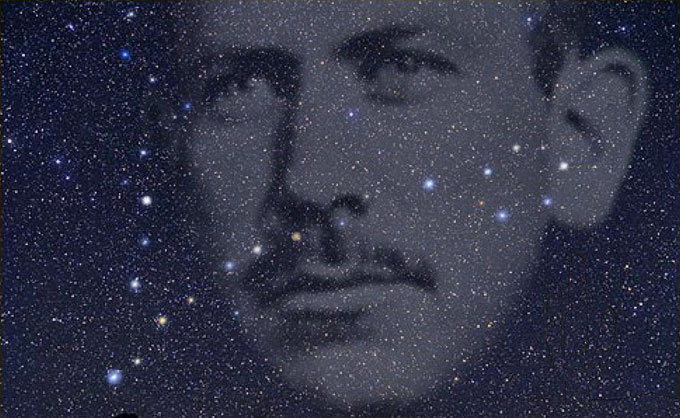
Image of John Steinbeck and the constellation Pisces

If you keep an open mind about astrology, as I’ve done in my investigation and application of its principles, you can learn quite a bit about John Steinbeck from his horoscope wheel. I know: reading astrology charts seems unusual for an electronic technician like me. Frankly, I was skeptical about the subject when I started—until I read the works Carl Jung and followers of the pioneering Swiss psychologist who fell out with his former mentor, Sigmund Freud. Steinbeck, who distinctly disliked Freud’s ideas about human sexuality and neurosis, was deeply attracted to Jung’s insights into human consciousness and imagination. Jung’s influence on Steinbeck is particularly compelling in Sea of Cortez, the record of Steinbeck’s expedition to Baja, California with Ed Ricketts 75 years ago.

John Steinbeck, who distinctly disliked Sigmund Freud’s ideas about human sexuality and neurosis, was deeply attracted to Carl Jung’s insights into human consciousness and imagination.

Steinbeck may have encountered Jung’s writing as early as 1922 while a student at Stanford, where he read philosophy and psychology along with other subjects that appealed to his needs as a writer. By the time he met Ed Ricketts and Joseph Campbell 10 years later, Jung had attracted the attention of these important figures in Steinbeck’s life as well. Sea of Cortez, written with Ricketts in 1941, bursts with Jungian ideas—such as the closely related concepts of synchronicity, acausality, and non-teleology—that get almost as much space as the ecology of the marine invertebrates and the culture of the people that Ricketts and Steinbeck observed along the way.

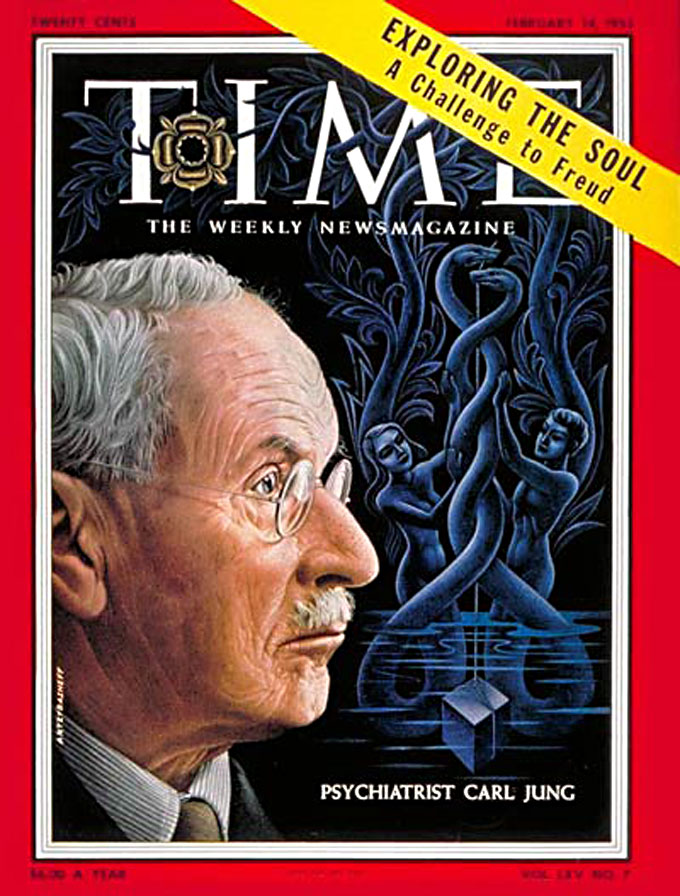
Image of Carl Jung on the cover of Time magazine

Carl Jung, Synchronicity, and Astrology Charts

I began my study of Carl Jung in 1965 and, three years later, astrology as part of a college assignment in which I intended to disprove astrology’s scientific validity. In my profession as an electronic technician at RCA’s Astro Electronic Division, I investigated further, mostly out of curiosity, but also out of respect for Jung’s rigorous empiricism. As a physician trained in the German tradition, he insisted on assembling evidence before expounding theory when he wrote about the personality, the unconscious, and the possibility that astrology had scientific value after all.

Jung insisted on assembling evidence before expounding theory when he wrote about the personality, the unconscious, and the possibility that astrology had scientific value after all.

I was three years into my study of Jung when I read “Synchronicity: An Acausal Connecting Principle,” where he endorses astrology as a tool in treating psychiatric patients. To be honest, the notion angered me so much I stopped reading his work until I renewed my research on astrology in an attempt to demonstrate, scientifically, why it really wasn’t worth the time. My method was simple: do as many horoscope readings as possible, then compare astrology chart results with what I learned from interviewing the individuals I had charted. I did dozens of charts and interviews and found much to discount and dismiss. But I also turned up evidence that, to my surprise, supported Jung’s claims about astrology.

I did dozens of charts and interviews and found much to discount and dismiss. But I also turned up evidence that, to my surprise, supported Jung’s claims about astrology.

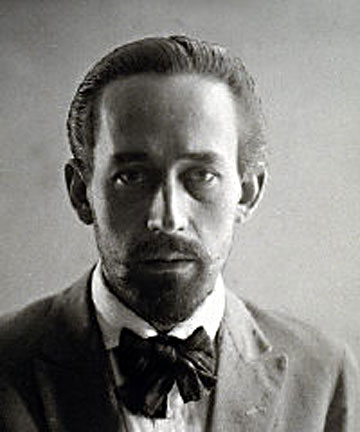
Image of the composer and astrologer Dane RudhyarDuring the same period I encountered the works of Dane Rudhyar, a long-lived and multi-talented follower of Carl Jung, born in Paris, who composed modernist music, practiced a form of humanistic astrology, and died in San Francisco in 1985. Discovering Rudhyar was a watershed moment in my study of Jung and astrology, and Rudhyar’s writing still influences me in my thinking and practice today. By reading Rudhyar, Marc Edmund Jones, and other writers on the subject, I learned about the influence of the astrological signs, the planets and houses, and what astrologists call angular relationships in our lives.

John Steinbeck, Ed Ricketts, and Sea of Cortez

I’m a practical, intuitive type, and I found interpreting chart patterns and relationships, in both their static and dynamic senses, fascinating. Probably for the same reason, I also enjoyed the fiction of John Steinbeck. What I learned from Carl Jung’s “Structure and Dynamics of the Psyche,” “Psychological Types,” and “Synchronicity: An Acausal Connecting Principle” clarified my understanding of Steinbeck and Ricketts’s holistic, non-teleological thinking in Sea of Cortez, Steinbeck’s most thoughtful work of non-fiction.

What I learned from Carl Jung’s ‘Structure and Dynamics of the Psyche,’ ‘Psychological Types,’ and ‘Synchronicity: An Acausal Connecting Principle’ clarified my understanding of Steinbeck and Ricketts’s holistic, non-teleological thinking in ‘Sea of Cortez.’

As I read astrology charts and applied what I was learning, Ricketts and Steinbeck’s perceptions helped hone my technique and increase my skill. In my business, I was discovering the truth of Carl Jung’s belief that “Astrology is assured of recognition from psychology without further restrictions,” that it “represents the summation of all the psychological knowledge of antiquity.” Jung explained why he believed this was so: “The fact that it is possible to construct a person’s characters from the data of his nativity shows the validity of astrology. I have often found that in cases of difficult psychological diagnosis, astrological data elucidated points which I otherwise would have been unable to understand.” Astrology, said Jung, could be shown empirically to be scientific, “a large-scale example of synchronicity if it had at its disposal thoroughly tested findings.”

What John Steinbeck’s Astrological Chart Reveals

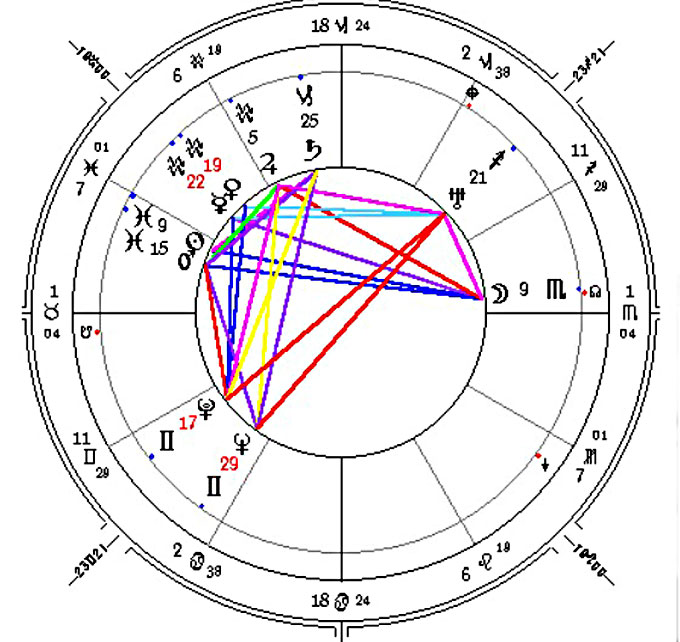
What can we learn from interpreting John Steinbeck’s astrological wheel chart, shown here?

Image of John Steinbeck's astrology chart

To start with, the most influential part of anyone’s horoscope chart is the Sun, the key element in life. For example, when we say we’re a Virgo, Leo, or Aquarius, we mean that the Sun was in that particular astrological sign or constellation at the moment of our birth. Based on the location of the Sun sign when John Steinbeck—a Pisces—was born, it’s clear that Steinbeck was an Introverted Sensation Type with a Thinking auxiliary in his psychological make-up. Sensation as the primary function naturally made him more perceptive than judgmental—a helpful profile for the non-teleological exploration of human behavior demonstrated in Sea of Cortez and in his fiction.

Sensation as the primary function naturally made Steinbeck more perceptive than judgmental—a helpful profile for the non-teleological exploration of human behavior demonstrated in ‘Sea of Cortez’ and in his fiction.

Practically speaking, this means that when Steinbeck considered a situation, all the information he gathered through observation and experience went from the source—what he actually sensed—into his imaginative unconscious. There it was shaped and modified by his fears, hopes, desires, and prejudices before becoming conscious in his mind or relating to his emerging Ego.

When Steinbeck considered a situation, all the information he gathered through observation and experience went from the source—what he actually sensed—into his imaginative unconscious.

Cover image of the first edition of Sea of CortezAs Steinbeck and Ricketts suggest in the long philosophical passages that make Sea of Cortez fascinating to readers like me (and perplexing to others), one goal of what they call non-teleological thinking is to reduce the unconscious influence and stick as closely as possible to the reality of the object being perceived. In this connection, introverts rely on internal, subjective, and experienced evidence, seeing the world in themselves. Extraverts, by contrast, judge their perceptions based upon external evidence, seeing themselves in the world. Though it’s a bit of an over-simplification, it seems fair to say that John Steinbeck was an introvert with extraordinarily acute perception about human character and behavior.

Though it’s a bit of an over-simplification, it seems fair to say that John Steinbeck was an introvert with extraordinarily acute perception about human character and behavior.

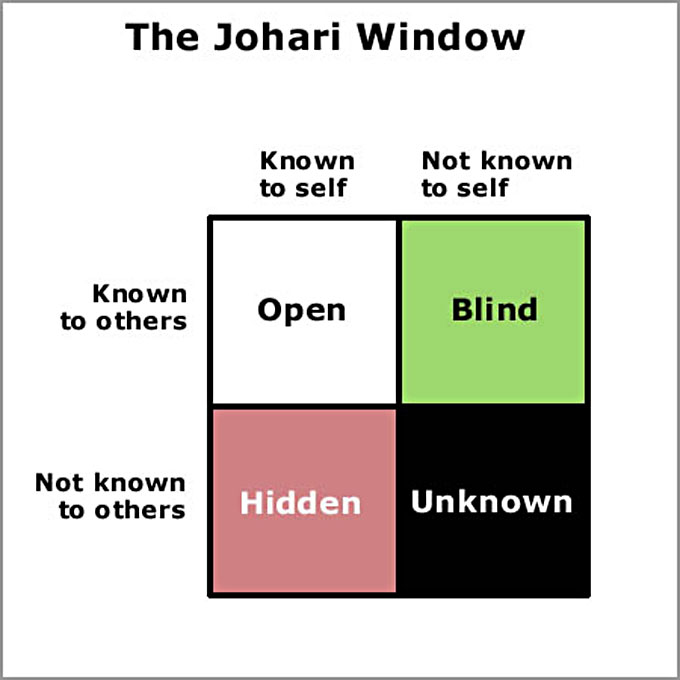
Image of the Johari WindowIn the humanistic astrology of Dane Rudhyar and others, the Sun’s location in an individual’s astrology chart reveals the Self, the Soul, at the center of the psyche. This Self can be described as having three major components in the terminology developed by Carl Jung: the personality or persona, the Ego, and the Unconscious. Using the Johari Window, we can visualize these three components. The persona is represented by the “Open” and “Blind” panes. The “Blind” pane signifies the parts of our Ego that others see in us but about which we are unaware. The “Hidden” window includes those parts of our Ego that we recognize but do not wish them to see. In a horoscope wheel chart, the Sign and Degree of the cusp of the First House (the line between the 12th House and the 1st House, usually at nine o’clock) represents the way an individual projects to or is perceived by others: his or her “persona.”

In a horoscope wheel chart, the Sign and Degree of the cusp of the First House represents the way an individual projects to or is perceived by others: his or her ‘persona.’

All this suggests that how a person projects himself or herself may mask the real individual, often quite dramatically. So it’s important to remember that we are partially—sometimes significantly—responsible for the opinions others have about us: we unconsciously project our own qualities into the perceptual image those around us, coloring and frequently complicating our relationships. The influence of the Sun may be masked within the persona, and often we are responsible for the mask. Consider Carl Jung’s archetypal concept of Shadow, for instance. In Jungian terms, our life experiences provide growth lessons along a path between the image we project, our Ego, and who we actually are as defined by the sign degree of our Sun.

In Jungian terms, our life experiences provide growth lessons along a path between the image we project, our Ego, and who we actually are as defined by the sign degree of our Sun.

Humanistic astrologers recognize this truth: our journey through life includes challenges that cause the persona as defined by the qualities represented in our Ascendant to join the Ego and more closely align with the Sun or Self. As Jung suggests when discussing the Shadow, this makes the journey especially difficult when it challenges the perceptions of those closest to us and can create interpersonal problems with perfect strangers. These were issues for John Steinbeck throughout his life.

As Jung suggests when discussing the Shadow, this can create interpersonal problems with perfect strangers. These were issues for John Steinbeck throughout his life.

Steinbeck’s Ascendant is at 1 degree 4 minutes Taurus, significant because it increased the likelihood of his compatibility with Ed Ricketts, who had a Taurus Sun. Given what I’ve learned about Taurus Ascendants, I suspect that Steinbeck, with a Pisces Sun, was sometimes judged by others to be more predictable than he really was. On first meeting, his personality would have attracted someone like his wife Carol, who also had a Pisces Sun. A woman of her perceptiveness would have tacitly understood her need for a partner with stability, and when they met Steinbeck’s persona could have been mistaken for that of a Taurus. Steinbeck, with a Taurus Ascendant, would offer such an illusion.

Steinbeck’s Taurus Ascendant is significant because it increased the likelihood of his compatibility with Ed Ricketts, who had a Taurus Sun.

Most importantly, John Steinbeck’s horoscope wheel reveals a significant pattern formed by the location of planets in Sign and Houses. The majority of planets in his astrology chart are in the upper left quarter, an area that is associated with objective social types. Steinbeck’s avowed goal as a writer was social: to observe others, increase understanding, and influence change—a purpose that history has proven he met beyond anyone’s expectations, including his own. For readers today, this may be the most important lesson to be learned from John Steinbeck’s astrology chart, his understanding of Carl Jung, and his collaboration with Ed Ricketts in writing Sea of Cortez, a gift from the tide pool and the stars.

The author welcomes inquiries at wstillwagon1@earthlink.net.—Ed.

Orson Welles at 100: How Would a Meeting Between John Steinbeck and the Creator of Citizen Kane Go?

Image of Orson Welles, creator of Citizen Kane

The legendary American actor-writer-director Orson Welles was born 100 years ago today. That’s as good a reason as any to contemplate how a meeting might have gone between the controversial creator of Citizen Kane and the author of The Grapes of Wrath. Despite different backgrounds, opposite personalities, and divergent careers, John Steinbeck and Orson Welles shared much, including progressive politics, Hollywood troubles, and rocky friendships with the actor Burgess Meredith. It’s hard to imagine their paths never crossed and amusing to consider what they talked about if they had the chance. Opposites attract, particularly when there’s a common enemy like William Randolph Hearst.

Orson Welles was born 100 years ago today. That’s as good a reason as any to contemplate a meeting between the controversial creator of Citizen Kane and the author of The Grapes of Wrath.

Steinbeck’s 1939 novel and Welles’s 1941 film both caused serious problems for their creators, arousing public opinion against powerful interests and incurring the wrath of powerful men like Hearst, the California media mogul portrayed by Welles in Citizen Kane. Burgess Meredith, the puckish actor who played George in the 1938 film Of Mice and Men, was a member of Welles’s theater company in New York and became a close friend of Welles and Steinbeck as a result of artistic collaboration. It’s possible Meredith suggested that Welles read Steinbeck’s short story “With Your Wings,” written (perhaps at Meredith’s urging) for radio broadcast in the 1940s.

Steinbeck’s 1939 novel and Welles’s 1941 film caused serious problems for their creators, arousing public opinion and incurring the wrath of men like William Randolph Hearst.

For years John Steinbeck, Orson Welles, and Burgess Meredith moved in New York and Hollywood entertainment circles dominated by parties, personalities, and adultery-and-divorce gossip (all three had multiple wives). In later life, Welles and Steinbeck fell out with Meredith, though for different reasons. Until that happened, however, both writers were close to Meredith, whose sunny side attracted moody men like Steinbeck and Welles. Movies and politics, fame and fortune, Meredith and Hearst: Orson Welles and John Steinbeck, lubricated and relaxed if chemistry clicked, would have plenty to talk about over drinks or at a party.

Cover image of Orson Welles biography by Frank Brady

John Steinbeck, Orson Welles, and Biography

Robert DeMott, an enterprising scholar who thinks creatively along these lines, piqued my curiosity about a possible connection by suggesting that Burgess Meredith could have been Welles’s conduit for the radio broadcast of “With Your Wings.” In response to my question about the cloudy origin of Steinbeck’s story, Bob said Meredith knew both men well and was a member of the theater company that performed Welles’s sensational production of Shakespeare’s Macbeth, set in Haiti and staged in Harlem, which made headlines and caught the attention of the Hollywood film establishment. History moved fast from there.

Meredith was a member of the theater company that performed Welles’s version of Shakespeare’s Macbeth, set in Haiti and staged in Harlem, which made national headlines and caught Hollywood’s attention.

Meredith’s memoir, published 60 years later, recalls the excitement surrounding the production and relates incidents in the actor’s fraught friendships with Welles and Steinbeck. Unfortunately, So Far, So Good is weak on details and reveals nothing about Welles and Steinbeck having met. Nor does Frank Brady’s Citizen Welles, a film-focused account of Welles’s rapid rise and fall following the notoriety of Citizen Kane. But Brady’s perceptive portrait of a precocious, tormented genius suggests why Welles’s view of celebrity differed dramatically from Steinbeck’s, despite shared experience of publicized dalliances and divorces, film-studio mistreatment, and persecution by opponents in government and press.

Welles’s view of celebrity differed dramatically from Steinbeck’s, despite shared experience of publicized dalliances and divorces, film-studio mistreatment, and persecution by opponents in government and press.

Both men were autodidacts who read insatiably and relished the sound of words from an early age. Unlike Steinbeck, Welles was also an extroverted autocrat with an ability to project his voice, promote his talent, and write very quickly. Ireland was important to each, but for reasons that underscored their contrasting characters and careers. Welles, an ambitious Midwesterner, started acting on the Irish stage at 18. Steinbeck, a late-blooming Californian with Irish grandparents, visited Ireland only once, late in life, and was disappointed when he did. As New Deal Democrats, both produced patriotic propaganda for the U.S. war effort, Steinbeck in print and Welles on air. Each attracted the attention of the FBI anyway.

Unlike Steinbeck, Welles was also an extroverted autocrat with the ability to project his voice, promote his talent, and write very quickly.

They hated William Randolph Hearst, the powerful publisher who created yellow journalism and built the crazy castle caricatured, along with Hearst’s actress-lover Marion Davies, in Citizen Kane. As Brady’s biography demonstrates, Welles never really recovered from the aftermath of his attack on Hearst. The monied interests skewered by Steinbeck in The Grapes of Wrath were almost as hurtful, at least at first, but Steinbeck’s career didn’t suffer permanent damage, despite a dry spell during the 1940s when he churned out stories and scripts mangled by studio rewrite-men and directors. He never forgave Alfred Hitchcock for the racial stereotyping and sentimentality the English director inserted into Steinbeck’s World War II movie Lifeboat.

Welles never really recovered from the aftermath of his attack on Hearst. The monied interests skewered in The Grapes of Wrath were almost as hurtful to Steinbeck, who survived the dry spell that followed.

Hitchcock was a likely topic of any conversation Steinbeck had with Welles, whose obsessive anxiety about other directors’ treatment of his ideas shadowed him until he died. John Huston’s name probably came up as well. Both men were guests at Huston’s estate in Scotland, though Steinbeck’s enjoyment of the genial Irish director’s hospitality was free from the competitiveness that characterized Welles’s relations with most movie people. Henry Fonda read poetry at Steinbeck’s well-attended funeral in 1968. Welles’s death in 1985 attracted less devoted attention.

 Hitchcock was a likely topic of any conversation Steinbeck had with Welles, whose obsessive anxiety about other directors’ treatment of his ideas shadowed him until he died.

Welles and Steinbeck also enjoyed the hospitality of Burgess Meredith, whose country place not far from Manhattan was a convenient getaway for exhausted celebrities and uninhibited conversation. Steinbeck and Welles experienced Broadway fatigue at about the same time (Steinbeck with Pipe Dream and Burning Bright). Both loved music and liked to head downtown to hear jazz and to drink, the two great social equalizers of their period in New York. Eddie Condon’s jazz club in the Village is another appealing venue for an imagined conversation between the two men, perhaps about how badly it hurt to fail on Broadway while others were succeeding.

Cover images from memoirs by Henry Fonda and Burgess Meredith

Henry Fonda, Burgess Meredith, and Memory

Like Burgess Meredith, Henry Fonda offers little of substance about Welles or Steinbeck in Fonda: My Life. But when asked for an opinion about a Steinbeck-Welles connection, Steinbeck’s biographer Jay Parini said it was safe to assume Steinbeck and Welles not only met but probably got along: “I’d be amazed if they didn’t meet, and I’d be very amazed if they didn’t find something to like in each other.” Responding to the same question for this blog post, another expert source quoted a conversation that occurred between Welles and Peter Bogdanovich, the actor-director who worked hard to restore Welles’s reputation. Ironically, the quoted conversation confirms that—unlike Henry Fonda—Orson Welles actually read The Grapes of Wrath:

WELLES: I hated [John Ford’s film adaptation of The Grapes of Wrath].

BOGDANOVICH: Well, it’s better than the book.

WELLES: Oh no, the book is much better.

BOGDANOVICH: Really?

WELLES: At the time I saw The Grapes of Wrath, if you told me I’d ever have a good word to say for Ford again . . .  I hated him so. I would have hit him if I’d seen him afterwards. He made a movie about mother love. You know, a sentimental, stupid, sloppy movie. Beautifully photographed, and all the beautiful photography was done by a 2nd unit cameraman without Ford or Toland, as I found out. I complimented Toland on those great shots of those things, and he said, “I didn’t make it. I didn’t do it, and Jack Ford wasn’t there either.”

BOGDANOVICH: I didn’t know that.

WELLES: And all that stuff they did with that awful actress that everybody loves, Jane Darwell, that awful Jane Darwell, and all those terrible creeps walking around being cute. God, I hated that picture!

Welles’s dim view of John Ford’s adaptation of The Grapes of Wrath sounded pitch-perfect when I read it, and it led me to Henry Fonda, whose role as Tom Joad launched Fonda’s career and friendship with John Steinbeck. Steinbeck’s name comes up frequently in Fonda’s memoir, which includes details about Steinbeck’s funeral that differ from Steinbeck biographies. But Fonda’s version of the phone call he got from his agent about the casting of The Grapes of Wrath struck me as oddly off-key:

It was a joyous moment [for Fonda] when Leland Hayward telephoned . . .
“Ever hear of The Grapes of Wrath?” the agent asked.
“Sure have,” Fonda answered readily. “It’s about the farmers who were driven out of Oklahoma by the dust storms and made their way to California . . . “
“I didn’t ask you for a book report,” Hayward said, stopping the enthusiastic actor. “I just want you to know Zanuck bought it for Fox.”

I was intrigued by a recent remark from Richard Astro, an American scholar of prodigious memory, that Fonda admitted he never read The Grapes of Wrath when interviewed for Dick’s groundbreaking study of John Steinbeck. Clearly, Welles not only read Steinbeck’s book but understood the author’s deep meaning—another tempting topic of imagined conversation between the two men, along with the mystery of “Rosebud” in Citizen Kane. Like Welles, Steinbeck was misunderstood, even by friends such as Fonda, and he suffered for his art. Not long before he died he advised a struggling writer, “Your only weapon is your work.” Welles had every reason to agree.

Image of Ayn Rand, critic of John Steinbeck and Orson WellesMy source for the Welles-Bogdanovich exchange added the following tidbit from an era when actors like Burgess Meredith and Henry Fonda were attacked for being liberals and writers like Orson Welles and John Steinbeck were accused of being socialists or worse: “It’s interesting that Ayn Rand, in one of her private letters, lumped John Steinbeck and Orson Welles together as ‘Marxist propagandists.’” As a non-admirer of Ayn Rand, I consider her unintended tribute to Steinbeck and Welles, even if the pair never met, cause for celebration. Happy birthday, Orson. Unlike us, Citizen Kane will never die.

Cannery Row Symposium Celebrates Ed Ricketts, John Steinbeck’s Prince of Tides

Image of Ed Ricketts, John Steinbeck's Prince of Tides

John Steinbeck and Ed Ricketts’s legendary expedition from Monterey Bay to the Sea of Cortez 75 years ago was celebrated in a February 21 symposium organized by Cannery Row historian Michael Kenneth Hemp and sponsored by the not-for-profit Cannery Row Foundation. Richard Astro—an academic superstar who first identified the John Steinbeck-Ed Ricketts relationship as a reason for the enduring appeal of The Grapes of Wrath—was the opening speaker at the Pacific Grove, California event, establishing the context for a day of rediscovery, revival, and some surprising news.

Image of Richard Astro, pioneering John Steinbeck scholar

The Pioneer Who Blazed the Steinbeck-Ricketts Trail

Astro, former provost and current professor at Drexel University, finished writing his doctoral dissertation on Steinbeck the day the author died in 1968. The budding scholar’s first book, John Steinbeck and Edward F. Ricketts: The Shaping of a Novelist, appeared in 1973, setting the stage for Steinbeck research that continues to this day. In a distinguished career as a university administrator and writer about American literature, Astro—along with his ebullient wife Betty—divides his time between Philadelphia and Florida. Their return to Pacific Grove after a 10-year absence was welcome, and the early-morning audience was energized by Astro’s straight talk about Steinbeck and scholarship, his signature as a public speaker.

Astro’s first book, John Steinbeck and Edward F. Ricketts: The Shaping of a Novelist, appeared in 1973, setting the stage for Steinbeck research that continues to this day.

Astro got his PhD at the University of Washington and his first teaching job at Oregon State. At the time John Steinbeck was considered a has-been by critics, but Astro has a contrarian streak and choice and chance were on his side when he selected Steinbeck as his subject. An unsolicited visit from Joel Hedgepeth, a scientific colleague of Ricketts also teaching in Oregon, led to a meeting with Ricketts’s son, Ed Jr., who gave Astro letters between Steinbeck and Ricketts that no one else had seen. The senior Ricketts died in 1948, but others who knew Steinbeck well were still alive—celebrities types like Burgess Meredith and Henry Fonda, friends from Monterey Bay days, former and current wives—and Astro interviewed each.

At the time John Steinbeck was considered a has-been by critics, but Astro has a contrarian streak and choice and chance were on his side when he selected Steinbeck as his subject.

Occasionally, as with Steinbeck’s wife Carol Henning, there were moments of psychodrama that Astro learned to manage, gaining a useful ability to separate fact from fiction about Steinbeck’s complicated life. Ed Ricketts, a Monterey Bay biologist whose name was unknown to the public at the time, kept coming up in the process. Astro borrowed Ricketts’s metaphor—“breaking-through”—in describing the excitement he felt when he discovered Ricketts’s pervasive presence in Steinbeck’s best writing, including The Grapes of Wrath. As a result Steinbeck scholarship advanced rapidly, but Astro was modest about his role: “I set the table; those who followed cooked the dinner.”

As a result Steinbeck scholarship advanced rapidly, but Astro was modest about his role: ‘I set the table; those who followed cooked the dinner.’

Ricketts and Steinbeck first met in 1930, forging an intimate friendship that survived multiple partners, married and otherwise, and provided Steinbeck material for his fiction. Occasional rivalry rocked the boat, including relations with Joseph Campbell, who broke with Steinbeck after an emotional disagreement but continued to correspond with Ricketts, who possessed a knack for being loved by everybody. With money from The Grapes of Wrath, Steinbeck and Ricketts hired The Western Flyer in 1940 and explored the Gulf of California, describing the experience in a book, Sea of Cortez, published three days before Pearl Harbor.

With money from The Grapes of Wrath, Steinbeck and Ricketts hired The Western Flyer in 1940 and explored the Gulf of California, describing the experience in Sea of Cortez, published three days before Pearl Harbor.

Reissued in 1995 with an indispensable introduction by Richard Astro, Sea of Cortez comprises the core of Steinbeck and Ricketts’s collaborative thinking about God, man, and nature. In his remarks, Astro noted that the spirit of Ed Ricketts is also present in The Grapes of Wrath, where Ricketts appears as the questioning preacher Jim Casy, whose thinking about belief and behavior are essential to Steinbeck’s purpose in the novel. Other artists of the era—Oklahoma novelist Sonora Babb, New Deal filmmaker Pare Lorentz—also documented the Dust Bowl and Great Depression, but Astro observed that their works quickly became period pieces while The Grapes of Wrath, underpinned by Steinbeck and Ricketts’s collaborative philosophy, “transcends time and place, as valid now as the day it was written.”

Image of John Steinbeck scholar Susan Shillinglaw

How to Avoid Drowning in Sea of Cortez Scholarship

Perhaps no star in the current constellation of Steinbeck scholars has done more to complete the table set by Richard Astro than Susan Shillinglaw, author of Carol and John Steinbeck: Portrait of a Marriage and On Reading The Grapes of Wrath and the writer and editor of essays on Steinbeck and Ricketts’s environmentalism. A professor of English at San Jose State University who lives in the Monterey Bay area, she spoke on “Layered Fiction and Deep Ecology: John, Ed, Carol, and The Grapes of Wrath” at the conclusion of the Cannery Row symposium. Like Astro, she has a gift for expressing ideas clearly to the non-specialist audience attracted by Steinbeck’s works. (Shillinglaw met her husband, a marine biologist at Stanford University, when he was chief scientist on a 2004 voyage that recreated the Sea of Cortez trip taken by The Western Flyer.)

Like Richard Astro, Susan Shillinglaw has a gift for expressing ideas clearly to the non-specialist audience attracted by John Steinbeck’s works.

Bob Enea, a descendant of the colorful Western Flyer crew member Sparky Enea and the ship’s captain Tony Berry, recounted the rise and fall of the Monterey Bay fishing industry, describing the day Ricketts and Steinbeck left Monterey Bay for their Sea of Cortez journey after a bon-voyage party remembered as Cannery Row’s biggest bash ever. The symposium’s energetic organizer, Michael Hemp, spoke on “Cannery Row: The Industrial Stage for John Steinbeck’s Cannery Row Fiction.” Steven Federle, a John Steinbeck scholar at Solano College, discussed the provenance of Steinbeck’s libidinous short story “The Snake,” a psychological curiosity set in Ricketts’s lab on Cannery Row. Don Kohrs, librarian at Stanford’s Hopkins Marine Station, enumerated the obstacles Ricketts faced in finishing Between Pacific Tides, the textbook published by Stanford in 1939. Kohrs also described materials, including Ed Ricketts’s famous index-card file, from the collection at Hopkins, where Steinbeck took a summer course in biology several years before meeting Ed Ricketts.

 Image of The Western Flyer, the ship that explored the Sea of Cortez

A Pair of Cannery Row Films and Western Flyer News

In publicity for the symposium the Cannery Row Foundation promised variety and surprise and delivered both. Eva Lothar, a French medical doctor who created the 1973 cinematic poem Street of the Sardine, spoke about moving to the Monterey Bay area as a young widow shortly after the Cannery Row sardine supply collapsed. (Her story about filming Street of the Sardine, shown at the symposium, is the subject of an upcoming SteinbeckNow.com video special.) Monterey Bay-area filmmakers Steve and Mary Albert exhibited their impressive documentary, The Great Tide Pool, causing a viewer to say she wished Steinbeck and Ricketts were alive to see both films, one interpreting Cannery Row ecology as poetry, the other as prose.

A viewer said she wished Steinbeck and Ricketts were alive to see the pair of films, one interpreting Cannery Row ecology as poetry, the other as prose.

Two speakers not listed on the printed program provided the surprise promised before the symposium began. John and Andy Gregg, businessmen-brothers, announced that they were buying The Western Flyer to restore and return the legendary vessel to its Monterey Bay home as a permanent educational resource for students and, perhaps, visitors to Cannery Row. The Greggs operate a geophysical investigation and marine drilling business, the kind of know-how that makes success in meeting that objective seem likely. Their straight answers to cost-and-schedule questions were as impressive as their goal: to assure that the boat used by the Prince of Tides and the author of The Grapes of Wrath to explore the Sea of Cortez will survive as long as John Steinbeck, Ed Ricketts, and Monterey Bay continue to matter.

Jim Kent, Cannery Row visitor and symposium fan

Jim Kent: Symposium a Tipping Point for Cannery Row?

A frequent Cannery Row visitor who applies Steinbeck and Ricketts’s insights in his international consulting business flew from Colorado to attend the symposium. Asked for his reaction, Jim Kent expressed delight at the event’s energy and renewed optimism about Cannery Row’s future. “Don Kohrs got us excited when we learned that he has been assembling writings and other material of Ed Ricketts owned by the Hopkins Marine Station,” he explained. “Don located Ricketts’s legendary index cards,” detailing scientific specifics of unusual marine specimens from Monterey Bay tagged by the Prince of Tides as early as 1928. “Ricketts was a thinker and Steinbeck’s friend, but he was first and foremost a scientist,” Kent noted. “This dimension has been lost in academic writing about the characters Steinbeck based on Ricketts, and it’s great to see the Ricketts revival beginning here, where it all started.”

Jim Kent, a frequent Cannery Row visitor, observed, ‘It’s great to see the Ricketts revival beginning here, where it all started.’

Kent added that the symposium marked a new phase in public appreciation of John Steinbeck, Ed Ricketts, and Cannery Row. “My understanding of Steinbeck and Ricketts’s social ecology taught me how to bypass top-down thinking in working with community groups to make changes that benefit people, not just profit,” he said. “Ed Ricketts and John Steinbeck understood the importance of gathering places, informal networks, affinity-relationships, and bottom-up change. What I heard today leaves old ways of conceiving Cannery Row, Monterey Bay, and Steinbeck studies in the dust. Steinbeck and Ricketts saw ecological collapse coming when nobody would listen. I am sure they could see this, too!”

Image of Ed Ricketts from the historical photograph collection of Pat Hathaway, featured in the Winter 2015 issue of Carmel magazine.

Calling Dr. Freud? Letter Explains John Steinbeck’s Short Story “The Snake”

1953 LP cover image of John Steinbeck reading "The Snake."

Fresh questions raised by scholars about the source of John Steinbeck’s brief short story “With Your Wings,” recently published for the first time, reminded me that Steinbeck’s college friend, the writer A. Grove Day, once sent me a personal letter with an eye-witness explanation of the incident behind “The Snake,” an earlier short story set in Doc’s Lab on Cannery Row. “The Snake” was written before Tortilla Flat appeared in 1935, and Steinbeck’s friend Bruce Ariss, the Cannery Row painter-writer-publisher, printed it as “A Snake of One’s Own” (the original title) in a local publication called The Beacon. In 1938 the short story was published in Esquire magazine and in Steinbeck’s classic short story collection The Long Valley, where it continues to attract readers fascinated by its gritty, gruesome subject and intriguing origin.

Image from cover of Michael Kenneth Hemp's new history of Cannery Row“The Snake” takes place in a familiar version of Ed Ricketts’ Doc’s Lab on Cannery Row, a frequent venue in Steinbeck’s writing and a big part of my recently revised book Cannery Row: The History of John Steinbeck’s Old Ocean Avenue . Steinbeck tells the story from the viewpoint of a Dr. Phillips, the story’s Ed Ricketts character, and it contains stark sexual symbolism frequently interpreted by critics in Freudian terms. But did the disturbing incident at the story’s core come from Steinbeck’s imagination, or did it really happen as described? Even Steinbeck’s friends from the time didn’t agree about where he got the idea for “The Snake.”

Image of John Steinbeck's friend A. Grove DayWhile reading comments by Robert DeMott  concerning the context of John Steinbeck’s forgotten World War II story “With Your Wings,” I recalled an acknowledgement letter I received years ago from A. Grove Day, the late historian and biographer who became Steinbeck’s friend at Stanford in the 1920s, where both were members of the famous Stanford English Club. Born in Philadelphia in 1904, Grove died in Hawaii—the subject of his special expertise as a scholar—in 1994. I found his fascinating 1987 letter about “The Snake” in my files, postmarked from Honolulu.

Image of A. Grove Day's letter about the origin of John Steinbeck's "The Snake"

Grove’s letter, which shows his skill as a writer and his knowledge of Doc’s Lab, augments other interpretations of “The Snake,” including those by two other friends from Steinbeck’s Stanford student days, Toby Street and Dook Sheffield. (In this photo of the English Club, Day is seated far left on the middle row; Street sits third from the left on the same row.) Grove’s letter claims that Ricketts’s father—who helped out at his son’s Cannery Row marine specimen business—caught the snake on a golf course and put it in a cage at the Lab, where “a young lady with us” fed it a white mouse as the snake’s first meal in captivity. Sheffield, who became a newspaper reporter, was more direct when he spoke about the story. He claimed that a local showgirl needed the snake for her act, although a rattlesnake would be a dangerous choice for the purpose.

Image of the Stanford English Club with Grove Day and Toby Street

Street commented about “The Snake” in a 1975 interview with Martha Heasley Cox, founder of the Steinbeck Studies Center at San Jose State University. His version possesses the weight of what lawyers call credible evidence and is quoted in full below. At this point in his exchange with Professor Cox, Street mentions “a girl that was on the circuit here [who] took a fancy to Ed.” When asked by Cox to explain what he means by “the circuit” (roadhouse and bar entertainment replacing vaudeville with some burlesque), Street employed a combination of diplomacy and directness developed in his post-Stanford career as a Monterey attorney for clients including John Steinbeck and Ed Ricketts. Like Grove, Street was as careful with facts as with feelings. When he spoke to his interviewer for the record about “The Snake,” he may have omitted living names, dates, and details.

“They used to have, you know, the piano player and a couple of girls and they’d entertain and they’d go around. And this girl happened to be [at the Blue Bell Café] and took a fancy to Ed, and Ed invited her to the lab. And she was a kind of sexy-looking dame and so while she was there, he said that he had to feed the snake. He had a big cage, quite a big cage full of white rats—and he went in there and selected one and put it in with the rattlesnake. The mouse ran all around, and this girl was just fascinated by the damned thing. And then, pretty soon, the little mouse stopped and the rattlesnake struck. Its fang caught in the mouse. And when he pulled, he brought the mouse back with it, and of course the mouse didn’t pay any attention, just ran around until the toxic effects began to take hold. His back got all rigid, and he stood up on his back feet and when he fell down, he put his paws right on his nose, like that. This girl, by this time, was right up there looking down at that. And the rattlesnake went over, and you know the way they do—they go up and down the body, noticing how long it is and whether it is still alive. Their auditory nerve is on their tongue. It then finally discovered that the mouse was in fit shape to eat. He went over and went through all his business and got his jaws on the edge and took this little mouse in his mouth. And she watched, oh, I think perhaps half an hour, until there wasn’t anything left but the tail of this mouse hanging out of the snake. John made a story out of it and gave it a lot of implications that probably were there.”

Cover image of Inside Cannery Row by Bruce ArissIn his way, Toby Street agrees with Grove Day about the story’s Freudianism, as does Bruce Ariss, a Cannery Row legend in his own right. Bruce’s book, Inside Cannery Row: Sketches from the Steinbeck Era, identifies a tweedy, spinsterish dean from an eastern girl’s college as the woman in Doc’s Lab who became excited and told Ricketts she wanted to pay him to keep and feed the snake for her.


Image of Frank Wright at Doc's LabFrank Wright, another friend of Ed Ricketts from the 1940s, introduced me to “The Snake” more than 30 years after Steinbeck wrote his short story. Following Ed’s death, Frank became a member of the circle of men who saved Doc’s Lab, all friends of Monterey schoolteacher Harlan Watkins, who rented Doc’s Lab in the early 1950s before buying it from the Yee family (the real-life family of Lee Chong in Cannery Row). Watkins eventually sold the Lab to Frank and friends, and it was there that Frank first played for me the LP recording of John Steinbeck reciting “The Snake”—a dramatic way for any new reader to participate in Steinbeck’s provocative short story. Brought to life by Steinbeck’s distinctive baritone and experienced where the incident occurred, “The Snake” takes on a powerful feeling all its own. Friends lucky enough to have Frank as their Cannery Row guide continue to enjoy listening to John Steinbeck recite his story while visiting Doc’s Lab.

Now listen for yourself. Pay particular attention to what Steinbeck says before he recites the story. Though missing from printed editions, the compelling comments Steinbeck makes here about “The Snake” confirm how he liked to cover his tracks in his writing. Using the same phrase (“something that happened”) he employed elsewhere about other challenging subjects in his fiction, Steinbeck makes a funny reference to the sex-symbolism that distressed certain readers of “The Snake” from the beginning: “One of my favorite pieces of fan mail came from a small town librarian. She said it was the worst story she’d read anywhere; she was quite upset at its badness. Actually it isn’t a story at all. It’s just something that happened . . . . ”

Image of Joseph Campbell interviewed on Cannery RowPostscript: Steinbeck’s reading of “The Snake” and “Johnny Bear”—another short story from The Long Valley—was released in 1953 as a now-rare Columbia Literary Series record album. As noted, the details about the story’s origin provided by A. Grove Day in his letter differ in emphasis from those offered by Toby Street and Dook Sheffield, whose versions differ substantially from that of Bruce Ariss. As I thought about time and memory, another conversation with a friend of John Steinbeck came rolling out of the past. In 1983 I interviewed the great Joseph Campbell in Doc’s Lab, where he recalled the time “Ed called us all down to the Lab to watch him feed a rattlesnake.” Here is what Campbell had to say about “The Snake” that day on Cannery Row three decades ago.

John Steinbeck’s African-Americans—Author Susan Shillinglaw Clarifies the Context of the World War II Hero in “With Your Wings”

 Composite image of Susan Shillinglaw and John Steinbeck

The publication of John Steinbeck’s “With Your Wings” continues to stimulate conversation about the writer’s understanding of African-Americans and the roots and relevance of his forgotten World War II short story about a black Air Force aviator. Last week Steinbeck scholar Robert DeMott challenged assumptions about the story’s origins. This week Susan Shillinglaw, author of On Reading The Grapes of Wrath and Carol and John Steinbeck: Portrait of a Marriage, interprets the story’s African-American hero in the context of Steinbeck’s World War II experience and writings about African-American characters and issues. Like Robert DeMott, she responded generously to my request for expert comment about “With Your Wings.”

Susan Shillinglaw interprets the story’s African-American character in the context of Steinbeck’s World War II experience and writings about African-American characters and issues.

A professor of English at San Jose State University, she teaches the only regularly scheduled college-level John Steinbeck course offered anywhere. As Robert DeMott’s successor as director of SJSU’s Center for Steinbeck Studies, she introduced previously unpublished Steinbeck works of various kinds in Steinbeck Newsletter and Steinbeck Studies. These included the short story “The Kitten and the Curtain,” “The God in the Pipes”—an early fragment of what became Cannery Row—and an omitted chapter from the novel, “The Day the Wolves Ate the Vice Principal.” She wrote introductions for popular Penguin Classics editions of Steinbeck’s fiction, co-edited John Steinbeck’s America and Americans and Selected Nonfiction, and is co-editing a major Steinbeck reference work. Her 25-year record of teaching, editing, and writing was recognized by her designation as SJSU’s President’s Scholar in 2012-13. She is also Scholar in Residence at the National Steinbeck Center and co-director of a summer program on John Steinbeck for high school teachers funded by the National Endowment for the Humanities.

On Reading “With Your Wings”: African-Americans in John Steinbeck’s Life and Writing in and out of World War II

Susan Shillinglaw’s enlightening comments on the cultural and historical context of John Steinbeck’s World War II character William Thatcher, the African-American hero of the newly published short story “With Your Wings,” are quoted in full:

“This aviator, a second lieutenant with gold bars on his sleeves, would have earned his flight wings in Tuskegee, Alabama, where all African-American pilots were trained during World War II. ‘To have gone through the schools they must be very good, very intelligent and alert,’ Steinbeck writes in Bombs Away, a book-length propaganda piece published in 1942 on assignment for the U.S. war department in which Steinbeck lucidly explains the training of bomber pilots.

‘This aviator, a second lieutenant with gold bars on his sleeves, would have earned his flight wings in Tuskegee, Alabama.’

“Presumably Steinbeck produced ‘With Your Wings’ after writing Bombs Away and following his stint as a war correspondent covering England, North Africa, and a daring diversionary maneuver by Allied forces off the coast of Sicily and southern Italy. It’s tempting to think he wrote his short story after he returned from the front, where he might have encountered the Tuskegee Airmen, the 99th Squadron of the Army Air Forces first posted to North Africa in April 1943—four months before Steinbeck arrived at a ‘North African post,’ as in notes in Once There was a War, a collection of his World War II dispatches. Both Steinbeck and the 99th squadron then went on to Sicily, so it’s quite possible he knew and admired men like William Thatcher in this first African-American squadron posted overseas in World War II.

‘It’s tempting to think Steinbeck wrote his short story after he returned from the front, where he might have encountered the Tuskegee Airmen.’

“This aviator wants to detach from his 16-man group, to go home to ‘get something,’ to think about himself only. ‘He had thought to come home in triumph,’ a hero, a man set apart. But instead, like Tom Joad in The Grapes of Wrath, he discovers he is a group man, buttressed by family and community and ‘every black man in the world.’ That’s ‘something’ to hang on to.

Like Tom Joad, William Thatcher discovers he is a group man, buttressed by family and community and “every black man in the world.”‘

“Steinbeck’s lean little sketch, which reminds me a little of his short story ‘Breakfast,’ relies on sharp details: the aviator’s gold bars, straightness (the men ‘rigid as cypress logs,’ the aviator behind the wheel of his car, the young cotton, the standing community), the sun. It’s such an ordinary scene—except that the man is black, an exemplar because he’s earned those wings.

Steinbeck’s lean little sketch relies on sharp details: the aviator’s gold bars, straightness, the sun.’

“Steinbeck created a dignified African-American—Crooks—in his earlier novel Of Mice and Men, made into a movie in 1939. A dignified black man also occupies the lifeboat in another Steinbeck novella—Lifeboat—made into a movie in 1944. In the 1960s Steinbeck wrote about race in a long essay, in a letter to Martin Luther King, Jr., in Travels With Charley in Search of America, and in his 1966 volume of essays, America and Americans.

Steinbeck created a dignified African-American—Crooks—in his earlier novel Of Mice and Men. A dignified black man also occupies the lifeboat in another Steinbeck novella made into a movie.’

“Throughout his career John Steinbeck was deeply concerned with the common good, a phrase I recently heard NEH Director William Adams discussing on the Diane Rehm radio show. Steinbeck’s sense of the common good, I think, had something to do with empathy, humility, and understanding—for all.”

The Facts about “With Your Wings”—Robert DeMott on An Old John Steinbeck Short Story Recently in the News

Composite image of Orson Welles, John Steinbeck, and Burgess Meredith

For decades a leading scholar of American literature taught John Steinbeck using a race-themed Steinbeck short story described as lost in news reports on its recent publication by a colorful short story magazine. Printed in The Strand Magazine for the first time since being read on the radio by Orson Welles during World War II, “With Your Wings”—Steinbeck’s inspiring portrayal of a black pilot returning home to the South as a hero—is written in the idealized style of the author’s World War II book, Bombs Away: The Story of a Bomber Team. But Robert DeMott, Edwin and Ruth Kennedy Distinguished Professor of English Emeritus at Ohio University, says that Steinbeck’s short story wasn’t lost—and that Steinbeck’s friend Burgess Meredith, not Orson Welles, probably got first dibs on the story when it was written for broadcast in the 1940s.

John Steinbeck and Orson Welles

According to Andrew Gulli, managing editor of The Strand Magazine, Gulli discovered “With Your Wings” among Steinbeck’s papers at the University of Texas. In his editorial for the current issue of the magazine, Gulli adds that Steinbeck’s very short story about an African-American’s heroic homecoming was recited by Orson Welles on air in 1943 or 1944, then forgotten until it was recovered from the archives at Austin. Gulli’s version of the story’s provenance provides further evidence of Steinbeck’s role as a World War II propagandist. It also suggests that a relationship existed between Steinbeck and Welles, whose classic feature film Citizen Kane is based on William Randolph Hearst, the right-wing publisher of The San Francisco Examiner and The New York Morning Journal who was disliked by Steinbeck and disparaged (though not by name) in The Grapes of Wrath.

Gulli’s version of the story’s provenance provides further evidence of Steinbeck’s role as a World War II propagandist.

As Robert DeMott notes, more documentation is required before inferring a John Steinbeck-Orson Welles relationship from Gulli’s comments. But the possibility is intriguing, particularly in the context of continuing conjecture about Steinbeck’s connection to American intelligence agencies during and following World War II. Citizen Kane was every bit as controversial as The Grapes of Wrath, and for similar reasons. Steinbeck and Welles were celebrated artists with close ties to the Roosevelt administration. More important, they were political progressives who applauded the aims of the New Deal, decried the excesses of capitalism, and distrusted newspaper reviews of their works—though Steinbeck reported briefly on World War II for The New York Herald Tribune, a competitor of Hearst’s that Steinbeck described in private as reactionary.

Steinbeck and Welles were celebrated artists with close ties to the Roosevelt administration.

Co-written, produced, and directed by Welles—who also played the lead—Citizen Kane portrays Hearst, a Californian, as an eccentric empire-builder in the cut-throat world of New York newspaper publishing. Hearst’s papers boycotted the film, and Welles was accused of being a communist or worse even before the picture was released. Steinbeck’s labor novels In Dubious Battle and Of Mice and Men—made into a 1938 motion picture featuring Burgess Meredith—had provoked a similar reaction when they were written. The publication of The Grapes of Wrath fueled the fire, which had become a conflagration by the time Welles’s movie appeared two years after Steinbeck’s novel.

Writer and Actor Activists in World War II

Like John Steinbeck, Burgess Meredith, and other left-leaning writers and actors of the period, Orson Welles devoted his time and talent to the American war effort in Europe and the Pacific. Broadcasting proved particularly effective at boosting morale and providing writers and performers a way to entertain the troops at home and abroad. Welles’s World War II radio broadcasts included guest-hosting four episodes of the popular Jack Benny Program in 1943 and producing and hosting several radio series of his own, including Ceiling Unlimited, the program for which Andrew Gulli says John Steinbeck wrote “With Your Wings.” If true, the assertion raises a possibility of special interest to people who think Steinbeck worked for America’s emerging national security establishment in ways not apparent at the time.

If true, the assertion raises a possibility of special interest to people who think Steinbeck worked for America’s emerging national security establishment in ways not apparent at the time.

According to Wikipedia, Ceiling Unlimited was sponsored by the World War II aeronautical giant Lockheed-Vega Corporation “to glorify the aviation industry and dramatize its role in World War II,” much as Steinbeck’s Bombs Away and “With Your Wings” did for the Air Force pilots who flew the company’s planes. If Steinbeck wrote his short story for Orson Welles, was it at the behest of Lockheed, the California aerospace pioneer founded by two brothers in San Francisco? So far evidence is lacking. Wikipedia doesn’t list Steinbeck among the writers—including Arthur Miller—who contributed to Welles’s radio show. Nor does any reference to Orson Welles, Ceiling Unlimited, or Lockheed occur in Steinbeck: A Life in Letters (1975), Jackson H. Benson’s biography, The True Adventures of John Steinbeck, Writer (1984), or Brian Kannard’s Steinbeck: Citizen Spy.

John Steinbeck, Burgess Meredith, and “With Your Wings”

But references to Burgess Meredith abound in the record of John Steinbeck’s life. Like Orson Welles, Meredith achieved success as a New York stage actor before becoming a Hollywood screen star. Steinbeck met Meredith around the time the actor was cast as George in the 1939 movie Of Mice and Men, and the two men hit it off. When MGM refused to let Spencer Tracey narrate the 1941 film version of Steinbeck’s documentary The Forgotten Village, Steinbeck turned to Meredith, whose serene voice was well-suited to Steinbeck’s understated narrative. Like Orson Welles, Meredith and Steinbeck shared a penchant for politics, partying, and multiple partners. For a period they were neighbors, and they remained close until 1958, when a personal quarrel ended their 20-year friendship.

Like Orson Welles, Meredith and Steinbeck shared a penchant for politics, partying, and multiple partners.

Though the John Steinbeck-Orson Welles connection remains conjectural, Steinbeck’s relationship with Burgess Meredith supports Robert DeMott’s version of the “With Your Wings”  back-story. The author of Steinbeck’s Reading (1984; 2007) and Steinbeck’s Typewriter (1996; 2012) and the editor the Library of America’s collection of John Steinbeck’s works, he taught generations of students at Ohio University how to read, write, and think with the depth of reason and empathy required to appreciate Steinbeck, his scholarly specialty. In response to my inquiry about “With Your Wings,” he pointed out that Burgess Meredith knew both Steinbeck and Orson Welles and devoted a chapter to each man in his 1994 memoir, So Far, So Good. Most important, he corrected the claim that “With Your Wings” was lost and raised the possibility that it was written by Steinbeck for Meredith, or for Welles through Meredith. His insights into John Steinbeck’s World War II short story about race in America, the Steinbeck-Welles-Meredith connection, and Steinbeck’s “radical humanism” are quoted in full:

Image of John Steinbeck scholar Robert DeMott“I’ve known about the story for several decades and in fact have a Xeroxed copy of it in my files. On occasion I’ve used it in my classes and seminars when talking about Steinbeck and race and it never failed to elicit strong, positive responses from students. The more ‘politically correct’ among them were surprised that a dead white male author could cross racial boundaries like that! The story is on the feel-good side and surely shows Steinbeck’s idealism and patriotism but even at that Steinbeck was nearly alone among his writing peers in responsibly portraying African-American characters at a time when the Armed Services were segregated. Not just the pilot in this story but the character of Joe in Steinbeck’s original narrative treatment of Lifeboat. For me, these characters link up with Steinbeck’s other cast of down-trodden or marginalized characters who people his work of the 1930s and 1940s. So propaganda or not, it seems of a piece with his radical humanism.

“But I did not know about the Orson Welles connection, and while I am happy to learn of that new thread in the carpet I am not entirely convinced that Steinbeck wrote the piece expressly for Welles and/or the Lockheed-Vega Corporation. Recently, James Cummins, a rare-book dealer in New York, offered for sale a typewritten draft of the Steinbeck story as part of a batch of Steinbeck documents in the Burgess Meredith archive. Cummins quotes a letter (ca. 1943) from Steinbeck to Meredith that accompanied the story and in which the author says, ‘A different version of the following was done for overseas broadcast to the troops by O.W.I.’ [Office of War Information], though I am not certain whether that and the Welles broadcast are the same. Steinbeck went on to offer the piece to Meredith for use in his shows, and stressed that it be read like a ‘pure mood’ piece, to be ‘delivered like soft music.’ For what it is worth, I am inclined to believe that the connection between Steinbeck and Meredith on this subject is perhaps more telling and deeper than that between Steinbeck and Welles, and certainly deserving of more investigation.”