Flight: A Play in One Scene by Steve Hauk

 cave-of-dreams(2)

J.S., older, at his writing desk in his New York City apartment. Corduroy sport coat, plaid shirt open at the collar. Several pads of lined yellow paper and unopened letters on his desk. A hallway stage left, the front door to the apartment stage right. In the back wall, but not behind him, a window looking out onto the dark, some illumination from city lights. It is late night.

A bookcase close by. On top, a tape recorder, lighting making it slightly more noticeable. He snubs out a cigarette, looks at recorder. He clicks it on, clears his throat, changes his mind, clicks it off.

He is tense. Picks up a letter, puts it down. Turns and stares at window. Stands, goes to it, looks out. Paces, return to desk, opens a letter. Leans forward, reads to himself.

Hears a sound from outside the door, starts, gets up, goes to door, listens, tries   knob to make sure it is locked, returns to desk, sits, opens desk drawer, pulls out a revolver. Checks if it is loaded, sets it on the desk. Picks it up again, checks it again, smiles at his fear, returns it to desk top, facing the barrel toward the door.

Picks yellow tablet, looks at something he has written, takes a pencil, adds a word or two, scratches one out, clears his throat, reads from it:

J.S.: “He felt it intensely, in the tainted land, in houses, in small towns and . . .”

Looks at tape recorder, considers, switches it on, a slight whirring sound.

J.S. (Looks at tablet, clears his throat, reads again, to the tape recorder): He felt it intensely, in the tainted land, in houses, in small towns and large cities, on plains and rolling hills, a kind of evil –

A Man’s Voice (Interrupting): John, who’re you talking to . . . ?

He starts, looks up from his tablet. The Gaunt Man is standing downstage, half in and out of the light, in overalls, chewing on a toothpick.

J.S.: Tom!

Gaunt Man (Laughs): First time I ever scared you!

J.S.: Nah, you didn’t scare me.

Gaunt Man: You sure ‘n hell jumped! (Grins) Something you wrote – scare yourself?

J.S. (Smiles): I’ve done that.

Gaunt Man: Damn good writer who can scare himself.

J.S. (Furtively covering the revolver with a yellow pad): Well, I admit you surprised me, Tom – it’s been a while since your last visit.

Gaunt Man: You were doing okay there for a time – didn’t think you needed me.

J.S.: Don’t take this wrong, Tom, but don’t think I do now.

Gaunt Man: Course you do or I wouldn’t be here – you called for me.

J.S.: You always say that . . .

Gaunt Man: Cause it’s true. (Chews on toothpick, shakes his head) Beats me why anyone’d question those gone before them! . . . Like an infant questioning how her mama shells peas. Makes no sense. The infant hasn’t shelled a pea – and you haven’t been where I’ve been. (A beat) What’s that there?

J.S. (Thinking initially he means the revolver, puts his hand over pad): What’s what?

Gaunt Man (Pointing at the tape recorder): That – that thing goin’ round?

J.S. (Relieved): Oh, that’s called a tape recorder. I didn’t have it last time you visited?

Gaunt Man: I’d sure remember something goin’ round like that . . . does it do anything else?

J.S.: Copies your voice . . . when you play it back, you hear what you just said.

Gaunt Man: If you just said it, what’s the point?

J.S.: Well . . .

Gaunt Man: Why not just get a parrot?

J.S.: I got a talking myna bird, Tom, why would I want a parrot?

Gaunt Man (Looking around): Thought it was quiet in here. Where is he – where’s John L?

J.S. (Fingers to lips): In the bedroom, snoozing. Don’t get him started. John L kibitzes, I kibitz back, nothing gets done.

Gaunt Man: Keeping Elaine up?

J.S. (A beat, bordering on a mumble): Elaine’s gone a few days.

Gaunt Man (Pause): So that’s what you were doing when I came in, copying your voice?

J.S.: Well . . .

Gaunt Man: Tell me about it.

J.S.: It’s like a Dictaphone machine, Tom – you ever hear of those?

Gaunt Man (Nodding): Sure, like a parrot.

J.S. (Nettled): But you don’t have to be as close to be recorded, so it’s different. This thing can hear you clear across the room.

Gaunt Man: So can a parrot. This something new in the world?

J.S.: Been around a while, but now a little more affordable . . .

Gaunt Man: Even for Okies?

J.S.: Not back then. But the Okies today – if they can afford a radio, they can probably afford one of these.

Gaunt Man (Staring at it): Yeah, sure, but is it a waste of money?

J.S.: Not sure yet . . . still trying it out.

Gaunt Man: To do what?

J.S.: I read the words I’ve written into this, to see how they sound.

Gaunt Man: That’s what you were doing when I came in?

J.S.: Starting to . . .

Gaunt Man: That so important, how the words sound? Do your readers read your books out loud? Isn’t that for children’s books?

J.S. (Irritably): Listen, Tom –

Gaunt Man: I don’t get it, that’s all.

J.S.: It’s a rhythm thing . . . probably more than a sound thing.

Gaunt Man (Skeptical): Uh, okay . . . and what’s the excuse for the gun under your yellow writing pad . . . or do you think I missed that clever move of yours?

J.S.: That, Tom, is none of your business.

Gaunt Man: Come on – you wanted me to see it, so talk about it.

J.S. (Stands, paces): I didn’t want you to see it, and I don’t want to talk about it.

Gaunt Man: You sure about that?

J.S. (Felt): I’m clumsy, that’s all. Always have been, you know that. (Suddenly morose): Sorry, Tom, just tired . . . taking it out on you.

Gaunt Man (Curious, cocking his head): Tired? You are the one man I know never gets tired. What makes you tired now?

J.S.: Riling people, I guess.

Gaunt Man: Hell, John, riling people’s what makes you tick.

J.S.: Well then, I’m tired of people I riled threatening me and mine.

Gaunt Man: That happen?

J.S.: All my life, from the California days on.

Gaunt Man (Pause): Recently too?

J.S. (A beat): Sure . . .

Gaunt Man (Pushing): When?

J.S.: . . . few days ago. . .

Gaunt Man: That’s why the gun?

J.S.: Had guns before, after those cowboys came after me – about the time you were coming into being, Tom.

Gaunt Man (Gently): I know that story alright, you told me enough times – they kill you, no me, no Tom. We settled that . . . Now tell me about this one.

J.S.: Not much to tell – guy calls – soft voice – says don’t be thinking you’re safe just because you’re three thousand miles away. I’m coming for you.

Gaunt Man: Maybe a bill collector?

J.S. (Laughs): Could be.

Gaunt Man: Anything more this guy says?

J.S.: The usual – calls me a Commie. (Smiles ruefully) Well, J. Edgar would agree with him.

Gaunt Man: Hoover?

J.S.: Yeah.

Gaunt Man: Then what – about the call, I mean.

J.S.: Nothing more . . . he hangs up – softly.

Gaunt Man (A beat): Call’s from California?

J.S.: Three thousand miles . . . so works out . . . unless . . .

Gaunt Man: Unless?

J.S.: Unless he’s already here . . . the distance remark making me think I’ve got some time . . . be clever of him.

Gaunt Man (The gun): Why you have this ready to go?

J.S.: Be a fool not to, Tom.

Gaunt Man (Studies him, chews on toothpick): You get lots of threats, why this one bother you?

J.S.: The softness of the voice . . . something about it . . . reminded me when I was a kid and a soft wind blew up the valley, rustling the leaves outside my house . . . (Goes to window, looks out, pause) . . . in the afternoons, day after day. . . I told you before . . . don’t know why, but that scared me as a boy in Salinas . . . still does . . . this voice had that quality . . . like the soft wind through the trees . . .  and then . . . well . . . (Change of mood, shrugs his shoulders) . . . well, kind of a funny thing now . . .

Gaunt Man: Funny?

J.S.: Hoover’s men tailing me been driving me crazy lately – but since that call, I’m glad they are . . . doing me a favor – when I’m followed like this afternoon, and see it’s one of Hoover’s boys, I breathe easier . . . (Smiles) Hoover’d have a fit if he thought he was doing me a favor    . . .

They are quiet a moment as he looks out window meditatively. The Gaunt Man shifts his weight restlessly.

Gaunt Man: Watching you now? . . .

J.S. (As he moves away from window, back to desk): Across the boulevard . . . government’s renting a hotel room . . . a suite, probably.

Gaunt Man (Still skeptical): Watching you through that window?

J.S.: Yep.

Gaunt Man: John, you been drinking? (Goes to window, hand in an overall pocket, casually looks out, chewing on his toothpick) Can’t see nothin’ . . . just a big building . . .

J.S.: That’s a hotel. They’re there, Tom.

Gaunt Man: You sure?

J.S.: Third floor, fourth window from the left.

Gaunt Man: You seem pretty cool for a man being investigated by the Federal Bureau of Investigation.

J.S.: They’ve investigated me since the Thirties.

Gaunt Man: Get anything on you?

J.S.: Not much.

Gaunt Man (Looks out again): You think they’re lookin’ at me now?

J.S. (A beat): Better question is, can they see you?

Gaunt Man: You mean `cause I’m what some people call a apparition?

J.S.: That’s what I’m wondering.

Gaunt Man: Maybe I should wave . . . (Looking again) What floor you say?

J.S.: Third floor, fourth window from the left . . . almost straight across . . . should be dark so you can’t see them.

Gaunt Man (Looking): I’ll wave . . . (Does so, lazily, waits, turns back) And if they saw me? . . .

J.S.: Immediate report to J. Edgar – “Boss, the writer’s hanging out with a Commie in overalls.” Hoover’d say, “That figures,” might even laugh . . .

Gaunt Man: But you’re glad they’re watching you now . . .

J.S.: Someone kills me in this room, maybe they’ll see it, get the bastard . . . more important, get my body out of here before Elaine returns. (A beat) Hoover long ago . . . my California days . . . we go way back, you know . . . both of us young . . . sent me a typewritten note, unsigned, but I knew it was from him . . . wrote there were people wanted me dead . . . told me to be wary of strangers, maybe even some people I knew . . .

Gaunt Man: You take that as a threat?

J.S.: A warning – he wanted me for himself, wanted to be the one to get me to crack. I sent a return note thanking him, signed my name, never got a reply ­– think he was embarrassed he might have done something nice.

Gaunt Man: All this why Elaine’s gone? For your woman’s safety?

J.S. (Nodding): Sent her off for a while.

A Voice (From off, plaintiff tone): Elaine! Elaine!

They both look toward hallway.

J.S.: We woke him.

Gaunt Man: Bring him out?

J.S.: I don’t want him here . . . in case . . .

Gaunt Man: The man with the soft voice?

J.S.: Be the same as a child seeing it . . . animals know about death . . . maybe he’d kill John L too . . . sounded like someone who’d find pleasure doing something like that . . .

A Voice (Pleadingly): John! Elaine! John!

Gaunt Man (Pause, gesturing toward John L’s voice): Well?

J.S. (Pause): Not yet – I want him to get used to us not being around, not at his beck and call.

Gaunt Man: You goin’ somewhere?

J.S.: We’re flying to Europe soon, maybe after I’ll push on to Vietnam. (Pause, softer) John L doesn’t know it, but he’s leaving us . . . going to Hollywood, has a new home waiting with Fred, a movie man . . . makes damn good movies, Fred does.

J.S. looks off, then moves tablet, almost absently picks up the revolver, studies it.

Gaunt Man (Waits, then): How it feel?

J.S. (Noncommittal): Okay . . .

Gaunt Man: Colt automatic?

J.S.: Got two, one for here, the other (Pats his chest) for carry.

Gaunt Man: Licensed?

J.S.: (Nodding): Wasn’t easy . . .

Gaunt Man: Character witnesses?

J.S.: Needed four . . . had to scramble . . . Some friends backed off . . . that hurt some . . .

Gaunt Man: . . . should have expected . . .

J.S. (Nodding): I did . . . hurt anyway, you know? . . . One signed without hesitation – John L’s vet’ in Nyack, man named Morris Segal . . . said he likes the way I treat animals, doesn’t give a damn about my politics . . .

A Voice: John L’s hungry! John L’s hungry!

J.S: (Calling): Be there soon, John L . . . (A beat) Likes celery and bananas, John L does . . . and a thick piece of wheat bread spread with butter. (Pause) You know, Tom, the Irish have this belief if there’s a bird in your home the day after you die, your soul flies free . . .

The Gaunt Man turns away, looks off, with his hands in his overall pockets, chews restlessly on his toothpick.

J.S.: . . . they say a wild bird . . . but not many birds given the chance won’t take flight . . . why we clip their feathers and keep them in cages . . . denying them freedom.

Gaunt Man (Trying to sound offhand, but tense): Tell you, John, freedom hasn’t done much for me – I’m free but I killed a man and can’t forget it . . .

J.S.: Tom . . .? Tom, I wrote that.

Gaunt Man (Turns back to face him): You wrote it, but it happened to me.

J.S.: Needed to do it . . . you had to suffer . . .  thought you understood, thought we talked all this out long ago . . .

Gaunt Man: Talkin’ don’t make it go away. Sometimes I try imaginin’ that man – what he done to make me so angry . . .

J.S. (Pause): You bump into him out there?

Gaunt Man: Not yet . . . but keep an eye.

J.S.: You think he’d want revenge?

Gaunt Man: We’re beyond revenge out there but not above letting the other know. I keep an eye for cops, too, you havin’ me say wherever a cop was beating up a field worker and, well, the rest of that stuff, that I’d be there . . . don’t see me or anyone else lasting long sayin’ stuff like that . . .

J.S.: Don’t forget, Tom, I made you resourceful.

Gaunt Man: Yeah, maybe . . .

J.S. (Pause, studies him): . . . and gave you ideals . . .

Gaunt Man: I guess . . .

J.S. (Conceding): I’m sorry, Tom . . .

Gaunt Man (Nods acceptance, chews on toothpick, looks away, pause): It’s okay . . . I’m tired, that’s all . . . so takin’ it out on you, I guess.

J.S. looks at him with a kind of sorrow. There is a silence, then:

The Voice: John L’s lonely! John L’s lonely!

J.S. turns away, goes to window, looks out.

J.S.: John L realizes we’re coming to the end . . . Elaine, him, me . . . (Pause) . . .     would have liked him here the day after I die . . .

Gaunt Man (Looking toward door): He might be, you’re not careful.

J.S.: I named him after John L. Lewis . . . champion of the working man . . . not unlike you, Tom. (Looking out window, trying to lighten the mood) You can bet an agent’s dialing Hoover right now – “Hey, boss, no reason to worry about that writer anymore – he’s talking to himself again.” And Hoover says, “Imbecile, those are just the kind we need to worry about – the crazy ones.”

Gaunt Man tries to smile, can’t. They are silent a moment, awkward with each other for the first time. Footsteps heard. Then silence. They look toward door.

J.S.(Pause): You’d better go . . . just in case . . .

Gaunt Man: You sure?

J.S.: You being here would destroy something . . .  some kind of balance we shouldn’t fool with . . .

The Gaunt Man takes a few steps back, gesturing toward the window.

Gaunt Man: Use your head – shoot straight and keep the lights on and the blinds up . . . (Indicating tape recorder) . . . and that parrot machine goin’ round . . .  might prove handy somehow . . .

J.S: So maybe it’s good for something after all?

Gaunt Man: Maybe . . . (With a sudden cock of his head) You think it’s hearing me . . . hearing what I’m saying?

J.S. (Looking over at it, same curious attitude): I don’t know, Tom.

The Gaunt Man disappears into the darkness.

Gaunt Man’s Voice (Trailing off): . . . hearing my voice . . .

J.S. waits a moment, then approaches his desk.

The Voice: John L is lonely! John L is hungry!

J.S. (Sotto voce): I’m coming, John L. I’m coming with celery and a banana – maybe even a nice piece of wheat bread.

J.S. looks at the tape recorder. Sets the revolver on the desk pointing toward the door. He puts the recorder on rewind. The sound is intense. He waits, nervous, an eye on the door. The recorder lurches to a stop. The door is tried. J.S.  flips the recorder on play, without looking picks up the gun and holds it ready.

The Tape Recorder (After a few seconds of silence): “He felt it intensely, in the tainted land, in houses, in small towns and large cities, on plains and rolling hills, a kind of evil – “

Gaunt Man’s Voice (Interrupting): “John, who’re you talking to . . .?”

Blackout.

John Steinbeck, COVID-19, And Facing Homelessness

homelessness-san-francisco

What would John Steinbeck have to say about the COVID-19 crisis? What would he focus on? I think it would be the plight of the homeless in places like San Francisco and Los Angeles, teeming with people struggling to survive without shelter or support.

Sleepless in Los Angeles, Cold in San Francisco

I was “homeless” several times in Los Angeles. I don’t pretend it was a big deal. I was young. I could have returned to my family in the Midwest. And there wasn’t a virus on the loose threatening death. But I had a taste of what it was like to sleep on beaches and park benches on cold nights, amidst dangers real and imagined. One night I woke to a gang fight going on nearby and decided it would be just as easy to be homeless in San Francisco as Los Angeles. Putting everything I owned in a battered leather suitcase, I hitchhiked north toward San Francisco, stopping along the way in Monterey, a town I had never seen. It would be my first real exposure to John Steinbeck, beginning with the Monterey Public Library, a display of Steinbeck’s books in the window attracting me.

I had a taste of what it was like to sleep on beaches and park benches on cold nights, amidst dangers real and imagined.

I picked a copy of Of Mice and Men off the shelves. As the homeless do to this day—or once did, since libraries are currently closed across much of the country, making a huge difference in the lives of the homeless—I could get warm while reading. George and Lennie’s story is set in South Monterey County, which I had passed through that morning. I read till the library closed, lingering over passages as I do when something moves me. George and Lennie were, after all, in a way homeless too.

I picked a copy of Of Mice and Men off the shelves. I could get warm by reading.

Then I walked down a street called Calle Principal, leading to an old building with a sign reading “Hotel San Carlos.” I stood out front with my leather suitcase wishing I had enough money for a room. A man came along, and after talking he went into the hotel and convinced the desk clerk I should get a good deal on a room for the night. Decades later I would write a short story about John Steinbeck and his wife Carol and that raffish old hotel. Writing from my memories of that lonely evening in Monterey, it was easy to set the scene, back in the 1930s: “They made their way clumsily down Calle Principal toward the hotel . . . which was in the Spanish style with a plaza and fountain. In the lobby a moth flit from lamp to lamp . . . .“

I stood out front with my leather suitcase wishing I had enough money for a room.

The area intrigued me. In the morning I walked along the shoreline to the town of Pacific Grove, then hitchhiked the six or so miles to the Carmel Mission. The room at the San Carlos no longer available and having money for only food and cigarettes (yes, I smoked), I hitched on to San Francisco that evening. I learned The City is a harder place to be homeless than Los Angeles because it is colder, especially when the sea wind blows in from the bay. After several days meeting “partially homeless” people like myself, I hitched my way back to Los Angeles.

The City is a harder place to be homeless than Los Angeles because it is colder.

I was going to write about other homeless experiences in Los Angeles—having my clothes locked up because I owed rent at the Mark Twain hotel, which I chose because I’m from Missouri . . . sleeping at night under a golf course tree, caddying during the days to earn money . . . having a car for a time, parking it on Santa Monica beaches and bathing in the ocean . . . on a foggy night pulling over to sleep on Mulholland Drive, discovering at sunrise that only a few feet separated the car and me from a plunge into the San Fernando Valley . . . savoring the warmth of sitting in class at Los Angeles City College after cleaning up in the school’s lavatory.

What I Learned from Being (Briefly) Homeless

But when it comes down to it, I simply owe a lot to being briefly homeless. It introduced me to the Monterey Peninsula. John Steinbeck’s Pacific Grove eventually became my new home, the place where my wife Nancy and I raised our daughters Amy and Anne. I wrote for the Monterey Herald, learning more about Steinbeck from a soulful city editor named Jimmy Costello. Jimmy had been Steinbeck’s friend and told me of the incident at the Hotel San Carlos. He had been there. The Carmel Mission I’d hitchhiked to from Monterey became the site for the premiere of one of my plays. And I was honored to co-curate, with Patricia Leach, the inaugural art exhibition at the National Steinbeck Center in nearby Salinas. It was called This Side of Eden: Images of Steinbeck’s California, and the works on display included several depictions of homelessness, among them Maynard Dixon’s prophetically titled “No Place to Go.” Unfortunately, the subject of the painting is just as relevant today as it was in the 1930s.

I wrote for the Monterey Herald and learned more about Steinbeck from a soulful city editor named Jimmy Costello.

The greater irony for me is that the same Monterey Public Library which helped introduce me to the world of John Steinbeck recently asked if I would take part in a panel discussion on writing planned for late April. The event has been postponed, of course, because of the coronavirus. When it is rescheduled it will be a sign that that we have survived this latest test of our shared humanity—and that those living with homelessness can still count on libraries for warmth . . . as well as a good read.

Sketches of John Steinbeck and Ed Ricketts Resurface in Carmel, California Collection

john-steinbeck-ed-ricketts

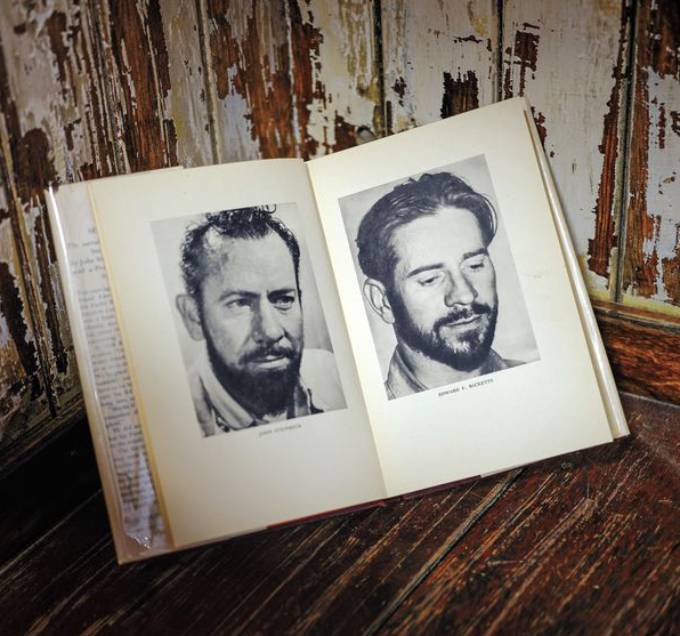
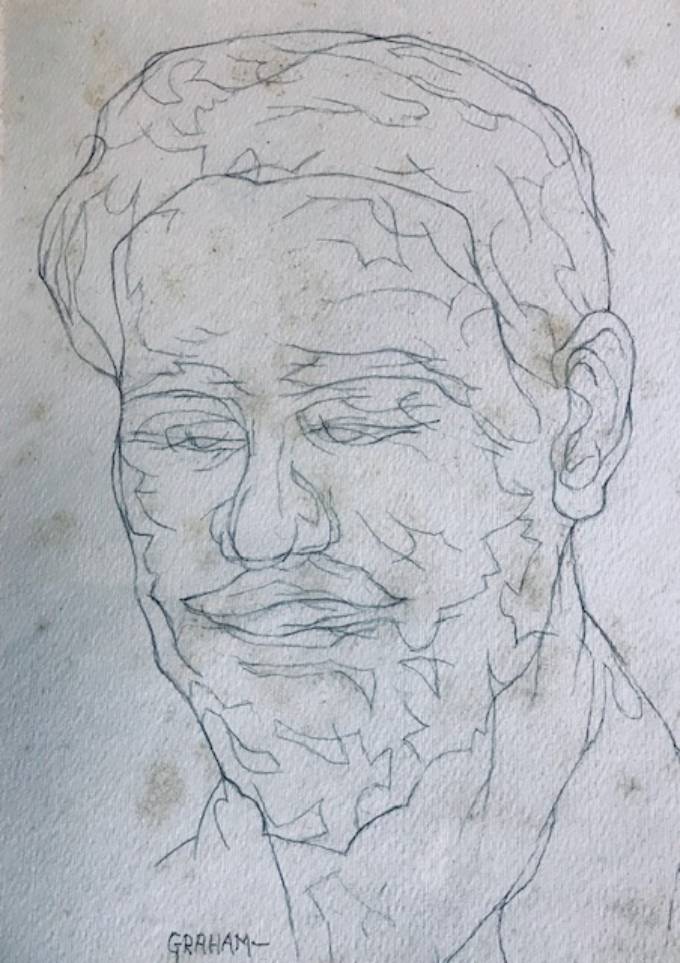
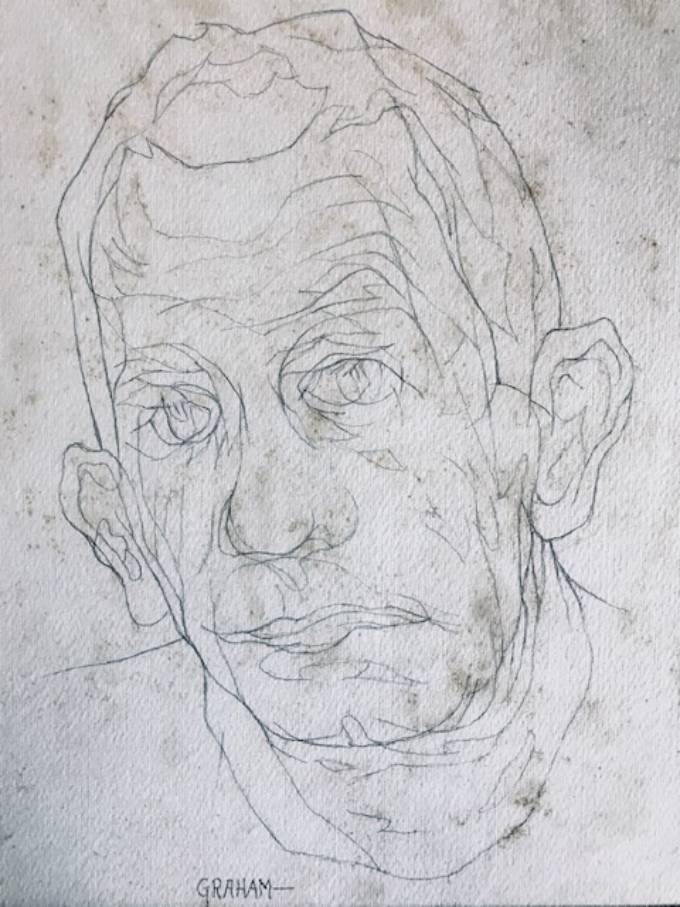
Numerous artists drew, painted, or photographed John Steinbeck, but artistic images of his friend Ed Ricketts are relatively rare. This made the chance discovery of a drawing of Ricketts by Ellwood Graham—in a Carmel, California art collection that also includes Graham’s sketch of Steinbeck—especially exciting. Both drawings are discolored and have acid burn, but Graham’s lines are vivid and the impression in both, even before restoration, remains strong.

edward-ricketts-ellwood-graham

john-steinbeck-ellwood-graham

In 1991 Graham penned his remembrance of doing the two drawings (shown here) around 1940-41, and in 1995 they were included in a Monterey Museum of Art exhibition, curated by Richard Gadd and called “Monterey Life: The Steinbeck Years.” Ironically, when I came across the pair on my first visit to a Carmel collector’s home several months ago I was writing The Willow Grave, a screenplay on Graham and his wife Judith Deim. Ricketts and Steinbeck are significant characters in the story.

“Doing John’s Portrait Was an Unusual Luxury” for Artist

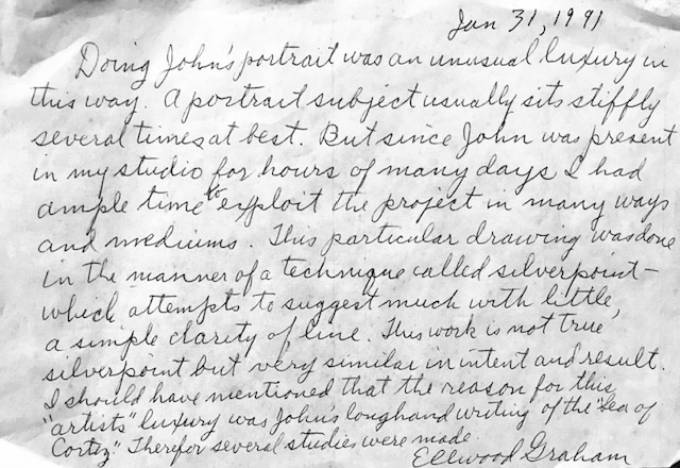
Graham’s recollection of sketching Steinbeck was still fresh when he wrote this note:

Doing John’s portrait was an unusual luxury in this way. A portrait subject usually sits stiffly several times at best. But since John was present in my studio for hours of many days, I had ample time to exploit the project in many ways and mediums. This particular drawing was done in the manner of a technique called silverpoint – which attempts to suggest much with little, a simple clarity of line. This work is not true silverpoint but very similar in intent and result. I should have mentioned that the reason for this “artists” luxury was John’s longhand writing of “The Sea of Cortez.” Therefor several studies were made.

ellwood-graham-john-steinbeck

Equally strong was Graham’s memory of sketching Ricketts:

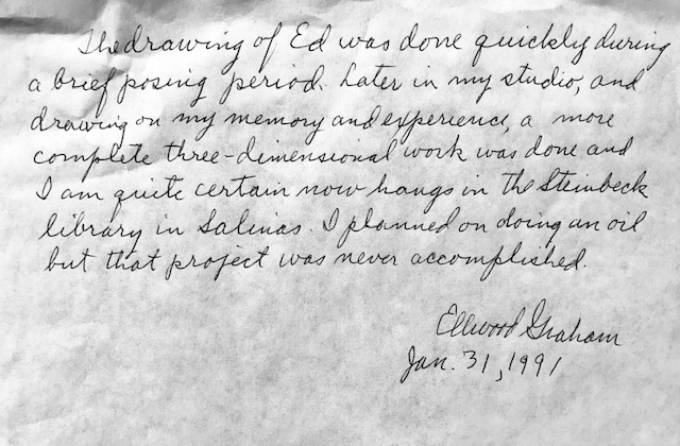
The drawing of Ed was done quickly during a brief posing period. Later in my studio, and drawing on my memory and experience, a more complete three-dimensional work was done and I am quite certain hangs in the Steinbeck library in Salinas. I planned on doing an oil but that project was never accomplished.

ellwood-graham-edward-ricketts

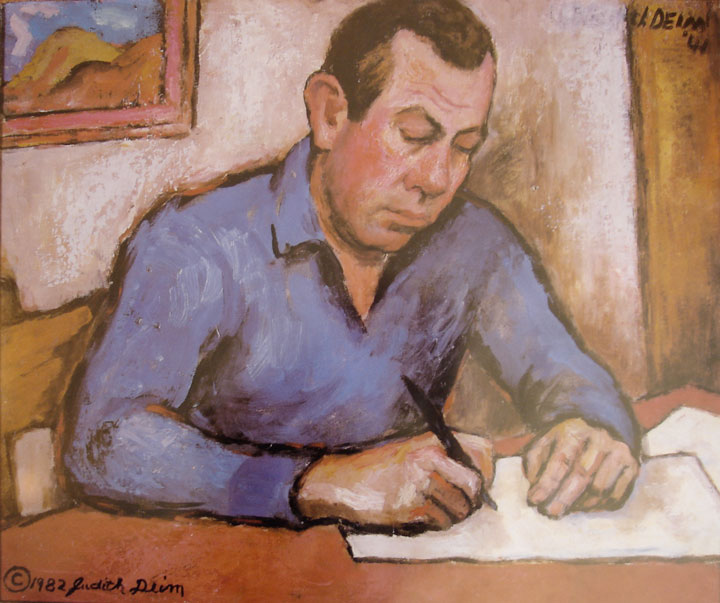
Ellwood Graham and Judith Deim—then going by her given name of Barbara Stevenson—were artists from St. Louis, Missouri, who made their way to California on Route 66 during the Dust Bowl days of the Great Depression. By chance in Los Angeles they met Gordon Grant, the California artist who was creating murals under the auspices of the Federal Art Project, and he hired them. They were working on the mural in the Ventura, California post office when—again a chance meeting—they met Steinbeck and Ricketts, who were passing through on their way to Mexico. Before parting, Ricketts and Steinbeck invited the young artists to visit Monterey, which, of course, they eventually did. Deim was to do her own portrait of Steinbeck (shown here). It is in the collection of the Martha Heasley Cox Center for Steinbeck Studies. Graham also did an oil portrait of the writer, but it was lost and its whereabouts are unknown.

john-steinbeck-judith-deim

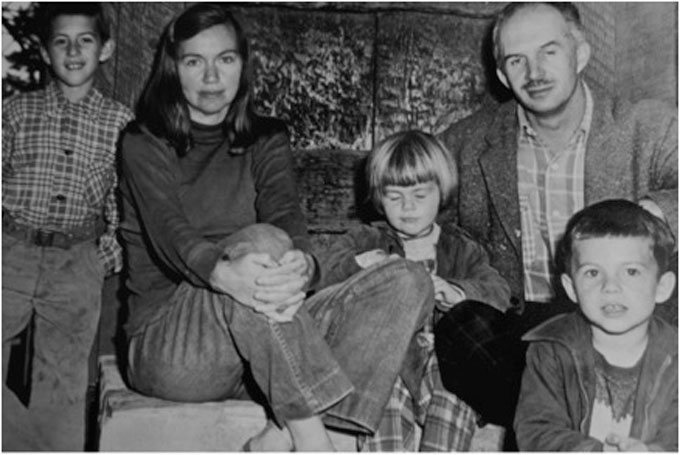
Newlyweds, Deim and Graham (shown with their children in this undated photo) met as students in the School of Fine Arts at Washington University and went on to distinguished careers in California and Mexicao. Deim exhibited at the San Francisco Museum of Art, the Palace of the Legion of Honor, and the Patzcuaro Museum (she spent the last years of her life in Mexico’s Michoacan). Among many honors, she was the first artist given a solo exhibition at the Carmel Art Association, in 1946. Graham has work in the Whitney Museum, the Los Angeles County Museum of Art, the De Young Museum, and the Monterey Museum of Art. Among dozens of exhibits and solos, he had work in the 1939 Golden Gate International Exhibition in San Francisco. Deim spent her last years in Mexico. Graham died in Oregon.

judith-deim-ellwood-graham

An art dealer in Los Angeles who specializes in early modernism told me he knew Graham had a strong sense of his worth as an artist, “because when I find his old paintings, they usually have a pretty high price—for the time—on the reverse side.” Steinbeck and Ricketts believed in Graham and Deim’s talent; Steinbeck, for instance, felt easy enough in their presence to write while they painted him. Luck brought Graham and Deim to the attention of Gordon Grant in Los Angeles and Ricketts and Steinbeck at the Ventura post office. I, too, was fortunate to happen upon Ellwood Graham’s drawings in that Carmel collection.

Ellwood Graham’s recently rediscovered sketches of John Steinbeck and Ed Ricketts courtesy of private collector in Carmel, California.


Artist’s Letter Recalls 1930s Life with John Steinbeck

beach-picnic-judith-deim

Seventeen or 18 years ago, maybe longer, the artist Judith Deim faxed me a long handwritten letter from near Lake (or Lago) Pátzcuaro in the Mexican state of Michoacán. It was a history of what she could remember, at around age 90, of her time in Monterey, California in the 1930s and beyond, the years of John Steinbeck and Ed Ricketts and so many others. She told me deep into the missive (in no uncertain terms, which was Judith’s way), “None of this group are living now, so you are lucky to get this story.” I wouldn’t argue that for a second.

Judith Deim’s Eye for Steinbeck’s Circle Never Failed

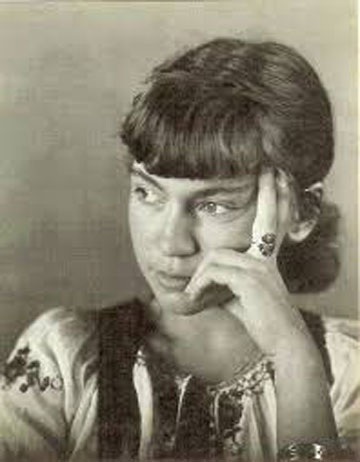
judith-deimA woman of great talent and immense courage, she traveled Europe and Africa with three children—and sometimes with a band of gypsies—for 16 years. Her marriage splintered and she lost a daughter, a flamenco dancer who drowned off the coast of Spain, and her art, called Magic Realism, became dark. Yet she persevered, composing music as well as painting before dying, at the age of 95, in 2006. She was born Barbara Stevenson in 1911 in St. Louis, where her mother taught piano, and during the Depression she traveled Highway 66 with a fellow artist, Ellwood Graham. The pair met up with Steinbeck and Ricketts in Southern California, which led them to settle in Monterey, and Barbara Stevenson became Barbara Graham. The name Judith Deim came later.

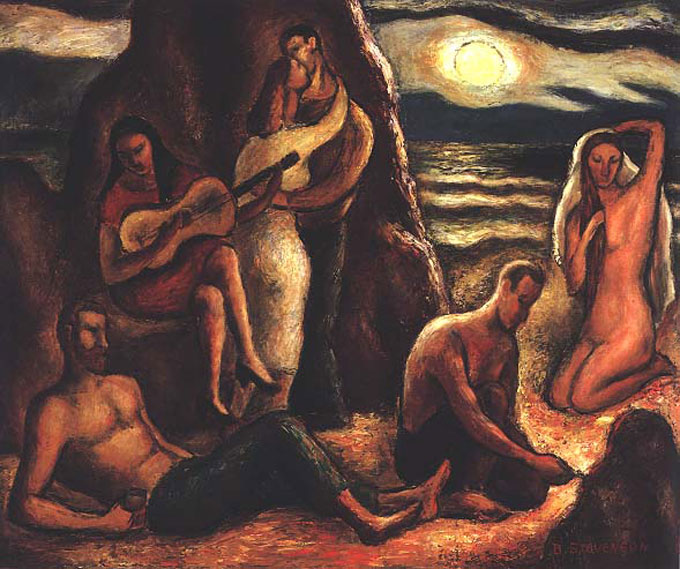
In the late 1930s she created the painting, called “Beach Picnic,” shown above. It depicts a group of companions—including a pensive-looking John Steinbeck, a broad-shouldered Ed Ricketts, and Deim herself—under a night sky. She told me once that artists, photographers, and poets used to accompany Steinbeck when (as reflected in this painting) his friends felt he needed protection. Sometimes Charlie Chaplin would drive up from Los Angeles and join them. The portrait of Steinbeck by Judith shown below hangs in the Martha Heasley Cox Center for Steinbeck Studies at San Jose State University. The one she mentions by Ellwood Graham—a nervous yet compelling effort—has been missing for years.

john-steinbeck-judith-deim

Judith did not pass unnoticed. I and others wrote about her and her work was exhibited, including a solo show at the Carmel Art Association. The film about her by the award-winning director Irena Salina, “Ghost Bird: The Life and Art of Judith Deim,” was voted an audience favorite on the Sundance Channel. She had a mystical side, as shown in the transcript of the undated letter she wrote me, reproduced here for the first time. Her spelling and grammar required some touching up and she begins with a mistake—mentioning a mural in Santa Barbara which she may be confusing with one she and Ellwood worked on at the Ventura, California post office under the direction of Gordon Grant. But her perceptions of Steinbeck, Ricketts, and their circle are precise, and her eye, unlike her memory, never failed her.

Judith Deim inspired the story “Judith” in my book Steinbeck: The Untold Stories, as well an almost completed screenplay I’m calling “The Willow Grave.” Then again, she has always been inspirational. Her sons Daniel, a sculptor, and Benje, a guitarist, continue her creative legacy. Granddaughter La Tania is a world-renowned flamenco dancer, and another granddaughter, Tiffany (shown here painting Judith), is an oil painter and muralist who works with disadvantaged kids in inner-city Los Angeles. Tiffany’s art, like that of her grandmother, expresses duende—the quality of inspired passion described by Judith in the letter.

tiffany-graham-judith-deim

Undated, Unpublished Letter from Judith Diem

Dear Steve—

Enclosed response to you [is] material for your article. We planned to record [the] interview with Vatche Geuvadjelian, a poet and painter, but the recording didn’t work (bad sound), so I dictated [the following for] Vatche, which he could write down far better than myself. I hope it will cover several of the questions [you] sent, improvised [with] little time to do it. Use what you wish.

I was working on a 1400-ft. mural in Santa Barbara with Ellwood Graham. I painted all the faces, sometimes mean, sometimes ugly, once in a while sweet. My work was finished [and] I left, where to? [on] the Monterey Peninsula. I met Virginia and Raymond Scardiglio; we liked each other; they invited me to live with them at their apartment in Carmel. They and 12 others of similar artistic interests were the nucleus of the group who met at Ed Ricketts[‘s] lab on Cannery Row in Monterey. There I met John Steinbeck, Ritchie Lovejoy, a writer; his wife Natalia Kashevarof, a Russian woman from Alaska; Dick and Francis Strong, Ed’s sister; Marjorie and Harold Lloyd; Henry Miller [who] came and went when his work permitted; Toby Street, John’s lawyer; and two or three others, thirteen all together. John Steinbeck and his great friend Ed Ricketts were the natural focus.

Carol Steinbeck made it possible, by working in a Relief office, for [John] to devote his time to writing. She was a wonderful country cook, with jars of preserves in all seasons. She was in rapport with all who came to the lab. She was a very important critic [of] his writing by demanding the best from him and [typing] all [of] his manuscripts.

Ed Ricketts was the ever-gracious host. He did his work, sending marine specimens all over the world. A great marine biologist, in the late hours he would disappear [in]to his lab on the ground floor and work. He loved paintings. I gave him one of an old farmwoman that he always kept above his chair, the only painting in the room.

Sometimes John spoke with me of the Big Sur. Going from the Little Sur country, his theory was [that] they were inhabited by poltergeists who were inimical to people invading the countryside and were the cause of [the] occasional disasters that occurred there.

I spent much time exploring that countryside. Sometimes I ran across the great poet Robinson Jeffers and talked with him about things he loved. His narrative poems were based on the tragic stories of people who lived in those canyons. One time I stayed behind my companions to explore an old cabin. Suddenly I felt all my strength being pulled out of me. I crawled with all my strength to get out of the cabin. I [lay] some time on a fallen tree before I continued on.

On the coast there was another well-known log cabin, run by Lolly and Bill Fassett. All [the] coast people and tourists, artists, [and] workers of the countryside gathered there. There was a bar and restaurant. Anderson Creek had been the old prison camp and had houses from the Second World War. Henry Miller and his good friends Elliott Sandow the sculptor, the Niemans, and Lilac Schatz, a fine painter, were working in these old prison houses.

A woman reporter from the Examiner [of] San Francisco came to interview all of them. They were hospitable, entertained her and showed her their work. [Then] the Sunday paper came out, devoting a whole page to the perverse [goings on and the] use of alcohol and drugs, so misusing their hospitality and their values as artists. The American Legion club members got together and planned to burn them out. [We] artists got up a petition and went to all the liberals of the community and succeeded in stopping this terrible plan.

Ellwood Graham returned to Monterey. We built [a] redwood house out of lumber we bought at an auction at Big Sur. Ellwood painted a lot of landscapes and had an experience [with] poltergeists on the Big Sur, where his canvases kept being torn from his easel even though there was no wind. He came back in a black rage, battling with the invisible. I told this story to a friend who had special photographic equipment [and] he went and took photos. The photos showed little floating light forms around the farmhouse. This related to what Steinbeck was saying about the canyons in Little Sur.

A trip was planned with two Italian brothers with their schooner to the Sea of Cortez. After much talk and discussion with the brothers they left. The idea behind the trip was for John to be inspired to write a book about the Sea of Cortez. On the trip Ed kept a log [of] everything that happened from day to day.

On their return [there was] much rejoicing, partying [and] storytelling at the lab. After a few days of this drinking and partying John felt it was time to get to work. He said, I have an inspiration. Why don’t you kids paint my portrait and I shall be forced to concentrate and get on with my book? He wanted Ellwood to have money to establish a studio. So we commissioned him to do his portrait, which he would buy whether he liked the result or not. He also wanted me to paint a portrait in any way I wanted. We celebrated his 40[th] birthday. At the time he was very proud of some Western boots he had bought for himself. He was a lot like a big child . . . . None of this group are living now, so you are lucky to get this story.

He did not like Ellwood’s portrait. [It] brought out an expressionist version of an alcoholic, which John was not. He liked my portrait very much but asked me to keep it as a souvenir, then added, “You might need it.” And I did. It was the only portrait of Steinbeck writing at his desk. I showed in on Cannery Row, where I met Steinbeck’s son [Thom]. He bought six accurately reproduced prints of the painting. I said, “I guess you like it.” He answered, “I like it because it expresses Steinbeck’s sinister side. I am having a difficult time surviving while his will waits until I [am] sixty years old to get it.” Right after the portraits [Steinbeck] suggested that he would pay for us to go to Mexico, and he said, “Go to Pátzcuaro and not to where all the tourists go.”

Pátzcuaro: in a Mexican boardinghouse with a beautiful doña. Raining and dark. At 7:00 p.m. a procession of men with torches. Very little, dim electricity, too low to read with. A dark and wild feeling, in the store windows jars of powder, of everything that humans desire: love, sex, babies, money. Only one outsider in town: a mad Englishman going in circles around the plaza without stopping. It was sad that the townspeople threw rocks to keep strangers out. But they did not throw rocks at us because I was very pregnant.

Lots of rain, and more rain. I got bronchitis and went to bed. Then the money that Steinbeck’s lawyer Toby was to send us did not arrive. The boardinghouse owner kept us going, then Ellwood went to the post office under the rain [and] returned cursing like I had never heard him before. The post office man had found the wire, but instead of paying him he had torn it right in front of Ellwood to little shreds. Finally we got paid, all in small coins. After a few days I got better and we took a boat to Janitzio, a small island in Lake Pátzcuaro. We got into the small motorboat with a married couple who still wore their wedding clothes.

By the time we got [to] the middle of the lake, storm clouds came and covered the sky. Then the motor stopped, the rain came thundering down, [and] the boat would not start, so there we sat, me coughing and soaked. In one hour a boat came and towed us to the island. A fish café [that] offered shelter played old songs [and] had an old Victrola. We were freezing so we danced, danced, and danced. I danced with [the doña] and Ellwood. I asked for a baño [and] her daughter took me to [a] totally flooded room. I made do [and] we stayed the night and [the] next day [took] a larger boat to Pátzcuaro. I had back pains [which] became serious, so we went to a doctor. He was in [the] midst of an operation but said that I had a serious infection that needed to be surgically cleaned. He finished amputating a leg in this rather dirty room [while] the nurse stripped me down and scrubbed me all over with this rather stiff brush. [The] next day [when] I was taken to be operated [on] the next operating table was full of guts and blood, [so] I bade this world goodbye. He put an old gas mask on my face and put me to sleep, 7 months pregnant. [The] next day he moved me out to the back of the station wagon because he had no room in the hospital of only one room.

Next stop Laredo, to pick up [a] money order. I stayed in the back of the car [while] Ellwood went to the post office. For an endless period of time he did not come back. Finally I struggled to get up and managed to go to the post office. He had been sent to the 5[th] floor and [the] postmaster was having him fingerprinted. On seeing me barely able to walk and very pregnant, he softened up and finally gave us the money.

We finally headed out to Monterey, Ca[lifornia]. But Ellwood started to run a high fever in the middle of Texas. We got ourselves in[to] a boardinghouse and contacted a doctor. First an old doctor [who] diagnosed malaria wanted to give him quinine, but the young assistant [who] wanted tests made in El Paso registered Ellwood into a hospital, very sick. [The] tests came back negative for malaria, but the old doctor insisted [on giving the] cure [for] this symptom. [When] the young doctor refused the older doctor appealed to my female intuition and I said, “Give him quinine.” In a few days he got better, but with big black-circled eyes.

Next [there was] a flood [and] a truck had to pull us out. Finally, [when] we got back with Steinbeck, who was anxious to see us back, [and] he took care of everything, including my delivery. There were celebrations in the lab with John and our friends. Pátzcuaro was inspiring and drew me back [in the] early [19]80s. I have painted a large number of paintings [that] I believe have “duende.”

Judith Deim

[P.S.] With so little time to write this [and] to get it off by Monday, I improvised spontaneously, trying to satisfy several inquiries [by this] subjective approach. If there is anything you would like me to elaborate on send a fax concerning it and I will fax back if possible. J.D.

“Beach Picnic” by Judith Deim courtesy of private collector. Portrait of John Steinbeck by Judith Deim courtesy Martha Heasley Cox Center for Steinbeck Studies.

East Meets West in the Illustrations for Tortilla Flat

tortilla-flat-peggy-worthington

A number of years ago an art dealer on the East Coast called me in Pacific Grove, California to say he had access to the original illustrations commissioned by Viking Press for the deluxe edition of Tortilla Flat. Would I be interested in buying? I found a copy of the 1935 novel that gave Steinbeck his first dose of security, glanced at the illustrations for the 1947 edition, and promptly phoned the dealer. I liked Steinbeck’s fiction, but I had no clue that I would write a book of stories about him. It was the art dealer and lover of art who said yes that afternoon. The illustrations for Tortilla Flat, by an artist named Peggy Worthington, were exquisite.

The inside cover flap of the book was sketchy about her life but accurate in explaining how well illustrations mirrored Steinbeck’s colorful text: “For this new edition, Peggy Worthington, the artist, has done seventeen paintings in oil, here glowingly reproduced as full color illustrations and jacket. She spent much time in Monterey, and has admirably captured the atmosphere of both the setting and the kind of people of whom Steinbeck wrote. The strong, primary, human quality of the story is expressed in her paintings, and the result is a thoroughly handsome book to give and to own.”

When I asked the dealer for information, he said that Peggy was an East Coast artist who was rumored to have been a student of Norman Rockwell, the most celebrated illustrator of 20th century. He added that she might also be known as Peggy Worthington Best, for she was married to Marshall Best, a senior editor at Viking.

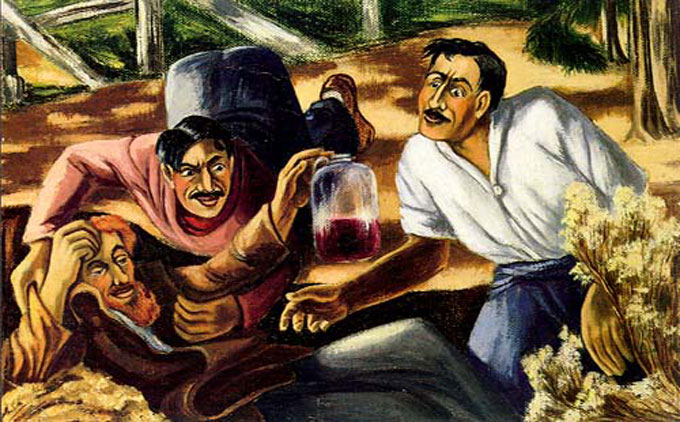
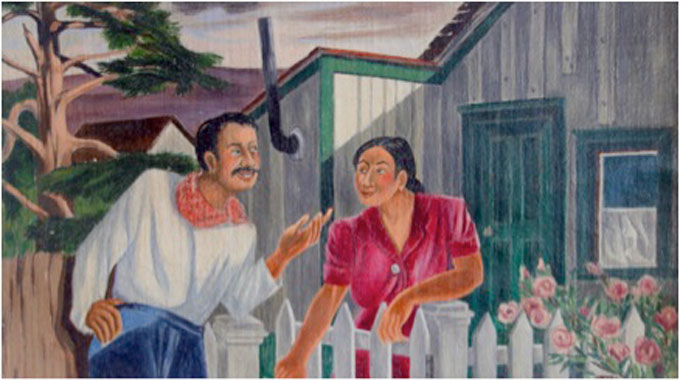
It wouldn’t have been surprising if she got the commission through her husband. Best is mentioned several times in Jackson Benson’s biography of Steinbeck, though the editor and the author weren’t close. Steinbeck’s editor at Viking, Pat Covici, was caught in the middle when conflict occurred, and Best was Covici’s boss. Peggy Worthington Best didn’t appear in Benson’s book, or anywhere else that I looked, but I bought two of the illustrations anyway. One shows Jesus Maria Corcoran polishing off a jug of wine, to the dismay of Pilon and Pablo. The other depicts Danny and Dolores in conversation over a picket fence. I wish I could have bought more, but money was tight and the price wasn’t cheap.

tortilla-flat-peggy-worthington

Both of the pieces I bought were included in the 1998 inaugural art exhibition of the National Steinbeck Center: This Side of Eden – Images of Steinbeck’s California, which I co-curated with Patricia Leach. From the Steinbeck Center in Salinas the show traveled to the Laguna Art Museum, accompanied by a brilliantly designed catalog by Melissa Thoeny and Glenn Johnson. The exhibition put our gallery on the map of Steinbeck’s California, and people started bringing in Steinbeck-related material—not just artwork, but letters and other important documents as well.

All of this eventually led to the book of short stories about Steinbeck’s life that I wrote and Steinbeck Books published in 2017. In 2008 we had created an exhibition featuring material brought in since 1998, along with the two illustrations from Tortilla Flat and other Steinbeck-related works of art. The title suggested by our friend Chris Carroll for the show—Steinbeck: Armed with the Truth—played on the idea of weaponry the way Steinbeck did when he wrote to a struggling novelist with the advice that “your only weapon is your work.” As in 1998, the show attracted a lot of attention. I still have Peggy’s picture of Danny and Dolores, but a buyer offered more than I could refuse for Jesus Maria, Pilon, and Pablo.

My curiosity about Peggy Worthington Best came to mind recently when I ran across collector copies of Tortilla Flat for sale online. Recalling the 1947 book blurb (“She spent much time in Monterey, and has captured the atmosphere of both the setting and the kind of people Steinbeck wrote of”), I realized how fully her art justified the praise. The clouds gathering over San Carlos Cathedral in one illustration, the mist drifting through the Monterey pines as the Pirate lectures his dogs, Danny and Dolores in front of her white board-and-batten cottage, so typical of Monterey and Pacific Grove past and present—everything looks seen.

Peggy must have kept a low profile when she visited. Assuming she came at or around the time of the Tortilla Flat commission, it’s possible that she (and perhaps her husband—though Benson doesn’t mention it) were hosted or helped by the author of the book she was illustrating. Less speculative than an encounter with Steinbeck in California is her relationship with an artist of equal stature in Massachusetts. This came to light recently, when a letter dated September 28 of 1961, addressed to “Peggy Worthington Best, Stockbridge,” came up for sale. The part quoted in the ad has the bones of a story by O. Henry: “Dear Peggy, since we are such good friends I just don’t want the news to reach you second hand. Molly Punderson and I are going to be married. I guess everyone in town will probably know this before long. I know you’ll be pleased for me.”

The seller of the letter in question is asking $1,000. A note to Peggy from the letter’s author sold for $250 or so some years ago. He had taken classes from Peggy in Stockbridge or Cambridge (versions differ) because his art had become tight and he wanted to loosen up. And he often sketched with Peggy. Who was the note-writer who wanted to brush up on his technique with the illustrator of Tortilla Flat? His name was Norman Rockwell . . . and he studied with her, not the other way around. Peggy Worthington may have been an East Coast artist, but East meets West in her work. Through it she came into contact with great artists on both coasts, including Norman Rockwell and John Steinbeck. Given time, who knows what other names will emerge.

Monterey Peninsula Chapter Closes in Bisbee, Arizona

john-steinbeck-short-stories

Steve Hauk, the author of Steinbeck: The Untold Stories, is a fiction writer and dramatist. Here he recalls the late Bill Clements, the last character in the book of short stories he based on the life and times of John Steinbeck. Fortune’s Way, his play about the Monterey Peninsula artist E. Charlton Fortune, will be performed at Carmel Mission Basilica this Friday and Saturday.—Ed.

We lost another link to the world of John Steinbeck and Ed Ricketts when Bill Clements died peacefully in his sleep last Saturday at his home in Bisbee, Arizona. Bill didn’t know Steinbeck or Ricketts, but when he lived on the Monterey Peninsula he met many people who did. The most important were Bruce and Jean Arris.

Bill didn’t know Steinbeck or Ricketts, but he met many people who did.

Bruce was an artist and author, and Jean was a writer, too. Together they drew Bill into their world when he first appeared on the Monterey Peninsula in the mid-1970s, a young Navy veteran driving an old pickup truck. Bill absorbed Bruce and Jean’s tales of the legendary 1930s so thoroughly that he became a storyteller himself, then an active part of the local scene.

Bill absorbed tales of the legendary 1930s so thoroughly that he became a storyteller himself.

When I came to write stories about this world, I included one on Bill that I simply called “Bill,” the last story in my collection, Steinbeck: The Untold Stories. Like everyone in the book besides Bill, Bruce and Jean were gone, and I was happy to close with a living character. In a sense, Bill’s death is the true ending.

I was happy to close my book with a living character. In a sense, Bill’s death is the true ending.

Bill was born in Philadelphia in 1944. An uncle was a professional boxer named Eddie Cool, a handsome, talented welterweight whose life ended badly. Once, talking about his uncle, Bill began to cry. He could be emotional, and that’s one of the reasons Bruce and Jean loved him so much. But they told him they loved him because he didn’t treat them like old people.

Bill could be emotional, and that’s one of the reasons Bruce and Jean Arris loved him so much.

Bill became a house painter, and though he never took a bad fall, the sandwich shop business he called Philly Billy’s failed and he worked part-time as a bartender. He lived in a rental home in Pacific Grove, and when people got in trouble, sometimes homeless, he rented them a room in his rented house, much like Danny’s boys in Tortilla Flat. This eventually got him into trouble with his landlord and the town. Being evicted convinced him to leave for Bisbee, Arizona, a place he also loved, though in the story I wrote I have him going elsewhere.

He lived in a rental home in Pacific Grove, and when people got in trouble, he rented them a room in his rented house.

Bill had lazy blue eyes and thick blond hair and a look like the actor Richard Widmark. One time he called the author Ken Kesey to ask him about writing One Flew Over the Cuckoo’s Nest, about shock treatments and lobotomies. When he got off the phone with Kesey he had tears in his eyes. He had a tender heart and a last name that meant mercy, and he went on helping others, as this Bisbee, Arizona interview showed last December.

https://www.youtube.com/watch?v=DfYwrwXwBKk

Elaine Brown Was Singing John Steinbeck’s Song

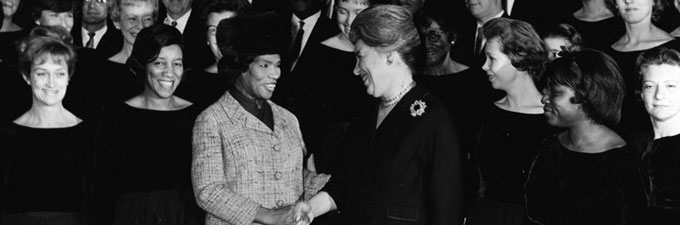
Image of Marian Anderson and Elaine Brown with Singing City

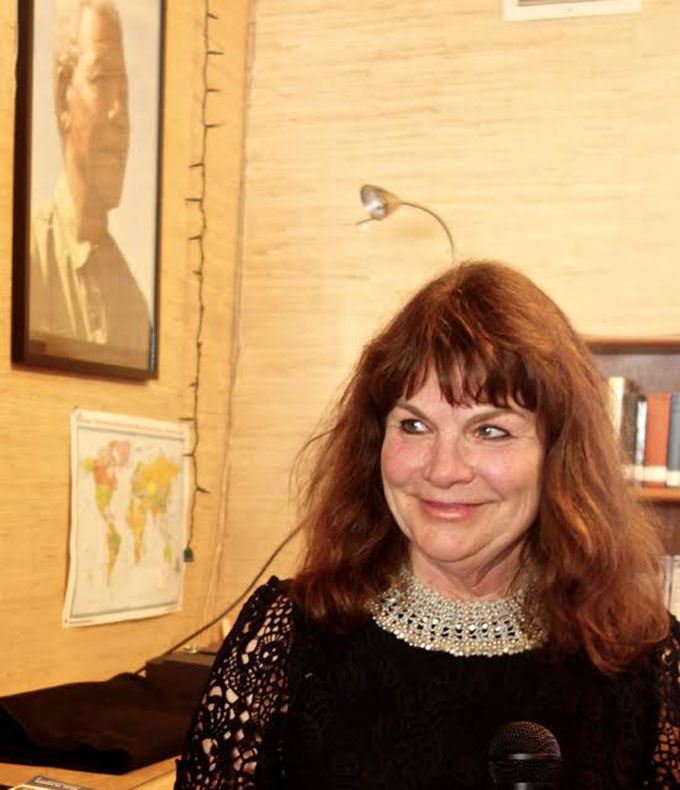
If you haven’t heard of Elaine Brown and Singing City, chances are you will beyond this article. Their message of justice and equality is more urgent than ever, and if Brown—not to be confused with Elaine Brown of the Black Panthers, who was also musically inclined—and John Steinbeck never met in the 1940s or 50s, they should have. Both believed in the rights of the individual and the power of art to break down racial and religious barriers. Steinbeck—a lover of music in many forms—made his argument with words. Brown—a music professor at Temple University who formed the interfaith, mixed-race choral group called Singing City in 1948—made hers in song.

If Elaine Brown and John Steinbeck never met, they should have. Both believed in the rights of the individual and the power of art.

Brown and her singers were fearless, touring the Middle East and the Deep South in the waning era of Jim Crow. If a Southern official insisted Singing City’s artists of color had to stay in a “colored” hotel, the white singers would stay there, too. The great African American contralto Marian Anderson (in photo with Brown and Singing City) honored Brown for her work in promoting “diversity and understanding among all people of religious, economic and racial differences.” Other voices joined the chorus of praise as Singing City broke barriers and set a new standard for music in the service of the social vision Steinbeck proclaimed in his writing.

If a Southern official insisted Singing City’s artists of color had to stay in a ‘colored’ hotel, the white singers would stay there, too.

The lives of Marian Anderson and Elaine Brown were examined in a film on Anderson and a talk on Brown presented under the title of “Marian Anderson and Elaine Brown—Breaking Barriers Through Song” at a meeting of the Monterey Peace and Justice Center in Seaside, California on March 11. The PowerPoint presentation on Elaine Brown was given by Lisa Ledin (pronounced Ledeen), Brown’s niece and a public radio voice who has long been involved in civil rights issues, especially in the music world. “My Aunt Elaine’s favorite quote was, ‘Music’s a great glue. It holds us all together,’” said Ledin, who produced two black history radio documentaries that resulted in the book Nelson Burton, My Life in Jazz.

The lives of Marian Anderson and Elaine Brown were examined at a meeting of the Monterey Peace and Justice Center on March 11.

Elaine Brown died in 1997 at the age of 87, having retired from leading Singing City a decade earlier. She knew Martin Luther King, Sidney Poitier, Robert Kennedy, and the legendary Philadelphia Orchestra conductor Eugene Ormandy, and she was influenced by the music educator Herbert Haslam, the composition teacher Nadia Boulanger, and William Sloan Coffin Jr., the CIA case officer-turned-peace-activist who inspired the Doonesbury character Reverend Scott Sloane. Brown subscribed to some of Coffin’s beliefs and lived by two of his most memorable maxims: “I love the recklessness of faith—first you leap and then you grow wings,” and “The world is too dangerous for anything but truth and too small for anything but love.”

Brown also knew Martin Luther King, Sidney Poitier, Robert Kennedy, and the legendary Philadelphia Orchestra conductor Eugene Ormandy.

Boulanger’s observation on the power of music (“Nothing is better than music; when it takes us out of time, it has done more for us than we have the right to hope for: it has broadened the limits of our sorrowful life, it has lit up the sweetness of our hours of happiness by effacing the pettinesses that diminish us, bringing us back pure and new to what was, what will be, what music has created for us”) fitted Brown perfectly. The recent publication of Lighting a Candle—The Writings and Wisdom of Elaine Brown serves as a reminder that Brown was quotable, too:  “Feel—not just talk. See—not just look. Listen—not just hear. Possess—not just profess.” Passion for justice and music sustained Brown when her husband Hugh was murdered in a Philadelphia parking lot and their daughter died of cancer, and her legacy endures. Singing City has survived and flourished, fielding mixed-race and children’s choral groups in the spirit of its founder.

Lisa Ledin Finds Inspiration in Her Famous Aunt

Image of Lisa Ledin at Monterey Peace Center

Lisa Ledin (photo right) grew up in Marin County, California and on the Monterey Peninsula, where her parents moved when she was 14. She earned a bachelor’s degree in journalism at UC Berkeley and worked at radio station KSNO in Aspen before taking the job that she says gave her true satisfaction: announcing and broadcasting classical and black music at WGUC in Cincinnati. Her father died, and when her mother Verna was diagnosed with Alzheimer’s disease she returned to the Monterey Peninsula to become a caregiver. Like Elaine, Verna was musical. Lisa remembers that although afflicted with dementia, her mother could still sit at the piano and play beautifully. When the two sisters were children, a piano teacher listened to them play and said, “She (Verna) has the talent but she (Elaine) has the discipline and focus.”

Lisa’s two older sisters died while she was caring for her mother, and when Verna passed away the tribute Lisa paid was quoted in a print publication: “With her death comes my rebirth with no regrets. What I have really learned is about my own depth and capacity to love. I’ve become more sensitive to my own mortality and to what matters in the end. Truly loving someone, being aware of beauty and keeping the senses alive helps you appreciate each breath. Some people get that from studying Zen or reading books. I learned it from taking care of my mother.” Lisa adopted a black infant named Erika and resumed her radio career, first at KBOQ in Monterey and now at the NPR affiliate KAZU, where she hosts Morning Edition on Fridays and Weekend Edition on Saturdays. Her melodious voice is a powerful presence for KAZU’s underwriting announcements, and her schedule leaves plenty of time for Erika, a high school student who is continuing the family tradition by singing and dancing.

Ledin went to school in Pacific Grove, and reading Steinbeck was her introduction to the Monterey Peninsula when she was her daughter’s age.

Ledin went to a public school in Pacific Grove, where Steinbeck did much of his writing, and reading Steinbeck was her introduction to the Monterey Peninsula when she was Erika’s age. “My way of acclimating myself to the area was by getting close to Steinbeck,” she recalls. “I read almost everything he wrote, all the novels and stories. I roamed Cannery Row and all the places he wrote about. When my parents drove on the highways and I looked out at the fields and workers, his words came to me—the true character of the region.”

“Steinbeck was a protector of each person’s humanity, like my aunt,” says Ledin. “Elaine felt that regardless of race, religion, rich or poor, laborer or professor, people can come together through music. And I feel Steinbeck believed that about literature”—adding “They were a lot alike that way, Aunt Elaine and John Steinbeck.”

How John Steinbeck’s Name Caused Confusion at the Pacific Grove Post Office

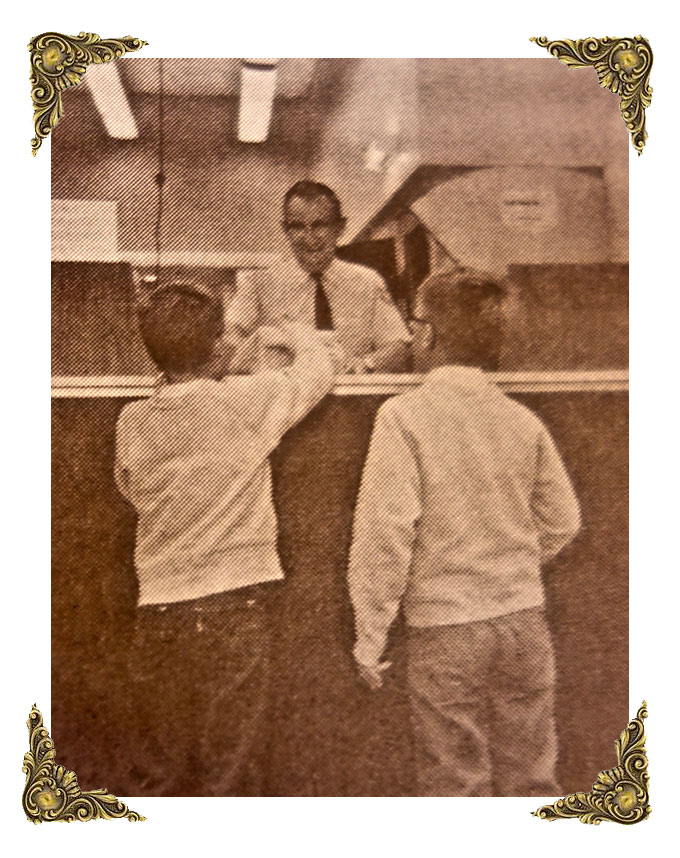
Image of John Steinecke at the Pacific Grove post office

Just the other day she stepped into our Pacific Grove, California gallery with a distinguished-looking gentleman who likes to do carvings. Her name’s Joy and the gentleman was her husband Jerry.

The subject of John Steinbeck came up—as it usually does in the gallery—and Joy said:

“My parents couldn’t stand him.”

“Why not?”

“They’d get late night phone calls from people, usually inebriated, asking for him—for John Steinbeck. Getting them up in the middle of the night infuriated my folks.”

Steinbeck probably would have liked Joy, a school teacher and administrator who has taught and teaches everything from English and business to quilting, because she added with finality: “And that’s all I know about it.”

It reminded me of something Ma Joad might say.

I waited a bit then asked some questions anyway.

Joy said her parents came to Pacific Grove in 1943. Her father was about 37 years old at the time but could have been drafted into the army even though he and his wife Lela had a young child. Someone recommended that he join the post office instead of the army and he did, becoming, eventually, a clerk in the Pacific Grove branch on Lighthouse Avenue, a branch Steinbeck would have used for many of his postal needs in the 1930s—perhaps sending off typescript copies of Tortilla Flat and Of Mice and Men to his publisher in New York.

What, I asked Joy, was her parents’ last name?

Steinecke,” she said. “It came right after Steinbeck in the phone book.”

“And what was your father’s first name?’

John,” she said.

It was beginning to come together . . . .

I could see someone in a phone booth looking up the Steinbeck phone number in the middle of the night—maybe to give the author some good advice, not realizing he was now living on the East Coast. Having had a few drinks, the caller could easily morph Steinbeck into Steinecke, or maybe the finger marking the place slipped down the page just a smidge and, hey, it still says John! If the Steinbeck name wasn’t listed, Steinecke would do nicely.

As a result, Mr. Steinecke, scheduled to begin work at the post office in a few hours, gets calls at two, three in the morning. Not easy to get back to sleep, the phone conversations likely still echoing in his head:

“Mr. Steinbeck, I think . . . I think you should change the ending of Tortilla Flat.

“I’m a postal clerk!”

“I know, but you wrote the book.”

According to Joy, John Steinecke would not have been amused.

“My dad was the grandson of a Prussian general who immigrated from Germany in the mid-1800s,” Joy said. “His sense of humor was not particularly well-developed, and he would probably huff about those phone calls if he were still alive. Anyway, he might not laugh, but he definitely would be pleased that you were writing about him and John Steinbeck.”

So, on a recent morning, with images of John Steinbeck and John Steinecke dancing interchangeably in my head, I went into the Pacific Grove post office for stamps and spoke with a clerk named Ron. For all I know, Ron was standing where Mr. Steinecke stood decades ago.

Ron said, quite the opposite of what Mr. Steinecke thought in the 1940s, “Steinbeck’s one of my favorites. People recommend other writers, but I always seem to come back to Steinbeck.”

Of course, if Ron had been living back then, working in the Pacific Grove post office, and his name was John Steinecke, even Ron Steinecke, he might have switched his literary allegiance to Hemingway or Faulkner.

Period photo of John Steinecke serving young customers at the Pacific Grove post office from Norton and Gus, by Margaret Hayden Rector (Grossmont Press, 1976).

The Passing of Frank Wright And the Men’s Clubs of John Steinbeck’s Cannery Row

Image of Frank Wright at Doc's Lab on Cannery Row

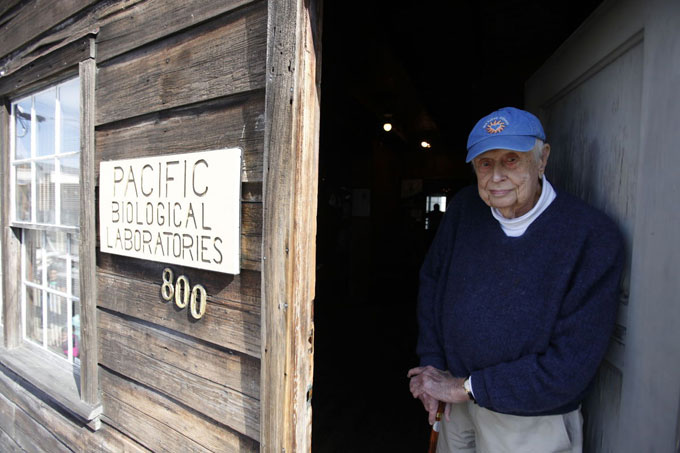
The recent death of Monterey, California businessman Frank Wright at age 98 served as a reminder that the life of Doc’s Lab—Ed Ricketts’s marine biology laboratory on Cannery Row—had two distinct phases. The 1930s and 1940s were the period of John Steinbeck and Ricketts and the artists and poets and philosophers who gathered around them. The 1950s began the Lab’s second incarnation as a men’s club of painters, cartoonists, teachers, journalists, lawyers, and business people founded by Frank and his friends—all with a passionate interest in Steinbeck and Ricketts and a way of life that was already fading into the past. Like the earlier, even more casual men’s club, Frank’s group met and socialized and partied in the Lab’s raffish rooms and outdoor concrete deck and holding tanks overlooking Monterey Bay. In the process they kept the Lab largely as it was, preserving it for posterity.

Image of Hank Ketcham in 1953

The Men’s Club That Saved Doc’s Lab

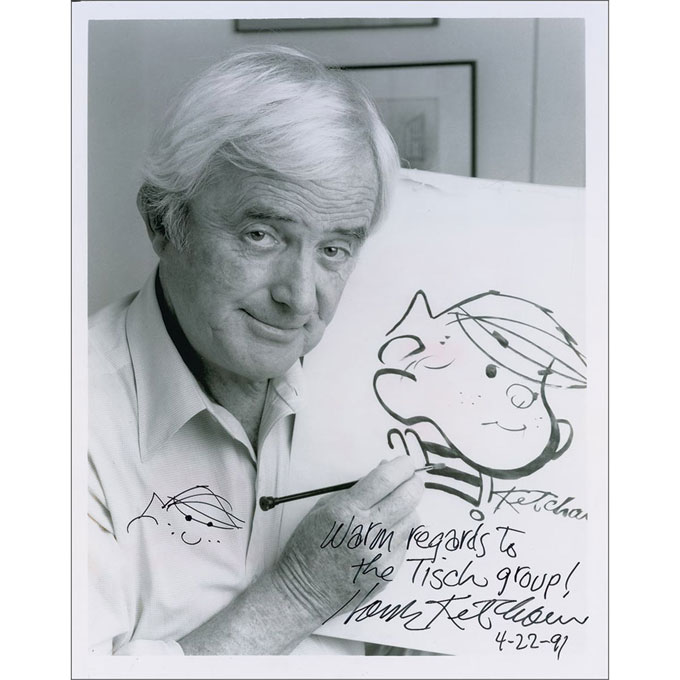
Frank met Ricketts after joining the Army in 1942, and they remained close until Ed died. In the early 1950s, Frank and two other men bought the Lab as a meeting place for their circle of artists, educators, and fellow enthusiasts. For a slim sampling of this second generation Cannery Row men’s club, there was Gus Arriola, the brilliant creator of the comic strip Gordo. Eldon Dedini, the farm boy from South Monterey County who became a successful and sophisticated cartoonist for Esquire and Playboy. Morgan Stock, the teacher and director who spearheaded the drama department at Monterey Peninsula College, which in turn named a theater for him. The irrepressible, crusading attorney Bill Stewart. The Dennis the Menace cartoon creator Hank Ketcham (in photo), also a serious painter. Like Steinbeck and Ricketts, they were creative types drawn together by a love of talk, drink, and music. The Monterey Jazz Festival grew from their collaboration. So did the idea of making Doc’s Lab a living museum, now under management by Monterey, California’s department of cultural affairs.

Image of Nancy Hauk and friends in front of Doc's Lab

The End of an Era on Cannery Row

A personal memory: Years ago my late wife Nancy and I were walking along Cannery Row with Sue and E.J. Eckert (in photo to Nancy’s right). When we stopped in front of the Lab we got lucky. Frank Wright was standing on the stairs with Dennis Copeland, cultural affairs director for Monterey, California. Frank offered to give us a tour. He was a natural storyteller, warm and personable and charming, and when we left, walking out onto the bright morning sunlight of Cannery Row, the Eckerts said, “Boy, that was something!” They’ve never forgotten the experience. It was Frank’s gift to many when he was alive, and he was active well into his 90s. His death was indeed the end of an era.

Photo of Frank Wright courtesy Monterey County Weekly.

The Conversation with John Steinbeck’s Widow That Was All About Names, and Love

Image of Elaine and John Steinbeck

It was 1998. I had co-curated with Patricia Leach the inaugural art exhibition at the grand opening of the National Steinbeck Center in Salinas, California. A week or so after the opening I received a phone call from a woman with a Southwestern accent, or at least that’s what I judged it to be.

“Mr. Hauk, this is Elaine Steinbeck, the widow of the author John Steinbeck.”

“Hello, how do you do?”

“I am doing well, thank you. I was wondering if you would do me a favor, please.”

“Yes, of course.”

“Could you look in a Monterey County telephone book and tell me how many times you see my late husband’s name associated with a business or commercial enterprise?”

I opened my phone book to the businesses section and started flipping the pages to the S’s. I wondered how Mrs. Steinbeck picked me to call, then realized it must have been because she saw my name in conjunction with the exhibition at the National Steinbeck Center, This Side of Eden: Images from Steinbeck’s California.

Well, I found Steinbeck’s name tacked on to six or seven area enterprises. There was, I recall, a credit union, a used car dealership, and a dry cleaner, among other Steinbeck-somethings. As I read them off to Mrs. Steinbeck, she said, “Oh, my.” She said this or something similar several times in a charming sort of way. I joked that I might think of adopting the Steinbeck name for my business. She laughed, sort of. The commercialization of her husband’s name obviously bothered her, but she didn’t seem terribly upset, just mildly irritated and genuinely curious.

We talked for several minutes. She asked about the National Steinbeck Center and wondered how her husband was remembered in Monterey County. I found her a pleasant conversationalist. Over time, as I grew more interested in her late husband’s work, I regretted I didn’t ask for her phone number that day so I could call now and then to ask questions about his life.

The other day, I picked up the Monterey County phone book, turned to the business section, and flipped to the S’s. Some of the businesses with the Steinbeck name in 1998 had obviously closed, but new ones had sprouted up and the number using the author’s name was up eight, including a kennel (Steinbeck loved dogs), two realty firms (he owned houses in Monterey and Pacific Grove), a dental center (he said he met Ed Ricketts at the dentist’s), a café (think Bear Flag), a produce business (perfect fit), even an equine clinic for ponies, red and otherwise.

At her husband’s funeral in New York, Elaine Steinbeck asked his friends and mourners not to forget him. It isn’t what she had in mind at the time, but in a way that Steinbeck would probably appreciate, the continued commercial use of his name in Monterey County, 50 years after his death, is a sign of recognition and respect. I think she realized that and it’s the reason she called me 20 years ago. I’m glad I got to speak with her. She was smart and personable, like most Texans I know, and she was a theater person with an ear for poetry. When she died in 2003, her ashes joined John’s at the Salinas, California cemetery where, as she predicted (quoting Keats), she came to rest, like Ruth, “amid the alien corn” of her loved one’s people.

The voice I hear this passing night was heard
In ancient days by emperor and clown:
Perhaps the selfsame song that found a path
Through the sad heart of Ruth, when, sick for home,
She stood in tears amid the alien corn . . . .

      (from “Ode to a Nightingale”)