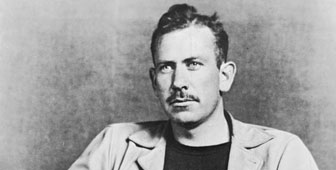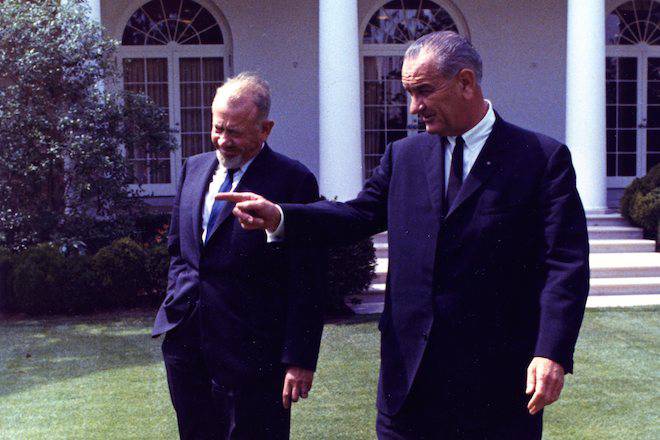
For the past two years I have been doing research at the LBJ Presidential Library in Austin, Texas on the correspondence between John Steinbeck and President Lyndon Johnson about the Vietnam War. Steinbeck and Johnson were friends and communicated often. Steinbeck even helped write some of Johnson’s only inaugural address. I wondered how two great humanists got dragged into the Vietnam War, which became so unpopular that Johnson—like Steinbeck, a liberal—was forced to drop out of the 1968 presidential race. I also have questions about similar conditions in our time.
For the author of the Great Society, the expansion of the war ended the expansion of programs intended to provide opportunities for minorities, working people, and the poor that President Johnson had fought hard for and persuaded Congress to pass. For the author of The Moon Is Down, it created significant conflict and confused some readers. Steinbeck, who understood the power of informal social networks to address and survive oppression, wrote The Moon Is Down to demonstrate how members of such a network resist occupation by an enemy force in a democracy not unlike the United States.
From the point of view of Steinbeck’s writing of the 1940s, it can be seen that Ho Chi Minh’s mastery of informal networking contributed to North Vietnam’s defeat of the forces of South Vietnam and its American allies. This perception led Steinbeck to ask a critical question: “How could we lose a war against peasant rabble (informal networks) when we had all the modern advantages (formal system)?” There is a disconnect between the apologist who defended Johnson’s Vietnam policy in the 1960s and the advocate who wrote sympathetically about America’s “peasant rabble” in 1930s and their persecution by exploitative agricultural interests holding formal “ownership advantage” in California. Critics turned this against Steinbeck at the time, and it continues to trouble those of us who wonder why Johnson stuck with the policy and Steinbeck defended it.
I am curious to know how two of my favorite Americans, both domestic change agents, got sucked into such an ugly and damaging foreign war. I am also interested to learn what overlooking the lesson of Tortilla Flat, Cannery Row, and The Moon Is Down—about the power of informal networks—warns us about in our day. From Wall Street to the Arab street, citizen rebellions are organizing organically to overcome oppression and bring about change. As in Johnson’s time, formal systems are responding with overwhelming force that has the opposite of the intended effect. When authoritarian overreach becomes violent and protestors become victims, today’s Tom Joads also say, “I’ll be there.”
Several years ago I wrote about the lessons of Steinbeck’s Cannery Row, laying out the theory and practice of the informal networks that I saw there, and which I use in my own work as a consultant. Now I would like to hear from other admirers of Steinbeck and Johnson who share my curiosity about their folly and my concern about our future. Please share your thoughts on the subject in the comment box below.
Photograph of John Steinbeck with Lyndon Johnson courtesy Martha Heasley Cox Center for Steinbeck Studies.
 About James Kent