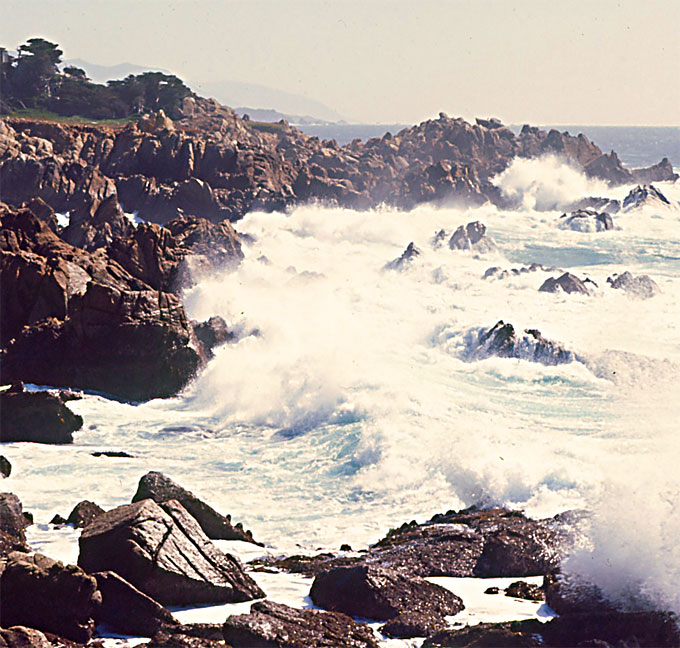
Under the wide and starry sky
Dig the grave and let me lie.
Glad did I live and gladly die,
And I laid me down with a will.This be the verse you grave for me;
‘Here he lies where he longed to be,
Home is the sailor, home from sea,
And the hunter home from the hill.’—Robert Louis Stevenson
A Home From the Sea
It was easy to see Monterey Bay from just about anywhere on Huckleberry Hill, and if you could see the blue of the water over the mottled roofs of Pacific Grove and Monterey then you could easily see the slow-moving tugs as they struggled through the waves towing barges of rough-cut lumber from the mills up north. The loads were destined for the lumberyards of Santa Barbara, Ventura, or maybe Los Angeles, but the only time that mattered to anyone on the Hill was when one of the tugs floundered in a storm and the restraining cables holding the lumber snapped, dumping the rich cargo into the choppy seas.
The only time that mattered to anyone on the Hill was when one of the tugs floundered in a storm and the restraining cables holding the lumber snapped, dumping the rich cargo into the choppy seas.
There was no system to alert anyone of that, just the understanding that high winds invariably led to fresh carrion being spread upon the waters of the bay and, like hungry gulls, when the storm was over they descended in their numbers onto the beaches to claim it. In crank-up Fords and Chevys, in Model-A and Studebaker pickups, they came, and in groups or alone, they came, a new kind of California coastal hunter and gatherer, scouring the beaches and hauling from the shore the salvage that the waves and the tides would deliver to their feet. Much of it was clear redwood timber cut from the massive trees that grew in profusion in the coastal forests above San Francisco: clear, sweet-smelling redwood boards perfect to build a house, a painter’s studio, or to add another room to a house already lived in.
There was no system to alert anyone, just the understanding that high winds invariably led to fresh carrion being spread upon the waters of the bay and, like hungry gulls, when the storm was over they descended in their numbers onto the beaches to claim it.
The Ariss house at the end of Lobos Street was like that, added to and built upon by Bruce and Jean over the years, constructed up and out with redwood boards gathered from the rocks near the canneries or from the wide beaches that embrace Pacific Grove. Bruce and Jean painted, but they also wrote, and when someone commented on the vast amount of building material that seemed to have gone into building so many homes on Huckleberry Hill, it was, as Bruce was wont to say, due to a perfect combination of ill wind and good fortune that had provided so many of them with shelter.
It was, as Bruce was wont to say, due to a perfect combination of ill wind and good fortune that had provided so many of them with shelter.
Apart from painting, writing and editing a monthly news magazine containing photographs, gossip, and items of interest to Monterey Bay’s fast-growing community of artists, Bruce had developed a zeal for sawing wood and pounding nails. And as the size of his family increased, one new room after another was added to his house. It had become the passion of his lifetime, friend and neighbor John Steinbeck was to say.
It had become the passion of his lifetime, friend and neighbor John Steinbeck was to say.
When Jean went into the hospital to have their fifth child, so many unwashed dishes had accumulated in the kitchen sink that Bruce, who didn’t like wasting time washing them, built a second kitchen next to the first one. And in it he added a second sink. The dishes in both were waiting for Jean when she returned home with Baby Holly. By then, Bruce had moved to the top of the house and was hammering together a box-like observation room from which he could look out over the whole of Monterey and Monterey Bay. When its construction was done, he installed a large round window and attached a salvaged ship’s wheel to the exterior. On a foggy day the house appeared to be a three-story ship negotiating its way through the towering pines.
On a foggy day Bruce and Jean’s house appeared to be a three-story ship negotiating its way through the towering pines.
From time to time John Steinbeck was there to lend a hand with a hammer, and later in the day with a jug of red wine nearby he would sit at the kitchen table to read aloud the pages he’d written that day or the day before. The house that Carol and John Steinbeck lived in was an older and much more conventional one down the hill in Pacific Grove, and it was there every morning that John, clutching a ledger book and a handful of sharpened pencils, would be led to a shed in the back garden and locked in. It had a window so he could make good an escape if necessary but, feeling that he lacked the discipline required to write, he’d made an arrangement with Carol to lock him up in the morning and let him out in the middle of the afternoon. Under those conditions he wrote The Red Pony, Tortilla Flat, In Dubious Battle, The Long Valley, and began Of Mice and Men.
The house that Carol and John Steinbeck lived in was an older and much more conventional one down the hill in Pacific Grove, and it was there every morning that John, clutching a ledger book and a handful of sharpened pencils, would be led to a shed in the back garden and locked in.
One day soon after Bruce’s cabin on the roof was finished, John and Bruce stood in the yard looking up at Bruce’s creation.
“It looks impressive to me, what do you think?” Bruce asked.
John’s eyes traveled from side to side and then up to the roof where a colorful flag of some sort flapped on a pole in a breeze coming off the bay.
“I can tell you this much,” he finally answered. “This house is an achievement over modern architecture.”
“Then maybe it’s done,” Bruce said thoughtfully.
“So, I guess it’s ‘home is the sailor, home from the sea,’” he chuckled, lifting his cup of wine in a salute, not just to his house but to Robert Louis Stevenson, who had at one time spent several months living just down the hill in Monterey working on the first draft of Treasure Island.
“No, it’s the other way around,” John said, turning to look at the sea over the rooftops. “Considering the source of your materials, in your case you should be saying, ‘Home is the sailor, his home is from the sea.’”
 About John Bell Smithback