John Steinbeck’s short novel Of Mice and Men is a powerful exploration of isolation, disenfranchisement, and problems of social integration in an era of cultural fracture. Divided by class, race, and gender, its characters struggle to assimilate into the small social world of a 1930s California ranch. But Steinbeck’s story possesses a timeless dimension as well—one that bears examination in the context of the psychologist Carl Jung’s concept of the unconscious and of two ancient narratives: the Mesopotamian Epic of Gilgamesh and the Genesis story of Jacob and Essau.
Carl Jung and Of Mice and Men as Mythic Pattern
Some critics argue that the appeal of Of Mice and Men derives from its dramatization of universal themes, while others suggest that its continued popularity results from its depiction of the reality of the lives of migrant ranch workers: from the power of realism and relevance. However, there is at least one other way to explain the novel’s resonance with readers of every type. Certain formal elements open Of Mice and Men to a mode of criticism that is interested not in realism or in theme alone, but in the psychological relationship of theme to character, specifically the potent symbolism of the character pair comprised by George and Lennie.
Carl Jung’s psychoanalytical vocabulary and myth criticism offer insights into the significance of Steinbeck’s use of a traditional archetype in describing George and Lennie, suggesting that much of the novel’s power derives from an ancient mythic pattern. Employing the character-pair archetype also found in The Epic of Gilgamesh and the Genesis story of Jacob and Esau, Steinbeck invites us to consider a fundamental principle of personal psychology and myth narrative that is related to Carl Jung’s transcendent function of the unconscious.
Carl Jung’s psychoanalytical vocabulary and myth criticism offer insights into the significance of Steinbeck’s use of a traditional archetype in describing George and Lennie.
In this context, Of Mice and Men can be taken as an example of a specific psychological process, rendered artistically, that seeks to externalize the relationship between the conscious ego and the unconscious, a process Carl Jung describes in his 1916 essay “The Transcendent Function.” In fiction and poetry, as in myth, we see this process take place through narrative and metaphor. The purpose of the process is the achievement of psychological balance. The tools of the process are mythogenes, the building blocks of myth—images drawn from the collective unconscious that facilitate communication between the conscious and unconscious parts of the mind. In art, the result of the process is often the creation of a myth narrative.
Along with a number of classic myth narratives that express this transcendent function in the acts of gods and heroes, we can point to works of modern fiction that represent mythic patterns such as that of the “unassimilated” man or woman estranged by nature from society. William Faulkner’s character Benjy in The Sound and the Fury and John Steinbeck’s Lennie in Of Mice and Men are examples, and Lennie shares similarities, both literal and thematic, with the character Chief in Ken Kesey’s One Flew Over the Cuckoo’s Nest. The Bengy-Lennie-Chief character type is a modern iteration of an ancient archetype: the unassimilated outcast or alien who represents unacceptable or unwanted urges of the unconscious mind and who—despite friendships and affections—is unable to integrate successfully into society. He is the shepherd in an age of farming. He is mute in a time of great debate. He is the man without power over his personal history or his place in society.
The Epic of Gilgamesh, Genesis, and Steinbeck’s Story
Although Of Mice and Men is enriched by the Jungian archetype of the unassimilated man, the novel’s echo of The Epic of Gilgamesh and the Biblical story of Jacob and Esau is equally consequential. All three narratives depict a character pair in which one individual, the true hero, is bonded by birth and fate to the other, the unassimilated man. The parallels are striking in number, detail, and effect: on multiple levels, George and Lennie are Gilgamesh and Enkidu, Jacob and Esau. Though The Epic of Gilgamesh, the Genesis story, and Of Mice and Men differ in other ways, each focuses on a pair of characters who appear to be cut from the same cloth—the “cloth” of mythology that Carl Jung identified as the material of the collective unconscious.
In Of Mice and Men, Lennie is the character with the closest relationship to the Jungian concept of the unconscious. Driven by animal impulses that he is unable to control, Lennie enters the scene trailing behind George through the brush, “a huge man, shapeless of face, with large pale eyes, with wide, sloping shoulders [. . .] dragging his feet a little, the way a bear drags his paws” (Steinbeck 798). In the opening chapter, his behavior is likened to that of a carp and a horse; going to the river, he “drank with long gulps, snorting into the water like a horse” (Steinbeck 798). Animalistic images and associations are carried through to the climax of the novel in which Lennie’s uncontrolled violence is compared to that of a wild beast. In the end, he returns to the river, “as silently as a creeping bear moves” (Steinbeck 872). Throughout, he is drawn to small creatures—mice, puppies, and rabbits—and he threatens to flee the society of the ranch to live in a cave.
In Of Mice and Men, Lennie is the character with the closest relationship to the Jungian concept of the unconscious.
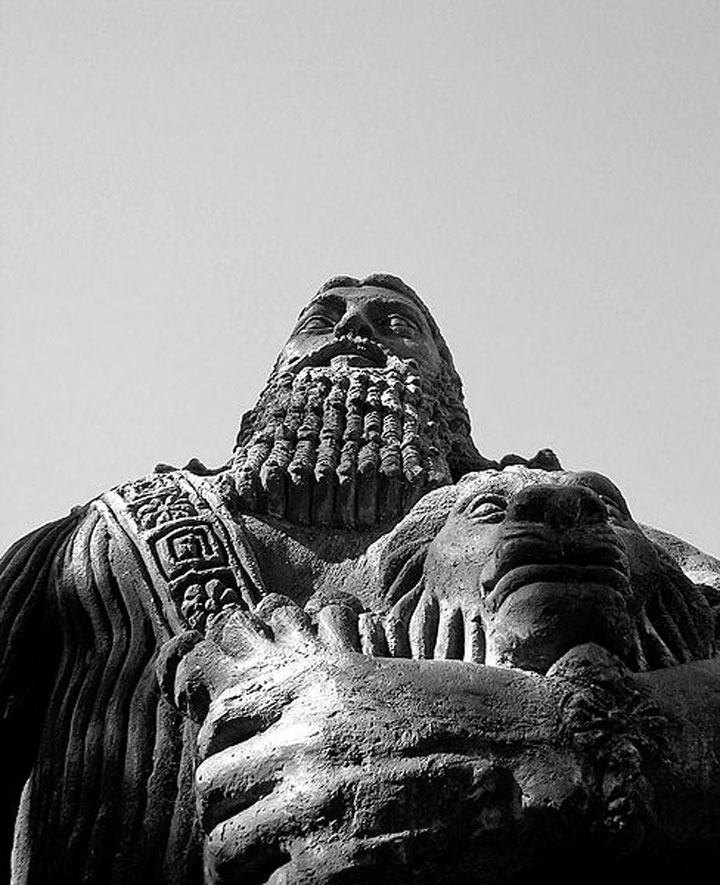
Enkidu in Gilgamesh and Esau in Genesis share these qualities. Born in the wilderness, Enkidu is described as having a body that is “rough” and “covered with matted hair” (Gilgamesh 63). Just as Lennie is attracted to the solitude of the river, Enkidu “had joy of the water with the herds of wild game” (Gilgamesh 63). Like Lennie, Enkidu is physically strong but mentally unprepared for social survival (Gilgamesh 65); his bond with the animals of the wild is broken when a harlot teaches him the ways of society (65). Arriving in the city, he establishes a bond of brotherhood with Gilgamesh and becomes tasked with the guardianship of the hero, who is the king of Uruk. Genesis describes Esau similarly—a hairy man, a shepherd and hunter at home with wildlife and wilderness (Tanakh 38). When Jacob wants to pass as Esau, his older brother, he puts goat hide on his hands and the neck (Tanakh 41). When Esau complains to Jacob that he is hungry, he demands that Jacob give him some of the “red stuff,” trading his birthright for a bowl of stew (Tanakh 38). Esau’s appetite for “red stuff” is echoed in Lennie’s demands for ketchup in Of Mice and Men (Steinbeck 804). Like Enkidu and Lennie, Esau is undone by a woman (Tanakh 43).
However, in the pairing of an unassimilated man with a heroic companion in Genesis, The Epic of Gilgamesh, and Of Mice and Men, relationship transcends individual identity. George and Lennie’s mythic significance lies in the nature of their archetypal connection with one another. As characters, they are both complementary and opposite, two halves of a codified relationship and two parts of a single unit. Their antecedents in the older stories—Jacob and Esau, Gilgamesh and Enkidu—are brothers. Steinbeck’s pair wears the same clothes (Steinbeck 797-798) and speaks a single voice (Steinbeck 812, 815), brothers in behavior if not by birth.
In the pairing of an unassimilated man with a heroic companion in Genesis, The Epic of Gilgamesh, and Of Mice and Men, relationship transcends individual identity.
Of the two, George is sharper and worldlier, “small and quick, dark of face, with restless eyes and sharp strong features” (Steinbeck 798). Just as Jacob in Genesis conducts business shrewdly (Tanakh 47), George proves capable of negotiating, manipulating, and conducting business with surprising skill (Steinbeck 802, 842). Gilgamesh, too, is savvy, smoothing the way for his quest by manipulating the powers that be in Uruk (Gilgamesh 72). The figures of George, Jacob, and Giglamesh dominate each of the fraternal relationship, not by seniority but through their ability to integrate with society and play by its rules.
While the less adept, unassimilated character remains a social weight on his socially skillful partner, this drag is accepted by both parties. Though “Lennie’s a God damn nuisance most of the time” (Steinbeck 41), George feels the obligation to protect him at any cost. For Jacob, Esau represents a function of reality itself, unavoidable and equally permanent. The fear of Esau felt by Jacob is significant and suggests Carl Jung’s concept of the Shadow self. Likewise, Lennie and Enkidu can be seen in terms of fear and Shadow—Jung’s term for the suppressed but active elements of the unconscious (Jung 146). The tie that binds each pair of characters is deep, dark, and definitive. Viewed in social terms, the unassimilated man in all three stories prevents his more socially adept partner from fully entering into and succeeding in the world. The psychological dynamic that results creates conflict: the socialized character must eliminate his animalistic, amoral, and unassimilated Shadow self to achieve complete social integration.
Viewed in social terms, the unassimilated man in all three stories prevents his more socially adept partner from fully entering into and succeeding in the world.
But the dominant partner has other gifts as well. George, a “smart little guy” (Steinbeck 825), is able to read the signs in a situation and, in a way, prophesy the future. Similarly, both Jacob and Gilgamesh possess the power of divination, interpreting dreams (Gilgamesh 78) and seeing visions—the stairway to heaven—while wrestling with angels (Tanakh 43, 52). Early in Of Mice and Men, George predicts trouble with Curley’s wife (Steinbeck 820), repeatedly voicing his anxiety about the probable outcome: “She’s gonna make a mess. They’s gonna be a bad mess about her” (Steinbeck 835). Though this sounds to us like common sense, no other character in Of Mice and Men “gets it” as George does. The other men in the bunkhouse recognize Curley’s wife as a threat, but none sees or says what seems inevitable.
The final vision described in The Epic of Gilgamesh is particularly remarkable in relation to George’s prophetic power in Of Mice and Men. Lamenting over his dying brother, Gilgamesh cries, “The dream was marvelous but the terror was great; we must treasure the dream whatever the terror; for the dream has shown that misery comes at last to the healthy man . . . .” (Gilgamesh 93). In this way Gilgamesh reads the last dream of Enkidu in which Enkidu is approached by a woman who questions him before awakening “like a man drained of blood who wanders alone in a waste of rushes; like one whom the bailiff has seized and his heart pounds with terror” (Gilgamesh 92-93). In narrative detail and poetic imagery, this passage presages the climactic conclusion of Of Mice and Men: Lennie flees after being questioned by a woman; terrified, he moves alone through the brush along the Salinas River. His dream of tending rabbits in a happy future with George dies, like Lennie himself—and like Enkidu, who leaves his bereaved partner Gilgamesh in “misery,” muttering about failed dreams.
Of Mice and Men: Social Commentary or Timeless Myth?
Applying Jungian psychoanalytical theory to Of Mice and Men is not the most common critical approach to John Steinbeck’s most widely read novel. The social realism of the text and its topical themes relating to migrant labor, disenfranchisement, and the American Dream typically take precedence over readings that emphasize the work’s psychological elements, raising this question: Can a work of social realism be read as myth or as psychological allegory?
In response, one might argue that the simplicity of setting, character, and dialog—as well as the deliberate use of types and stereotypes (racial, gendered, professional, intellectual, and class-based)—invites both political and psychological/symbolic interpretation. As noted by John Steinbeck’s sometime-friend, the mythologist Joseph Campbell, formalized tropes of character and setting are precisely the stuff of myth (Campbell 12-15). As much as Of Mice and Men may be read as a social-realist text, therefore, it is realistic only insofar as it is interested in the social and political issues of its era. In style and formula it falls neatly into the timeless categories of symbolic and myth literature, forms of narrative in which the application of Carl Jung’s insights are particularly fruitful.
Can a work of social realism be read as myth or as psychological allegory?
The archetypal pair represented by George and Lennie in Of Mice and Men evokes two principles of Jungian psychoanalytic theory: the Shadow and the transcendent function, concepts related to the individual ego’s relationship with the unconscious. As in the example of Jacob and Esau, the unassimilated character is associated with impulsive, irrational, and anti-social behavior. Like Lennie, Esau represents the Jungian Shadow, characterized by “uncontrolled or scarcely controlled emotions [. . .] like a primitive” and “singularly incapable of moral judgment” (Jung 146). The individual ego both desires and fears communion with this dark element of the unconscious: in the end the ego wants to exorcise the Shadow in an ultimately transcendent function.
If Lennie is the submerged Shadow, George is the ruling ego—aware, socialized and civilized—for whom the threat of the unconscious will exist until the transcendent function is enacted and the Shadow has been purged by being brought to light. According to Carl Jung, this takes place when the two forces, ego and Shadow, achieve a direct and “compensatory relation” to one another (Jung 294). The means may be aesthetic, as the ego attempts to formalize the formless unconscious and the repressed unconscious attempts to “rise” into conscious mind. In this way the transcendent function “manifests itself as a quality of conjoined opposites” (Jung 298); the goal is for the ego to find the “courage to be oneself” (Jung 300), a state of psychological singleness that George accomplishes when he shoots Lennie.
If Lennie is the submerged Shadow, George is the ruling ego—aware, socialized and civilized—for whom the threat of the unconscious will exist until the transcendent function is enacted.
Thus George and Lennie can be interpreted as two parts of one “mind,” symbolically undergoing the necessary process of overcoming a latent set of “wild” impulses that impede full social integration. As long as George keeps Lennie with him, he will never “stay in a cat house all night long” or “set in a pool room and play cards or shoot pool” (Steinbeck 804). Impulsive, ungovernable, and “incapable of moral judgment,” Lennie holds George back from normal social activity. When Candy shows George the dead body of Curley’s wife, George’s social future in the predictable aftermath is his first concern. When Candy asks George if the plan to buy their own ranch is off, George replies by forecasting a future in which he can “stay all night in some lousy cat house. Or I’ll set in some pool room till ever’body goes home” (Steinbeck 868).
But Lennie’s representation of the unconscious goes beyond his relationship with George. Uniquely within the world of Of Mice and Men, Lennie has the ability to bring out the impulsiveness latent in other characters and to engage them in conversations about dreams, resentments, and other emotions. His conversation with Crooks demonstrates this trait, as Crooks breaks with social convention to let Lennie into his room and explore hidden feelings that he suppresses with everyone else (Steinbeck 849). A similar dynamic characterizes Lennie’s conversation with Curley’s wife when she divulges things that she “ain’t told [. . .] to nobody before” and “ought’n to” (Steinbeck 863). Not only is Lennie incapable of self-control; he inspires this incapacity, however briefly, in others as well.
Not only is Lennie incapable of self-control; he inspires this incapacity, however briefly, in others as well.
Duality of mind and will is a common theme in mythology and in modern literature. Steinbeck’s use of the archetypal character pair in Of Mice and Men dramatizes this duality, offering us a deeper understanding of its meaning. As in much American writing of the 1930s, social repression and human disenfranchisement function socially and politically as facts of contemporary life. But they are also internalized. Ironically, the humble American dream of property ownership is aligned in the narrative with irrational, unconscious urges, with the primitive and undeveloped Shadow represented by Lennie. To survive in the hard world of Of Mice and Men, characters like Crooks suppress their desire for friendship in favor of being accepted, abstractly and impersonally, by the group. Characters like Curley’s wife are shunned and isolated because they are associated with desires that the group considers taboo. Lennie, unassimilated and unsocialized, accesses these suppressed elements in others, bringing them briefly into the open until he can be eliminated.
Ironically, the humble American dream of property ownership is aligned in the narrative with irrational, unconscious urges, with the primitive and undeveloped Shadow represented by Lennie.
On a literary and functional level, Steinbeck’s archetypal character pair serve as a vehicle for demonstrating social values and for considering a compelling question: What must be eliminated from consciousness—from the ego personality—in order for an isolated individual to integrate with society? Steinbeck’s answer is painfully clear. As one partner dies, a path opens for the survivor. In The Epic of Gilgamesh, the survivor is made king. In Genesis he becomes the father of nations. Unlike Genesis and Gilgamesh, however, Of Mice and Men constitutes a sad and somber commentary on group values and cultural norms. To survive, a man must put away his innocence and his love for “nice things.” He must be hardhearted and ruthless. He must not dream.
What must be eliminated from consciousness—from the ego personality—in order for an isolated individual to integrate with society? Steinbeck’s answer is painfully clear.
By the time Of Mice and Men ends, George has acknowledged and accepted the severity of this requirement, proving his emotional and psychological fitness for social survival in a difficult environment. His world is heartless, but he can cope: He has eliminated his unacceptable impulses—embodied in Lennie—by slaying them. If we accept the literary critic Alfred Kazin’s axiom that “psychology is always less true than art,” we can hope, at least, that applying Jungian psychoanalytical criticism to Of Mice and Men does not lower Steinbeck’s art to the level of psychology but raises psychology to the level of art. Seen in this light, the power of Steinbeck’s most popular novel can be located, in large part, in the writer’s use of mythic archetypes to explore a psychological truth.
Works Cited
Anonymous. The Epic of Gilgamesh. London: Penguin Books. 1972. Print.
Anonymous. Tanakh. Philadelphia: The Jewish Publication Society. 1985. Print.
Campbell, Joseph. The Hero with a Thousand Faces. 3rd Edition. Novato, California: New World Library. 1949. Print.
Faulkner, William. The Sound and the Fury. New York: Random House. 1929. Print.
Jung, Carl. “The Transcendent Function.” The Portable Jung. New York: Penguin Books. 1976. 273-300. Print.
Kazin, Afred. The Inmost Leaf. New York: Harcourt Brace Jovanovich. 1941. Print.
Kesey, Ken. One Flew Over the Cuckoo’s Nest. New York: Penguin Books. 1962. Print.
Steinbeck, John. Of Mice and Men. Steinbeck: Novels and Stories 1932-1937. New York: Literary Classics of the United States. 1994. 795-878. Print.
 About Eric Matthew Martin