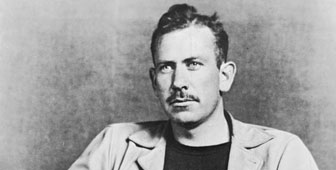
In the 1980s, it was E.M. Forster. In the 90s, Jane Austen and Henry James. Fitzgerald, Faulkner, and Hemingway had their turn, along with writers of B-list bestsellers whose names have faded, like the films made from their books. In 2015, Hollywood’s Favorite Author is the American Nobel Laureate John Steinbeck. Again.
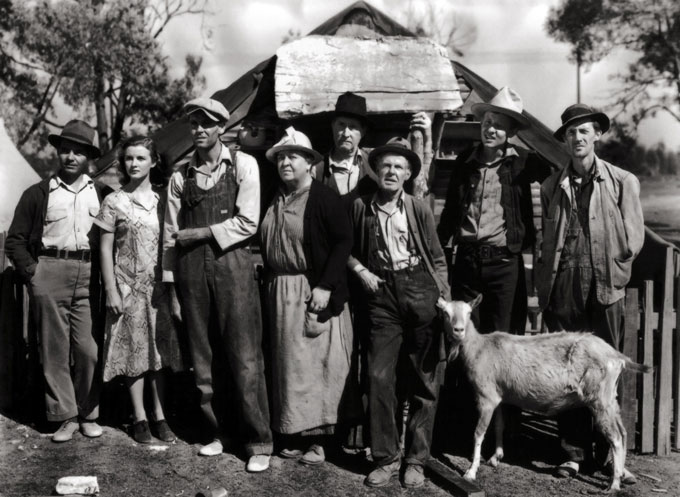
The Roots of the Recent John Steinbeck Renaissance
Interest in Steinbeck is surging. Steven Spielberg is reportedly preparing a remake of The Grapes of Wrath. Jennifer Lawrence has signed on to play the lead in East of Eden. Recently the actor James Franco, who starred on Broadway last year as George in Of Mice and Men, announced that next month he will start filming an adaptation of Steinbeck’s little-known 1936 novel In Dubious Battle.
Interest in Steinbeck is surging. Steven Spielberg is reportedly preparing a remake of The Grapes of Wrath.
This isn’t Steinbeck’s first trip to Hollywood. Between 1939 and 1957, eight of his books were made into movies, and he wrote original scripts for four more. The best of these films became classics, like John Ford’s Grapes of Wrath; Lewis Milestone’s Of Mice and Men; and Elia Kazan’s East of Eden.
This isn’t Steinbeck’s first trip to Hollywood. Between 1939 and 1957, eight of his books were made into movies.
But these films were made more than half a century ago. When John Ford’s movie of The Grapes of Wrath debuted in 1940, just a year after Steinbeck’s novel was published, the Dust Bowl was still in the news. How do we explain the Steinbeck Renaissance of 2015? What is it about Steinbeck’s work that resonates with us today?
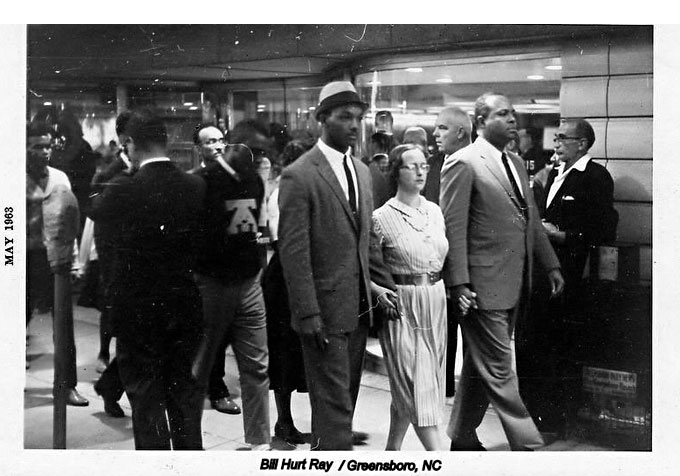
From The Grapes of Wrath to Ferguson, Missouri
The answer is a sad comment on our times. Many of the issues Steinbeck addressed in novels like The Grapes of Wrath are as relevant today as they were 75 years ago. Police abuse, for example, continues to be a major problem in America. As we demonstrate solidarity with the victims in Ferguson, Staten Island, and too many other communities, it’s hard not to think of Tom Joad’s famous line from his farewell speech: “Wherever there’s a cop beatin’ up a guy, I’ll be there.”
Many of the issues Steinbeck addressed in novels like The Grapes of Wrath are as relevant today as they were 75 years ago.
Our society also still discriminates against migrant laborers. The undocumented workers who harvest our fruits and vegetables are today’s “bindlestiffs,” as Steinbeck called the laborers George and Lennie in Of Mice and Men. Our politicians talk about immigration reform, but nothing ever happens, and as we argue, produce rots in the fields and those laborers who dare to remain here illegally live in constant fear of deportation. I wouldn’t be surprised if this surprisingly modern conundrum is what drew James Franco to In Dubious Battle, a novel about a farmworkers’ strike in California.
Our society also still discriminates against migrant laborers. The undocumented workers who harvest our fruits and vegetables are today’s ‘bindlestiffs.’
But there’s one more reason Steinbeck resonates today. He famously said that his job as a writer was “to reconnect humans to their own humanity.” In this era of braggy Christmas letters and sanitized Facebook personas, it’s easy to forget that when we suffer, we are not alone. Steinbeck showed us humanity in all its forms, not only the happy family on vacation, but the poor and dispossessed, the filthy, the starving, and the mad. It’s no subject for a Facebook post, but it never goes out of style.
 About Nick Taylor